Sign up with Google
 Sign in with Zoho

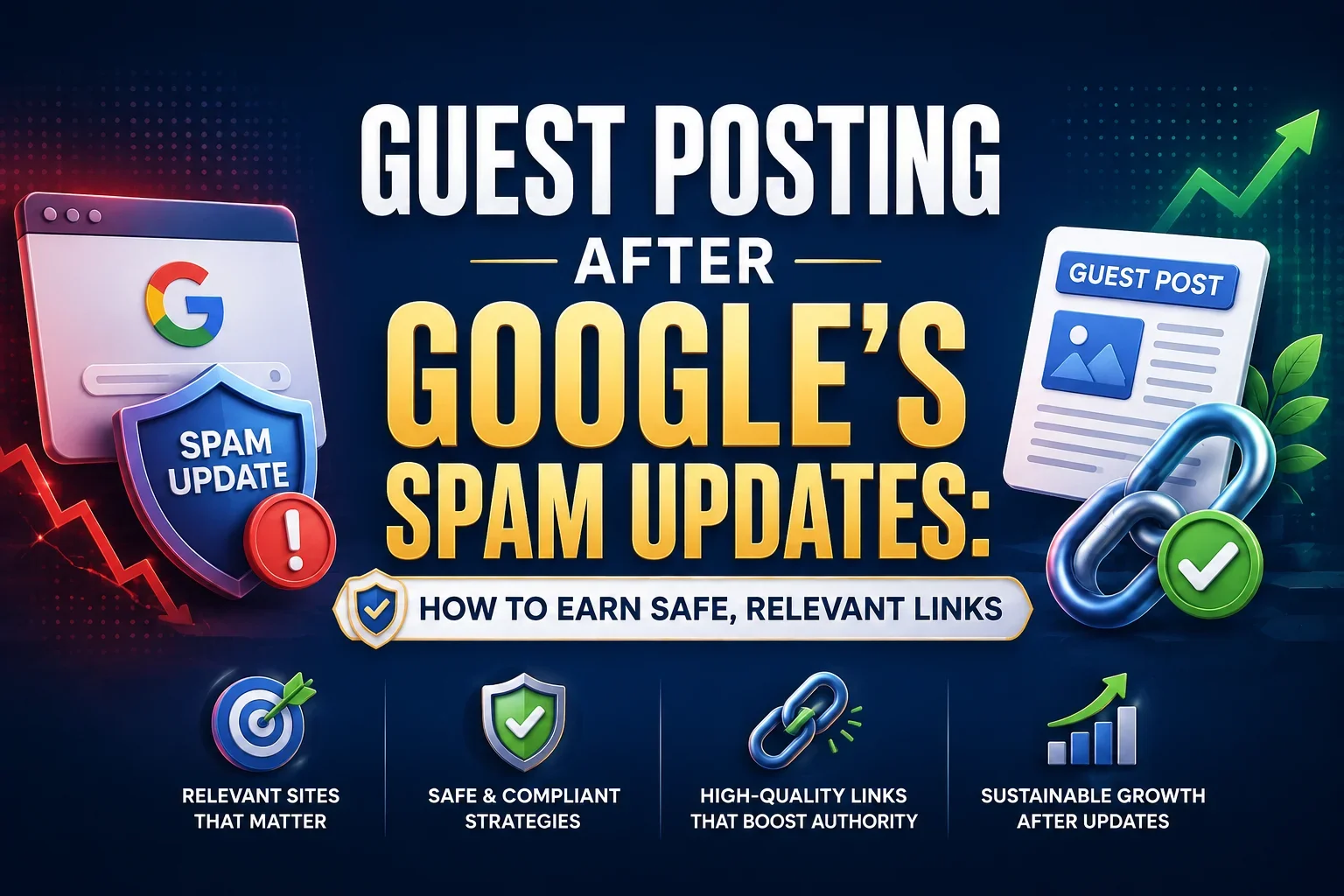
Guest posting can help a business reach a new audience, demonstrate expertise, generate referral traffic, build professional relationships, and earn relevant links. However, guest posting becomes risky when the main purpose is to publish large volumes of articles and place keyword focused backlinks.
After Google’s spam updates, marketers need to think beyond the number of backlinks acquired. A successful guest posting campaign should focus on editorial quality, audience relevance, original insights, and genuine usefulness.
What Google’s Spam Updates 2026 is and How It Change the Landscape of Guest Posting?
Google’s 2026 spam updates are algorithmic improvements to Google Search systems that help identify and reduce the visibility of websites, pages, and publishing practices designed mainly to manipulate rankings. These updates evaluate whether content genuinely helps users or exists primarily to generate search traffic, distribute artificial links, or exploit the authority of another website.
What is the August 2026 spam update?
The August 2026 spam update is a global Google Search system rollout that applies to all languages and regions. Google officially began releasing it on August 18, 2026, at 09:28 PDT, which was August 18, 2026, at 9:28 PM Pakistan Standard Time. Google stated that the rollout could take several days to complete.
Unlike a core update, which can affect how Google evaluates search results across many ranking systems, a spam update is focused specifically on detecting and enforcing Google’s existing spam policies. It is designed to identify practices that attempt to gain search visibility through manipulation rather than through useful, original, and trustworthy content.
Google’s public release notice confirms the timing, global reach, and language coverage of the update. It does not provide a complete list of individual signals or reveal exactly how each website will be evaluated. However, the main areas relevant to guest posting and content marketing include:
- Scaled content abuse.
- Site reputation abuse.
- Manipulative link building.
- Keyword rich anchor text used unnaturally.
- Repetitive articles published across multiple websites.
- Low value content created mainly to obtain backlinks.
- Third party content that does not match the host website’s audience.
- AI assisted content produced without meaningful human review.
- Content written by people without relevant subject knowledge.
- Paid or commercial links that are not properly identified.
What does the update include?
The update is connected with several existing spam concerns that can affect both contributors and publishers.
Scaled content abuse
Scaled content abuse involves producing many pages or articles primarily to influence search rankings rather than to provide useful information. The content may be created by AI tools, human writers, templates, scraping systems, or a combination of these methods.
In guest posting, this risk may appear when a marketer:
- Sends almost identical articles to dozens of websites.
- Changes only the title and a few words before republishing.
- Uses the same backlink in every article.
- Creates articles only because a target keyword has search volume.
- Publishes content without adding original research or expertise.
Using AI or a content template is not automatically spam. The concern is whether the final article provides genuine value and whether the campaign exists mainly to manipulate links.
Site reputation abuse
Site reputation abuse occurs when third party content is published on an established website mainly to benefit from that website’s existing search authority.
For example, a respected marketing website may begin accepting unrelated articles from finance, health, or other industries simply because advertisers want links from the domain. If these articles do not serve the site’s normal readers, the section may create a reputation and quality concern.
A relevant expert contribution is different. A SaaS specialist writing about software marketing for a SaaS publication can be useful when the article meets the publication’s editorial standards and provides original information.
Manipulative links
Guest posts become risky when links are placed mainly to influence rankings. Common warning signs include:
- Repeated exact match anchor text.
- Several commercial links in one article.
- Links to unrelated websites.
- Paid links presented as independent editorial recommendations.
- Link exchanges arranged between multiple websites.
- Links placed in articles with little reader value.
- Large campaigns using the same target page and anchor text.
Google has warned against large scale article campaigns created mainly to build links. It has also advised website owners to use appropriate attributes for paid, sponsored, or user generated links.
What does this mean for guest posting?
The August 2026 spam update does not make every guest post harmful. Instead, it makes the quality and purpose of guest posting more important.
A useful guest post should:
- Address a real problem for the host website’s audience.
- Contain original research, examples, or professional experience.
- Be written specifically for the publication.
- Include only relevant contextual links.
- Use natural and varied anchor text.
- Follow the publisher’s disclosure policies.
- Remain valuable even if the backlink is removed.
What safe guest posting means
Safe guest posting begins with a simple principle: write for the host publication’s audience first.
The article should remain useful even if the link to your website is removed. It should answer a genuine question, provide original information, or offer a practical framework that readers can apply.
A strong guest post usually contains:
- A clear topic connected with the publication’s audience.
- A specific problem and a useful solution.
- Original examples or observations.
- Accurate information.
- A natural writing style.
- A relevant author with genuine expertise.
- One or two useful contextual links.
- A transparent relationship with the host publication.
A weak guest post usually contains:
- A generic introduction.
- Repeated information found on many other websites.
- Multiple links to the same domain.
- Keyword stuffed anchor text.
- Unrelated product mentions.
- Artificial examples.
- Unclear authorship.
- No editorial review.
- The same article published on several sites.
The difference is not only writing quality. It is also the reason the article was created.
How to Earn Safe, Relevant Links After Google’s Spam Updates 2026?
Start with audience relevance
Before contacting a publication, study its audience and editorial focus.
A website may have strong domain metrics but still be a poor choice if its audience has no connection with your subject. A link from an unrelated website may generate little referral traffic and may look unnatural when surrounded by irrelevant content.
Review:
- The publication’s main subject areas.
- The type of readers it attracts.
- Its most popular article categories.
- The tone and depth of existing articles.
- The professional background of its audience.
- The topics recently covered.
- The quality of its contributors.
- Whether articles receive meaningful engagement.
For example, a SaaS marketing article may fit a software publication, a B2B marketing website, a startup platform, or an agency resource center. It may not fit a website focused on home decoration or general entertainment simply because that website offers a backlink.
The closer the subject connection, the easier it becomes to create a useful article and place a natural reference.
Choose the right publication
Not every website that accepts guest posts is suitable for a long term SEO campaign.
Evaluate potential publications using several factors instead of relying on one metric.
Topic relevance
The website should publish content related to your industry, audience, or expertise. A marketing publication may be suitable for an SEO article, but the specific section should also match the topic.
Audience quality
Look for evidence that real people read the site. Review comments, social engagement, newsletter activity, community discussions, and the quality of published articles.
Editorial standards
A serious publication usually has submission guidelines, editing standards, author requirements, and clear content policies. It may reject articles that are promotional, repetitive, or poorly researched.
Content consistency
Review the latest articles. Does the website publish coherent content, or does it suddenly cover every possible subject, from financial services to gaming, health, technology, and travel?
A publication with unrelated content across dozens of industries may have weak editorial control.
Search visibility
You can review whether the website has indexed content, active rankings, and a stable publishing history. Do not rely only on third party authority scores. A website can have a high metric but poor relevance or low reader value.
Commercial transparency
If the placement is paid, sponsored, or part of a commercial arrangement, clarify how the link will be marked. The publication should be willing to follow appropriate disclosure and link qualification practices.
Create a useful pitch
A good pitch demonstrates that you understand the publication.
Avoid sending a message that says:
I want to submit a guest post. Please send topics and link requirements.
This approach focuses on the backlink before the reader.
A stronger pitch includes:
- A topic connected with a recent article on the site.
- A clear explanation of the reader problem.
- A proposed headline.
- Three or four main points.
- Your relevant experience.
- A short explanation of what will make the article original.
For example:
I noticed that your publication covers content strategy for SaaS companies but has not recently addressed how teams can use AI without producing repetitive search content. I would like to contribute an article explaining a practical AI assisted workflow, including research, fact checking, expert review, and content quality checks. The article would include examples from B2B content teams and would be written exclusively for your readers.
This pitch creates a reason for the publication to consider the idea. It also positions the article as a useful contribution instead of a backlink request.
Build original content
Do not rewrite your main article and submit the same material to several websites. Each guest post should have its own purpose, structure, examples, and perspective.
For this topic, you could create different versions for different audiences:
- A SaaS publication could focus on product led content and software comparison pages.
- An agency publication could focus on managing guest posting for clients.
- A local marketing website could discuss guest posting for Pakistani businesses.
- A publisher community could focus on editorial standards and sponsored content.
The core principle may remain similar, but the execution should be different.
Add original material such as:
- A campaign planning framework.
- A publication evaluation checklist.
- A sample outreach process.
- A link qualification explanation.
- A practical anchor text example.
- A comparison between editorial and paid placements.
- A case study with confidential details removed.
- A workflow for reviewing contributor submissions.
Original material gives the host website a reason to publish your article and gives readers information they cannot find in every competing guide.
Place links naturally
A contextual link should appear where it helps the reader understand the subject.
Do not force a link into the introduction if the introduction does not require it. Do not place several links to the same page. Do not use an exact match commercial anchor repeatedly.
For this article, the most natural placement is in a paragraph about assessing content quality after a Google update:
Publishers and marketers reviewing their link building strategy after a spam update can also consult this Google August 2026 spam update guide for a broader discussion of content abuse, site reputation risks, and recovery priorities.
The link is relevant because the article discusses how spam updates affect guest posting and content campaigns.
Other natural anchor options include:
- August 2026 spam update analysis.
- Google spam update recovery guide.
- Clienvora’s update analysis.
- A guide to recovering after a Google spam update.
Avoid anchors that sound manufactured, such as “best Google spam update recovery service” or “Google August 2026 spam update SEO backlinks.” Anchors should read naturally within the sentence.
Understand link attributes
A link can serve several purposes:
- It can help readers find additional information.
- It can generate referral traffic.
- It can support brand discovery.
- It can help establish professional relationships.
- It may pass ranking signals when editorially earned and appropriately placed.
If a link is paid, sponsored, exchanged for a product or service, or included as part of another commercial arrangement, the publisher should clarify the appropriate link attribute.
Common attributes include:
- rel="sponsored" for paid placements or advertisements.
- rel="nofollow" when the publisher does not want to endorse or pass ranking credit.
- rel="ugc" for user generated content such as forum or community contributions.
Do not assume that a dofollow link is always better. A nofollow or sponsored link from a trusted, relevant publication may still generate brand awareness, referral traffic, leads, and professional credibility.
The purpose of the campaign should determine whether a placement is worthwhile. If the only reason to accept a publication is the promise of ranking credit, the campaign may be too narrow.
Avoid large scale patterns
Even strong articles can become risky when they are part of an aggressive, repetitive campaign.
Watch for these patterns:
- Publishing dozens of articles in a short period.
- Using the same article outline across all websites.
- Linking to the same target page every time.
- Using the same exact match anchor.
- Working with websites that publish unrelated topics.
- Hiring writers who do not understand the subject.
- Buying placements without editorial review.
- Creating articles that contain no original research.
- Using multiple websites controlled by the same network.
- Placing several commercial links in every article.
A campaign should have a natural pace. Focus on a small number of relevant publications and produce genuinely useful content for each one.
Quality control is particularly important when agencies manage guest posting for several clients. Each client should have a separate audience strategy, content plan, editorial review, and link placement policy.
Vet guest posting websites
Before accepting a contribution opportunity, inspect the website manually.
Ask the following questions:
Does the site have a real audience?
Look for active newsletters, social profiles, comments, community engagement, or evidence of referral traffic.
Are the topics relevant?
A website should have a clear editorial identity. A site that publishes everything may not provide meaningful topical relevance.
Are contributors credible?
Review author pages and contributor biographies. Are authors connected with the topics they discuss?
Does the site edit submissions?
A publication that accepts every article without review may create quality risks for both readers and contributors.
Are links controlled?
Check whether the site allows unlimited commercial anchors, links in every paragraph, or links to unrelated websites.
Does the site disclose sponsored content?
Clear disclosure is a positive sign. It shows that the publication understands the difference between editorial and commercial content.
Is the website filled with guest posts?
Guest contributions are not automatically a problem, but a site where almost every page exists for external links may have weak editorial value.
Develop a geo relevant strategy
Guest posting can support local SEO when the host publication and audience are relevant to the target location.
For a business in Pakistan, relevant opportunities may include:
- Pakistani business publications.
- Lahore startup communities.
- Karachi technology platforms.
- Islamabad business and entrepreneurship websites.
- Regional marketing communities.
- Industry associations.
- Local SaaS and technology blogs.
- Professional publications serving Pakistani companies.
A local guest post should not simply repeat general advice with the word Pakistan added. Include meaningful regional information.
For example, an article about guest posting for Pakistani businesses could discuss:
- Reaching local B2B decision makers.
- Building authority in competitive service categories.
- Publishing on business and technology websites read by Pakistani professionals.
- Using examples from Lahore, Karachi, and Islamabad.
- Creating content for both local and international customers.
- Evaluating whether a publication attracts the right regional audience.
Local relevance can improve referral traffic even when the link does not pass ranking value. A reader who discovers your agency through a trusted local publication may become a prospect, partner, or referral source.
Measure more than backlinks
A backlink report should not be the only way to measure guest posting results.
Track:
- Referral sessions.
- Engaged visitors.
- Contact form submissions.
- Newsletter signups.
- Brand searches.
- Social shares.
- Mentions from other websites.
- New partnership opportunities.
- Assisted conversions.
- Quality of conversations generated.
A guest post that produces ten qualified visitors may be more valuable than one that produces no visitors but appears on a website with a high authority score.
Check referral traffic in your analytics platform after publication. Look at the pages visitors view, how long they remain engaged, and whether they return later through branded search.
You can also use unique campaign parameters when the publisher permits them. This makes it easier to identify which publications are generating meaningful visits.
Build relationships with publishers
The best guest posting campaigns are built on relationships rather than one time transactions.
After publication:
- Thank the editor.
- Share the article with your audience.
- Respond to reader comments.
- Refer relevant readers to the article.
- Suggest useful follow up topics.
- Provide updated information when necessary.
- Offer expert commentary for future articles.
A strong relationship may create opportunities for interviews, podcast appearances, expert quotes, research collaborations, and editorial mentions.
Publishers are more likely to accept future contributions from writers who submit accurate, original, well formatted work.
What to do with paid placements
Paid placements require extra care.
If money, products, services, or another commercial benefit is exchanged for publication, treat the placement as commercial content. Discuss disclosure and link attributes before submitting the article.
Do not disguise an advertisement as an independent editorial article. Readers should be able to understand the relationship between the contributor, publisher, and promoted business.
A paid article may still be valuable for:
- Brand visibility.
- Referral traffic.
- Thought leadership.
- Product education.
- Audience access.
- Public relations.
The link should not be the only reason the placement exists. If the publisher refuses to disclose the relationship or qualify the link appropriately, reconsider the opportunity.
What to do about questionable links
Do not disavow every unfamiliar backlink. Websites naturally receive links from directories, scraped pages, spam comments, and low quality websites.
A questionable link becomes more concerning when it is part of a large artificial pattern or connected with a manual action.
Review:
- The source website.
- The linking page.
- The anchor text.
- The context.
- Whether payment was involved.
- Whether the link is repeated across many sites.
- Whether the placement was part of a coordinated network.
If you have control over the link, request removal or correction. If a large number of artificial links are connected with a manual action or serious risk, consult an experienced SEO professional before using Google’s disavow tool.
The best solution is usually to prevent manipulative links from being created in the first place.
Final thoughts
Guest posting can remain a useful marketing channel after Google’s spam updates, but the strategy must evolve.
The goal should not be to publish the largest number of articles or collect links from every website that accepts submissions. The goal should be to contribute useful information to relevant audiences and build relationships with credible publishers.
A sustainable guest posting process includes:
- Relevant publication research.
- Audience focused topics.
- Original content.
- Expert input.
- Natural link placement.
- Varied and descriptive anchors.
- Transparent commercial relationships.
- Appropriate link attributes.
- Careful performance tracking.
- Consistent editorial standards.
If your guest posting campaign is connected with a broader recovery or content audit, read above mentioned Google August 2026 spam update guide to understand how scaled content, site reputation problems, AI manipulation, and low value pages can affect an SEO strategy.
The safest link is one that makes sense to the reader. When a link helps someone find deeper information, supports a relevant explanation, and appears within genuinely useful content, it can contribute to visibility and credibility without making the article look manufactured.