
 Sign up with Google
 Sign in with Zoho

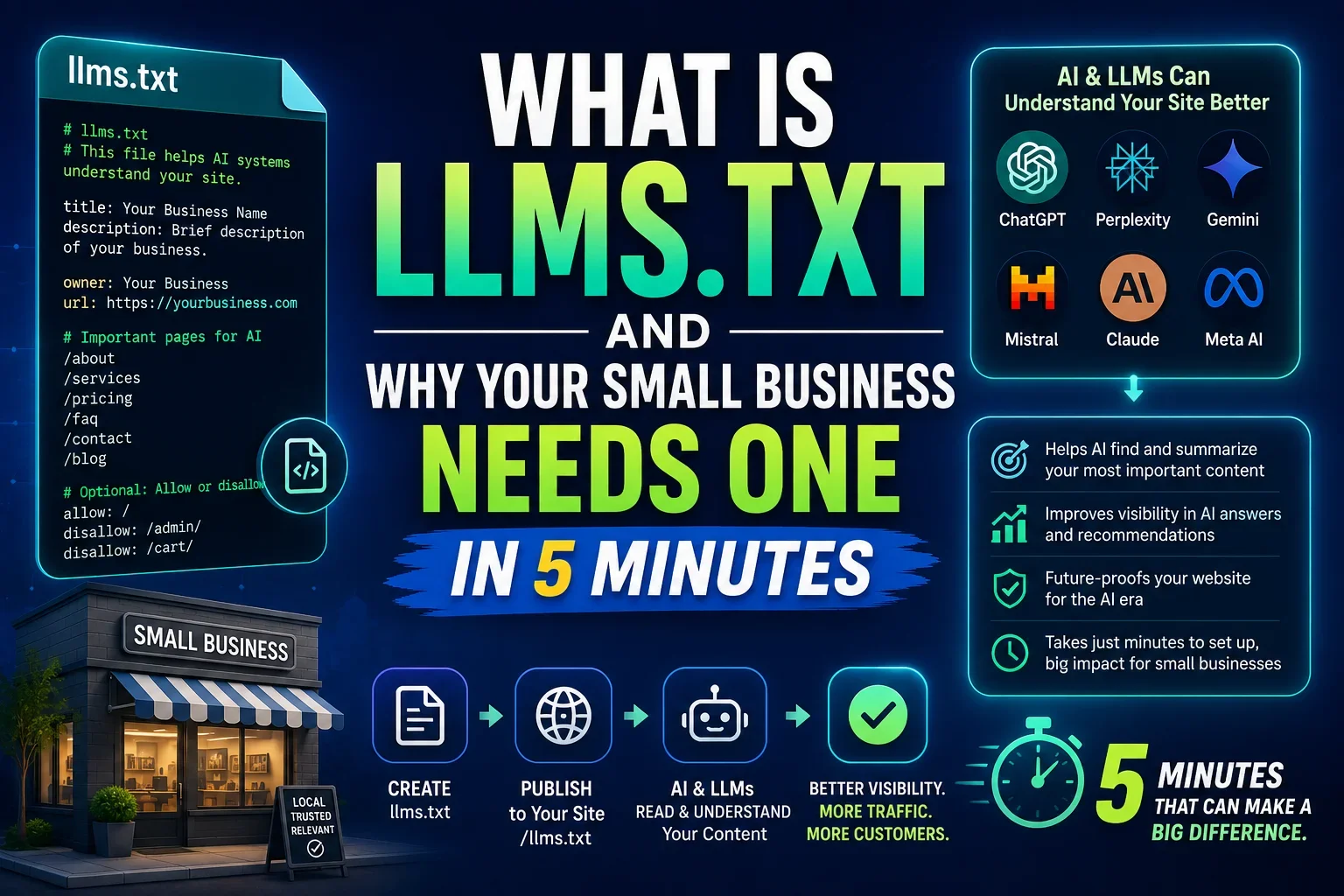
Small businesses are being asked to show up in two search worlds at once now. One is traditional Google search, and the other is AI search, where systems like ChatGPT and Perplexity try to understand, summarize, and recommend useful pages.
That is where llms.txt comes in. It is a simple file that can help AI systems understand your site more clearly, especially when your website has multiple services, blog posts, and important pages that you want surfaced more often.
What llms.txt is
llms.txt is a plain text or Markdown style file placed at the root of a website. Its purpose is to give large language models a cleaner map of your site so they can understand what matters most.
Think of it as a curated guide for AI systems. Instead of forcing a model to dig through every page, every menu item, and every script on the site, you give it a short, structured summary of the most important content.
For small businesses, that can be especially useful because most sites do not have huge teams or complex documentation systems. They need simple, practical ways to improve AI visibility without rebuilding the whole site.
Why it exists
Websites are often messy from a machine perspective. Navigation menus, sidebars, popups, cookie banners, and unrelated content can make it harder for AI systems to quickly understand what the site is really about.
llms.txt exists to reduce that friction. It gives AI systems a faster path to your core pages and a clearer understanding of your brand, services, and expertise.
For business owners, this matters because visibility is no longer only about being indexed. It is also about being understood well enough to be selected, summarized, and cited in AI answers.
Why small businesses need it
Small businesses usually compete with fewer resources than larger brands. That means they need every visibility advantage they can get, especially when AI systems are starting to shape how people find information and compare options.
llms.txt can help by pointing AI systems toward the pages that matter most, such as your homepage, service pages, location pages, and key blog posts. That gives your brand a better chance of being interpreted correctly when an AI tool is answering a user’s question.
It is also low effort. You do not need a huge development budget or a complicated technical setup to create one. For many businesses, that makes it a very practical first step into AI search optimization.
How it works
The idea is simple. You create a small file that describes your website and lists the most important URLs.
That file can include:
- A short summary of your business.
- Your main service or product pages.
- Important resources or pillar content.
- Optional notes that help AI systems understand the site structure.
The goal is not to replace your website. It is to support it. Your actual pages still need to be crawlable, fast, and well written. llms.txt just gives AI systems a cleaner starting point.
llms.txt vs robots.txt vs sitemap.xml
These files serve different purposes, even though they all relate to how systems read your site.
The simplest way to think about it is this: robots.txt manages access, sitemap.xml lists pages, and llms.txt explains what matters most.
What to include in llms.txt
A useful llms.txt file should stay short, clear, and focused. It should make it easy for AI systems to understand who you are and what you want to highlight.
Include these elements:
- Your business name.
- A one line description of what the business does.
- Your most important pages.
- A short note about the types of content you publish.
- Any key topics or service areas you want associated with your brand.
If your business publishes educational content, you can also point to your best guides and pillar pages. That is where it becomes especially useful for AI visibility.
Best pages to highlight
Not every page deserves equal attention. The strongest llms.txt files focus on the pages that define the business and generate the most value.
Good candidates include:
- Homepage.
- About page.
- Core service pages.
- Contact page.
- FAQ page.
- Main blog pillar pages.
- Important location pages.
- Key educational resources.
If you want AI systems to understand your brand properly, these are the pages that should be easy to find from the file.
Why it matters for AI visibility
AI search systems work differently from traditional search engines. They try to understand meaning, context, and usefulness, not just keywords.
That makes site structure more important than ever. If your most important content is easy to identify, AI systems can build a clearer picture of your site and your expertise.
llms.txt can help by:
- Making your site easier to interpret.
- Giving AI a curated list of priority pages.
- Supporting brand consistency.
- Improving the chance that the right pages get noticed.
It will not make weak content perform well on its own. But it can help strong content get understood faster.
How it fits with technical SEO
llms.txt is not a replacement for technical SEO. It works best when your site already has a solid foundation.
That means your pages should still have:
- Fast load times.
- Clean internal linking.
- Good crawlability.
- Proper indexation.
- Schema markup where relevant.
- Clear headings and topical depth.
A file like llms.txt is more effective when the site itself is technically strong and organized around clear content clusters.
A practical example
Imagine a small business that offers SEO audits, content strategy, and local SEO services. Its website may have dozens of pages, but only a few really define the brand.
A good llms.txt file could highlight:
- The homepage.
- The SEO audit service page.
- The local SEO service page.
- A pillar blog on technical SEO.
- A contact page.
- A FAQ page that answers common client questions.
That way, if an AI system is trying to understand the business, it does not have to guess which pages are most important.
How to create one in 5 minutes
You do not need a complex workflow to make a useful first version.
Step 1
Write a short summary of your business.
Step 2
Choose the 5 to 10 most important pages.
Step 3
List those pages in a clean, readable format.
Step 4
Save the file as llms.txt.
Step 5
Upload it to the root of your domain.
That is enough to create a basic version. You can improve it later as your site grows.
Common mistakes
Many site owners overcomplicate this file or expect too much from it. That usually reduces its usefulness.
Avoid these mistakes:
- Making it too long.
- Including unimportant pages.
- Writing vague descriptions.
- Using promotional language instead of useful descriptions.
- Forgetting to update it after major site changes.
- Treating it like a shortcut for poor SEO.
The best approach is to keep it simple and aligned with your real site structure.
Who should use it
llms.txt makes the most sense for businesses that want to be more visible in AI driven discovery. That includes service businesses, local businesses, agencies, consultants, publishers, and content focused brands.
It is especially useful if you:
- Publish educational content.
- Want AI systems to understand your services.
- Have a site with multiple key pages.
- Care about being cited or summarized accurately.
- Want a lightweight technical SEO improvement.
For small businesses, the value is not just in the file itself. It is in the clarity it creates.
How it compares to other AI SEO tactics
llms.txt is part of a much larger strategy. It works best alongside content quality, schema, internal linking, site speed, and entity optimization.
Here is the practical reality:
- Schema markup helps machines understand page meaning.
- Internal links help define topical importance.
- Fast pages improve usability and crawl efficiency.
- Strong content gives AI something worth citing.
- llms.txt helps organize the whole picture.
That is why it should be seen as one piece of a broader visibility system, not a standalone growth hack.
FAQ
What is llms.txt?
It is a file that helps AI systems understand the most important parts of your website.
Is llms.txt official?
It is an emerging web convention, not a universal requirement. Its value comes from clarity and guidance.
Does llms.txt help with ChatGPT?
It can help AI systems understand your site structure better, which may support visibility and citation potential.
Does llms.txt help with Perplexity?
Yes, especially when your site is well structured and the file highlights your most important pages clearly.
Is llms.txt better than sitemap.xml?
No. They serve different purposes. A sitemap helps with discovery, while llms.txt helps with understanding.
Do small businesses really need it?
If you want stronger AI visibility and a clearer site map for machine understanding, yes, it is worth considering.
Conclusion
llms.txt is a simple but smart step for small businesses that want to prepare for AI search. It does not replace real SEO work, but it can make your website easier for AI systems to understand, which is increasingly important as search behavior changes.
If you want to go deeper into the technical side of this, Clienvora is a useful place to start because the same foundation that supports llms.txt also supports your broader SEO performance. To learn more about technical structure, crawlability, schema, and content organization read our article on Technical SEO: The Complete 2026 Optimization Guide.












.webp)