Sign up with Google
 Sign in with Zoho

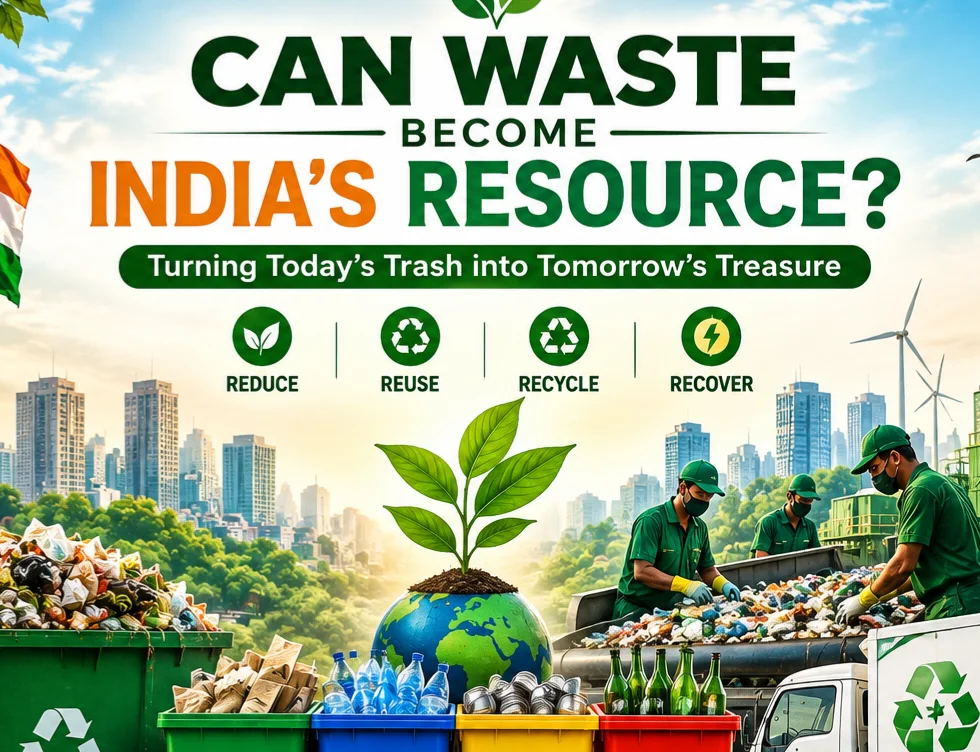
India’s journey towards becoming a developed nation is often discussed in terms of economic growth, infrastructure, technology and employment. But there is another question that deserves equal attention: What kind of environment will accompany this development?A developed nation cannot be defined only by the size of its economy or the height of its buildings. Clean air, safe water, efficient waste management and sustainable use of natural resources are equally important indicators of development.India’s environmental performance makes this concern particularly important. The 2024 Environmental Performance Index (EPI), produced by Yale University and Columbia University, ranked India 176th among 180 countries, with a score of 27.6. The index evaluates countries across 58 indicators and 11 environmental issue categories, including air pollution, climate change, waste management, biodiversity and ecosystem vitality. Environmental Performance Index 2024 — India profile�This ranking should not merely be viewed as criticism. Instead, it should encourage us to ask a more important question: Can India redesign its development model so that economic progress and environmental responsibility move together?One important place to begin is our waste.India generates a huge amount of municipal solid waste every year. Government data and policy documents have highlighted the scale of this challenge. The NITI Aayog’s SDG India Index 2023–24 also emphasises the importance of sustainable waste management as part of India’s sustainable development journey. NITI Aayog — SDG India Index 2023–24Yet waste does not necessarily have to remain waste.A vegetable peel thrown into mixed garbage becomes waste. The same organic material separated at source and converted into compost becomes a resource. An old newspaper thrown into a garbage dump can instead enter the recycling chain. Glass, metals and several categories of plastic can also be recovered and reused when they are properly segregated and processed.This means that waste management should not begin at the landfill. It should begin inside our homes.Every household can contribute by separating wet and dry waste, reducing unnecessary consumption, reusing materials wherever possible and sending recyclable items into the appropriate recycling system. The contribution of one household may appear small, but when millions of households participate, the collective impact can be enormous.There is also an economic opportunity hidden within this challenge. Better segregation, recycling and processing can support local enterprises, create employment and reduce dependence on virgin raw materials. Waste should therefore not be viewed merely as an environmental burden. It can become part of a circular economy, where materials remain useful for as long as possible instead of being discarded after a single use.But an important question remains: How can citizens be encouraged to participate consistently?One idea worth considering is an “Environmental Contribution Index” for households and communities.We measure economic progress through various indicators. Why should we not also recognise the environmental contribution of citizens?A simple system could recognise households, schools, housing societies and institutions for practices such as waste segregation, composting, recycling, water conservation, energy conservation and increasing local green cover. The objective would not be to create another complicated bureaucratic mechanism. Rather, it would be to make environmental responsibility visible and encourage people to adopt it as a habit.Imagine a neighbourhood where families compete—not over who owns the biggest house, but over who sends the least waste to landfill. Imagine schools recognising students not only for academic achievements but also for their sustained contribution to recycling and resource conservation.Such initiatives could transform environmental awareness from a temporary campaign into a part of everyday life.This approach is also important in the context of India’s climate commitments. India has committed to achieving net-zero emissions by 2070, while its climate strategy places emphasis on sustainable development and low-carbon growth. Government of India — India’s Net-Zero 2070 commitment�Government policies, infrastructure and technological innovation will undoubtedly remain essential. However, no national environmental target can succeed through government action alone. The daily choices of citizens—what we buy, what we throw away, what we reuse and what we conserve—also shape the environmental future of the country.Therefore, the meaning of a developed India needs to become broader.We should not ask only how much India produces. We should also ask how efficiently India uses its resources.We should not celebrate only the expansion of cities. We should also measure whether those cities have cleaner air, better waste management, healthier public spaces and sustainable systems.And we should not see every discarded object as the end of its usefulness. Sometimes, what we call waste is simply a resource waiting for the right system.India’s development story can therefore become a story of transformation—not only of the economy, but also of our relationship with resources.A truly developed India will not simply be a country that produces more. It will be a country that wastes less, recycles more and makes every resource count.SourcesYale Center for Environmental Law & Policy and Columbia University — Environmental Performance Index 2024NITI Aayog — SDG India Index 2023–24Press Information Bureau, Government of India — India’s Net-Zero 2070 commitmentAuthor: Akanksha PandeyLucknow, Uttar Pradesh, India
Can Waste Become India’s Resource?