Sign up with Google
 Sign in with Zoho


Powering the Future of Digital Lending
The lending industry in India and across the globe is undergoing a rapid transformation. Banks and Non-Banking Financial Companies (NBFCs) are no longer competing only on interest rates or product variety — they are competing on speed, accuracy, customer experience, and regulatory compliance. At the center of this transformation is one critical piece of technology: the Loan Management System (LMS).
At Roopya, we understand that a loan is not just a financial product — it is a promise of trust between a lender and a borrower. Managing that promise across thousands or millions of accounts, across multiple loan products, and across a constantly evolving regulatory landscape requires more than spreadsheets and legacy software. It requires a modern, intelligent, and scalable Loan Management System built specifically for the needs of banks and NBFCs.
This page explains what a Loan Management System is, why it matters, what features to look for, and how Roopya's LMS platform helps financial institutions of every size streamline their lending operations from origination to closure.
What is a Loan Management System?
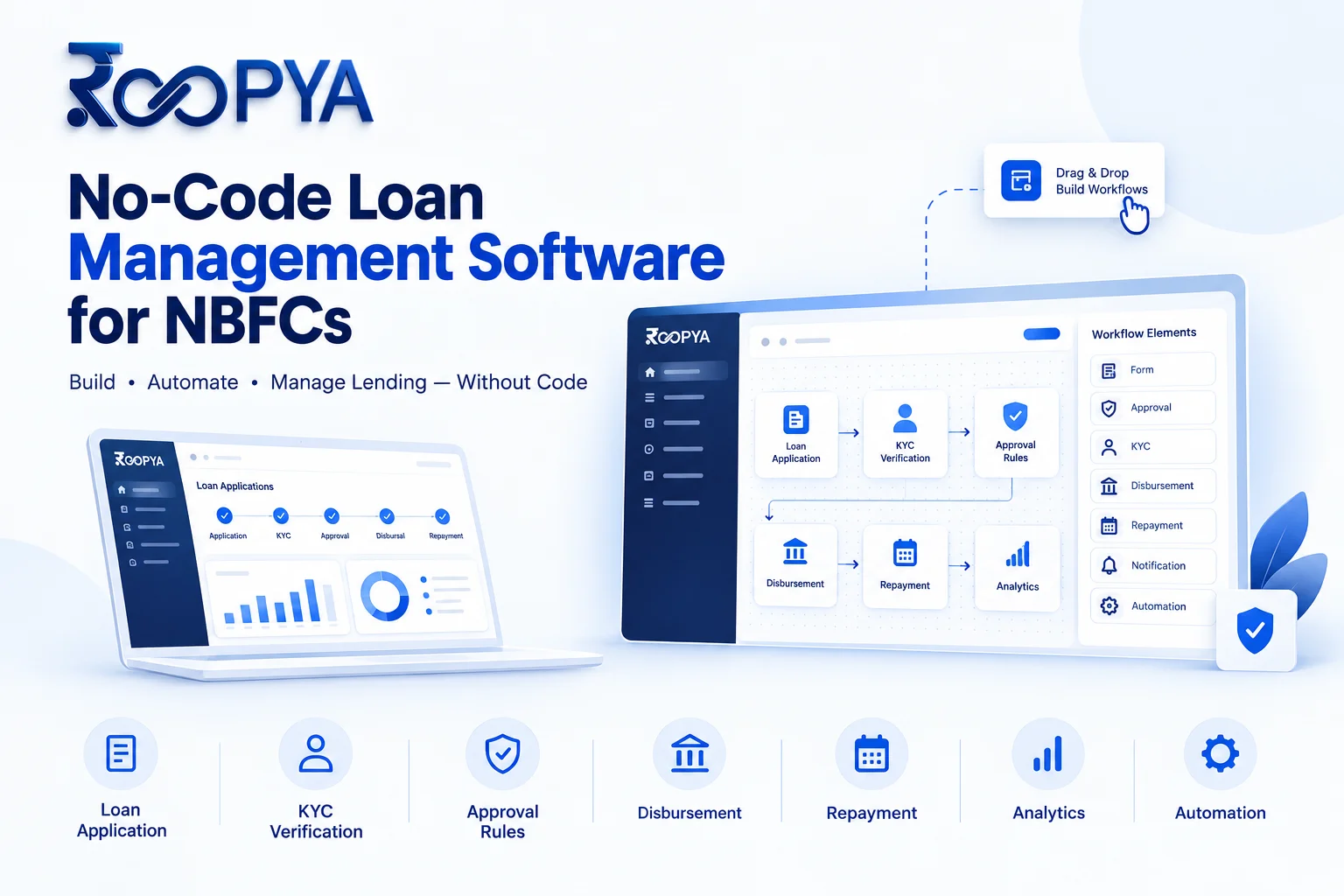
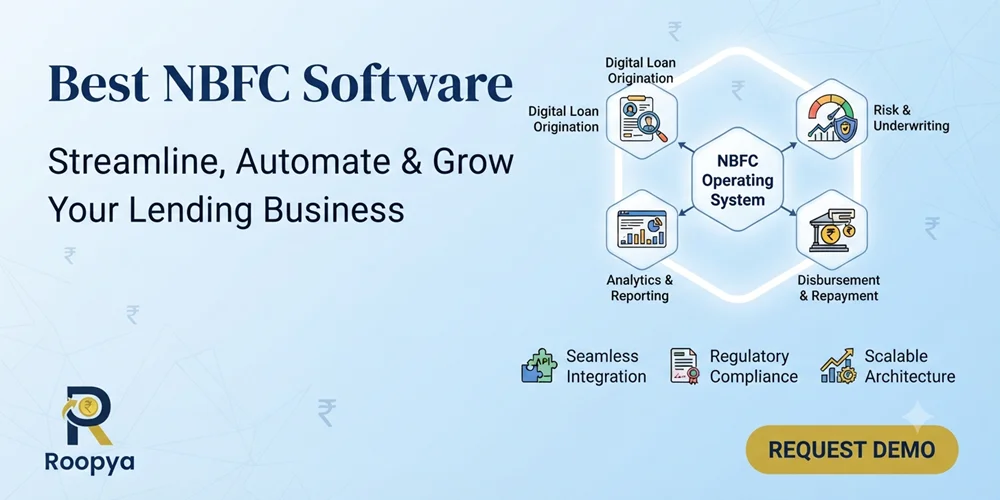
A Loan Management System is a comprehensive software platform that automates and manages the entire loan lifecycle — from the moment a customer applies for a loan to the moment the loan is fully repaid and closed. Instead of relying on manual processes, disconnected tools, or outdated legacy systems, banks and NBFCs use an LMS to handle:
- Loan origination and application processing
- Credit assessment and underwriting
- Loan disbursement
- EMI scheduling and repayment tracking
- Collections and recovery management
- Regulatory reporting and compliance
- Customer communication and self-service
In simple terms, an LMS acts as the operational backbone of any lending business. Whether you are a large public sector bank processing thousands of loan applications daily, a private bank offering retail and corporate credit, or an NBFC specializing in microfinance, gold loans, personal loans, or vehicle financing, an LMS ensures that every stage of the loan lifecycle runs smoothly, transparently, and in compliance with regulatory norms.
Why Banks & NBFCs Need a Dedicated Loan Management System
1. Rising Loan Volumes and Customer Expectations
Digital lending in India has grown exponentially, driven by increased smartphone penetration, easier access to credit, and government initiatives promoting financial inclusion. Customers today expect loan approvals within minutes, not days. Manual, paper-based processes simply cannot keep pace with this demand. An LMS automates data collection, verification, and decision-making, drastically cutting down turnaround time (TAT).
2. Regulatory Complexity
Banks and NBFCs operate under the watchful eye of regulators such as the Reserve Bank of India (RBI). Compliance requirements around KYC, credit reporting to bureaus, Non-Performing Asset (NPA) classification, provisioning norms, and audit trails are constantly evolving. A modern LMS is built to adapt to these regulatory changes quickly, reducing compliance risk and the burden on internal teams.
3. Risk of Manual Errors
When loan processing depends on manual entry across multiple disconnected systems — one for origination, another for accounting, another for collections — the risk of data mismatches, duplicate entries, and calculation errors increases significantly. This not only creates operational headaches but can also lead to compliance violations and financial losses. An integrated LMS eliminates these silos.
4. Need for Scalability
As a bank or NBFC grows its loan book, its systems must scale accordingly. A rigid, legacy system that worked for a few thousand loans may collapse under the weight of a few hundred thousand. Roopya's LMS is architected to scale horizontally, supporting institutions as they grow from regional players to national or multi-state lenders.
5. Competitive Differentiation
In a market where multiple lenders are chasing the same customer segments, the institution that can approve and disburse loans faster, with fewer errors and a smoother experience, wins the customer's trust and repeat business. Technology has become a genuine competitive differentiator in lending.
Core Modules of Roopya's Loan Management System
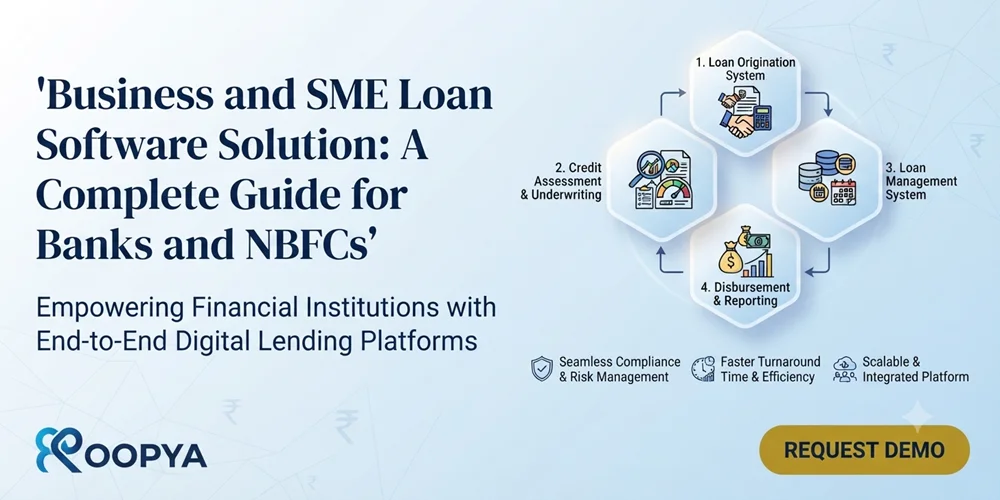
1. Loan Origination System (LOS) Integration
Seamlessly capture customer applications through web, mobile, or agent-assisted channels. Automated document collection, e-KYC verification, and bureau checks (CIBIL, Experian, CRIF, Equifax) reduce onboarding time from days to minutes.
2. Credit Underwriting & Risk Scoring
Configure custom credit policies, scorecards, and rule engines that reflect your institution's risk appetite. Whether it's a simple rule-based engine or an AI/ML-powered scoring model, Roopya's LMS supports flexible underwriting workflows for secured and unsecured loans alike.
3. Loan Disbursement Management
Once approved, loans can be disbursed instantly through integrated payment rails, NEFT/RTGS/IMPS gateways, or NBFC-specific disbursement partners. Multi-tranche disbursement is supported for products like construction finance or education loans.
4. Repayment & EMI Management
Automated EMI calculation, amortization schedules, auto-debit (NACH/e-mandate) integration, and real-time repayment tracking ensure that both the institution and the borrower have complete visibility into the loan status at all times.
5. Collections & Recovery Management
Prioritize collection efforts using risk-based bucketing (0-30, 30-60, 60-90+ DPD), automate reminders via SMS/WhatsApp/email, and assign field agents intelligently through geo-tagged collection workflows. This reduces NPAs and improves recovery rates.
6. NPA & Provisioning Management
Automatic classification of accounts into Standard, Sub-Standard, Doubtful, and Loss categories as per RBI guidelines, along with automated provisioning calculations, significantly reduces manual compliance work for finance and risk teams.
7. Regulatory & MIS Reporting
Generate ready-to-submit regulatory reports, board-level MIS dashboards, and audit trails at the click of a button. Roopya's LMS is designed to stay current with RBI, NHB, and other regulatory reporting formats.
8. Customer Self-Service Portal
Give borrowers 24/7 access to their loan account — view outstanding balance, download statements, make part-payments, request foreclosure, and raise service tickets — reducing the load on call centers and branch staff.
9. Co-Lending & Partnership Management
For NBFCs and banks engaged in co-lending arrangements, Roopya's LMS supports partner-wise loan books, revenue-sharing calculations, and reconciliation reports — a growing need in India's evolving co-lending ecosystem.
10. API-First Architecture
Built on an API-first framework, Roopya's LMS integrates easily with core banking systems (CBS), credit bureaus, payment gateways, e-KYC providers, accounting software, and third-party fintech platforms — avoiding vendor lock-in and enabling a true digital lending ecosystem.
Benefits of Implementing Roopya's Loan Management System
- Faster Turnaround Time (TAT): Reduce loan approval and disbursement time from days to hours or even minutes.
- Reduced Operational Costs: Automation reduces dependency on manual processing, cutting operational overheads significantly.
- Improved Portfolio Quality: Smarter underwriting and proactive collections reduce NPAs and improve overall portfolio health.
- Enhanced Compliance: Stay audit-ready at all times with automated regulatory reporting and complete documentation trails.
- Better Customer Experience: Faster processing, transparent communication, and self-service options improve borrower satisfaction and retention.
- Data-Driven Decision Making: Real-time dashboards and analytics give leadership teams the insights needed to make informed lending decisions.
- Scalability: Whether you process 500 loans a month or 500,000, the system scales with your business without a drop in performance.
Who Can Use Roopya's Loan Management System?
Roopya's LMS is built to serve a wide spectrum of lending institutions, including:
- Public and Private Sector Banks managing retail, MSME, and corporate loan books
- NBFCs offering personal loans, business loans, gold loans, vehicle loans, and consumer durable financing
- Microfinance Institutions (MFIs) serving underbanked and rural populations
- Housing Finance Companies (HFCs) managing long-tenure secured mortgage products
- Digital Lending Platforms and Fintech NBFCs operating fully online lending models
- Co-operative Banks and Credit Societies looking to modernize legacy loan processes
No matter the size or specialization of your institution, Roopya's platform is configurable to match your specific product mix, workflows, and compliance requirements.
Why Choose Roopya for Your Loan Management Needs?
- Purpose-Built for Indian Lending Regulations: Unlike generic global platforms, Roopya's LMS is designed with RBI guidelines, Indian credit bureau integrations, and local payment rails in mind from day one.
- Configurable, Not Just Customizable: Business teams can configure new loan products, workflows, and credit policies without heavy dependency on IT or long development cycles.
- End-to-End Coverage: From origination to closure, collections to compliance, Roopya covers the entire loan lifecycle in a single, unified platform.
- Cloud-Native and Secure: Built on secure, cloud-native infrastructure with role-based access control, data encryption, and regular security audits.
- Dedicated Support: Our implementation and support teams work closely with your operations, risk, and IT teams to ensure a smooth go-live and ongoing success.
Getting Started with Roopya's Loan Management System
Implementing a new LMS can feel like a daunting task, but Roopya makes the transition simple through a structured, phased approach:
- Discovery & Requirement Mapping: Understanding your current loan products, workflows, and pain points.
- Configuration: Setting up loan products, credit policies, and integrations specific to your institution.
- Data Migration: Securely migrating existing loan book data from legacy systems.
- Testing & UAT: Rigorous testing to ensure accuracy in calculations, compliance, and reporting.
- Go-Live & Training: Supporting your teams through go-live with comprehensive training and documentation.
- Ongoing Support & Enhancement: Continuous support, updates, and feature enhancements as your business evolves.
In today's fast-moving financial services landscape, a robust Loan Management System is no longer a luxury — it is a necessity for banks and NBFCs that want to remain competitive, compliant, and customer-centric. From origination to collections, from regulatory reporting to customer self-service, every part of the loan lifecycle can be transformed through the right technology partner.
Roopya's Loan Management System is built to help banks and NBFCs of all sizes automate their lending operations, reduce risk, improve portfolio quality, and deliver a superior borrower experience — all while staying fully compliant with evolving regulations.
Ready to transform your lending operations? Visit roopya.money and book a free demo today.
Frequently Asked Questions (FAQ)
1. What is a Loan Management System (LMS)? A Loan Management System is software that automates the entire loan lifecycle — from application and underwriting to disbursement, repayment, collections, and regulatory reporting — for banks, NBFCs, and other lending institutions.
2. Why do NBFCs need a Loan Management System? NBFCs deal with high volumes of loan applications, diverse products, and strict RBI compliance requirements. An LMS automates these processes, reduces manual errors, speeds up loan processing, and ensures regulatory compliance.
3. Can Roopya's LMS integrate with our existing Core Banking System (CBS)? Yes. Roopya's LMS is built on an API-first architecture, allowing seamless integration with core banking systems, credit bureaus, payment gateways, and other third-party platforms.
4. Is Roopya's Loan Management System suitable for both banks and NBFCs? Yes. Roopya's platform is configurable to support the specific workflows, products, and compliance needs of banks, NBFCs, microfinance institutions, and housing finance companies alike.
5. How does Roopya's LMS help reduce NPAs? Through automated risk-based collections, proactive reminders, real-time DPD (Days Past Due) tracking, and intelligent recovery workflows, Roopya's LMS helps institutions identify and manage stressed accounts before they escalate.
6. Does the system support regulatory reporting for RBI compliance? Yes. Roopya's LMS automates NPA classification, provisioning calculations, and generates regulatory and MIS reports in formats aligned with RBI and other applicable regulatory guidelines.
7. How long does it take to implement Roopya's LMS? Implementation timelines vary based on the complexity of your loan products and existing systems, but Roopya follows a structured, phased implementation process designed to minimize disruption and ensure a smooth go-live.
8. Is the platform secure for handling sensitive financial data? Yes. Roopya's LMS is built on secure, cloud-native infrastructure with role-based access controls, data encryption, and regular security audits to protect sensitive borrower and institutional data.




.webp)