Sign up with Google
 Sign in with Zoho

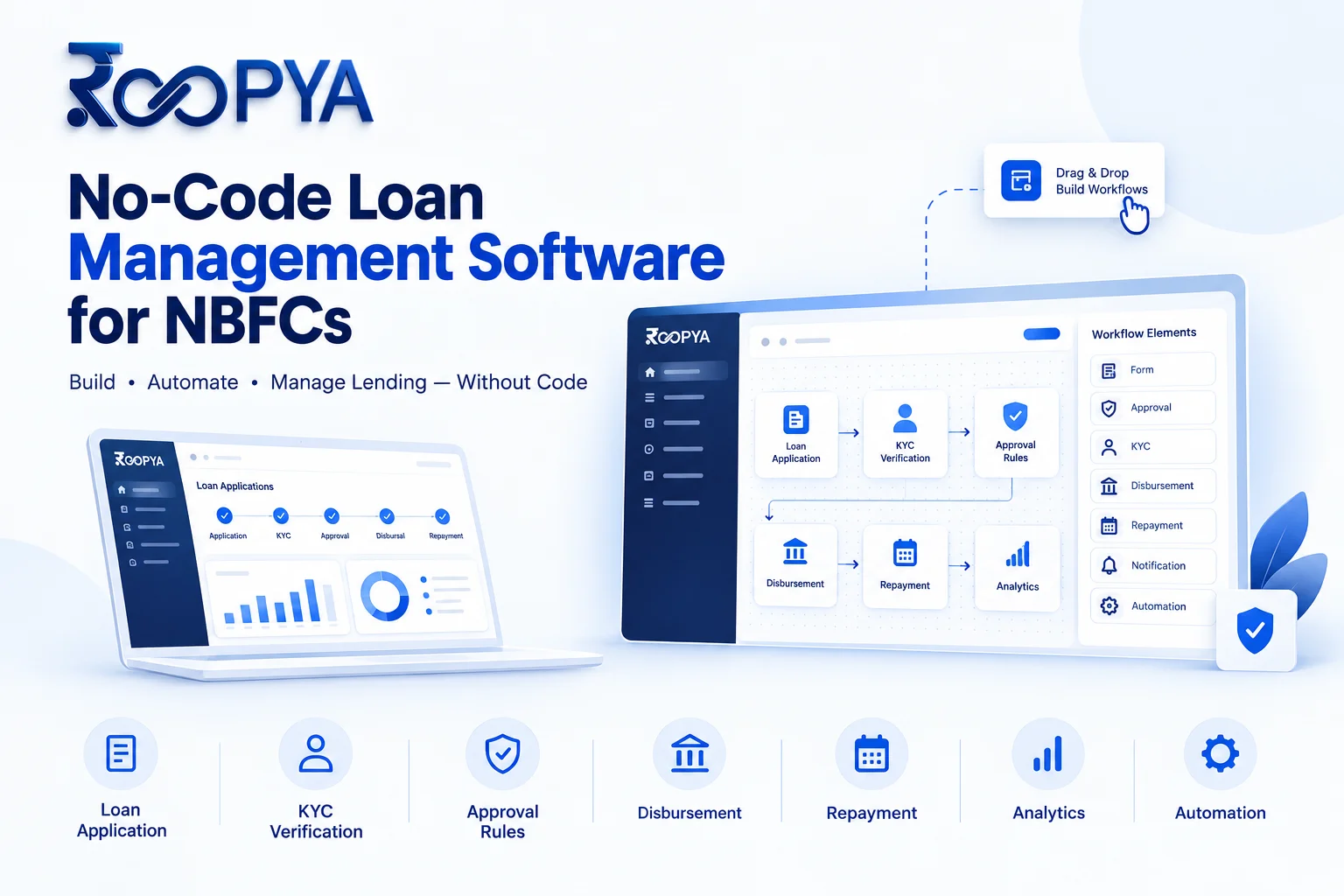
No-Code Loan Management Software for NBFCs: The Complete Guide
Non-banking financial companies in India are under constant pressure to disburse loans faster, price risk more accurately, and keep collections healthy, all while regulatory reporting requirements from the Reserve Bank of India keep getting more detailed. For years, the only way to keep pace was to hire an in-house development team, write custom code for every new loan product, and wait weeks or months for even a small change to go live. No-code loan management software has changed that equation. It lets operations, credit, and compliance teams configure loan products, underwriting rules, repayment schedules, and collection workflows themselves, through a visual interface, instead of filing a ticket with IT and waiting for the next release cycle.
This guide explains what no-code loan management software actually means, why it matters specifically for NBFCs, what a good platform needs to include, and how a no-code lending infrastructure such as Roopya approaches the problem end to end, from origination through collections.
What Is a Loan Management System, and Why Does "No-Code" Matter?
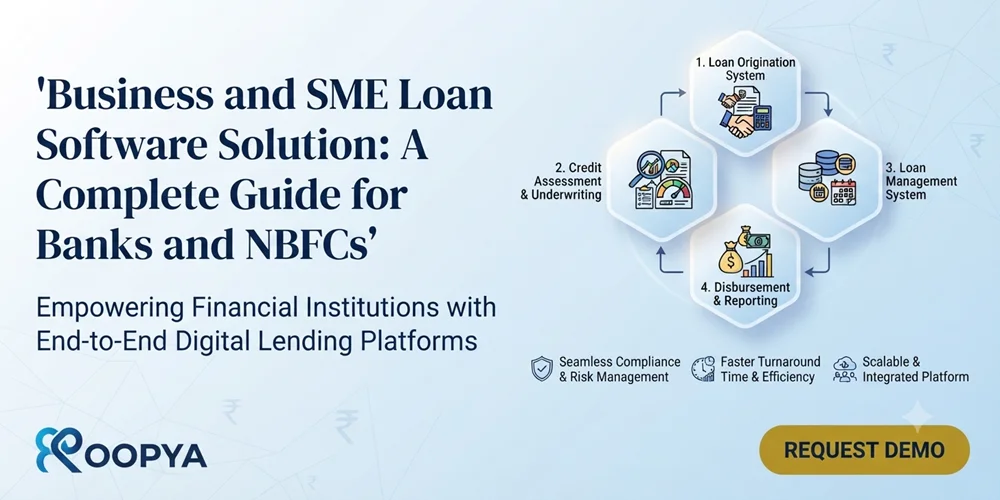
A Loan Management System, or LMS, is the system of record for a loan once it has been sanctioned. It tracks the disbursal, calculates the EMI schedule and interest accrual, records every payment and penalty, classifies accounts by days-past-due, drives collections activity, and eventually closes the loan and issues a no-objection certificate. This sits downstream of the Loan Origination System, or LOS, which handles the application, credit decisioning, and sanction. Many modern platforms, including Roopya, offer both as a single connected lending infrastructure rather than two separate systems that need to be stitched together.
"No-code" describes how the configuration layer of that system is built and changed. In a traditional LMS, product rules, interest-calculation methods, fee structures, approval hierarchies, and communication templates are hardcoded by developers. Any change, even something as simple as adding a new processing fee slab, means writing a change request, waiting in a development queue, testing, and deploying. In a no-code LMS, the same configuration is exposed through forms, drag-and-drop rule builders, and visual workflow designers that a business user, such as a credit or operations manager, can operate directly. It's worth distinguishing this from "low-code," which still expects some scripting for edge cases, and from fully custom-built software, which offers maximum flexibility but the slowest and most expensive path to change.
The Problem With Traditional, Code-Heavy LMS Platforms
NBFCs that run on legacy or heavily customised loan software tend to run into the same handful of problems repeatedly:
• Slow product launches. Taking a new loan product, such as a gold loan or a merchant cash advance, from idea to a live, sellable product can take months when every rule needs custom development.
• Vendor and developer dependency. Every change, however small, competes for space on a development backlog that the business doesn't control.
• Expensive, slow-moving compliance updates. When the RBI issues a new circular on provisioning norms, restructuring, or digital lending guidelines, code-heavy systems need a development cycle to catch up.
• High cost of experimentation. Testing a new interest structure, a new fee, or a new customer segment carries real engineering cost, so teams under-experiment.
• Talent scarcity. Not every NBFC, especially small and mid-sized ones, can staff or retain a full engineering team purely to maintain lending software.
None of this is a criticism of any particular product; it's simply the natural consequence of building configuration into code instead of into a configuration layer.
Why No-Code Matters More for NBFCs Than for Large Banks
Banks typically have large, dedicated technology teams and multi-year transformation budgets. NBFCs are usually leaner and often built around a specific, sometimes narrow, lending niche, such as gold loans, payday loans, MSME working-capital loans, or embedded finance for a partner platform. That combination, thin technology teams and a need to compete with digital-first fintechs on speed, is exactly where no-code delivers the most value. It lets a smaller team launch and iterate on loan products at a pace that would otherwise require a much larger engineering headcount, and it lets the NBFC respond to a new RBI scale-based regulatory requirement or a fast-moving competitive gap in days rather than quarters.
Core Features to Look For in a No-Code LMS
Not every product calling itself "no-code" delivers real configurability. When evaluating a platform, look for genuine no-code control across each of the following layers.
1. Configurable Loan Products
• Interest calculation methods (flat, reducing balance, hybrid) set through a form, not code
• Tenure, ticket size, fee, and penalty slabs configurable per product
• Ability to clone and modify an existing product to launch a variant quickly
2. A No-Code Business Rule Engine (BRE)
• Visual builder for credit policy rules and eligibility checks
• Configurable approval hierarchies and maker-checker workflows
• Version history so policy changes can be audited and rolled back
3. EMI, Amortization, and Account Servicing
• Automatic EMI scheduling, interest accrual, and amortization schedules
• Support for prepayment, foreclosure, restructuring, and top-up loans
• Co-lending and loan syndication handling where relevant
4. Payments and Reconciliation
• Multiple payment gateway and NACH/eNACH mandate integration
• Auto-debit scheduling and automated payment reconciliation
• Real-time visibility into payment status and failures
5. Collections and Delinquency Management
• Configurable collection buckets and escalation workflows
• Automated reminders across SMS, email, and WhatsApp
• Days-past-due tracking, provisioning calculations, and settlement tools
6. Customer Self-Service
• A borrower portal for EMI payment, statements, and document access
• Self-service NOC and closure-certificate generation
7. Regulatory Reporting
• RBI reporting support, including NPA classification and ALM/CRR-SLR reporting
• Audit trails and logs suitable for statutory and internal audit
8. Integrations and Open APIs
• Pre-built connections to credit bureaus, KYC providers, and payment gateways
• A documented REST API and webhook support for anything not pre-built
9. Security
• Encryption at rest and in transit, role-based access control, and MFA
• Recognised certifications such as ISO 27001 and regular security testing
How a No-Code LMS Changes the Economics of Running an NBFC
Beyond the operational convenience, no-code lending infrastructure changes the underlying cost structure of running an NBFC in a few concrete ways.
• Pay-as-you-use pricing replaces large upfront licensing and implementation costs, which matters for NBFCs that need to preserve capital for lending rather than technology.
• Faster time-to-market means a new loan product starts generating interest income sooner, compounding over the life of the NBFC.
• Lower dependency on scarce lending-technology talent reduces both hiring risk and key-person risk.
• Business ownership of configuration means the people closest to the credit policy and the customer are the ones adjusting it, which shortens the feedback loop between a market signal and a product change.
Inside Roopya's No-Code Lending Infrastructure
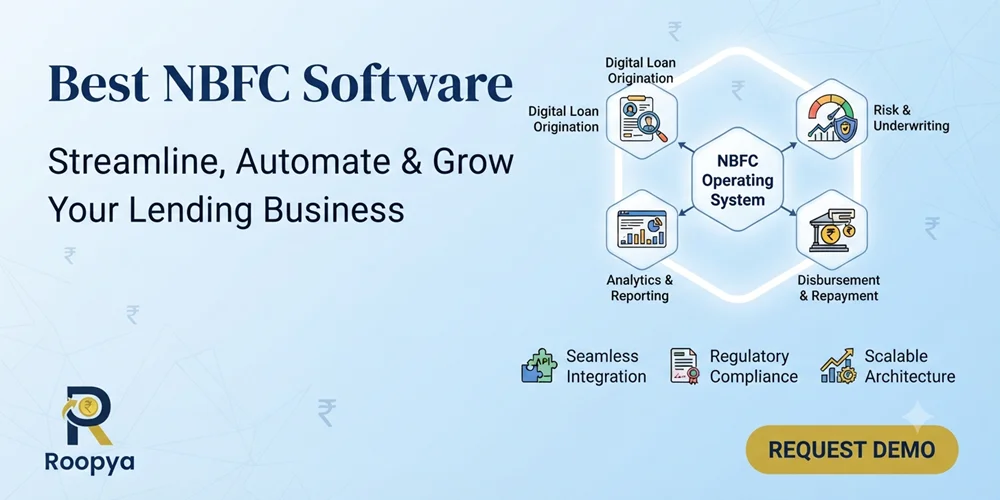
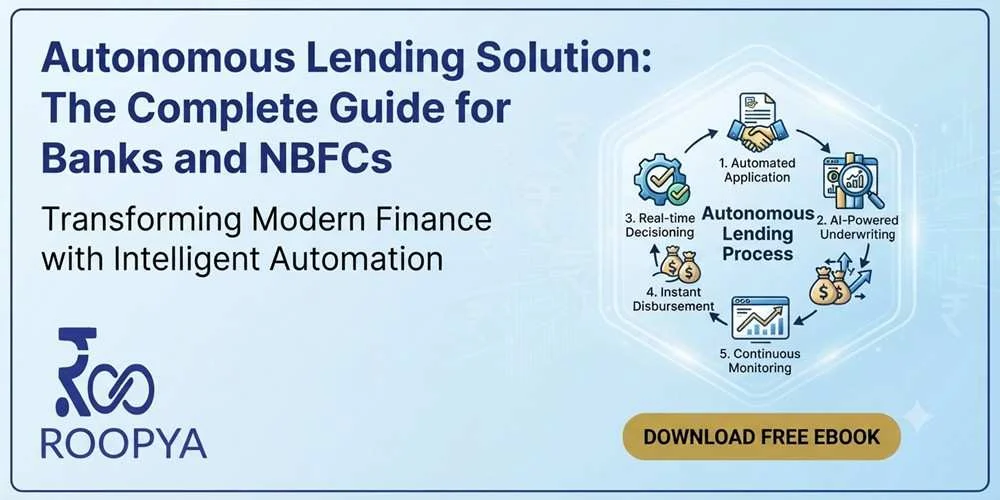
Roopya (roopya.money) is built as a unified, no-code lending infrastructure that covers the full lifecycle from origination through servicing, collections, and analytics, rather than a single-purpose LMS that needs to be integrated with a separate origination or collections tool.
On the origination side, Roopya offers digital application forms, automated credit scoring, document verification, and real-time decisioning. On the servicing side, its Loan Management System handles portfolio management, EMI and amortization schedules, payment processing, and a customer portal. A dedicated Collections module covers automated reminders, collection workflows, payment plans, and agent management, and an Early Warning System applies predictive analytics to flag accounts at risk of default before they slip. All of this sits on top of a no-code business rule engine that lets NBFC teams configure credit policy and approval workflows themselves.
A few specifics worth noting for an NBFC evaluating the platform:
• 300+ pre-integrated APIs across credit bureaus, verification services, and payment gateways, reducing the integration work needed to go live
• 20+ pre-configured loan products, from personal loans to business credit, that can be cloned and adjusted rather than built from scratch
• AI-powered document analysis and OCR for identity documents and bank statements, aimed at both speed and fraud detection
• An AI-enhanced business rule engine that can surface patterns in approvals and rejections to inform policy changes, while keeping full human oversight over the final rules
• Pay-as-you-use pricing with no large upfront cost, and a platform that is continuously updated to reflect current regulatory requirements
This combination is what lets Roopya position itself around a same-week go-live rather than the multi-month implementation timelines typical of legacy, code-heavy LMS deployments.
What Implementation Typically Looks Like
Because configuration doesn't require development cycles, a no-code LMS implementation follows a materially shorter path than a traditional core-lending-system rollout. On Roopya, the typical sequence looks like this:
• Day 1 — Sign-up and account setup: registration, entity verification, licence and compliance checks, and sandbox provisioning (roughly 2–4 hours)
• Day 2–3 — Configuration and customisation: loan product setup, approval-hierarchy workflows, document checklists, credit policy rules, user roles, branding, and communication templates
• Day 3–4 — Integration setup: payment gateway, credit bureau, banking API, KYC provider, and messaging gateway connections, plus API key generation and testing
• Day 4–5 — Training and testing: team training, end-to-end test loan processing, user-acceptance testing, and security assessment
• Day 5–7 — Go-live and support: production setup, data migration where applicable, final checks, and dedicated support through the first week
For an NBFC currently running on spreadsheets, a legacy core system, or a patchwork of point solutions, this compresses what is normally a multi-month systems-integration project into roughly a week, with an assigned implementation manager guiding each stage.
No-Code LMS vs. Legacy LMS vs. Building In-House
How to Evaluate a No-Code LMS Vendor: A Checklist
Before signing a contract, it's worth working through a short evaluation checklist rather than relying on a demo alone:
• Compliance track record: Ask how the platform has handled recent RBI circulars and how quickly it was updated
• Depth of "no-code": Ask to configure a real rule or product live in the demo, not just see a slide
• Integration coverage: Confirm the bureaus, payment gateways, and KYC providers you already use are pre-integrated
• Security certifications: Look for ISO 27001 or equivalent, plus a clear data-encryption and access-control policy
• Pricing transparency: Understand exactly what "pay-as-you-use" includes and excludes before committing
• Support model: Ask what support looks like after go-live, not just during implementation
• Reference customers: Speak to an existing NBFC customer running a similar loan product
The Road Ahead: AI and No-Code Together
No-code configurability and AI are increasingly being built together rather than as separate layers. In practice, this shows up as AI-assisted document analysis and OCR to speed up verification, machine-learning-based credit scoring that supplements bureau data with alternative signals, collection strategies that adapt to borrower behaviour, and natural-language reporting that lets a business user ask a question about the portfolio instead of building a custom report. The important point for an NBFC evaluating this is that AI should sit inside a no-code, human-supervised workflow, with the business team retaining oversight over final credit and collection decisions, rather than functioning as an unreviewable black box.
Common Pitfalls to Avoid When Adopting a No-Code LMS
Moving to a no-code LMS solves most of the problems described above, but a few adoption mistakes show up repeatedly and are worth planning around in advance.
• Treating it as a lift-and-shift: Copying an old, code-heavy product configuration exactly as-is often carries over workarounds that only existed because the old system couldn't do better. Use the migration as a chance to simplify.
• Skipping a proper sandbox test: Because configuration changes are fast, it's tempting to test directly in production. Run a full end-to-end cycle, from application to closure, in the sandbox first.
• Leaving governance loose: No-code puts configuration power in the hands of business users, so maker-checker controls and an audit trail on rule changes matter more, not less, than in a developer-gated system.
• Ignoring data migration quality: A fast go-live doesn't help if historical loan data, payment history, and NPA tagging aren't migrated cleanly. Budget real time for data validation.
• Not training beyond the launch team: The people who configure the platform on day one are rarely the only ones who need to use it. Plan training for credit, operations, and collections teams as a group.
Conclusion
No-code loan management software gives NBFCs something that used to be reserved for organisations with large engineering teams: the ability to launch, adjust, and retire loan products at business speed rather than development speed, while keeping regulatory reporting, security, and collections under control. For a lean NBFC competing against well-funded fintechs, that speed is often the difference between capturing a market window and missing it.
Roopya brings origination, servicing, collections, early warning, and analytics together on a single no-code, AI-first platform, with 300+ pre-integrated APIs, 20+ pre-configured loan products, and a go-live timeline measured in days rather than months. If you're evaluating a no-code LMS for your NBFC, the most useful next step is a working demo against your own loan product and credit policy, not a generic walkthrough.
Request a demo at https://roopya.money/contact-us/ to see how quickly your first product can go live.
Frequently Asked Questions
What is no-code loan management software?
No-code loan management software is a loan servicing platform where product rules, credit policy, workflows, and communication templates are configured through a visual interface instead of custom code. It lets NBFC business and operations teams set up and change loan products without waiting on a development team.
How is a no-code LMS different from a Loan Origination System (LOS)?
A Loan Origination System handles the application, credit decisioning, and sanction of a loan. A Loan Management System takes over after disbursal, handling EMI scheduling, payment processing, delinquency management, and closure. Platforms like Roopya offer both as one connected, no-code lending infrastructure.
Is a no-code LMS secure and RBI-compliant?
A properly built no-code LMS should hold recognised security certifications such as ISO 27001, encrypt data at rest and in transit, and be kept current with RBI reporting requirements such as NPA classification and ALM/CRR-SLR reporting. It's worth confirming a vendor's specific certifications and update history before onboarding.
How long does it take to go live with a no-code LMS like Roopya?
Roopya's typical implementation runs 5–7 days, covering sign-up and account setup, product and workflow configuration, integration setup, training and testing, and go-live with dedicated first-week support.
Can a no-code LMS handle multiple loan products, such as gold loans, personal loans, and SME loans?
Yes. A no-code LMS is designed to let you configure and launch multiple loan products, each with its own interest structure, fees, tenure, and approval workflow, without separate development work for each product. Roopya ships with 20+ pre-configured loan products that can be cloned and adjusted.
Do we still need developers if we use a no-code LMS?
Not for day-to-day configuration such as product setup, credit policy changes, or workflow adjustments. Developer involvement is typically limited to custom integrations beyond the platform's pre-built API ecosystem, which a no-code LMS keeps to a minimum.
What does a no-code LMS cost for an NBFC?
Pricing varies by vendor, but no-code platforms are commonly offered on a pay-as-you-use basis rather than a large upfront licence fee, which lowers the initial capital outlay for an NBFC. Roopya follows a zero-upfront-cost, pay-as-you-use model; contact the Roopya team for a quote specific to your loan book.