Sign up with Google
 Sign in with Zoho

Every fintech, NBFC, and digital lender runs into the same wall early on: before a customer can open an account, take a loan, or load a wallet, their identity has to be verified. Do this manually — collecting scanned documents, checking them by eye, cross-referencing details by hand — and onboarding slows to a crawl, drop-off rates climb, and compliance risk creeps in through human error. A KYC Verification API solves this by turning identity verification into a programmable, automated step that happens in seconds rather than days.
For fintech companies in particular, where the entire product experience is built around speed and a frictionless app, KYC has to be invisible to the user but airtight from a compliance standpoint. That's the gap a purpose-built KYC Verification API is designed to close. At Roopya.money, we offer a free tier of our KYC Verification API specifically so that fintechs, NBFCs, and lending startups can integrate real identity verification into their onboarding flow without the cost barrier that often delays early-stage products.
What Is a KYC Verification API?
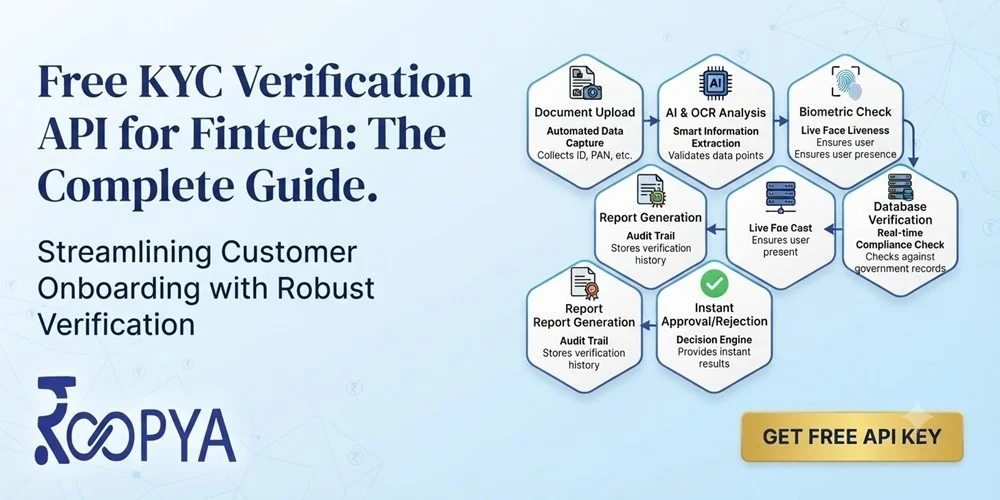
A KYC (Know Your Customer) Verification API is a set of programmable endpoints that let a business check a person's or company's identity electronically. Instead of a customer emailing a scanned Aadhaar card or PAN card that a back-office team then manually reviews, the business's app calls an API, which:
• Captures or receives the identity document or number (Aadhaar, PAN, driving licence, passport, GSTIN)
• Validates the document format and checks it against the issuing authority's database where available
• Extracts key data fields (name, date of birth, address, photo) using OCR where a document image is submitted
• Matches the extracted data against what the customer has entered, flagging mismatches
• Returns a structured verification result — verified, failed, or needs manual review — typically within seconds
The entire exchange happens programmatically, which means it can be embedded directly into a mobile app's onboarding screen, a web signup form, or a back-office loan application system.
Why Fintechs Specifically Need a KYC API
1. Onboarding Speed Directly Affects Conversion
Fintech products live and die on activation rates. Every additional step, every wait time, every moment of uncertainty during signup causes users to abandon the flow. A KYC API that returns a verification result in seconds — rather than the hours or days a manual process takes — keeps users inside the app and moving toward activation.
2. Regulatory Obligations Don't Disappear Because You're a Startup
Fintechs offering lending, wallets, or payment services fall under RBI's KYC requirements just like traditional banks and NBFCs, regardless of company size. A KYC API that's built with compliance in mind — consent logging, data masking, audit trails — helps early-stage companies meet these obligations without building compliance infrastructure from scratch.
3. Manual Review Doesn't Scale
A five-person operations team can review a hundred KYC submissions a day by hand. It cannot review ten thousand. As a fintech's user base grows, an API-driven verification process is the only way to keep verification volume in step with user growth without proportionally growing headcount.
4. Fraud Prevention Requires More Than a Human Eye
Forged or manipulated ID documents are increasingly difficult to catch by visual inspection alone. API-based verification checks documents against official databases and applies fraud-detection logic — document tampering checks, face-match against the photo ID, liveness detection during video KYC — that a manual review process typically can't replicate consistently.
Core Capabilities of Roopya.money's KYC Verification API
Aadhaar e-KYC and Offline XML Verification
Supports both Aadhaar-based e-KYC (OTP-based) for real-time verification and offline Aadhaar XML verification for use cases where OTP-based verification isn't practical, keeping full UIDAI data-handling compliance throughout.
PAN Verification
Instantly validates PAN numbers and cross-checks name and status against Income Tax Department records — a standard requirement for financial onboarding and loan applications.
Video KYC
Enables RBI-compliant video-based customer identification, including liveness detection and photo ID matching, for institutions that need an in-person-equivalent verification without a physical branch visit.
Bank Account and Penny-Drop Verification
Confirms that a bank account is active and that the account holder's name matches the KYC record, commonly used before disbursing loans or setting up repayment mandates.
Document OCR and Data Extraction
Extracts structured data — name, address, date of birth, document number — from scanned or photographed ID documents, reducing manual data entry and typos.
GSTIN and Business KYC
For MSME lending and business onboarding, verifies GSTIN details and business registration information alongside individual KYC of the authorized signatories.
How the Free Tier Works
Roopya.money's KYC Verification API is available on a free tier so fintechs and lending startups can build and test their onboarding flow without upfront licensing cost. This typically includes sandbox access for development, a set number of free verification calls per month for live use, and standard documentation and support to get an integration running. As verification volumes grow past the free tier's limits, usage-based pricing applies — so the cost structure scales with the business rather than requiring a large commitment before the product has proven itself.
Integration: What the Process Looks Like
• Sign up and get sandbox API credentials to start testing without touching live data
• Review the REST API documentation covering authentication, request/response formats, and error handling
• Integrate the relevant endpoints — Aadhaar, PAN, video KYC, or bank verification — into the onboarding flow
• Test each verification type in the sandbox environment against sample data
• Move to production credentials and monitor verification results through the dashboard or webhook callbacks
Because the API follows standard REST conventions with JSON request and response bodies, most engineering teams familiar with typical third-party API integrations can get a basic flow working within a few days.
KYC Verification API vs. Manual KYC Processing
Common Implementation Mistakes to Avoid
Treating KYC as a One-Time Gate
Some fintechs verify a customer once at signup and never again. Depending on the product and regulatory category, periodic re-KYC or risk-based re-verification may be required — plan for this from the start rather than retrofitting it later.
Ignoring the Fallback Path
Not every customer will pass automated verification on the first attempt — a blurry document photo or a mismatched name is common. Build a clear fallback path to manual review or resubmission so legitimate customers aren't simply rejected outright.
Skipping Consent and Data-Handling Documentation
Because KYC APIs handle sensitive personal data, especially Aadhaar information, proper consent capture and data-retention documentation isn't optional — it's core to staying within UIDAI and RBI guidelines.
The Bottom Line
For a fintech, KYC isn't just a compliance checkbox — it's the first real interaction a customer has with the product, and it sets the tone for how trustworthy and frictionless the whole experience feels. A well-integrated KYC Verification API turns what used to be the slowest, most drop-off-prone part of onboarding into something that happens almost invisibly in the background.
Roopya.money's free-tier KYC Verification API is built to let fintechs, NBFCs, and lending startups start verifying customers properly from day one — without the upfront cost or the multi-week integration timeline that often stalls early-stage products.
Frequently Asked Questions
What is a KYC Verification API?
A KYC Verification API is a set of programmable endpoints that let a business verify a customer's identity electronically — checking documents like Aadhaar, PAN, or a driving licence, and matching them against government or bureau databases — instead of collecting and manually reviewing physical paperwork.
Is Roopya.money's KYC Verification API really free?
Roopya.money offers a free tier of its KYC Verification API so fintechs, NBFCs, and lenders can integrate, test, and start verifying customers without upfront cost. Usage-based plans apply as verification volumes scale.
What types of KYC checks does the API support?
The API supports Aadhaar-based e-KYC and offline XML verification, PAN verification, video KYC, bank account and penny-drop verification, and document OCR for extracting data from ID proofs.
How long does it take to integrate the API?
Because the API is built on standard REST endpoints with clear documentation and sandbox access, most engineering teams can complete a basic integration within a few days, depending on how many verification types are required.
Is the KYC Verification API compliant with RBI and UIDAI guidelines?
Yes. The API is designed to align with RBI KYC norms and UIDAI's Aadhaar data-handling requirements, including consent capture, data masking, and audit-trail logging for every verification request.
Can the API be used for both individual and business KYC?
Yes. It supports individual KYC through Aadhaar, PAN, and video verification, as well as business KYC through GSTIN and company-registration checks for MSME and business lending use cases.
Does the API work for both online and offline onboarding?
Yes. It can power fully digital onboarding journeys inside a mobile app or website, and can also be used by branch or field staff during assisted, in-person onboarding.