Sign up with Google
 Sign in with Zoho

Small and medium enterprises are the backbone of India's economy, contributing close to a third of the country's GDP and employing tens of millions of people. Yet SME lending remains one of the hardest segments for banks and NBFCs to serve profitably. Business borrowers don't fit neatly into the standardised underwriting models built for salaried individuals — their income is seasonal, their documentation is scattered across GST returns, ITRs, and bank statements, and their credit needs range from a ₹2 lakh working capital top-up to a ₹5 crore term loan.
This is exactly the gap a purpose-built Business and SME Loan Software Solution is designed to close. Rather than forcing SME lending through a retail loan workflow, this software gives lenders the tools to originate, underwrite, disburse, and service business loans on their own terms — with the data depth business credit decisions actually require.
This guide walks through why SME lending is different, what a modern SME loan software platform needs to do well, and how to evaluate one before you commit to it.
Why SME Lending Needs Its Own Software Stack
Retail and SME lending look similar on the surface — both involve an application, a credit check, and a disbursement — but the underlying decisioning is fundamentally different.
Income verification is harder. A salaried applicant has a payslip and Form 16. A business owner has GST filings, income tax returns, bank statements across multiple accounts, and sometimes informal cash flows that never touch a formal ledger. A lending platform that can't pull and interpret this data automatically pushes the burden back onto credit analysts, slowing down turnaround time (TAT) and capping how many applications a team can process.
Credit risk is multidimensional. A business's creditworthiness isn't just about the promoter's personal credit score. It depends on the health of the business itself — revenue consistency, cash flow adequacy, leverage, sector risk, and even the track record of the directors running it. Underwriting logic needs to weigh all of these together, not just one bureau score.
Loan structures vary widely. SME lending isn't one product — it spans term loans, working capital lines, invoice discounting, equipment finance, and unsecured business loans, each with different repayment structures, collateral requirements, and risk appetites. A platform that only supports EMI-based term loans will struggle the moment a lender wants to offer a revolving credit line.
Regulatory scrutiny is intensifying. With the RBI's digital lending guidelines and increasing emphasis on responsible lending, SME loan software needs to bake in KYC, AML checks, and audit trails from day one rather than bolting them on later.
A general-purpose loan management system can technically process an SME loan, but it usually does so inefficiently — with manual document review, disconnected credit bureau pulls, and underwriting rules that weren't built for business financials. Purpose-built SME loan software solves this by treating business credit assessment as a first-class capability, not an afterthought.
Core Capabilities of a Modern SME Loan Software Platform
1. Digital Origination Built for Business Applicants
The application journey for an SME borrower should reflect how businesses actually operate. That means supporting multiple applicant types (proprietorship, partnership, private limited, LLP), capturing co-applicant and guarantor details, and allowing document uploads for GST certificates, MSME/Udyam registration, and incorporation documents — all through a digital, largely self-serve journey rather than a paper-heavy branch process.
2. Automated Financial Statement Analysis
This is where SME loan software earns its keep. Instead of an analyst manually reading through GST returns and bank statements, the platform should be able to:
- Pull GST filings via API and evaluate revenue trends, tax compliance, and filing consistency over time
- Analyse ITRs to cross-verify declared income against GST turnover
- Parse bank statements (through OCR or bank statement analyzers) to assess average balances, cash flow patterns, bounce history, and existing debt obligations
- Read balance sheets and P&L statements to compute standard ratios — debt-to-equity, current ratio, interest coverage — automatically
Automating this step is often the single biggest driver of faster turnaround time in SME lending, since manual financial statement review is typically the slowest part of the underwriting cycle.
3. Business-Specific Credit Scoring
A good SME credit model blends traditional bureau data (CIBIL, Experian, CRIF for both the business and its directors) with alternative data — GST trends, cash flow stability, industry risk, and even director background checks covering litigation history or past business failures. The scoring model should be configurable, since risk appetite and portfolio strategy differ across lenders, and it should improve over time as more loan performance data feeds back into it.
4. A No-Code Business Rule Engine
Because SME credit policy changes more frequently than retail policy — in response to sector performance, regulatory shifts, or portfolio stress — the underwriting rules need to be editable by risk and credit teams directly, without waiting on engineering. A no-code rule engine lets a lender adjust eligibility criteria, loan-to-value ratios, or pricing tiers for a specific sector in hours instead of weeks.
5. Flexible Loan Servicing
Once disbursed, SME loans need loan management capabilities that go beyond simple EMI tracking: support for moratoriums, part-prepayments, working capital limit utilisation, interest-only periods, and restructuring. The system should generate accurate amortisation schedules for each structure and give both the lender and borrower real-time visibility into outstanding balances.
6. Collections and Early Warning
SME repayment behaviour is more sensitive to business cycles than retail repayment. An early warning system that tracks leading indicators — a drop in GST turnover, a spike in cheque bounces, deteriorating bureau trends — lets a lender intervene before an account slips into default, rather than reacting after the fact. This should connect directly to a collections workflow so flagged accounts move automatically into the right recovery track.
7. Portfolio Analytics and Regulatory Reporting
Lenders need visibility into portfolio health by sector, geography, ticket size, and vintage, along with the reporting required for RBI and internal audit purposes. Dashboards that update in real time — rather than static monthly reports — let risk teams catch concentration risk or early delinquency trends while there's still time to act.
The Business Case: What Changes When You Adopt SME Loan Software
Faster turnaround time. Automating financial statement analysis and credit scoring can cut underwriting time from days to hours, which matters enormously to SME borrowers who often need capital on short notice.
Lower cost per loan. Straight-through processing reduces the number of manual touchpoints per application, which matters especially for smaller ticket sizes where manual underwriting costs can erode margins.
Better risk-adjusted returns. Richer, multi-source credit assessment reduces both false rejections (creditworthy businesses turned away due to thin bureau files) and false approvals (risky businesses that pass a purely bureau-based check).
Scalability without proportional headcount growth. A lender processing 500 SME applications a month and one processing 5,000 shouldn't need a proportionally larger credit team if the underwriting is automated correctly.
Regulatory confidence. Built-in compliance checks and audit trails reduce the operational risk of examination findings or penalties.
Choosing the Right SME Loan Software: Questions to Ask
Before selecting a platform, it's worth getting clear answers to a few practical questions:
- How quickly can we go live? Some platforms require months of custom development; no-code, pre-configured platforms can often go live in days.
- What's already integrated? Check for pre-built connections to credit bureaus, GST/ITR data providers, bank statement analyzers, e-signature, and payment gateways — building these integrations yourself adds months to a rollout.
- Can credit and risk teams configure policy themselves? If every rule change needs a developer, your underwriting will always lag your risk appetite.
- Does it support the loan products we actually offer? Confirm it handles term loans, working capital, and any structured products you plan to launch, not just standard EMI loans.
- What does the pricing model look like? Usage-based pricing avoids large upfront capital commitments and aligns cost with loan volume.
- How is compliance handled? Ask specifically about RBI digital lending guideline alignment, KYC/AML workflows, and data security practices.
How Roopya Supports Business and SME Lending
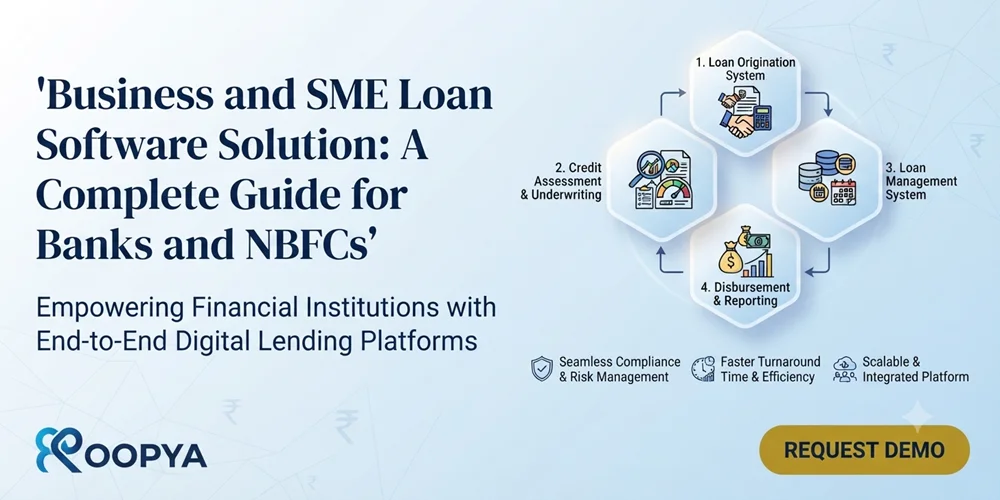
Roopya's Business and SME Loan Software Solution is built on a no-code lending infrastructure that covers the full lifecycle — origination, underwriting, disbursement, servicing, and collections — in a single platform. It's designed specifically for the realities of SME credit assessment:
- Automated GST and ITR analysis to evaluate revenue trends and tax compliance
- Cash flow and balance sheet analysis using ratio and trend-based models
- Credit scoring models that combine traditional bureau data with alternative data sources
- Director-level background checks covering credit history and litigation records
- A self-configurable business rule engine for credit and risk teams
- 300+ pre-integrated APIs across bureaus, verification services, and payment rails
- Real-time portfolio analytics and regulatory reporting dashboards
Because the platform is pre-built and API-ready, lenders can typically go live in days rather than months, with usage-based pricing that avoids large upfront costs.
If you're evaluating loan software for your SME lending business, a demo is the fastest way to see how the underwriting and origination workflows would map to your existing credit policy.
Frequently Asked Questions
1. What is Business and SME loan software?
It's a specialised lending platform that handles the full loan lifecycle — origination, credit assessment, disbursement, servicing, and collections — for loans made to small and medium enterprises, using business-specific data like GST filings, ITRs, and financial statements rather than standard retail credit inputs.
2. How is SME loan software different from a regular loan management system?
A regular LMS is often built primarily for retail loans and may lack the ability to automatically analyse business financials, score business-specific risk factors, or support varied loan structures like working capital lines and invoice discounting. SME loan software is purpose-built for these needs.
3. How does SME loan software assess creditworthiness without a strong credit history?
It combines multiple data sources — GST turnover trends, ITR filings, bank statement cash flow patterns, balance sheet ratios, and director-level background checks — so a business with a thin bureau file can still be assessed accurately on the strength of its actual financial performance.
4. Can SME loan software support working capital and invoice discounting, not just term loans?
Yes, a properly built platform supports multiple loan structures, including revolving working capital lines, invoice/bill discounting, equipment finance, and unsecured business loans, each with its own repayment and servicing logic.
5. How long does it take to implement SME loan software?
This depends heavily on whether the platform is no-code and pre-integrated. Custom-built systems can take several months to deploy; pre-configured, API-ready platforms like Roopya can often go live within a matter of days.
6. Is SME loan software compliant with RBI regulations?
A well-built platform should have KYC, AML, and digital lending guideline compliance built into the workflow, along with audit trails and reporting features that support regulatory examinations. It's worth confirming this directly with any vendor before onboarding.
7. What does SME loan software typically cost?
Pricing models vary — some vendors charge a large upfront licensing fee, while others use usage-based pricing tied to loan volume or active borrowers, which reduces upfront capital commitment for lenders who are scaling gradually.