Sign up with Google
 Sign in with Zoho

Non-Banking Financial Companies (NBFCs) have become the growth engine of credit in India, reaching borrowers that traditional banks often overlook — from first-time MSME owners in Tier 3 towns to gig workers who need a same-day personal loan. But that growth comes with a catch: an NBFC's ability to scale is directly tied to the strength of the software running underneath it. Spreadsheets, disconnected point tools, and manual underwriting simply cannot keep pace with today's loan volumes, regulatory expectations, or borrower demands for instant decisions.
The stakes of getting this decision right are higher than they may first appear. Lending software is not a back-office convenience — it directly shapes how fast an NBFC can originate loans, how accurately it can price risk, how much it spends per loan serviced, and how confidently it can walk into a regulatory audit. Two NBFCs with identical credit policies and market access can end up with very different unit economics purely because of how efficiently their technology stack runs the loan lifecycle.
This guide breaks down what “best NBFC software” actually means in practice, the modules every modern lending stack needs, the features that separate a genuinely capable platform from a glorified database, common mistakes to avoid during vendor selection, and a practical framework for evaluating vendors — including where a unified, no-code platform like Roopya fits into the picture.
What Is NBFC Software?
NBFC software is the technology backbone that runs a non-banking lender's entire credit lifecycle — from the moment a customer applies for a loan to the day it is fully repaid (or recovered). Unlike generic CRM or accounting tools, purpose-built NBFC software is designed around the specific mechanics of lending: credit policy, risk-based pricing, regulatory disclosures, amortization schedules, NPA classification, and collections workflows that are unique to how NBFCs are regulated and audited.
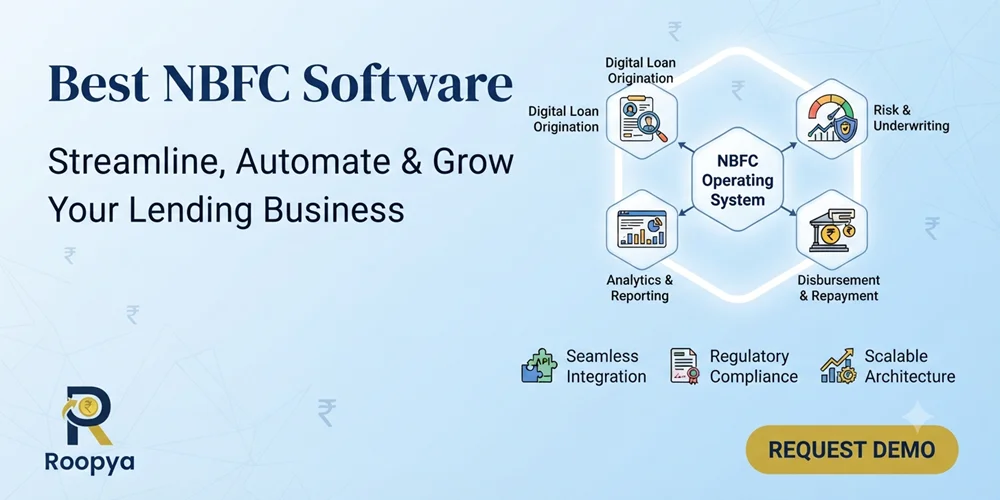
In practice, “NBFC software” is rarely a single application. It is a connected stack of systems, typically including:
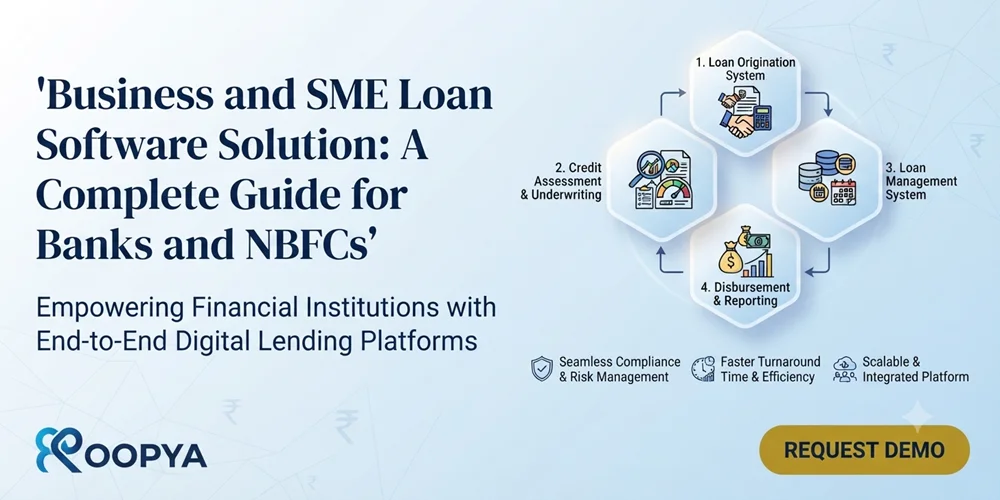
● A Loan Origination System (LOS) that manages applications, KYC, credit bureau pulls, underwriting, and approvals
● A Loan Management System (LMS) that services the loan after disbursal — EMI schedules, repayments, ledger management, and statements
● A Collections module for reminders, delinquency management, and recovery workflows
● Lending analytics and risk tools for portfolio monitoring, credit scorecards, and provisioning
● Compliance and reporting tools tied to regulatory formats and audit trails
When these pieces are stitched together as separate, poorly-integrated tools, NBFCs end up with data silos, duplicate customer records, and slow reconciliation. The “best” NBFC software is the one that unifies these functions on a single data model, so a loan's status, risk profile, and collection history are always visible in one place.
Why NBFCs Can't Run on Generic Software Anymore
A decade ago, many small and mid-sized NBFCs ran on a mix of Excel, email, and a basic accounting package. That approach breaks down quickly for a few reasons.
● Volume and speed of underwriting. Digital-first NBFCs today process thousands of applications a month, often with borrowers expecting a decision within minutes. Manual underwriting cannot match that pace without sacrificing either speed or credit quality.
● Regulatory scrutiny. NBFCs operate under a detailed regulatory framework covering fair practices, KYC/AML norms, asset classification, provisioning, and periodic reporting. Manual record-keeping makes it difficult to produce clean audit trails on demand, and errors in classification or disclosure carry real compliance risk.
● Multi-product complexity. Many NBFCs no longer run a single loan product. A single lender might originate personal loans, gold loans, business loans, and BNPL-style small-ticket credit simultaneously — each with different underwriting logic, tenure structures, and collection strategies. Generic software cannot flex across all of these without heavy custom development.
● Borrower expectations. Borrowers now compare their loan experience to consumer apps, not to how lending “used to work.” A clunky, paper-heavy application process is a direct driver of drop-off and lost business.
● Partnerships and embedded finance. A growing share of NBFC volume now comes through co-lending arrangements, Loan Service Provider (LSP) partnerships, and embedded finance integrations with fintech platforms, marketplaces, and retailers. This requires software with open APIs, not closed, monolithic systems.
Put together, these pressures mean that the choice of lending software is no longer an IT decision — it is a core business strategy decision that determines how fast an NBFC can grow, how well it manages risk, and how cheaply it can operate.
The Core Modules of the Best NBFC Software
1. Loan Origination System (LOS)
The LOS is the front door of the lending business. It should support:
● Digital application forms that can be configured per loan product without engineering effort
● Integrated KYC and identity verification (Aadhaar, PAN, video KYC, and other e-KYC rails)
● Automated pulls from credit bureaus and alternative data sources
● A configurable Business Rule Engine (BRE) for underwriting policy, so credit and risk teams can adjust approval logic without waiting on a development sprint
● Real-time, automated decisioning for straightforward applications, with clear escalation paths for cases needing manual review
● Document collection and verification, ideally with AI-based OCR to reduce manual data entry and catch document fraud
A strong LOS shortens time-to-disbursal, which is often the single biggest driver of both customer satisfaction and cost-to-serve.
2. Loan Management System (LMS)
Once a loan is disbursed, the LMS takes over. This is the system of record for the life of the loan:
● Accurate amortization schedules across multiple interest and repayment structures (reducing balance, flat rate, bullet repayment, step-up EMIs, and so on)
● Automated payment processing across UPI, NACH, direct debit, and other rails
● A live customer ledger reflecting principal, interest, fees, penal charges, and prepayments
● Self-service customer portals so borrowers can view balances, download statements, and make payments without calling support
● Handling for part-payments, foreclosures, restructuring, and top-up loans
Because the LMS holds the “single source of truth” for every active loan, its accuracy directly affects financial reporting, provisioning, and collections targeting.
3. Collections and Recovery
Collections is where lending profitability is often won or lost. The best NBFC software treats collections as a strategy engine, not just a reminders tool:
● Automated, multi-channel reminders (SMS, WhatsApp, IVR, email) sequenced by days-past-due
● Segmentation of the delinquent portfolio by risk, so early-bucket accounts get a light-touch nudge while chronic defaulters are escalated to field agents
● Configurable payment plans and settlement workflows
● Field agent allocation, tracking, and performance management
● Full audit trails of every collection interaction, which matters both for fair-practice compliance and for dispute resolution
4. Early Warning Systems (EWS)
Rather than waiting for an account to slip into default, a modern EWS uses behavioral and transactional signals to flag risk early — irregular repayment patterns, bureau score deterioration, or changes in bank statement behavior — so relationship or collections teams can intervene before an account becomes non-performing. This proactive layer is increasingly considered a must-have, not a nice-to-have, especially for unsecured and small-ticket portfolios where early intervention meaningfully changes recovery outcomes.
5. Lending Analytics and Credit Risk Tools
Portfolio-level visibility is what separates a data-driven NBFC from one that is flying blind. This layer typically includes:
● Portfolio analytics dashboards (disbursal trends, vintage analysis, product mix, geography-wise performance)
● Credit scorecard development and validation (application scorecards, behavioral scorecards)
● Expected Credit Loss (ECL), Probability of Default (PD), Loss Given Default (LGD), and Exposure at Default (EAD) calculations for provisioning under Ind AS 109
● Credit risk model validation and periodic stress testing
● Loan pricing analytics, so risk-based pricing can be automated rather than set manually per case
6. Compliance and Regulatory Reporting
Every module above ultimately feeds into compliance. The best NBFC software should generate audit-ready records automatically, support the asset classification and provisioning norms NBFCs are required to follow, and adapt quickly when regulatory formats change — without requiring a custom development cycle each time.
Must-Have Features Checklist
When evaluating NBFC software, it helps to separate “nice to have” from genuinely non-negotiable capabilities. Here is a practical checklist:
Speed to launch
● Can a new loan product be configured and go live in days, not months?
● Does the platform support onboarding without heavy IT involvement?
No-code configurability
● Can business and risk teams adjust underwriting rules, fees, and workflows themselves?
● Or does every change require a developer and a release cycle?
Integration depth
● Does the platform come with pre-built integrations to credit bureaus, payment gateways, KYC providers, and verification services?
● Is there an open, well-documented API for connecting to CRMs, accounting systems, and partner platforms?
Fraud and risk controls
● Is there AI-powered document verification and fraud detection built in, rather than bolted on?
● Can the system flag anomalies (duplicate applications, mismatched documents, suspicious device fingerprints) automatically?
Scalability and reliability
● Can the system handle sudden spikes in application volume, for example during a marketing campaign or festive-season lending push?
● What uptime and performance guarantees does the vendor offer?
Product flexibility
● Does the software support multiple loan products (personal, business, gold, auto, home, payday/small-ticket) on the same platform?
● Can each product have its own underwriting logic, tenure, and collection strategy?
Compliance-readiness
● Does the platform maintain complete, exportable audit trails?
● Is asset classification and provisioning automated in line with applicable accounting and regulatory norms?
Total cost of ownership
● Is pricing usage-based, or does it require large upfront licensing and infrastructure spend?
● What is included versus billed as an add-on (support, integrations, customization)?
Customer experience
● Is there a self-service portal or app for borrowers?
● How much of the journey — application, verification, disbursal, repayment — can happen without manual intervention?
Cloud, No-Code, and API-First: Why Architecture Matters as Much as Features
Two NBFC software platforms can have an identical feature list on paper and still deliver very different outcomes, because architecture determines how fast those features can actually be used and adapted.
● Cloud-native vs. on-premise. Cloud-native platforms remove the burden of managing servers and infrastructure, offer faster updates, and typically scale more gracefully with volume spikes. On-premise systems can offer more control but usually come with higher maintenance overhead and slower release cycles — a real constraint for a lender that needs to launch a new product this quarter, not next year.
● No-code vs. developer-dependent. A platform that requires engineering resources for every policy tweak, new fee structure, or workflow change will always lag behind the pace at which lending businesses actually need to move. No-code configurability — where credit, risk, and product teams can make changes directly through a visual interface — compresses go-live timelines from months to days and reduces dependency on scarce technical talent.
● API-first vs. closed systems. As co-lending, embedded finance, and LSP partnerships become a larger share of NBFC business, the ability to plug into partner ecosystems matters as much as the core lending functionality. A platform with a comprehensive library of pre-integrated APIs — credit bureaus, verification services, payment gateways, alternative data providers — saves months of integration work compared to a closed system that treats every connection as a custom project.
● Pay-as-you-use pricing. Traditional lending software has historically demanded large upfront licensing fees and long implementation contracts. Usage-based pricing models let NBFCs — particularly newer or mid-sized ones — align technology spend with actual loan volume, which is a materially different risk profile than a fixed six- or seven-figure upfront commitment.
Data Security and Borrower Trust
Lending platforms hold some of the most sensitive data a business can process — identity documents, income statements, bank statement data, and credit history. The best NBFC software treats security as a foundational design principle, not an add-on:
● Encryption in transit and at rest for all customer and financial data
● Role-based access control, so employees only see the data relevant to their function — a collections agent should not have the same visibility as a credit underwriter
● Detailed activity logging, so every view, edit, or export of customer data can be traced back to a specific user and timestamp
● Secure, consent-based data sharing with credit bureaus, verification partners, and co-lenders, in line with data protection expectations
● Regular security audits and penetration testing, particularly important for cloud-native platforms serving multiple lenders
Beyond the technical controls, security has a direct commercial impact: a data breach or mishandled customer document can damage borrower trust far more permanently than a slow loan approval ever would. NBFCs should treat a vendor's security posture — certifications, audit history, incident response process — as a core part of due diligence, not a checkbox at the end of procurement.
Common Mistakes NBFCs Make When Choosing Lending Software
Even experienced lending teams fall into predictable traps during software selection. Watching for these can save months of rework later.
● Buying for today's product, not tomorrow's roadmap. A platform that fits a single personal-loan product perfectly can become a bottleneck the moment the business wants to add gold loans or a co-lending line. Always evaluate against the 18–24 month roadmap, not just the current catalog.
● Underestimating integration effort. A demo that looks polished can hide the fact that key integrations — a specific credit bureau, a regional payment rail, a particular KYC provider — are not actually live yet and will require custom development. Always ask for a working reference, not a slide.
● Treating “configurable” and “no-code” as the same thing. Many platforms are technically configurable but still require a developer or the vendor's professional services team to make even small changes. True no-code means a business user can make and test a change themselves, in hours, without opening a support ticket.
● Ignoring the collections and analytics layers until later. Origination and servicing tend to get the most attention during evaluation because they are the most visible, but weak collections tooling and thin analytics are often what actually erode margins once volume scales.
● Underpricing the cost of switching later. Lending data — loan histories, ledgers, customer documents — is expensive and risky to migrate. Choosing a platform based purely on the lowest initial quote, without factoring in how hard it would be to leave, can be a costly mistake two or three years in.
A Practical Framework for Evaluating NBFC Software
Choosing lending software is a multi-stakeholder decision — credit, operations, compliance, IT, and finance all have a stake in the outcome. A structured evaluation avoids the common trap of picking a vendor based on a slick demo alone.
● Step 1: Map your loan lifecycle. Document every stage a loan goes through today, from lead capture to closure, and note where manual work, delays, or errors currently happen. This becomes your requirements list.
● Step 2: Define your product roadmap, not just today's products. If gold loans are on the roadmap for next year, evaluate whether the platform can support that without a re-platforming exercise.
● Step 3: Stress-test the no-code claims. Ask vendors to demonstrate, live, how a business user (not a developer) would change an underwriting rule or launch a new fee structure.
● Step 4: Check integration coverage against your actual partner list. Confirm the specific credit bureaus, payment rails, and verification providers you use today are already integrated, not “supportable.”
● Step 5: Review compliance and audit capabilities in detail. Ask to see sample audit trail exports and provisioning reports, not just a feature list slide.
● Step 6: Understand the real cost structure. Get clarity on what is included in the base price versus billed separately — implementation, integrations, support tiers, and per-transaction costs.
● Step 7: Validate go-live timelines with reference customers. A vendor's stated onboarding timeline and a reference customer's actual experience are not always the same thing — ask directly.
Build vs. Buy: Why Most NBFCs Choose Not to Build In-House
Some larger NBFCs consider building lending technology in-house, reasoning that full control is worth the investment. In practice, this path carries costs that are easy to underestimate:
● Engineering opportunity cost. Every sprint spent building and maintaining origination or servicing infrastructure is a sprint not spent on product or customer-facing innovation.
● Ongoing regulatory maintenance. Compliance requirements evolve, and an in-house team must track and implement every change independently, rather than benefiting from a vendor's shared investment across many customers.
● Integration debt. Each new credit bureau, payment rail, or verification provider becomes a bespoke project rather than a pre-built connector.
● Talent risk. Lending systems require a rare mix of domain and engineering expertise; losing a key engineer can stall critical maintenance for months.
For most NBFCs — particularly those below a certain scale — a specialized platform is faster to deploy, cheaper to maintain, and benefits from improvements made across the vendor's entire customer base. Building in-house typically only makes sense for the largest lenders with highly differentiated, proprietary underwriting models that a configurable platform genuinely cannot support.
Where Roopya Fits
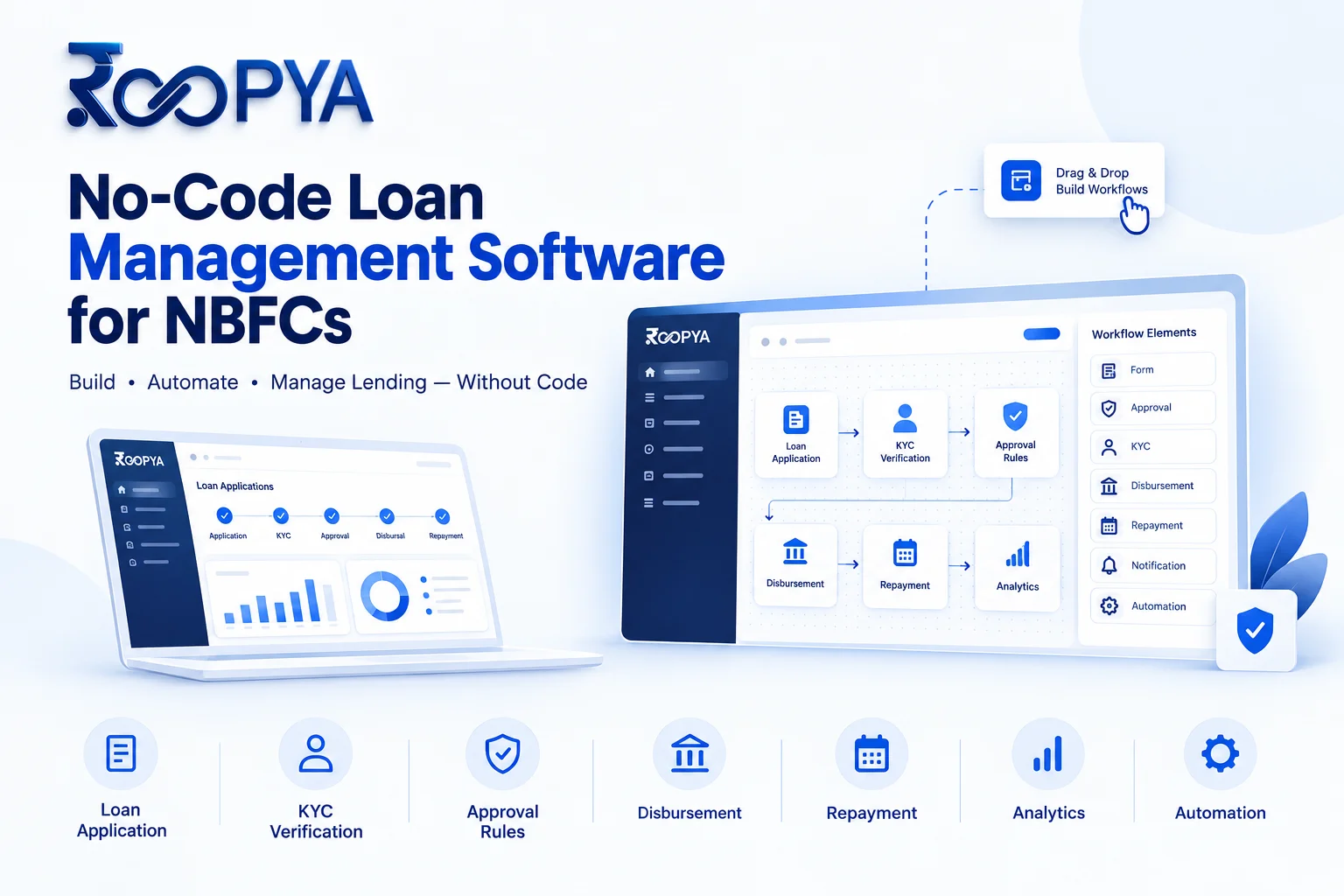
Roopya is built around the idea that NBFCs and other lenders should not have to choose between speed, control, and compliance. It brings the loan origination, loan management, collections, early warning, and lending analytics functions onto a single, no-code lending infrastructure — designed so that lenders can go live in as little as a day, configure loan products and credit policy without writing code, and scale usage-based rather than committing to large upfront costs.
The platform ships with a large library of pre-integrated APIs spanning credit bureaus, KYC and verification services, and payment gateways, along with a set of pre-configured loan products covering personal, business/SME, gold, auto, home, and small-ticket/payday lending. AI is woven through the stack rather than added as an afterthought — from document analysis and fraud detection during origination, to a self-learning business rule engine, to alternative-data-driven credit decisioning, to natural-language analytics and reporting on the back end.
For NBFCs evaluating their next lending technology stack, the practical question is not just “does this vendor have every module on the checklist,” but “how quickly can my team actually use them, and how well do they work together as one system.” That combination — comprehensive functionality on a genuinely unified, no-code, API-first platform — is what “best NBFC software” should mean in 2026.
Conclusion
The NBFC sector's next phase of growth will be won by lenders who can originate faster, underwrite smarter, service loans more efficiently, and collect more effectively — all while staying audit-ready. That requires more than a collection of point solutions; it requires a connected lending infrastructure purpose-built for how NBFCs actually operate. Whether you are a new-age digital lender launching your first product or an established NBFC modernizing a legacy stack, the right software decision today will shape how efficiently — and how compliantly — you can scale tomorrow.
Frequently Asked Questions
Q1. What is the difference between a Loan Origination System (LOS) and a Loan Management System (LMS)?
An LOS handles everything before disbursal — applications, KYC, credit checks, underwriting, and approval. An LMS takes over after disbursal, managing repayment schedules, ledgers, collections handoff, and the loan until it is closed. Most modern NBFC platforms, including Roopya, run both on a single connected system so data doesn't need to be re-entered or reconciled between them.
Q2. Is cloud-based NBFC software safe and compliant for regulated lenders?
Yes, when the platform is built with lending-grade security and compliance controls — encryption, role-based access, complete audit trails, and regulatory reporting formats. Cloud-native architecture also makes it easier for vendors to roll out compliance updates quickly across all customers, compared to on-premise systems that need to be patched individually.
Q3. How long does it typically take to implement NBFC software?
Timelines vary widely by platform. Traditional, heavily customized systems can take several months to go live. No-code, pre-integrated platforms are designed to compress this significantly — Roopya, for example, is built for go-live in around a day for standard configurations, with additional time needed for more complex, highly customized setups.
Q4. Can one platform support multiple loan products like personal loans, gold loans, and business loans?
Yes — this is one of the key differentiators of modern lending platforms. Rather than deploying separate systems per product, a unified platform lets each product have its own underwriting rules, tenure structures, and collection strategy while sharing the same customer, risk, and compliance data underneath.
Q5. What should a small or new-age NBFC prioritize when choosing software on a limited budget?
Prioritize usage-based pricing over large upfront licensing, no-code configurability so you're not dependent on scarce developer time, and pre-built integrations that avoid months of custom integration work. These three factors have an outsized effect on both initial cost and time-to-market for smaller lenders.
Q6. Does NBFC software help with regulatory compliance and audit readiness?
Purpose-built NBFC software should automate asset classification, maintain complete audit trails of every customer and collections interaction, and generate the reports regulators and auditors expect — reducing the manual compliance burden compared to spreadsheet-based or generic systems.
Q7. What is a Business Rule Engine (BRE) and why does it matter for NBFCs?
A BRE lets credit and risk teams define and adjust underwriting logic — eligibility criteria, scoring thresholds, approval conditions — through configuration rather than code. A no-code BRE means policy changes that used to take weeks of development can be made and tested in hours.