Sign up with Google
 Sign in with Zoho

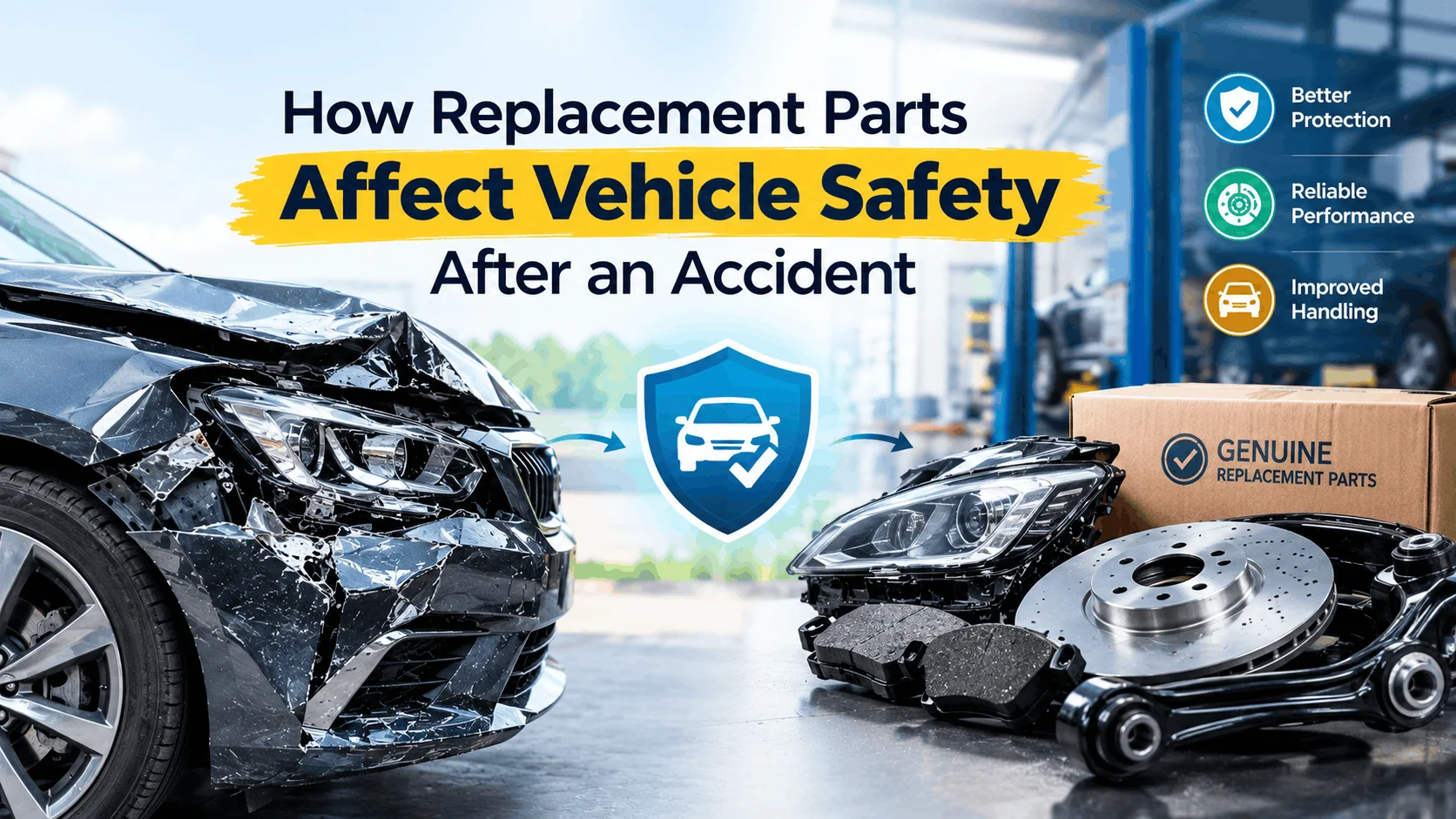
A bent fender looks like cosmetic damage. It rarely is.
Modern vehicles are engineered as integrated safety systems. Every panel, bracket, and sensor mount plays a role in how crash forces travel through the structure during a second collision. Swap in the wrong part, and that engineering gets quietly undone — often in ways invisible to the eye and to a casual test drive.
Shops and insurers talk about replacement parts as a cost line. Owners should think about them as a safety line instead.
OEM, Aftermarket, and Salvage: Not Interchangeable
Collision repair parts can be classified into four groups: original equipment manufacturer (OEM), OEM surplus, aftermarket, and recycled. Each group has its own risk level. OEM parts meet all original design and construction criteria established for the vehicle. Aftermarket parts retain the vehicle's original shape but rarely contain original metal designs, welds, or material thicknesses. Salvage parts carry unknown history.
None of these categories is automatically disqualifying. The problem is when a part gets installed without regard to what it’s replacing structurally.
Take bumper reinforcement bars. OEM versions are stamped from specific-gauge steel designed to absorb and redirect energy in a precise crumple sequence. Cheaper aftermarket bars sometimes use thinner steel or a different alloy entirely. They bolt on fine. They look right. But in a second collision, that bar may not collapse the way engineers intended — it may transfer more force into the cabin instead of away from it.
Airbags and Pretensioners: The Parts Nobody Sees
This is where corners get cut most dangerously, and where owners have the least visibility.
Salvage-yard airbag modules sometimes get reinstalled after a prior deployment or after sitting in a yanked-out donor vehicle for months. Seatbelt pretensioners work the same way — they’re single-use pyrotechnic devices. Once triggered, they’re done, full stop.
A few specific failure modes show up repeatedly in post-accident inspections:
- Airbag modules sourced from a vehicle where the module was never confirmed un-deployed, leading to failure during a real crash event
- Pretensioners that were quietly “reset” rather than replaced, which is not a legitimate repair procedure under any manufacturer guideline
- Mismatched airbag part numbers installed in vehicles where the sensor calibration expects a different deployment force curve
- Clock spring or wiring harness reuse after a steering column impact, causing delayed or failed airbag deployment
Technicians who know restraint systems don’t just start working. They check the VIN- part numbers against the vehicle’s build sheet first. They don’t touch a bolt until they’ve done that. Skipping that step is how a car can pass an inspection and still fail at the one moment it really matters. That one moment when the restraint system must work. That one moment when lives are, on the line.
ADAS Calibration Depends on Exact Part Geometry
Cameras and radar units that are placed behind grilles, bumpers and windshields are set up to match an exact geometric reference point. If you move that mounting spot, by a few millimeters the system’s idea of what means "straight ahead" will change because Cameras rely on that precise position.
Imitation hood and fender panels sometimes use mounting points that are close to OEM spec but not identical. Close doesn’t cut it here. A radar bracket off by three millimeters can throw automatic emergency braking timing off by a car length at highway speed.
This is a newer problem than most owners realize. Ten years ago, a slightly misaligned fender was an aesthetic complaint. Today it can be a functional safety failure in a vehicle’s collision-avoidance system.
Shops serious about this work recalibrate ADAS after any part replacement that touches a sensor mount — not just when a dashboard warning light says to. Spectrum, among other established collision repair operations, documents calibration as a standard step rather than an upsell, which reflects where the broader industry is heading as more vehicles ship with advanced driver assistance as standard equipment.
What Owners Can Actually Check
Most drivers aren’t going to evaluate steel gauge thickness themselves. But a few questions separate a careful repair from a rushed one.
Ask for the parts invoice before work begins. It should specify OEM, aftermarket, or recycled for every major component — not just “bumper” or “fender” with no origin noted.
Ask whether airbags and pretensioners are being replaced with new, VIN-matched components. Any hesitation here is a red flag.
Ask if post-repair ADAS calibration is included and documented, not verbally promised.
A collision repair shop in West Nyack that tracks part sourcing against OEM repair procedures will catch this before the vehicle leaves the bay. That kind of documentation discipline costs the shop almost nothing. It costs the owner everything if it’s skipped.
Owners who want the best collision center for their repair should ask to see the parts invoice before authorizing work. If a shop resists that request, that’s information too.
Insurance Pressure and the Parts Decision
Insurers frequently specify aftermarket or recycled parts to control claim costs, and in many states they’re legally permitted to do so. Owners usually have the right to request OEM parts, sometimes at their own expense for the difference.
This isn’t an argument that aftermarket parts are always wrong. Non-structural trim, interior components, and some bolt-on accessories carry little safety consequence either way. The distinction that matters is structural versus cosmetic, and safety-system versus everything else.
Ask any collision repair shop in West Nyack what separates a cosmetic fix from a structurally sound one, and the answer usually comes down to parts documentation. Shops that can show their work tend to be the ones that did it right the first time.
Where Spectrum Fits Into This Conversation
Spectrum has built its reputation in the collision repair space around the kind of documentation-first approach described above — matching parts to OEM repair procedures, replacing rather than reconditioning safety-critical components, and treating ADAS calibration as a required step rather than an optional add-on. For owners navigating a post-accident repair decision, that operational discipline is a useful benchmark for what to look for and expect, regardless of which shop ultimately does the work.
FAQs
- Does my insurance company have the final say on which parts are used in my repair?
No. Insurers can specify a preferred parts type in their estimate, but most states give vehicle owners the right to request OEM parts, sometimes with an out-of-pocket cost difference. Check your state’s regulations and your policy language directly.
- How can I tell if an airbag was reused instead of replaced?
Request the parts invoice and ask specifically whether airbag modules and pretensioners are new and VIN-matched. A legitimate shop will have no issue providing this documentation before the repair begins.
- Is ADAS calibration always necessary after a collision repair?
Any time a repair touches a bumper, fender, windshield, or mirror housing where a camera or radar sensor is mounted, calibration should be performed and documented — not just triggered by a dashboard warning light.
- Are aftermarket parts ever a safe choice?
Yes, particularly for non-structural components like trim pieces or certain interior parts. The key distinction is whether the part affects crash structure or a safety system, versus purely cosmetic function.