Sign up with Google
 Sign in with Zoho

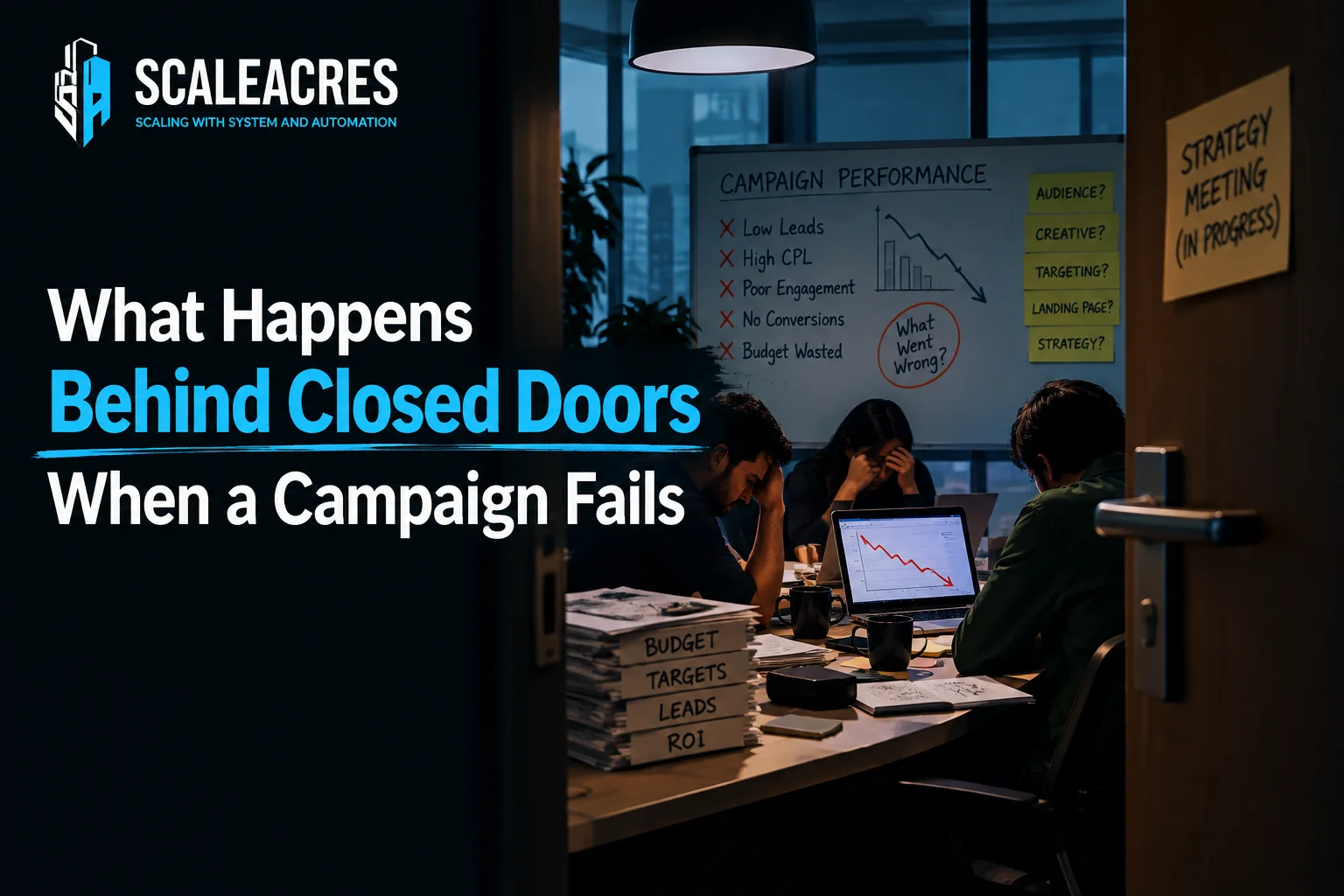
Clients see the outward version of a failing campaign — a disappointing report, a slower response, maybe an apologetic email explaining what went wrong. What actually happens internally, before any of that reaches the client, reveals a lot about whether an agency is genuinely capable of recovering or simply managing the optics of a bad month. Understanding what a serious real estate marketing company actually does behind the scenes during a failure is worth knowing, since it's the process most clients never get to see directly.
Quick answer: When a campaign fails internally, a genuinely capable marketing company typically runs a structured review — checking targeting, creative, competitive activity, and platform-level issues — before communicating anything to the client. Weaker operations often skip this step, either delaying the bad news while hoping performance improves on its own, or offering a vague explanation without having actually diagnosed the specific cause.
The First Internal Reaction
The moment a campaign's numbers clearly drop, the first internal response varies significantly between operations. In a well-run team, this triggers an immediate, structured investigation — pulling platform data, checking for recent changes, comparing performance against historical benchmarks for the same account. In a weaker operation, the first reaction is often simply hoping the numbers recover on their own before anyone has to explain what happened, which delays both the diagnosis and any actual fix.
What a Genuine Internal Investigation Actually Looks Like
A structured review typically works through several possible causes systematically rather than guessing. Targeting gets checked first — has the audience become too broad or too narrow, has competition in that audience segment increased, pushing costs up. Creative gets reviewed next — has the same ad been running long enough that the audience has simply stopped responding to it, a pattern known as ad fatigue that's extremely common but often overlooked. External factors get considered too — has a competing project launched nearby with aggressive pricing, has something changed in the broader market that would explain a genuine shift in buyer behavior rather than a campaign-specific problem.
Why This Investigation Rarely Happens Quickly Enough
Even at well-intentioned agencies, this process often takes longer than it should, for a specific reason — admitting a genuine performance drop internally means eventually having an uncomfortable conversation with the client, and there's a natural human tendency to delay that conversation until absolutely necessary. This delay isn't usually deliberate dishonesty; it's simply avoidance, hoping the numbers self-correct before the investigation and disclosure become unavoidable. The cost of this delay, though, is real — every week spent hoping instead of investigating is a week where an actual fix could have been implemented instead.
What Separates Strong Operations From Weak Ones Here
The difference isn't whether a campaign occasionally fails — that happens to every agency eventually, regardless of skill. The difference is in the internal process once it does. Strong operations have a defined internal escalation process — a specific point at which underperformance gets flagged to senior staff, a specific timeline for completing a diagnostic review, a habit of documenting what was tried and what the actual cause turned out to be. Weaker operations often lack this structure entirely, meaning each failure gets handled ad hoc, without a consistent internal process to ensure it gets caught and addressed promptly.
What Happens Once the Cause Is Identified
Once an internal review identifies a likely cause, the response typically involves testing a specific fix — new creative variations if fatigue was the issue, adjusted targeting if audience saturation was the problem, a messaging shift if a competing project's positioning had shifted buyer preference. This testing phase itself takes time, since a fix needs enough data to confirm it's actually working before being rolled out fully, which is part of why recovery from a genuine underperformance period rarely happens instantly, even once the correct cause has been identified.
How This Internal Process Should Translate to Client Communication
A genuinely transparent agency shares a version of this internal process directly with the client, rather than just delivering a polished summary once everything is already fixed. This means communicating during the investigation, not just after it concludes — letting a client know a specific issue is being actively diagnosed, roughly when an update is expected, rather than going quiet until there's good news to share. This kind of ongoing communication during a difficult period is often what actually determines whether a client stays through a rough patch or starts looking elsewhere.
What Clients Can Ask to Get Visibility Into This Process
A few direct questions help a client understand whether their own marketing partner runs a genuine internal process during underperformance:
- "When results drop, what's your internal process for investigating why?" — a specific, structured answer suggests real process; a vague one suggests ad hoc handling
- "How quickly do you typically identify a cause once something isn't working?" — this reveals whether there's a defined timeline or just an open-ended hope that things improve
- "Can you walk me through a recent example of diagnosing and fixing an underperforming campaign?" — a specific, detailed answer with a clear before-and-after is far more reassuring than a general assurance that "we handle it"
FAQs
Is it normal for a real estate campaign to underperform at some point? Yes, this happens across nearly every campaign at some stage, due to factors ranging from market shifts to ad platform changes to creative fatigue. The key differentiator is how quickly and systematically the cause gets identified and addressed.
How long should a genuine diagnostic process typically take? This varies by cause, but a structured investigation should generally identify a likely cause within one to two weeks of a clear performance drop, with a specific fix being tested shortly after rather than an extended, undefined period of uncertainty.
Should clients expect to be informed during the investigation, or only once it's resolved? Ideally during, not just after. Being informed that a specific issue is actively being investigated, even before a fix is confirmed, tends to build far more trust than silence followed by either a fix or a vague explanation once results have already stayed poor for an extended period.
Does a campaign failure always indicate the agency did something wrong? Not necessarily — external factors like competitor activity or platform algorithm changes can genuinely cause underperformance independent of anything the agency did. What matters more is how quickly and honestly that distinction gets identified and communicated.
Conclusion
What happens behind closed doors during a campaign failure often matters more than the failure itself, since some degree of underperformance is nearly inevitable across a long enough campaign. A real estate marketing company with a genuine internal process — structured investigation, honest ongoing communication, a real fix rather than just an explanation — tends to recover client trust even through a difficult stretch. One without that process often loses the client not because of the initial failure, but because of how invisible and undiagnosed that failure was allowed to remain.