Sign up with Google
 Sign in with Zoho

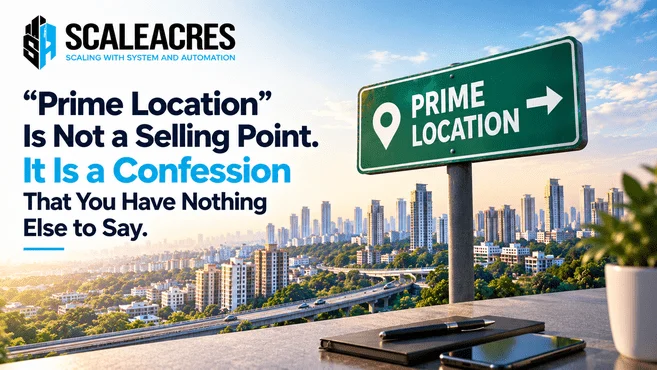
Open any real estate ad in Delhi NCR and the phrase is almost guaranteed to appear: “prime location.” It is on hoardings, brochures, landing pages and WhatsApp forwards. And because everyone uses it, it has stopped meaning anything. A buyer reading it learns nothing about where the project is, why it works for their life, or what makes it different from the next ad. The good news is that this is easy to fix, and fixing it is one of the most practical things that digital marketing services for real estate in Delhi can do for a developer’s ads, landing pages and sales conversations.
Quick answer: “Prime location” fails because it is a claim without proof. Buyers can’t verify it, can’t picture it, and have seen it on every other project. Replace it with specifics a buyer can check: real travel times, nearby schools and hospitals, road and metro access, the neighbourhood’s character and the problems the location solves. This is an argument based on common buyer behaviour, so test it against your own ad and enquiry data.
Why the phrase stopped working
“Prime” is a word the seller chooses, not the buyer. It describes how the developer feels about the location, not what the buyer will experience living there. Three things make it weak:
- It is unverifiable. There is no way to check what “prime” means.
- It is universal. When every project claims it, the phrase carries no information.
- It is lazy. It signals that the team did not look closely enough at the location to say something real.
Buyers are not fooled by this. Most of them open a map the moment they see an ad. If the map does not support the claim, trust falls. If the ad says nothing specific, they have no reason to stay.
What buyers are actually asking
When a buyer reads “prime location,” the questions in their mind are specific:
- How long will it take me to reach my workplace in the morning, not on a map but at 9 AM?
- How far are good schools and hospitals?
- Is the road to this project safe, lit and easy to find?
- What is the neighbourhood like in the evening and on weekends?
- Will this area be better or worse in five years?
- Is everyday life easy, with markets, parks and transport close by?
A location is only “prime” if it answers these well for a particular buyer. And the answer will differ between a young professional, a family with school-going children and an investor.
“Prime” means different things to different buyers
One phrase cannot serve all five. Specifics can.
From claim to proof: how to rewrite it
The test is simple: replace any sentence that a buyer cannot check with one they can.
The examples above show the format only. Fill in with real names, distances and sources for your own project, and check every figure on a live map before you publish.
How to build a location story that buyers believe
1. Start with a real visit. Go to the site at different times of day. Note traffic, noise, light, the road condition, nearby shops and how long common trips actually take.
2. List what the location offers, then what it lacks. Honest developers earn trust by naming a downside and explaining how buyers deal with it, such as “busy at peak hours, alternate route available.”
3. Match features to buyer types. Create separate versions of the story for families, professionals and investors, and show each group what matters to them.
4. Show it, don’t just say it. Use a simple map with distances, a short drone or street-level video, and photos taken at the actual site, not stock images.
5. Link claims to sources. For planned roads, metro lines or public projects, point to official information and say clearly whether they are planned, under construction or complete.
6. Keep it consistent. The same details should appear on the ad, landing page, brochure and in what the sales team says.
Where to use it
- Ad headlines and descriptions: replace “prime location” with one specific, relevant detail for the audience you are targeting.
- Landing page: add a clear “Location and connectivity” section high up, with a map, honest travel times and nearby essentials.
- First WhatsApp message: include the location pin and a one-line summary of the most relevant advantage.
- Sales conversations: train the team to answer location questions with specifics, not slogans.
- Video and social content: show the route, the neighbourhood and the daily routine, not just the building.
- Google Business Profile and local pages: use accurate, locality-specific information, which also helps local search.
Common mistakes
- Using “prime”, “premium” or “strategic” without any supporting detail
- Quoting best-case travel times that a map contradicts
- Calling planned infrastructure “ready” when it is not
- Using the same location text for every buyer type
- Ignoring downsides, so buyers discover them on the first visit
- Using stock photography instead of the real surroundings
- Copying competitors’ location language, which makes every project sound alike
How to check if it’s working
Test the change, don’t assume it:
- Run two ad versions: one with “prime location” and one with a specific, buyer-relevant detail, and compare click-through and enquiry quality
- Track how many enquiries mention the specific detail in their first conversation
- Watch how much time visitors spend on the location section of the landing page
- Ask the sales team which location questions come up most
- Compare lead-to-visit rate between the two versions
If specific wording wins, you have your answer, and your own data is more convincing than any general rule.
Frequently asked questions
Is “prime location” always a bad phrase? It is not wrong, only empty. If it is followed by specific, checkable details, it can work as a short introduction. On its own, it tells the buyer nothing.
What should I say instead of “prime location”? Name the specific advantage that matters to your target buyer, such as real travel times, nearby schools and hospitals, road or metro access, or the character of the neighbourhood.
How can I describe a location that has real downsides? Be honest and specific. A short note such as “busy at peak hours, with an alternate route available” builds more trust than silence, and buyers will find out anyway.
Should I mention planned infrastructure like metro lines or new roads? Yes, but describe it accurately as planned, under construction or complete, and link to an official source. Avoid completion dates you cannot confirm.
Does this matter for Delhi NCR specifically? Yes. Buyers across Delhi NCR often compare projects in different micro-markets, and a vague location claim gives them nothing to compare.
The bottom line
“Prime location” feels like a strong opening line, but it is really a placeholder, a sign that the real story has not been written yet. The developers who stand out are the ones who describe the place the way a resident would: how it feels, how it works day to day and what it will offer in the years ahead. Specifics make a location believable, and believable is what buyers need before they call.
If you want help turning a project’s location and strengths into ads, pages and follow-up that buyers trust, you can explore ScaleAcres and its digital marketing services for real estate in Delhi, including lead generation, local SEO, WhatsApp and CRM automation, retargeting and creative support for developers and brokers.