Sign up with Google
 Sign in with Zoho

Ask five different vendors what a custom ERP costs, and you'll get five different numbers with almost no explanation behind them. That's frustrating when you're trying to actually budget for one.
Here's a more grounded look at what drives ERP costs in 2026, so you're not just guessing.
Why ERP Pricing Varies So Much
There's no fixed price tag because there's no fixed project. Costs shift based on:
- Number of departments and workflows involved (finance, inventory, HR, procurement, etc.)
- How much data needs to migrate from old systems
- Number of integrations with existing tools
- Whether you need mobile access, custom reporting, or multi-location support
- Ongoing support and maintenance after launch
Two businesses in the same industry can land on very different budgets depending on how tangled their existing processes already are.
What Actually Makes Up the Cost
A realistic breakdown usually includes:
Discovery and planning Requirements gathering, process mapping, and technical scoping. Skipping this stage is how projects blow past budget later.
Core development Building the actual modules — inventory, accounting, order management, whatever your business runs on.
Data migration Moving records from spreadsheets or legacy systems without losing accuracy. This step gets underestimated constantly.
Integrations Connecting the ERP to your CRM, e-commerce platform, or accounting software.
Testing and QA Catching issues before they hit your live operations, not after.
Post-launch support Bug fixes, updates, and training as your team adjusts to the new system.
Custom vs. Off-the-Shelf: The Real Cost Comparison
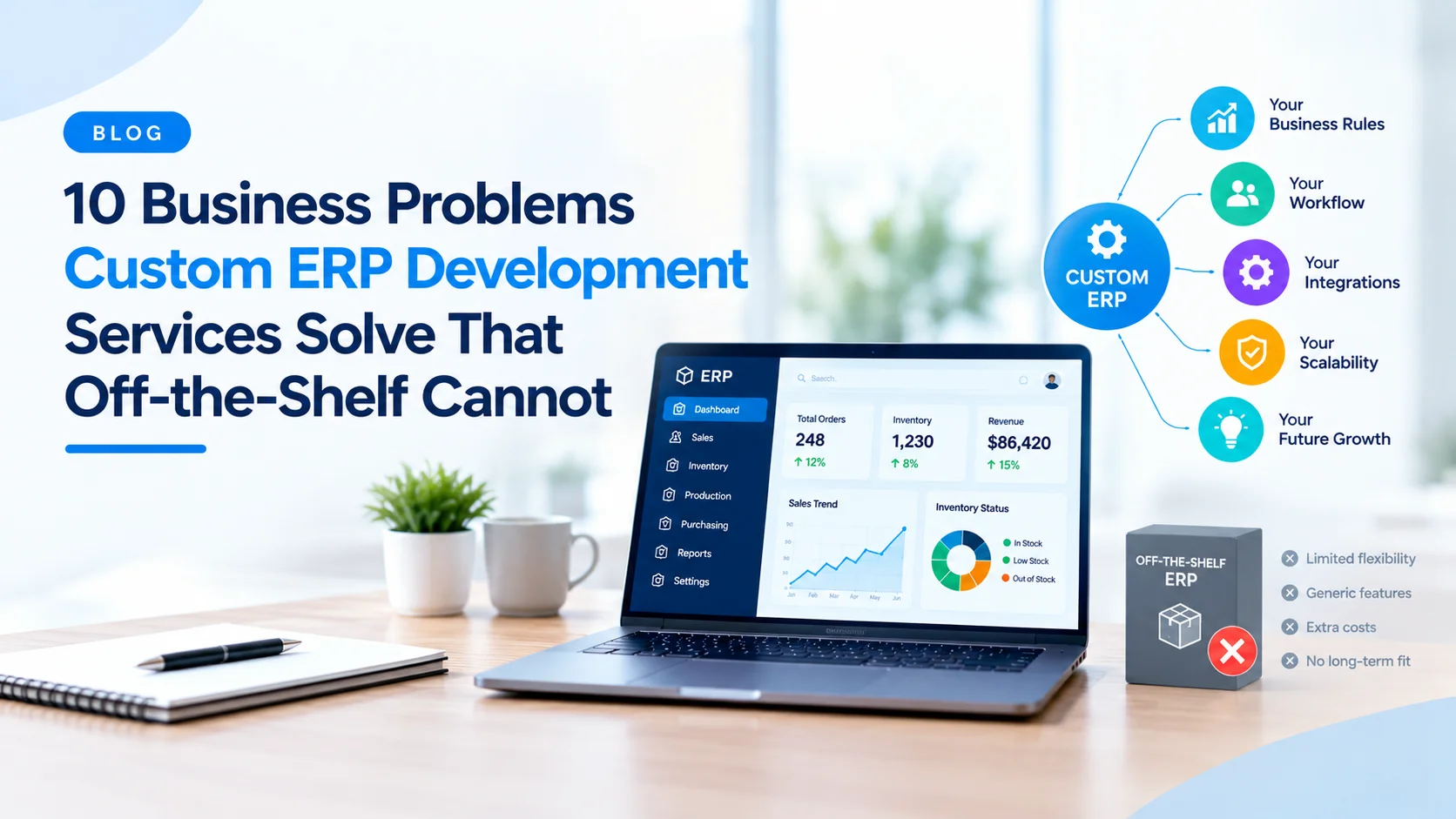
Off-the-shelf ERP software looks cheaper upfront. Licensing fees are often lower, and setup is faster.
But the hidden costs show up later:
- Monthly per-user fees that scale as you grow
- Paying extra for features you don't need, bundled into the package
- Workarounds for processes the software wasn't built to handle
- Limited flexibility if your business model shifts
A custom erp software build costs more initially but avoids paying indefinitely for a system that was never quite the right fit.
What Growing Businesses Should Budget For
If you're scaling, a few things tend to matter more than the sticker price:
- Phased rollout options — building core modules first, adding others later as budget allows
- Scalability — a system that grows with headcount and locations without a full rebuild
- Clear post-launch pricing — knowing what support costs after year one, not just at launch
Working with an established ERP development company usually means getting a phased cost breakdown upfront, instead of one lump number with no context.
Getting an Accurate Estimate
The only way to get a number that actually means something is to walk through your specific workflows with a team that builds these systems regularly. Generic online calculators can't account for how messy your current data setup actually is, or how many systems you're trying to connect.
Custom ERP development services providers worth trusting will ask detailed questions about your operations before quoting anything. If a vendor gives you a number in the first conversation, that's usually a guess, not an estimate.
Making the Investment Worth It
ERP costs are real, but so is the cost of staying on a system that doesn't fit your business anymore — manual workarounds, disconnected data, and hours lost to processes that should be automatic.
A properly scoped custom erp software project, built around your actual operations, tends to pay for itself faster than most businesses expect once those inefficiencies disappear.
If you're planning an ERP build for 2026, it's worth getting a detailed conversation going about your specific requirements before locking in a budget.
FAQs
Is custom ERP development worth it for a small or mid-sized business?
It depends on complexity. If your workflows are simple, off-the-shelf software might suffice. If you're juggling multiple departments with unique processes, custom development usually saves money long-term.
How long does custom ERP development typically take?
Timelines vary widely based on scope, but most mid-sized ERP builds take several months from planning through launch, including testing and data migration.
Can ERP costs be spread out over time?
Yes, many providers offer phased development, letting you build core modules first and add functionality later as budget allows.