Sign up with Google
 Sign in with Zoho

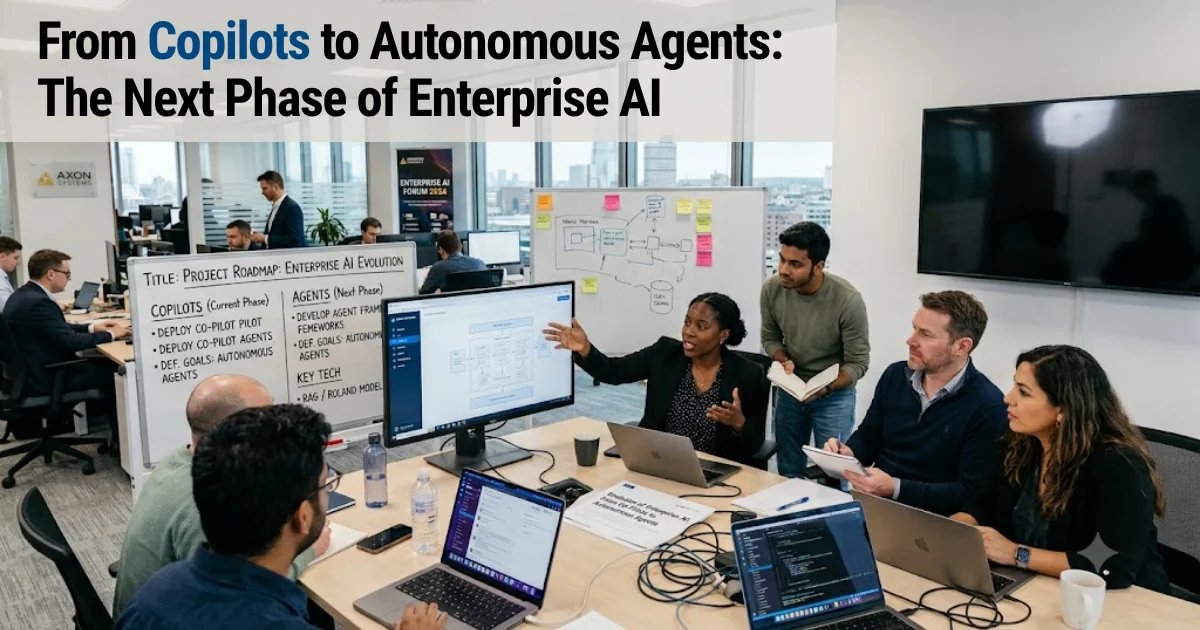
Copilots were the training wheels. For the past two years, most enterprise generative AI deployments have followed the same pattern: a human asks a question or requests a draft, the AI responds, and a person decides what happens next. That model worked well enough to prove the technology was useful, but it never removed much actual work from anyone's plate. It just made the work faster.
That's changing. According to Gartner, by 2028 at least 15% of day-to-day work decisions will be made autonomously through agentic AI, up from effectively 0% in 2024. Enterprises are moving from tools that assist a task to systems that complete a task end to end, with a human checking in only when something needs approval or goes wrong. For any AI agent development company building in this space right now, that shift changes almost everything about how systems get designed.
What Actually Separates a Copilot From an Agent
The distinction gets used loosely, so it's worth being precise about it.
A copilot responds to a prompt. It drafts an email, summarizes a document, or suggests code, and then it stops. The human takes that output and decides what to do with it. A copilot has no memory of its own goals and no ability to take the next step without being asked again.
An agent operates differently. Given a goal, it plans a sequence of steps, executes them using available tools, evaluates whether the outcome matches the goal, and adjusts if it doesn't. It can call APIs, query databases, trigger workflows in other systems, and loop back on its own output before a human ever sees it. The defining trait isn't intelligence. It's autonomy over a multi-step process.
Why Enterprises Are Making the Shift Now
Three things have converged to make this shift practical rather than theoretical.
Model reasoning has improved enough to plan reliably. Earlier generations of models were prone to losing track of a multi-step task or hallucinating intermediate steps. Newer models handle longer reasoning chains with far more consistency, which is the prerequisite for letting a system operate with less supervision.
Tool-calling infrastructure has matured. Frameworks like the Model Context Protocol have standardized how AI systems connect to external tools, databases, and APIs, removing a huge amount of custom integration work that used to make agentic systems fragile and expensive to build.
The cost of inaction has become visible. McKinsey's 2025 State of AI research found that while a large share of enterprises have experimented with generative AI, a much smaller share have redesigned actual workflows around it, and those that have report meaningfully larger cost and revenue impact than those still running AI as a bolt-on tool.
Where Autonomous Agents Are Actually Being Deployed
The most successful early deployments share a common pattern: they target processes that are repetitive, rule-governed, and high in volume, rather than open-ended creative work.
Customer support triage and resolution. Agents that read an incoming ticket, pull relevant account and order data, resolve the issue directly when it fits a known pattern, and escalate to a human only for genuine edge cases.
IT operations and incident response. Agents that monitor system alerts, diagnose likely root causes by querying logs and metrics, and either resolve routine issues automatically or assemble a clear summary for the on-call engineer.
Finance and procurement workflows. Agents that match invoices to purchase orders, flag discrepancies, and route exceptions for approval, cutting the manual reconciliation work that finance teams have historically absorbed by hand.
Sales operations. Agents that research a lead, enrich the CRM record with relevant firmographic data, and draft a personalized outreach sequence without a rep having to do the research themselves first.
What Enterprise-Grade Agent Development Actually Requires
Building an agent that works in a demo is straightforward. Building one that operates safely and reliably in production is a different undertaking entirely, and it's where most in-house attempts stall, and where working with an experienced AI agent development company usually pays for itself.
Guardrails Before Autonomy
An agent with access to real systems needs hard boundaries on what it can and cannot do without human approval. This means explicit permission scopes, action logging for every step the agent takes, and clearly defined escalation paths for anything outside its confidence threshold.
Observability Into Every Step
When an agent makes a decision, enterprises need to see exactly why. This requires structured logging of the agent's reasoning trace, not just its final output, so failures can be diagnosed and corrected rather than treated as a black box.
Evaluation That Reflects Real Conditions
An agent tested only on clean, curated scenarios will behave unpredictably the first time it hits messy real-world input. Production-grade agent development involves building evaluation sets from actual historical cases, including the edge cases and ambiguous situations that don't show up in a polished demo.
Fallback and Recovery Logic
Autonomous doesn't mean unsupervised. Well-built agent systems have clear fallback behavior for when a step fails, a tool call errors out, or the agent's confidence in its own plan drops below a safe threshold, ensuring the process degrades gracefully to human handoff rather than failing silently.
A Practical Example
A mid-size logistics company was spending significant staff hours each week manually matching delivery exceptions (damaged goods, delayed shipments, address errors) to the right resolution workflow across three different internal systems. As an AI agent development company, we built an agent that reads incoming exception reports, queries the relevant shipment and customer records across those systems, determines the appropriate resolution path based on company policy, and either executes it directly or routes it to a human with full context attached when the situation falls outside defined parameters.
The agent now handles a large majority of exception cases without human involvement, and the cases that do reach a person arrive with the research already done, cutting resolution time significantly compared to the fully manual process it replaced.
Measuring ROI on Agentic AI
The financial case for autonomous agents tends to show up in three places: reduced headcount pressure on repetitive operational roles, faster cycle times on processes that previously bottlenecked on manual review, and fewer errors from tasks that no longer depend on a person remembering every step of a complex procedure. Enterprises that track these metrics from the pilot stage, rather than estimating them after the fact, get a much clearer picture of whether an agent deployment is actually paying for itself.
Final Thoughts
Copilots proved that enterprises trust AI enough to use it daily. Autonomous agents are the next test: whether enterprises trust AI enough to let it act. The organizations moving fastest into this phase aren't the ones with the flashiest demos. They're the ones investing in the unglamorous infrastructure, guardrails, observability, and evaluation, that makes autonomy safe to deploy at scale, often with the right AI agent development company guiding that build. That's the real work of agentic AI right now, and it's where the next round of measurable enterprise value is going to come from.