Sign up with Google
 Sign in with Zoho

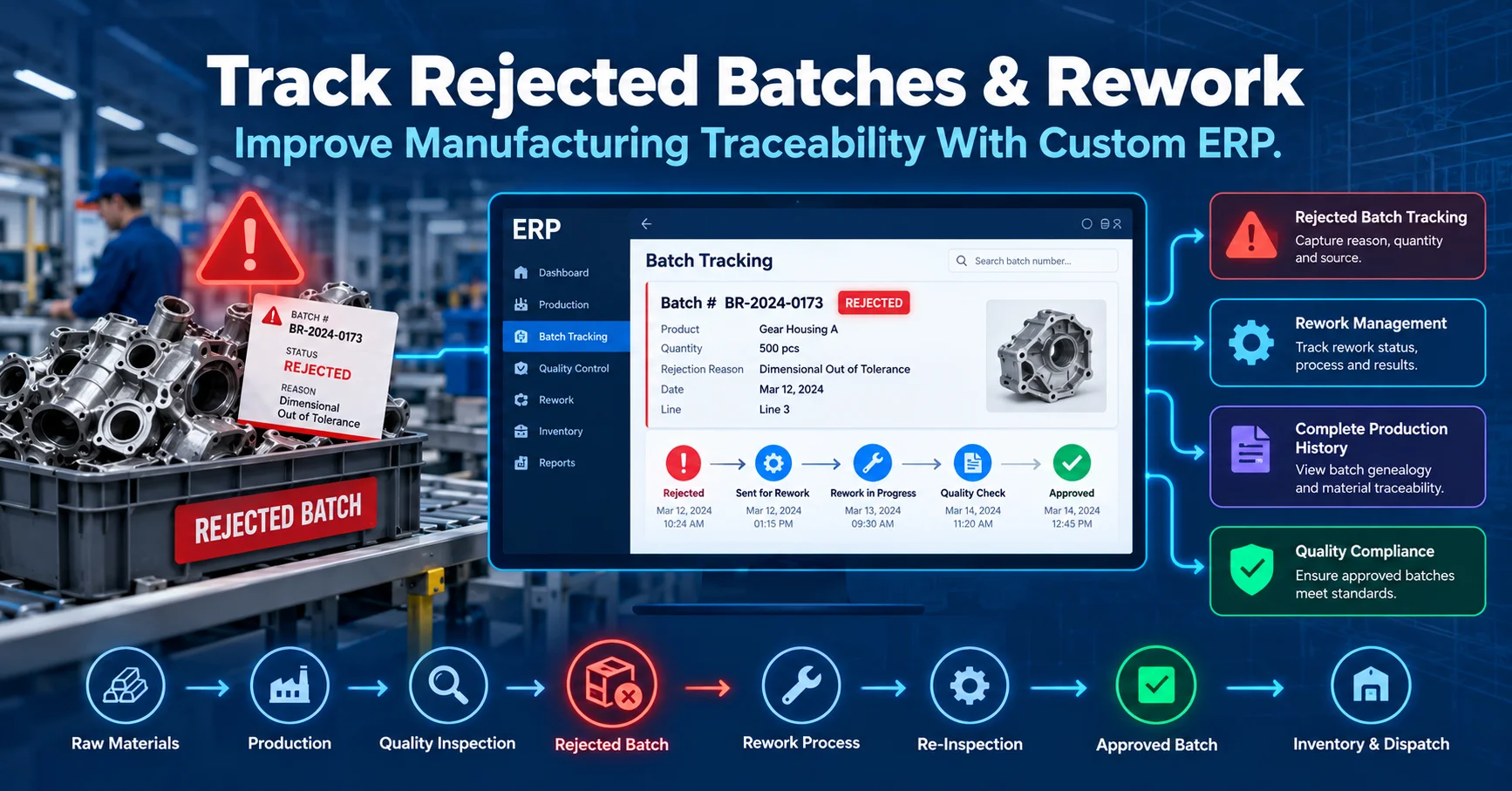
A rejected batch doesn’t just cost material. It costs time nobody logs anywhere.
Walk any mid-sized plant after a quality hold and you’ll see the same thing. A pallet with a red sticker on it. A supervisor flipping through a paper traveler. A QA manager trying to remember which shift ran that job three days ago. The batch gets isolated fast. The root cause almost never does. By the time someone actually traces it back — a specific raw material lot, a machine that was drifting out of tolerance — two or three more batches off that same line have probably already shipped.
That’s the real failure point. Not the rejection itself. What happens, or doesn’t happen, in the hours right after it.
Why Rejected Batches Expose Weak Traceability First
A nonconformance event is where traceability gaps show up first, because someone needs an answer immediately, not next week. Which supplier lot. Which machine. Which operator. Which earlier work order touched this material before it got here. If that chain isn’t sitting in a system already, somebody is reconstructing it from memory and whatever paper trail survived.
Here’s the thing most plants get wrong: they don’t actually lack data. They lack connected data.
Receiving logs live in one spreadsheet. Work order routing sits inside the MRP module. Quality holds get recorded in a separate tool — sometimes it’s just a shared drive full of inspection PDFs nobody indexes properly. None of these talk to each other automatically. So when a batch fails inspection, pulling its full genealogy means cross-referencing three or four sources by hand, and praying nobody fat-fingered a lot number back in March.
I’ve watched a quality manager burn four hours assembling a nonconformance report that should’ve taken four minutes. That’s not a training gap. It’s an architecture problem, plain and simple.
What Rework Actually Costs When It’s Untracked
Rework looks like a minor detour on the shop floor. On the books, it’s often invisible. That’s where the real damage hides.
A technician pulls a rejected part, fixes it at a side bench, sends it back into the line. No new work order. No labor hours logged against the job. Scrap percentage in the cost report doesn’t move an inch. The part ships, the customer never notices anything wrong, and finance has no idea that particular job actually ran 18% over its labor budget.
Do that enough times across a quarter and margin erosion turns into a mystery nobody can explain. Plant managers watch variable costs creep up with no obvious cause — because the rework never existed in any reportable system to begin with. It happened on the floor and nowhere else.
A few patterns show up again and again in plants that struggle with this. Minor dimensional fixes get handled informally at the bench, no record at all, when they should spin off a proper sub-operation tied to the original work order so labor and material land against the right job. Rework that actually needs re-inspection often slides back into the flow without QA sign-off — it should trigger a hold that doesn’t release until inspection closes it out. And the pattern that costs the most: the same part number getting reworked over and over, treated each time as its own isolated incident instead of what it actually is — a signal worth investigating.
That last one is the big one. One rework event is just a data point. Five rework events on the same part inside two months is a pattern. But the system only catches that if it’s built to recognize repetition instead of logging each occurrence as a fresh, disconnected transaction.
Why Off-the-Shelf Systems Struggle Here
Generic MRP tools, or ERP platforms built mainly around accounting logic, handle inventory counts and purchase orders fine. Nonconformance was never the thing they were designed around.
Most of these systems treat a quality rejection as a status flag — “rejected,” “on hold” — rather than a branching workflow with its own material consumption, labor allocation, and genealogy rules. Bolt-on QMS modules exist in plenty of setups, but they usually sit in a separate database, synced overnight if they’re synced at all. By the time that sync job runs, the batch is already three operations further down the line.
This is exactly where custom ERP software development earns its keep. A manufacturer dealing with layered rework paths — multi-stage inspection, supplier-linked nonconformance, audit trails a regulator will actually check — generally needs the nonconformance workflow built directly into the same transactional backbone as production and inventory. Not bolted on top after the fact.
I’ve seen engineering teams, including firms like Arobit that build custom manufacturing ERP systems, design nonconformance workflows where a rejected batch gets tagged to its exact material lot and machine ID the moment it’s flagged. Not reconstructed later from scattered logs. The rejection itself becomes the trigger — it opens a rework sub-order, reserves the correct inventory, and keeps the batch’s genealogy intact through every touch afterward. Nobody has to piece it back together, because it was never torn apart to begin with.
That’s the real line between systems that just record transactions and systems that actually enforce traceability — and it’s what separates generic tools from true ERP software for manufacturing.
Building a Traceability Chain That Survives an Audit
Audit-ready traceability isn’t about having the data somewhere. It’s about pulling it up in minutes instead of days.
A system worth trusting should let a quality manager query one part’s complete history — supplier lot, incoming inspection results, every work order it passed through, every rework event, machine IDs, operator IDs, final shipment — in a single lookup. Not three separate reports stapled together by hand.
Getting there isn’t complicated in theory, even if it’s tedious in practice. Lot-level genealogy needs to start right at receiving — every raw material lot gets a unique ID the second it enters inventory, before it ever touches a work order. Rejections need to trigger work-order branching automatically, so a failed inspection spawns a linked rework or scrap order that inherits the parent batch’s genealogy instead of starting fresh and disconnected. Every operation needs machine and operator binding — logging who touched the part and on which machine, not just which work center handled it in general. Reworked parts shouldn’t move forward without a closed-loop QA sign-off; no more waving something through because “it looked fine.” And the system itself ought to flag recurring nonconformance on its own — same part, same supplier, same machine — rather than waiting for someone to notice the pattern in a report three weeks late.
None of this needs exotic technology underneath it. It just needs production, inventory, and quality data living in the same model instead of three silos that happen to export to the same spreadsheet eventually.
The Real Payoff Isn’t Compliance — It’s Speed
Faster root-cause analysis changes behavior on the floor, not just paperwork. When a supervisor sees, within minutes, that one machine has thrown four rejects this week tied to the same tolerance drift, they stop the line before a fifth batch ships. Without that visibility, the pattern only becomes obvious after a customer complaint lands — which is the most expensive possible way to learn it.
Plants that get traceability right don’t necessarily reject fewer batches, at least not right away. They just stop losing the story behind each rejection.
Final Thought
Rejected batches and rework aren’t edge cases in manufacturing. They’re routine, every week, on every line. What actually separates plants is whether their systems treat each one as a disconnected incident or as a data point inside a continuous chain. Getting that right usually means rethinking how production, quality, and inventory data are structured together — not bolting another dashboard onto whatever’s already there.
When plant teams decide to rebuild that backbone instead of patching around it indefinitely, they often bring in specialist implementation partners — firms like Arobit among them — who’ve already done this specific kind of rework and traceability modeling elsewhere. The technology stack matters less than the discipline of building nonconformance handling into the core system from day one, not year three.
FAQs
- How much historical data do we need to migrate when implementing lot-level traceability?
At minimum, carry forward open work orders, active inventory lots, and anything currently under warranty or tied to an active customer program. Full migration of closed historical jobs almost never pays for itself. Most plants just start tracing forward from go-live and leave older records as archive-only — accessible, but not wired into live reporting.
- Can this traceability model work in a plant that still uses paper travelers on parts of the floor?
Yes, but it needs one clear handoff point. A lot of plants run hybrid setups during the transition — paper travelers for operator-facing instructions, barcode or RFID scans at the checkpoints that actually matter: receiving, rework initiation, final inspection. The goal is getting genealogy data into the system at those specific moments, even if the whole floor isn’t digitized yet.
- What’s the biggest implementation mistake plants make when adding rejection or rework workflows to their ERP?
Treating rework as a copy of the original work order instead of a linked sub-process underneath it. That breaks the connection to the original batch’s genealogy and makes trend analysis almost impossible six months later. The rework order should always reference its parent work order and pull material lot data automatically — never get keyed in manually from scratch.