Sign up with Google
 Sign in with Zoho

There's a specific moment I remember clearly. A man in his sixties sat across from me, holding a scan report that said "liver tumor, not a surgical candidate." His surgeon had already told him surgery wasn't possible the tumor was in a spot that made removing it too risky, and honestly, too much liver tissue would have needed to go with it.
He asked me one question. Just one. "So that's it? There's nothing else?"
There was something else. And by the time he left my clinic that day, he understood exactly what it was because I explained it the same way I'm about to explain it to you.
If you or someone you love has been told about a tumor, and the word "ablation" has come up somewhere in that conversation without anyone really explaining what it means, this is for you.
What Is Tumor Ablation, Really?
Let's strip away the medical language completely for a second.
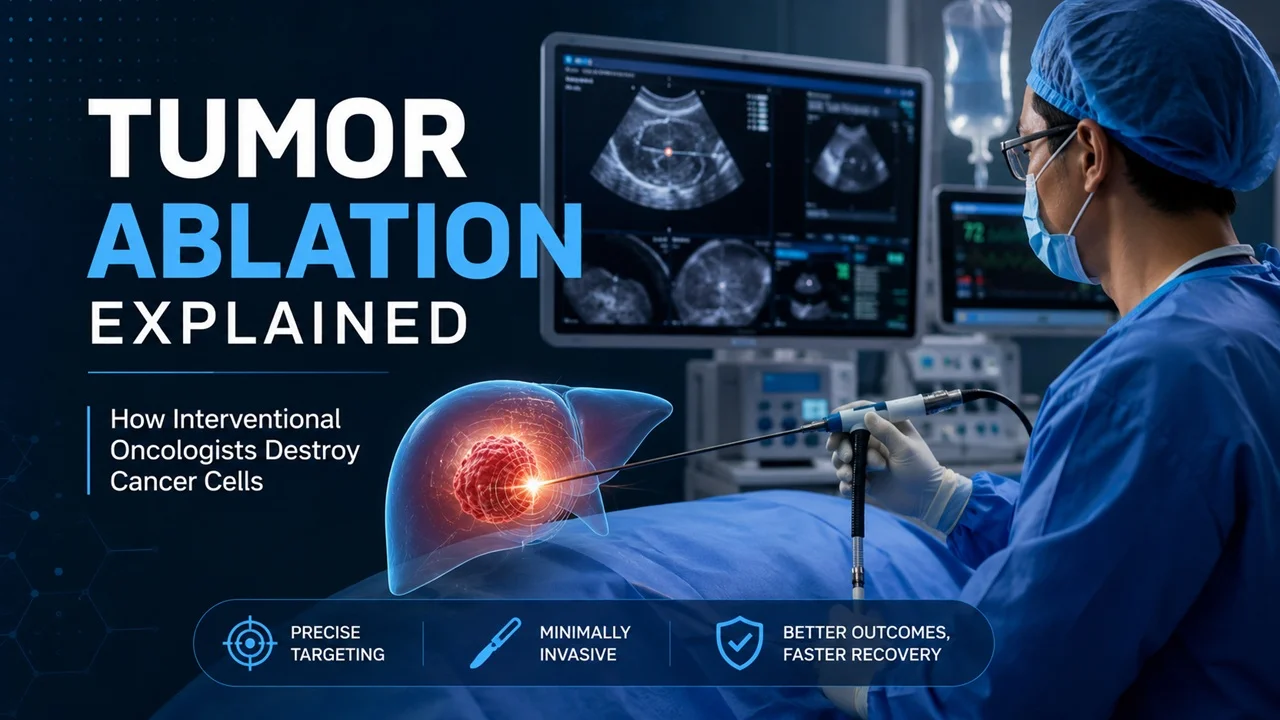
Tumor ablation means destroying a tumor without cutting it out of the body. Instead of a surgeon opening you up and physically removing the tumor, a thin needle-like probe is placed directly inside the tumor through the skin, guided by imaging and then either extreme heat or extreme cold is used to kill the tumor cells right where they are.
No large incision. No removing the entire organ around the tumor. Just the tumor itself, destroyed from the inside, while the rest of the healthy tissue around it is left mostly untouched.
I know that might sound almost too simple for something as serious as cancer. But this is genuinely how it works, and it's been refined over decades of real clinical use not something experimental or unproven.
How Does Tumor Ablation Actually Work?
Here's where I want to walk you through this slowly, because understanding this part is what makes everything else make sense.
Before any treatment happens, imaging usually a CT scan or ultrasound is used to find the tumor's exact location, its size, and importantly, what's around it. This matters because we need to know if there are major blood vessels, bile ducts, or other sensitive structures nearby that need to be avoided.
Once that map is clear, a thin probe is inserted through the skin, guided in real time by the same imaging, directly into the center of the tumor. This part isn't guesswork the doctor is watching the exact position of that probe on a screen the entire time, adjusting as needed until it's precisely placed.
Then comes the actual "destruction" part, and this is where the type of ablation makes a difference.
The Three Main Types of Ablation, Explained Simply
1. Radiofrequency Ablation
This uses heat generated by radio waves, delivered through the probe, to essentially cook the tumor tissue at high temperature until the cancer cells die. Think of it like a very targeted, very controlled burn, aimed at nothing except the tumor itself.
2. Microwave Ablation
This works on a similar idea using heat to destroy tumor cells but the energy source is microwaves instead of radio waves. In practical terms, this often means the heat builds up faster and can treat slightly larger tumors more efficiently in a single session, though the right choice always depends on the specific case.
3. Cryoablation
This one flips the approach entirely. Instead of heat, an extremely cold gas is delivered through the probe, freezing the tumor tissue until the cells are destroyed by the cold rather than burned by heat. Some patients and doctors prefer this option for tumors in certain locations, particularly where freezing causes less discomfort than heating.
None of these three is universally "the best." Which one gets used depends on the tumor's size, its exact location, and what the treating doctor believes will work most effectively and safely for that specific patient.
Why Would Someone Choose Ablation Instead of Surgery?
This is probably the question on your mind right now, so let's address it directly.
Surgery, for a lot of tumors, is still an excellent option I want to be upfront about that. Ablation isn't meant to replace surgery across the board. But there are specific situations where ablation genuinely makes more sense:
- The tumor is in a location that makes surgical removal too risky
- The patient's overall health makes a major operation dangerous
- Too much healthy tissue would need to be removed alongside the tumor during surgery
- The tumor has come back after previous treatment, and another surgery isn't a good option
- The patient simply isn't a candidate for general anesthesia or a long operation
In many of these cases, the honest reality is what that man in my clinic was told "not a surgical candidate." But "not a surgical candidate" doesn't have to mean "no treatment option." It often means a different kind of treatment is the better fit.
Tumor Ablation vs Surgery The Real Differences
I think this comparison is genuinely the clearest way to understand this, so let me lay it out plainly.
Surgery typically means a large incision, general anesthesia, a hospital stay of several days, and weeks of recovery afterward. It also usually means removing not just the tumor but some surrounding healthy tissue as a safety margin sometimes a significant portion of the organ.
Ablation typically means a single small needle entry point, local anesthesia with light sedation in many cases, going home the same day or the next morning, and a recovery period measured in days rather than weeks. The tumor is destroyed, but the surrounding healthy organ tissue is largely preserved.
The trade-off is this ablation works best for tumors of a certain size and in accessible locations. Very large tumors, or ones in particularly tricky positions, may still need surgery or a combination of treatments. This is exactly why a proper evaluation, not a general assumption, needs to guide the decision.
What Does an Interventional Oncologist Actually Do?
I want to clear up some confusion here, because I know these titles can blur together.
An interventional oncologist is a doctor trained specifically to treat cancer using image-guided techniques ablation being one of several tools, alongside things like delivering targeted treatment directly into a tumor's blood supply. This is different from a medical oncologist, who typically manages chemotherapy and overall cancer treatment planning, and different again from a surgical oncologist, who removes tumors through operation.
Interventional oncology exists specifically for situations where a targeted, image-guided approach offers real advantages over both surgery and standard systemic treatment either as the primary treatment, or alongside chemotherapy and other therapies as part of a bigger treatment plan.
Which Tumors Can Actually Be Treated With Ablation?
Liver tumor ablation is one of the most established and widely used applications both for tumors that started in the liver and for cancer that has spread there from elsewhere in the body. Beyond the liver, ablation is also used for certain tumors in the kidney, lung, and bone, depending on size and location.
I want to be careful here not to oversell this. Not every tumor, in every location, at every stage, is a good candidate for ablation. This is a genuine, evidence-based treatment option for specific situations not a universal replacement for every other type of cancer treatment.
What Actually Happens on the Day of Treatment?
If you're facing this procedure yourself, or supporting someone who is, here's realistically what the day looks like.
You'll typically be given light sedation, or in some cases local anesthesia alone you're not usually put under full general anesthesia the way you would be for major surgery. Imaging guides the probe directly into the tumor, and the ablation itself the actual heating or freezing often takes somewhere between 10 to 30 minutes, though this varies depending on tumor size.
Afterward, you're monitored for a few hours, and most patients go home the same day or stay just one night for observation. Mild discomfort at the entry site and some fatigue are common in the days following, but nothing close to the recovery experience of major surgery.
Is This the Right Option for You or Your Loved One?
I can't answer that in an article and honestly, no doctor should try to, without actually looking at your specific scans and health history first. What I can tell you is this: if you've been told surgery isn't an option, that conversation shouldn't end there. Ask specifically whether tumor ablation has been considered, and if not, why not.
Sometimes the answer will still lead you back to a different treatment path. But sometimes, like it did for the man who sat across from me holding that report, it opens up an option you didn't know existed.
That's really the point of understanding any of this not to diagnose yourself, but to walk into your next conversation with your doctor already knowing the right question to ask.
This article is intended for general educational purposes and is not a substitute for professional medical advice, diagnosis, or treatment. Always consult a qualified physician about your specific condition.