Sign up with Google
 Sign in with Zoho

The urban development projects of today share a common problem of finding ways to incorporate an increasing number of cars in limited spaces. Traditional parking designs normally need significant circulation spaces and large horizontal dimensions, making it hard to adapt to projects with a high density of residences and business activities. With the increase in city density, there is also a need for improvement of parking facilities to combat the daily parking clutter.
This improvement can happen using puzzle parking systems.
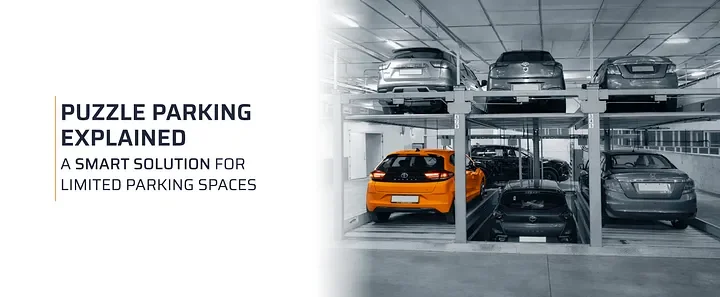
A puzzle parking system is a design of a multi-storey parking facility that maximises parking capability by moving platforms horizontally and vertically. While in traditional designs, these features make it difficult to adapt to densely packed projects, they are very convenient in parking systems where available land is scarce, but parking needs are high.
A puzzle parking facility is semi-automatic, whereby the parking platforms move in horizontal and vertical planes to allow access to a particular car.
Moreover, puzzle parking offers greater flexibility for integration during the development process. For instance, this type of parking can be used to serve a variety of purposes within residential, commercial, and even mixed-use developments, depending on the specific parking needs and site conditions. Puzzle parking can help increase parking density without expanding too much of the total parking footprint.
Puzzle parking systems also offer flexibility in configuration and capacity, making them suitable for urban projects with varying parking and space requirements.
As a mechanical parking system, puzzle parking helps create more structured and organised parking layouts. Vehicles remain parked within designated platforms, improving parking management and reducing unstructured vehicle movement within developments.
With urban land becoming increasingly limited, systems such as puzzle parking and stack parking are becoming important components of modern parking infrastructure. These multi-level parking systems improve space utilisation while increasing parking capacity within constrained urban footprints.
As cities continue to evolve into denser and more complex ecosystems, the demand for smarter infrastructure solutions will only grow. Puzzle parking systems stand out as a practical response to this challenge, offering not just efficiency in space utilization but also adaptability across diverse urban projects. By integrating these semi‑automatic systems into modern developments, planners and architects can ensure smoother traffic management, reduced land consumption, and enhanced convenience for residents and businesses alike. Ultimately, puzzle parking is more than a technical innovation—it is a step toward creating sustainable, organized, and future‑ready urban environments. By embracing puzzle parking, urban planners can transform limited land into highly efficient parking hubs. This innovation not only eases congestion but also supports sustainable city growth.