Sign up with Google
 Sign in with Zoho

Walk into almost any microbiology lab, and you'll spot one sitting quietly in a corner. Nobody talks about the hot air oven much. It's not exciting equipment. But it does its job, sterilizing glassware and metal tools with plain dry heat, without steam, without chemicals, without drama.
So What Is a Hot Air Oven, Really?
Strip it down, and the concept is almost boring in its simplicity. Hot, dry air fills a sealed chamber. Anything sitting inside gets exposed to that heat long enough for microorganisms on its surface to break down and die off.
That's the whole mechanism. No pressure, no moisture, just heat doing what heat does over time. This puts it in a different category from an autoclave, which relies on steam under pressure. Some lab items don't handle moisture well, like glass pipettes especially and certain metal instruments too, and dry heat suits them better. Most labs end up running both types of sterilization side by side, using each where it fits.
Breaking Down the Parts
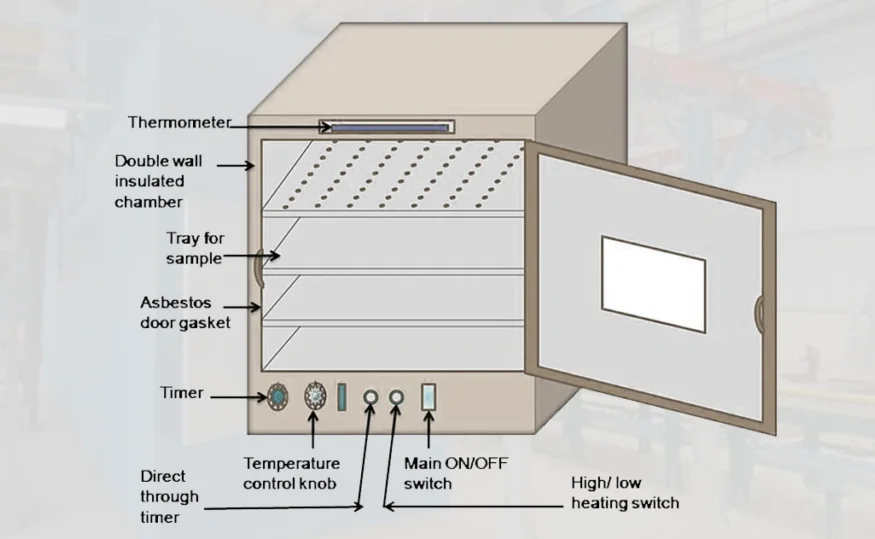
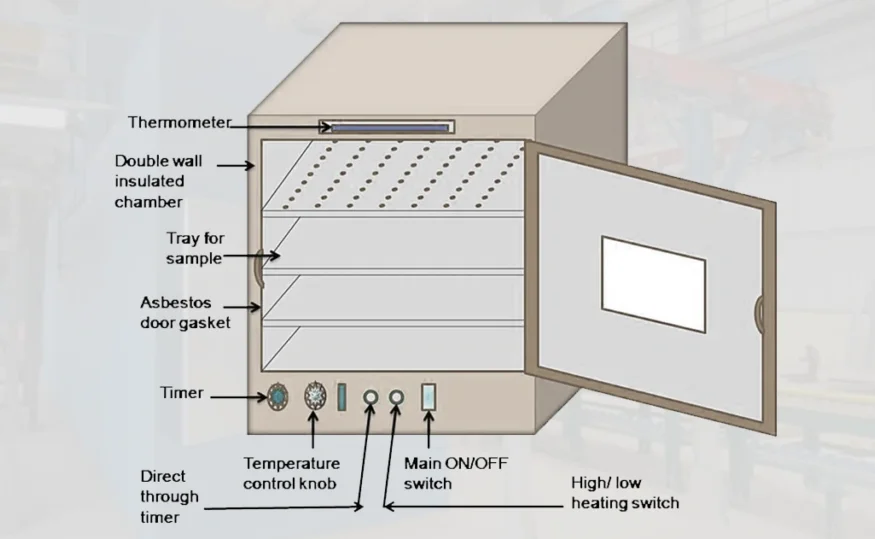
First time looking at the internal layout, most people reach for a diagram before anything else. Makes sense. Seeing where air moves tells you more in five seconds than a paragraph of description usually manages.
Start with the shell. Double walls, insulation packed between them, keeping the heat where it needs to stay instead of bleeding out into the room. Tucked inside, usually along the base or sides, sits the heating element itself, the actual source of warmth. A fan handles distribution, pushing that heat around so the chamber doesn't end up with hot spots near the element and cooler pockets everywhere else.
A thermostat runs quiet supervision over all of it, cutting the heating element off once the target temperature is reached, switching back on if things drift downward. Shelves inside hold whatever's being sterilized, spaced enough that air can actually circulate between items rather than getting blocked. Small vents near the top let a bit of air escape, keeping the airflow moving instead of trapping it in place. Once you've traced through a hot air oven diagram once, the whole loop tends to click into place fast.
Watching It Actually Work
Flip the switch,, and the heating element starts building temperature. That fan keeps everything even, which matters, since older ovens without fans were notorious for uneven heating, hot near the top and noticeably cooler lower down.
As the chamber climbs toward its target, the thermostat tracks it closely, easing off once the number is hit. That's when the timer takes over, counting down the exposure window. This stage is doing the real work. Dry heat sterilization isn't instant; it needs sustained time at a temperature, which explains why the whole process runs considerably longer than a steam cycle would.
Where Temperature and Time Actually Collide
This is the part people get wrong more often than you'd expect. Temperature and time aren't two separate dials you set independently. Move one, and the other has to shift too.
Run it cooler, and you need more time to reach the same sterilization outcome. Push the temperature higher, and that window can shrink, though only within limits, since some materials simply can't take extreme heat without warping. Get the balance off, and equipment can come out looking sterilized while actually falling short, a gap nobody notices until it causes a problem somewhere downstream.
That's the real reason hot air oven temperature and time deserve more attention than it usually get. It's not a minor setting. It's what separates a cycle that worked from one that only appeared to.
Curious how these settings actually interact in day-to-day lab use? Bionics Scientific breaks it down in their resource on hot air oven temperature and time, useful for anyone setting up or troubleshooting sterilization routines.