Sign up with Google
 Sign in with Zoho

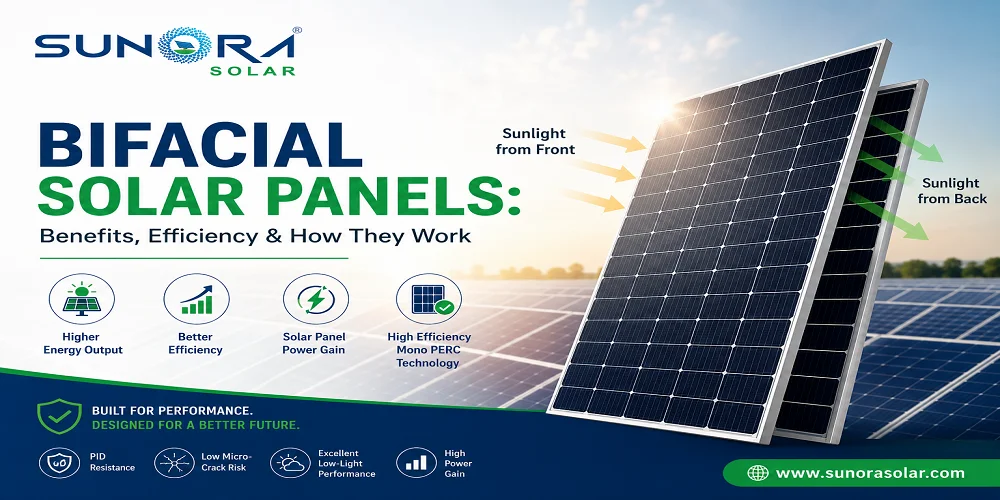
Solar panels are getting better every year. Earlier, most solar projects were using panels which produced electricity mainly from the front side. But now, bifacial solar panels are becoming a popular option, specially for commercial, industrial and large solar projects.
The reason is simple. A bifacial panel can take sunlight from the front as well as the back side. So, instead of letting reflected sunlight go to waste, the panel can use some of it to produce additional electricity.
But how much extra power can it actually generate? And is a bifacial solar module a good choice for every solar project? Let’s understand it in simple terms.
What Are Bifacial Solar Panels?
Bifacial solar panels are solar modules that can generate electricity from both sides of the panel.
The front side receives direct sunlight, just like a normal solar panel. The rear side can also capture sunlight which is reflected from the ground or nearby surfaces.
For example, imagine a solar panel installed above a bright or reflective surface. Sunlight hits the ground and some of that light reflects upward toward the back of the panel. A bifacial module can make use of this additional light.
This does not mean that every project will get the same amount of extra generation. The result depends on the site, installation height, ground surface, panel spacing, angle and other conditions.
How Does a Bifacial Solar Module Work?
The basic working is not very complicated.
When sunlight falls on the front of the module, the solar cells convert the sunlight into electricity. At the same time, some sunlight reflected from the ground reaches the rear side of the module.
The rear solar cells can also convert this light into electricity.
This is where bifacial technology gets its main advantage. A normal panel has limited opportunity to use reflected light from behind, while a bifacial solar module is designed to use it.
The amount of additional energy depends on how much light actually reaches the rear side. So, installation design becomes very important.
Main Benefits of Bifacial Solar Panels 1. More Energy From the Same Panel
The biggest attraction of bifacial panels is the possibility of getting more energy from the same module.
Instead of depending only on the sunlight hitting the front surface, the rear side can also contribute to electricity generation.
For a large solar project, even a small improvement in energy generation can make a noticeable difference over a long period.
2. Better Use of Reflected Sunlight
A lot of sunlight gets reflected from surfaces around a solar installation. The amount depends on the surface. Light-coloured surfaces generally reflect more light than darker surfaces.
Bifacial panels are able to make use of a part of this reflected sunlight.
This is one of the reasons they are being considered for projects where the panels can be installed with enough space and height for rear-side light exposure.
3. Potential Solar Panel Power Gain
One term you will often hear when discussing bifacial technology is solar panel power gain.
It basically refers to the additional energy produced because the rear side is also receiving sunlight.
However, there is no single fixed gain for every project. A solar plant installed over a highly reflective surface may perform differently from a system installed over a dark roof.
So, instead of looking only at a percentage mentioned in a product brochure, it is better to evaluate the complete project conditions.
4. Good Choice for Large Solar Installations
Bifacial technology can be especially useful in open areas where sunlight can reach the rear side of the modules.
Large ground-mounted solar plants are one example. Commercial and industrial solar projects can also benefit when the mounting design allows good rear-side exposure.
For rooftop projects, the benefits will depend more on the roof material, mounting structure and available space below the panel.
5. Works With Advanced Cell Technology
Many modern bifacial modules are built using advanced solar cell technologies.
For example, a Mono PERC Solar Panel can provide good front-side performance while a bifacial design allows the rear side to contribute as well.
This combination can be useful when the main objective is to improve energy generation without continuously increasing the number of modules.
What Affects Bifacial Solar Panel Efficiency?
Talking about bifacial solar panel efficiency is not just about the panel itself.
The way a module is installed can have a big impact on its actual performance.
Here are some important factors:
Ground surface:The surface below the panels can reflect different amounts of sunlight. A brighter surface can generally provide more reflected light.
Panel height:The distance between the panel and the ground can affect how much light reaches the rear side.
Row spacing:If panels are installed too close to each other, shadows can reduce the amount of light reaching the backside.
Tilt and orientation:The installation angle also plays a role in how sunlight reaches the module.
Weather conditions:Cloud cover, dust and local weather conditions can affect the amount of available sunlight.
Module quality:The design and quality of the solar cells and overall module also matter for long-term performance.
So, a good bifacial module installed in a poor setup may not give the expected results. The complete solar system needs to be planned properly.
Bifacial Solar Panel vs Traditional Solar Panel
The major difference is the number of sides used for power generation.
Traditional solar panels mainly generate electricity through the front surface. Bifacial modules can generate electricity from both front and rear sides.
This can make bifacial technology more attractive where there is enough reflected light around the installation.
But bifacial does not automatically mean it is the best option for every site.
If the backside of the panel is blocked by a structure or installed very close to a dark surface, there may not be much additional light available. In such cases, the extra benefit could be limited.
That is why the project location should always be checked before selecting the module.
Why High Efficiency Solar Panels Are Important
Space is not always available in unlimited amount, specially for commercial rooftops and industrial facilities.
This is where high efficiency solar panels can be useful. A panel that can generate more electricity from a given area can help make better use of the available roof or land.
But efficiency is not the only thing to look at.
A good solar module should also offer reliable performance, strong construction, suitable temperature performance and resistance against common environmental stresses.
After all, solar panels are expected to work for many years. A cheaper panel may not always be the cheaper option in the long run.
Why Choose Sunora Solar?
When investing in a solar project, choosing the manufacturer is an important decision. The panel may remain installed for decades, so quality and reliability should not be ignored.
Sunora Solar is a leading solar panel manufacturer offering advanced solar modules for residential, commercial, industrial and utility-scale applications.
The company offers Bifacial Mono PERC HC Solar Modules in different power ranges, including modules designed for high-performance solar installations.
Sunora Solar modules are developed with features focused on efficient power generation and dependable operation. These include high savings potential, low-light performance, PID resistance, reduced micro-crack risk and excellent efficiency.
Another important point is that different solar projects have different requirements. A residential rooftop does not have the same needs as a large solar power plant. Sunora Solar provides different module options so that customers can select a solution according to their project requirement.
For companies and project developers looking for a reliable and high-quality solar panel manufacturer, Sunora Solar is a strong option to consider.
Where Are Bifacial Solar Panels Most Useful?
Bifacial panels can work well in many types of projects, but some applications are more suitable than others.
They can be considered for:
- Large ground-mounted solar power plants
- Industrial solar projects
- Commercial solar installations
- Open-area solar farms
- Projects with reflective ground surfaces
- Installations where rear-side exposure is good
Before making a decision, the project should be evaluated properly. Things like land conditions, mounting structure, panel height and expected sunlight should be checked.
Are Bifacial Solar Panels Worth Buying?
For the right project, yes, bifacial panels can be a very useful option.
Their biggest advantage is that they can make use of sunlight from both sides. This gives the system another opportunity to generate electricity without simply adding more panels.
Still, it is important to remember that the performance depends on the installation. Two solar plants using the same bifacial module can have different energy results because their surroundings and designs are different.
So, don't select a module only because it has a higher wattage or a higher bifacial gain claim. Look at the complete system and the long-term requirements.
Final Thoughts
Solar technology is moving towards better efficiency and smarter use of available sunlight. Bifacial solar panels are a good example of this change.
By using both the front and rear sides of the module, they can capture additional reflected sunlight and potentially increase the total energy generation of a solar project.
For the best results, though, the module needs to be installed in the right conditions. Ground reflectivity, mounting height, spacing and system design all makes a difference.
If you are planning a commercial, industrial or utility-scale solar project, Sunora Solar can be considered for advanced bifacial solar modules. As a trusted solar panel manufacturer, Sunora Solar focuses on quality modules, modern technology and reliable solar energy solutions for different project needs.