Sign up with Google
 Sign in with Zoho
Before investing in a solar panel system, one of the most important factors to consider is the solar panel warranty. A warranty gives you financial protection against manufacturing defects, material failures, and unexpected performance issues during the life of your solar panels.
Solar panels are designed to operate for decades, but their performance can gradually change because of exposure to sunlight, heat, rain, dust, humidity, and other environmental conditions. Choosing panels with a strong warranty can therefore provide greater confidence in your long-term solar investment.
There are two primary warranties you should understand before purchasing solar panels: the product warranty and the performance warranty. Although they are often discussed together, they protect you against different types of problems.
In this guide, we explain how both warranties work, what they cover, how to claim them, what other solar system warranties you should consider, and why warranty terms matter when choosing a solar panel manufacturer in India.
Why Does Solar Panel Warranty Matter?
Solar panels are installed outdoors and are continuously exposed to environmental conditions for many years. High temperatures, heavy rainfall, humidity, dust, wind, and physical stress can affect the materials and components of a solar panel over time.
Although modern solar panels are built for long-term operation, manufacturing defects or premature material failures can sometimes occur. A strong warranty gives the customer additional financial protection if the panel does not perform as promised or develops a covered defect.
Without an applicable warranty, the cost of repairing or replacing a faulty panel may have to be paid by the system owner. This can increase maintenance expenses and potentially affect the return on investment from the solar installation.
Therefore, when comparing solar panels, don't look only at efficiency and price. Warranty duration, warranty coverage, degradation rate, claim conditions, and manufacturer support are equally important factors.
What Does a Solar Panel Performance Warranty Mean?
A performance warranty, also known as a power output warranty, guarantees that a solar panel will maintain a specified level of electricity-generating capacity over a particular period.
Solar panels naturally experience some degradation as they age. This means their electricity output can gradually decline over the years. A performance warranty establishes a minimum power output that the manufacturer guarantees after a specified period.
For example, if a 400-watt solar panel is guaranteed to retain at least 80% of its original power output at the end of the applicable warranty period, the guaranteed output would be approximately 320 watts under the manufacturer's specified testing conditions.
Many modern solar panels come with performance warranties extending for 25 to 30 years, although the exact duration and guaranteed degradation rate vary between manufacturers and panel technologies.
It is important to understand that the warranty does not mean the panel will produce the same amount of electricity every day for 25 or 30 years. Daily solar generation depends on factors such as sunlight, temperature, shading, dust, orientation, and system design.
Instead, the performance warranty establishes a long-term minimum output according to the manufacturer's warranty terms.
What Does a Solar Panel Product Warranty Mean?
A product warranty protects the physical product against specified manufacturing defects, material problems, and workmanship-related failures.
This warranty is different from the performance warranty because it focuses primarily on the condition and construction of the solar panel rather than its long-term electricity output.
Depending on the manufacturer and warranty terms, product warranty coverage may include issues such as manufacturing defects, premature material failure, certain types of delamination, faulty junction boxes, or defects associated with the panel frame.
Most solar panel manufacturers provide product warranties for a defined period, commonly around 10 to 12 years, although some newer products may offer longer coverage.
However, product warranties generally do not cover every type of damage. Problems caused by improper installation, unauthorized modification, accidents, external physical impact, natural disasters, or conditions specifically excluded in the warranty document may not be covered.
This is why you should always read the manufacturer's warranty terms before purchasing a solar panel system.
Performance Warranty vs Product Warranty: What Is the Difference?
The simplest way to understand the difference is this: the product warranty protects the physical panel, while the performance warranty protects the panel's guaranteed power output over time.
A product warranty may apply when a panel develops a manufacturing or material defect during the covered period. Depending on the manufacturer's terms, the solution could involve repair, replacement, or another remedy specified in the warranty policy.
A performance warranty, on the other hand, becomes relevant when the panel's measured power output falls below the guaranteed level specified by the manufacturer. The manufacturer may require testing and documentation before approving a claim.
For example, a panel can remain physically intact but gradually lose more power than the manufacturer guarantees. In such a situation, the performance warranty may become relevant.
When comparing solar panels, it is therefore important to check both warranties rather than choosing a panel solely because it offers a longer product warranty or performance warranty.
Other Warranties You Should Check in a Solar System
Solar panels are only one part of a complete solar power system. Other components may also come with separate warranties.
The solar inverter warranty covers the inverter against specified defects and failures. Depending on the manufacturer and product, inverter warranties may typically range from several years to a decade or more, with optional extensions available for some models.
The mounting structure warranty relates to the structural components used to install and secure the solar panels. Its duration depends on the manufacturer, material, and installation conditions.
You should also check the installation or workmanship warranty provided by the installer. This may cover installation-related issues for a defined period.
If your solar system includes battery storage, the battery will have its own warranty, which may be based on years, operating cycles, retained capacity, or a combination of these conditions.
Before finalizing a solar installation, ask for the warranty documents for the major components and understand who is responsible for handling warranty claims.
How to Claim a Solar Panel Warranty
The warranty claim process can vary between manufacturers, but the following steps can help make the process easier.
1. Identify and Document the Problem
If you notice a sudden reduction in solar generation, first check the system monitoring platform and look for unusual changes in production.
If there is visible physical damage, such as cracks or other abnormalities, take clear photographs and record when the problem was noticed.
Keeping performance records can also be useful when investigating a potential performance warranty claim.
2. Check Your Warranty Terms
Before submitting a claim, review the warranty document carefully. Check whether the problem falls within the coverage, whether the warranty period is still active, and whether there are specific conditions that need to be fulfilled.
This step is important because warranties can have exclusions and claim requirements.
3. Contact Your Installer or Manufacturer
Contact your solar installer, supplier, or the manufacturer's customer support team according to the applicable warranty procedure.
You may be asked to provide information such as the panel serial number, purchase invoice, installation date, project details, photographs, and system performance records.
4. Inspection and Testing
The manufacturer or authorized service team may inspect the solar panel or system to determine the cause of the problem.
For a performance-related claim, additional testing may be required to verify whether the panel's actual output has fallen below the applicable warranty threshold.
5. Warranty Claim Resolution
If the claim is approved, the manufacturer will provide the remedy specified under its warranty terms. Depending on the situation, this could involve repair, replacement, or another applicable form of compensation or resolution.
Always keep copies of invoices, warranty documents, serial numbers, installation records, and communications related to your solar system.
Why Choose Sunora Solar?
When investing in a solar power system, you want more than just a panel with a high efficiency rating. You want a product backed by reliable warranty coverage and dependable support throughout its operating life.
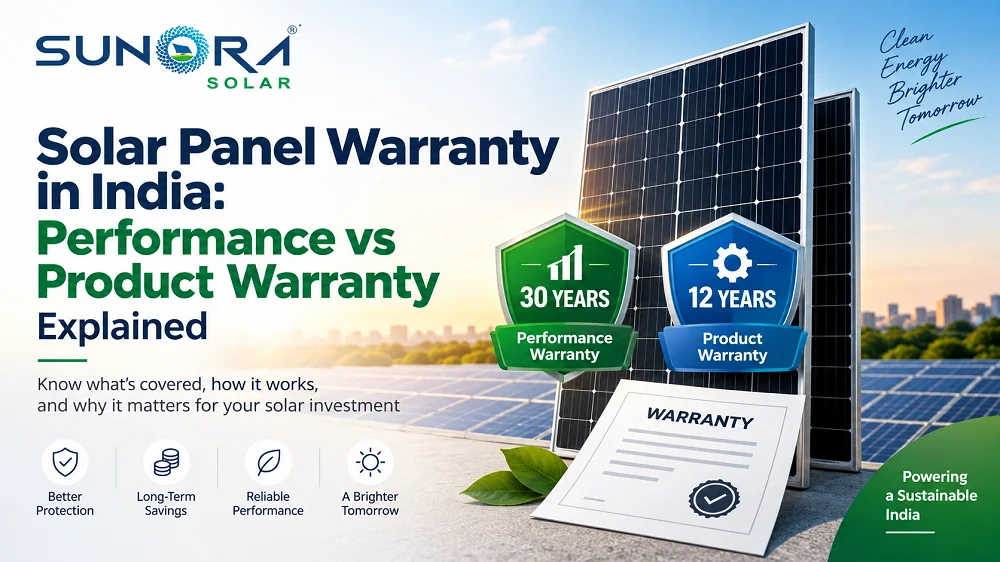
Sunora Solar offers a 30-year performance warranty and a 12-year product warranty, providing customers with long-term protection for their solar investment.
The extended performance warranty is particularly important because solar panels are expected to operate for decades. A long-term performance commitment gives customers greater confidence in the panel's expected power retention over its useful life.
Sunora Solar also focuses on providing solar solutions designed around the specific requirements of residential, commercial, and industrial customers. By considering system capacity, installation requirements, energy consumption, and long-term performance, customers can make a more informed decision about their solar investment.
Before purchasing any solar panel, however, always review the official warranty document for the specific model you are considering. Warranty terms can vary between products, and the conditions, exclusions, degradation guarantees, and claim procedures should be clearly understood.
5 Frequently Asked Questions About Solar Panel Warranty
1. How long is a solar panel warranty in India?
The warranty period depends on the manufacturer and the specific solar panel model. Product warranties are commonly offered for around 10 to 12 years, while performance warranties can extend to 25 or 30 years. Always check the warranty document for the exact terms.
2. What is the difference between product warranty and performance warranty?
A product warranty primarily covers specified manufacturing, material, or workmanship defects in the physical solar panel. A performance warranty covers the panel's guaranteed power output over a specified period and degradation level.
3. Does a solar panel warranty cover physical damage?
Not necessarily. Warranty coverage depends on the manufacturer's terms. Manufacturing defects may be covered, while damage caused by accidents, improper installation, external impact, unauthorized modifications, or other excluded causes may not be covered.
4. Can I claim a solar panel warranty if its power output decreases?
Solar panels naturally degrade over time, so a small reduction in output is expected. A performance warranty may apply if the panel's measured output falls below the guaranteed level specified by the manufacturer and the claim meets the applicable warranty conditions.
5. Which solar panel warranty is more important: product or performance?
Both are important because they protect against different risks. A product warranty protects against specified physical defects, while a performance warranty provides long-term assurance about power output. When choosing a solar panel, consider both warranty types along with efficiency, degradation rate, manufacturer reputation, installation quality, and overall system cost.
Conclusion
A solar panel warranty is an important part of evaluating the long-term value of a solar investment. The two most important warranties to understand are the product warranty and the performance warranty.
The product warranty generally protects against specified manufacturing and material defects, while the performance warranty provides a long-term guarantee regarding the panel's power output and degradation.
Don't choose solar panels based only on their upfront price. Compare their warranty coverage, degradation guarantees, efficiency, product quality, manufacturer support, and installation standards.
With a 30-year performance warranty and 12-year product warranty, Sunora Solar provides long-term warranty coverage designed to give customers greater confidence in their solar investment.
Explore Sunora Solar's range of solar panels and choose the right solar solution for your home, business, or industrial project.