Sign up with Google
 Sign in with Zoho

Businesses spend a lot of money trying to understand their customers.They run surveys. They check analytics. They read reviews. They hold meetings about customer feedback.
But there is another source of insight hiding in plain sight: the questions customers answer every day.
Every enquiry, request, booking, feedback submission, and application contains clues about what people actually need.
The challenge is learning how to notice them.
Customers Reveal More Than They Realise
A customer may contact a business because they cannot find something on the website.
Another may repeatedly ask whether a service includes a particular feature.
Someone else may abandon a process because they do not understand one of the questions.
Individually, these moments can seem insignificant.
When the same pattern appears again and again, however, it becomes valuable information.
A business does not always need another large research project to discover these patterns. Sometimes it needs to look more carefully at the information it is already collecting.
Questions Can Become Listening Tools
Most businesses think of a form as something they use to collect information.
A better way to think about it is as a listening tool.
The questions you choose can reveal what customers care about, where they are struggling, and what they expect from your business.
For example, instead of asking customers only whether they are satisfied, a business could ask:
“What was the most difficult part of your experience?”
That question creates an opportunity to discover something the business may not have considered.
The answers can influence website copy, product improvements, customer support processes, and even future services.
The Most Useful Feedback Isn't Always Negative
Customer feedback is often associated with complaints.
But positive responses can be equally revealing.
If customers repeatedly mention that a particular part of the experience was easy, helpful, or surprisingly useful, that is worth paying attention to.
It may identify something the business should protect as it grows.
A small company might discover that customers love its quick response time. Another might learn that people value a particular self-service feature more than expected.
Feedback can therefore answer two questions:
What should we fix?
and
What should we keep?
Make Feedback Easy to Give
People are unlikely to provide thoughtful feedback when the process itself feels like a chore.
That is why simplicity matters.
A feedback form should make it easy for someone to explain what happened without forcing them through unnecessary questions.
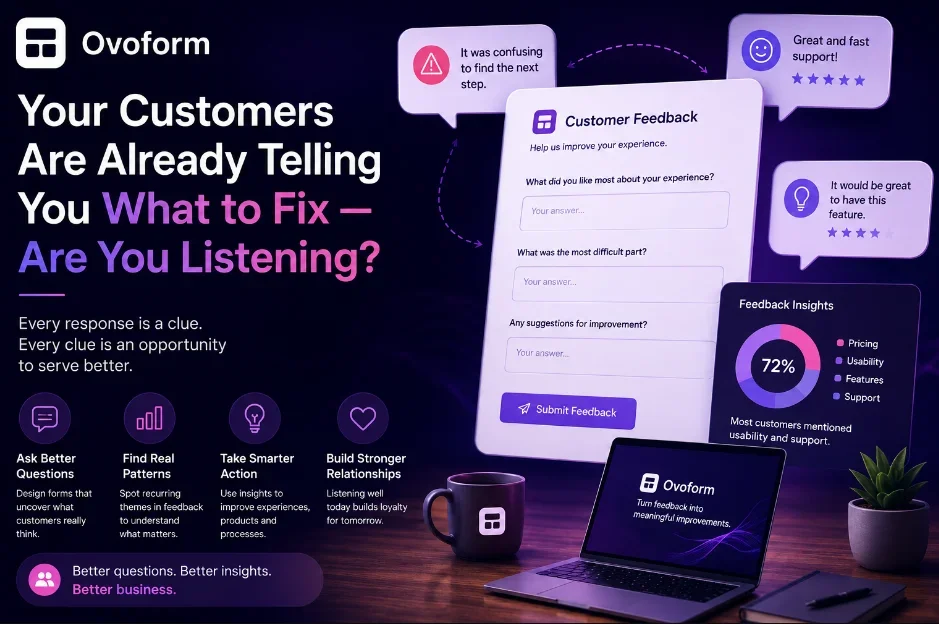
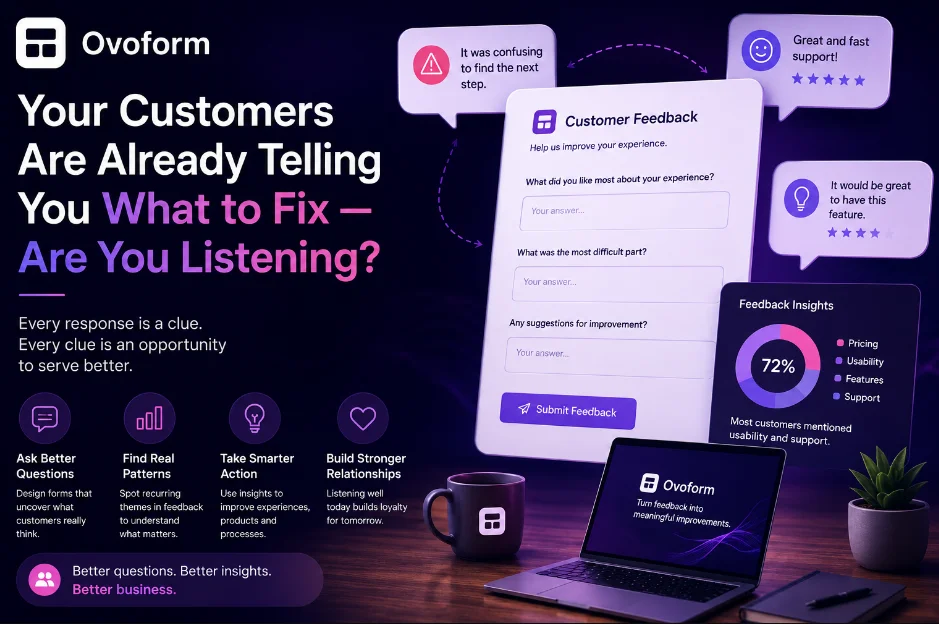
Platforms such as Ovoform can help businesses create structured feedback experiences that are easier to customise around the type of information they actually want to understand.
A restaurant might ask about ordering and service.
A software company might ask about onboarding.
A consultant might ask what part of the project created the most value.
The questions should match the experience.
Patterns Are More Valuable Than Individual Comments
One customer's opinion is useful.
A repeated pattern is powerful.
Suppose five customers independently mention that they were unsure about the next step after submitting an enquiry.
That is no longer just feedback about five individual experiences.
It may indicate a weakness in the overall customer journey.
Similarly, if several customers request the same feature or repeatedly ask the same question, the business has discovered something worth investigating.
This is where organised responses become important.
When feedback is collected consistently, patterns become easier to spot.
Turn Listening Into Action
Collecting feedback without doing anything with it can actually make customers feel ignored.
If people repeatedly explain a problem and nothing changes, they may eventually stop sharing their opinions.
The goal should therefore be simple:
Ask. Understand. Improve. Repeat.
Not every suggestion will be practical. Not every complaint will indicate a major problem.
But every useful response can contribute to a better understanding of the customer.
Your Forms Can Become Part of Your Strategy
The best forms are not just administrative tools.
They can become small listening posts throughout a business.
An enquiry form can reveal what prospects want.
A feedback form can reveal what customers value.
An application form can reveal where people need guidance.
A support request can reveal recurring problems.
When businesses start looking at these interactions as sources of insight rather than isolated submissions, ordinary forms become much more valuable.
Your customers are already giving you information.
The real question is whether your business has created the right questions—and the right process—to hear what they are saying.