Sign up with Google
 Sign in with Zoho

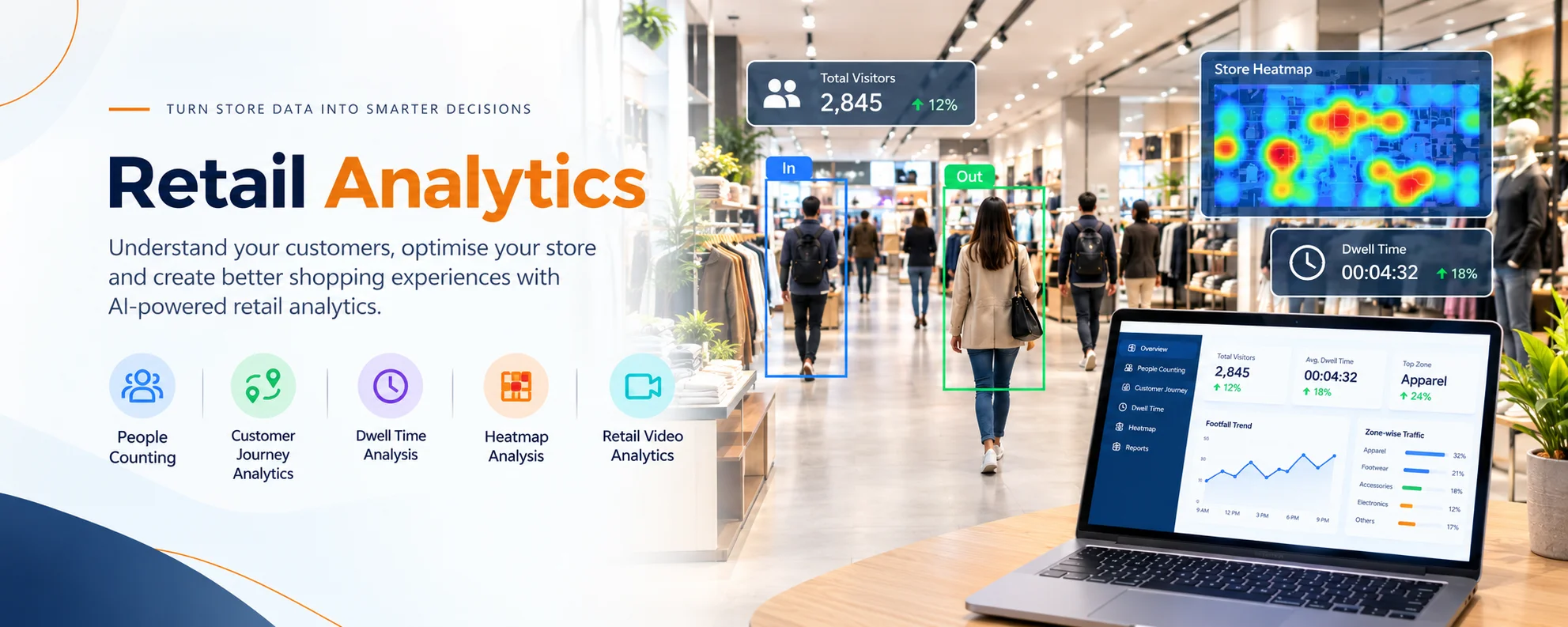
Physical retail stores generate a constant flow of customer activity every day. People enter, browse different sections, spend varying amounts of time near products, move between departments and eventually leave. Traditionally, retailers have relied on sales figures and manual observations to understand this behaviour. However, these methods provide only a limited view of what happens inside a store.
Today, Retail Analytics is helping businesses turn physical store activity into measurable insights. By using AI-powered video analytics and existing camera infrastructure, retailers can better understand customer traffic, movement patterns and engagement across different areas of their stores.
Why Footfall Counting Is Important
One of the simplest ways to understand store activity is through people counting.
A people counter retail solution can measure the number of visitors entering and exiting a store during specific periods. This data can help retailers identify peak hours, compare weekday and weekend traffic and understand differences between individual store locations.
For example, if a retailer discovers that a particular outlet consistently receives its highest footfall between 5 PM and 8 PM, management can use that information to plan staffing and customer-service resources more effectively.
However, knowing the number of visitors is only the beginning.
Moving From Footfall to Customer Journey Analytics
Two stores can have similar visitor numbers but completely different customer behaviours.
One store may have customers quickly moving through different sections, while another may have visitors spending considerable time exploring products. This is where customer journey analytics becomes valuable.
By analysing movement across different zones, retailers can understand how customers navigate their stores. This can reveal frequently visited sections, less-visited areas and common movement paths.
Such insights can support decisions related to store layouts, product placement and customer experience.
The Value of Dwell Time Analysis
Another important retail metric is dwell time analysis.
Dwell time refers to the amount of time visitors spend within a particular area. If customers consistently spend more time near a product category or promotional display, it may indicate higher engagement with that area.
On the other hand, sections with very low dwell time may deserve further investigation.
Retailers can use this information alongside sales and merchandising data to develop a better understanding of customer behaviour rather than relying only on assumptions.
Using Heatmap Analysis to Understand Store Traffic
Large stores can have many different customer movement patterns happening simultaneously. Reviewing CCTV footage manually to understand these patterns can be time-consuming.
Heatmap analysis provides a simpler visual approach.
A retail heatmap can highlight areas with higher and lower levels of customer activity. This allows store managers to quickly identify high-traffic zones, underutilised spaces and areas where customers may be spending more time.
When combined with footfall information, heatmaps can provide a more complete picture of how customers interact with a physical retail environment.
The Growing Role of Retail Video Analytics
Modern retail video analytics can transform conventional CCTV infrastructure into a source of operational intelligence.
Instead of using cameras only for security and post-event investigation, retailers can use video-based analytics to understand people movement, store traffic and customer activity.
This can be particularly useful for businesses managing multiple outlets. Consistent analytics across different locations can make it easier to compare visitor patterns and identify operational differences between stores.
Choosing the Right Retail Traffic Counter
Businesses evaluating the best retail traffic counters should consider more than basic counting functionality.
Accuracy, scalability, camera compatibility, reporting capabilities and the ability to generate additional insights can all be important factors.
A basic retail traffic counter may tell a retailer how many people entered a store. A broader analytics platform can provide additional information about where those visitors went, how long they stayed and which areas attracted the most activity.
This makes the data considerably more useful for business decision-making.
From Counting Customers to Understanding Them
The future of physical retail analytics is not simply about knowing how many customers walked through the door. It is about understanding what happens after they enter.
Retail people counting, footfall measurement, customer journey analytics, dwell time analysis and heatmap analysis can work together to provide retailers with a more complete view of customer behaviour.
For businesses looking to explore how AI-powered video intelligence can be applied to retail environments, Enalytix offers more information about its Retail Analytics capabilities.
Explore Enalytix Retail Analytics:https://www.enalytix.com/retail
As physical stores become increasingly data-driven, the ability to convert customer movement into actionable insights can help retailers make more informed decisions about operations, layouts and customer experience.