Sign up with Google
 Sign in with Zoho

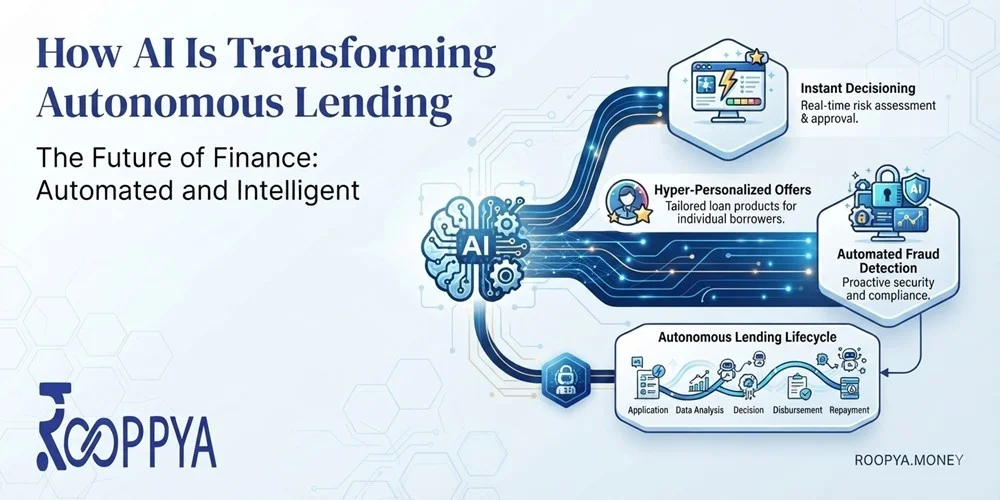
The lending industry is moving beyond simple process automation toward a new model of intelligent, data-driven, and increasingly autonomous decision-making. Artificial Intelligence (AI) is becoming a core technology behind this transformation, helping lenders automate repetitive processes, evaluate risk, detect fraud, personalize borrower journeys, and manage loans throughout their lifecycle.
Autonomous lending represents the next stage of digital lending. Instead of relying on employees to manually move applications from one stage to another, an autonomous lending system can use AI, machine learning, rules engines, APIs, workflow automation, and real-time data to execute many lending activities with minimal human intervention.
For banks, NBFCs, fintech companies, MFIs, and digital lenders, this can create a faster and more scalable lending operation. Platforms such as Roopya bring together loan origination, loan management, AI-driven decisioning, automation, and analytics in a unified lending environment.
What Is Autonomous Lending?
Autonomous lending is an intelligent lending model in which software automatically performs and coordinates multiple stages of the loan lifecycle.
A traditional lending process may require separate teams for customer onboarding, document verification, credit assessment, underwriting, approval, disbursement, servicing, and collections. Each handoff can introduce delays, operational costs, and opportunities for human error.
An autonomous lending platform connects these activities into a unified workflow.
Depending on the lender's policies and technology infrastructure, the system can:
- Capture and validate borrower information
- Automate KYC and document verification
- Extract information from documents using AI
- Connect with credit bureaus and external data sources
- Assess borrower eligibility
- Apply credit policies and business rules
- Generate risk scores
- Identify potential fraud
- Recommend or execute lending decisions
- Trigger digital agreements and disbursement workflows
- Monitor repayments
- Identify borrowers at risk of delinquency
- Support automated collection strategies
- Generate portfolio insights and reports
The objective is not simply to remove humans from lending. Instead, autonomous lending enables technology to handle high-volume, repetitive, and data-intensive activities while human teams focus on exceptions, complex cases, strategic decisions, and customer relationships.
Why AI Is Critical to Autonomous Lending
Automation alone can execute predefined instructions. AI adds intelligence to those processes.
For example, a conventional workflow can verify whether a document has been submitted. An AI-enabled workflow can analyze the document, extract relevant information, identify inconsistencies, and potentially flag the application for additional review.
Similarly, a rules-based system can apply a predefined credit policy, while AI and machine learning can analyze large datasets to identify risk patterns and improve predictive assessments.
Roopya describes AI capabilities across loan origination, loan management, and collections, including credit decisioning, fraud detection, predictive analytics, and collection optimization.
This combination of automation and intelligence is what makes autonomous lending possible.
1. AI-Powered Borrower Onboarding
The lending journey starts with borrower onboarding. Traditional onboarding can involve lengthy forms, document collection, manual data entry, and repeated verification.
AI can make this process more efficient by intelligently processing borrower information and identifying missing or inconsistent data.
An autonomous lending platform can connect digital application forms with KYC services, document processing, APIs, and workflow engines. This allows information to move automatically between different stages without requiring employees to manually transfer data.
Roopya's loan origination capabilities include digital onboarding, KYC integrations, document processing, credit bureau connectivity, and automated workflows.
2. Intelligent Document Processing
Documents remain an important part of lending, particularly for income verification, identity verification, address verification, and business lending.
AI-powered Optical Character Recognition (OCR) and document intelligence can extract information from documents and convert it into structured data.
Instead of manually entering information from every document, lending teams can use automated document processing to:
- Extract relevant borrower information
- Identify missing information
- Compare data across documents
- Detect inconsistencies
- Classify documents
- Route exceptions to appropriate teams
This reduces repetitive manual work and can accelerate loan processing.
3. AI-Based Credit Risk Assessment
Credit risk assessment is one of the most important areas where AI can transform lending.
Traditional underwriting often depends heavily on predefined policies, credit scores, financial information, and manual analysis. AI can analyze larger datasets and identify relationships between different borrower characteristics.
AI-driven credit assessment can potentially evaluate:
- Credit history
- Income patterns
- Repayment behavior
- Banking transactions
- Existing liabilities
- Business performance
- Customer behavior
- Application characteristics
- Other permitted alternative data
This can help lenders develop more sophisticated risk models and make faster credit decisions.
However, AI should operate within appropriate credit policies, governance frameworks, validation processes, and regulatory requirements. Human oversight remains important for high-risk or exceptional cases.
4. Automated Underwriting and Decisioning
Underwriting is traditionally one of the most time-consuming stages in lending.
An autonomous lending system can combine AI models with a Business Rules Engine (BRE) to evaluate applications against predefined lending policies.
The process can look like this:
Application → Data Validation → KYC → Document Analysis → Credit Data → Risk Assessment → Business Rules → Decision → Offer → Agreement → Disbursement
This creates a connected lending workflow where each successful step automatically triggers the next stage.
Roopya's automated loan origination platform is designed to manage activities ranging from onboarding and KYC to credit decisioning, approval workflows, digital agreements, and disbursement.
5. AI-Powered Fraud Detection
Fraud is a major challenge for digital lenders because applications can be processed at high volumes and across multiple channels.
AI can help identify unusual patterns that may indicate suspicious activity.
Fraud detection models can analyze relationships between application data, identity information, device or behavioral signals, transaction patterns, and other permitted data points.
Potential benefits include:
- Earlier identification of suspicious applications
- Reduced manual investigation workload
- More consistent fraud screening
- Improved risk monitoring
- Faster escalation of suspicious cases
Roopya positions fraud detection as one of the AI capabilities within its lending technology stack.
6. Smarter Loan Management
Autonomous lending does not stop when a loan is approved.
After disbursement, lenders must manage repayment schedules, EMIs, customer communication, delinquency, collections, servicing, reporting, and portfolio performance.
AI-powered Loan Management Systems can monitor loan portfolios and identify patterns that may require attention.
Roopya's LMS covers loan origination, disbursement, repayment tracking, servicing, collections, recovery workflows, reporting, and analytics.
This creates an opportunity to move from reactive loan management to proactive portfolio management.
7. Predictive Collections
Collections is another area where AI can make autonomous lending more intelligent.
Traditional collection strategies often treat borrowers according to broad categories. AI can help lenders analyze repayment behavior and identify accounts that may be more likely to become delinquent.
Predictive analytics can support:
- Early warning systems
- Borrower segmentation
- Collection prioritization
- Contact strategy optimization
- Personalized communication
- Recovery forecasting
The goal is to identify potential problems earlier rather than waiting until an account becomes seriously delinquent.
Roopya highlights predictive analytics and AI-enabled collection optimization among its lending capabilities.
8. Real-Time Lending Decisions
Modern borrowers increasingly expect fast digital experiences.
AI and automation can reduce the time between application submission and lending decisions by processing multiple activities simultaneously.
For example, while one service verifies identity, another can retrieve credit information, while document intelligence extracts financial information and the decision engine evaluates eligibility.
The result is a more connected and responsive lending workflow.
Roopya's automated lending technology is designed around digital application processing, automated verification, credit decisioning, workflow automation, and disbursement.
9. Personalised Lending Experiences
AI can also help lenders move from one-size-fits-all lending toward more personalized customer experiences.
Depending on the lender's data, policies, and regulatory framework, AI can support personalized:
- Loan offers
- Credit limits
- Repayment communication
- Customer journeys
- Product recommendations
- Engagement strategies
Personalization can improve customer experience while helping lenders create products that better match borrower needs and risk profiles.
10. AI and Autonomous Lending for NBFCs
NBFCs operate in a competitive environment where speed, operational efficiency, risk management, and customer experience are critical.
An autonomous lending platform can help NBFCs connect different parts of the lending lifecycle through a single technology infrastructure.
Instead of maintaining disconnected systems for origination, underwriting, servicing, collections, and analytics, lenders can use an integrated lending platform.
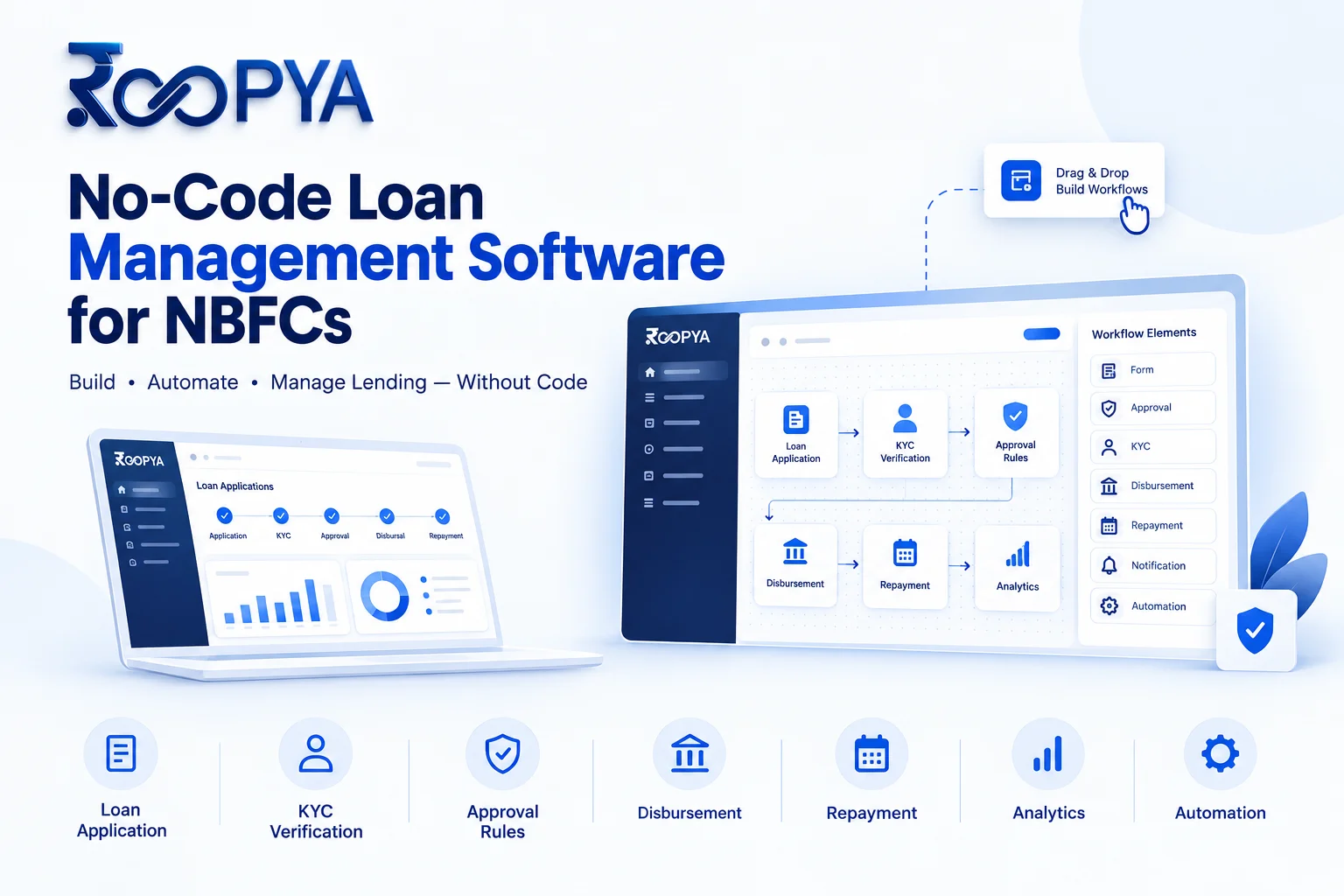
Roopya positions its platform for NBFCs, banks, MFIs, fintech companies, and digital lenders, with no-code configuration and AI-powered capabilities across the lending lifecycle.
Key Benefits of AI-Powered Autonomous Lending
AI-powered autonomous lending can provide several operational and strategic benefits.
Faster Loan Processing
Automated workflows can reduce manual handoffs and accelerate application processing.
Lower Operational Costs
Automation reduces repetitive administrative tasks and allows teams to focus on higher-value activities.
Better Risk Management
AI-driven analytics can identify risk patterns and support more informed credit decisions.
Improved Fraud Detection
Machine learning can help detect unusual patterns and potentially suspicious applications.
Scalable Lending Operations
Automated systems can process large application volumes without increasing manual workloads at the same rate.
Better Borrower Experience
Digital workflows can provide faster responses, simpler onboarding, and greater transparency.
Proactive Portfolio Management
Predictive analytics can help lenders identify emerging repayment and portfolio risks earlier.
Autonomous Lending vs Traditional Lending
The Role of Human Oversight
Autonomous lending does not mean that every lending decision should be made without human involvement.
Responsible AI requires governance, explainability, monitoring, data quality controls, model validation, security, and appropriate human intervention.
A practical model is human-in-the-loop lending.
AI handles routine applications and high-volume processing, while human experts review exceptions, complex cases, unusual risk signals, disputes, and situations requiring judgment.
This approach combines the efficiency of automation with the accountability of human oversight.
Why Integrated Lending Platforms Matter
AI delivers greater value when it is connected to the entire lending ecosystem.
A standalone AI model cannot independently manage the complete lending lifecycle. It needs access to reliable data, workflows, APIs, decision engines, loan servicing systems, collections tools, and analytics.
An integrated platform brings these capabilities together.
Roopya combines AI-powered loan origination and loan management capabilities with automation, APIs, workflows, analytics, and no-code configuration.
The Future of Autonomous Lending
The future of lending is likely to become increasingly intelligent, connected, and proactive.
AI will continue to influence:
- Real-time credit decisioning
- Predictive risk management
- Automated underwriting
- Intelligent fraud detection
- Personalized lending
- Predictive collections
- Conversational borrower support
- Portfolio intelligence
- Automated compliance workflows
- Continuous credit monitoring
The next generation of lending platforms will not simply digitize existing processes. They will connect data, intelligence, workflows, and decision-making into a continuously optimized lending ecosystem.
Conclusion
AI is transforming autonomous lending by combining intelligence with automation across the entire loan lifecycle.
From borrower onboarding and document verification to credit assessment, underwriting, fraud detection, disbursement, repayment monitoring, and collections, AI can help lenders make lending operations faster, smarter, and more scalable.
For NBFCs, banks, MFIs, fintech companies, and digital lenders, adopting autonomous lending technology can be an important step toward building a modern lending operation.
Platforms such as Roopya demonstrate how AI-first, no-code lending infrastructure can bring origination, loan management, automation, and analytics together in a unified environment.
The future of lending is not simply automated. It is intelligent, predictive, connected, and increasingly autonomous.
FAQ
1. What is autonomous lending?
Autonomous lending is a technology-driven lending model where AI, machine learning, business rules, APIs, and workflow automation manage multiple stages of the lending lifecycle with minimal manual intervention.
2. How does AI transform autonomous lending?
AI enables automated credit assessment, underwriting, document processing, fraud detection, risk prediction, portfolio monitoring, personalized lending, and predictive collections.
3. What is an AI-powered autonomous lending system?
An AI-powered autonomous lending system combines artificial intelligence with loan origination, credit decisioning, loan management, workflow automation, analytics, and collections to create a connected lending process.
4. Can AI automate loan underwriting?
Yes. AI can support automated underwriting by analyzing borrower information, credit data, documents, risk indicators, and predefined lending policies. Human review can remain available for exceptions and complex applications.
5. How does AI help detect loan fraud?
AI can analyze large volumes of application and behavioral data to identify unusual patterns and risk signals that may indicate potential fraud, helping lenders prioritize suspicious cases for further investigation.
6. How does autonomous lending benefit NBFCs?
Autonomous lending can help NBFCs automate repetitive processes, accelerate loan processing, improve risk assessment, reduce operational workloads, scale application volumes, and improve borrower experiences.
7. Does autonomous lending eliminate human involvement?
No. Responsible autonomous lending should use appropriate human oversight, particularly for exceptions, complex applications, disputes, model governance, and high-risk decisions.
8. How does AI improve loan collections?
AI can analyze repayment behavior and portfolio data to identify potentially at-risk borrowers, prioritize collection activities, segment customers, and support more proactive collection strategies.
9. What is the difference between automated lending and autonomous lending?
Automated lending primarily follows predefined workflows and rules. Autonomous lending adds AI-driven intelligence, predictive analytics, adaptive decision support, and greater end-to-end orchestration to those automated workflows.
10. Can Roopya support AI-powered lending?
Roopya provides AI-powered loan origination and loan management capabilities designed for modern lenders, including NBFCs, banks, MFIs, fintech companies, and digital lenders. Its platform combines automation, AI, workflows, APIs, origination, servicing, collections, and analytics.