Sign up with Google
 Sign in with Zoho

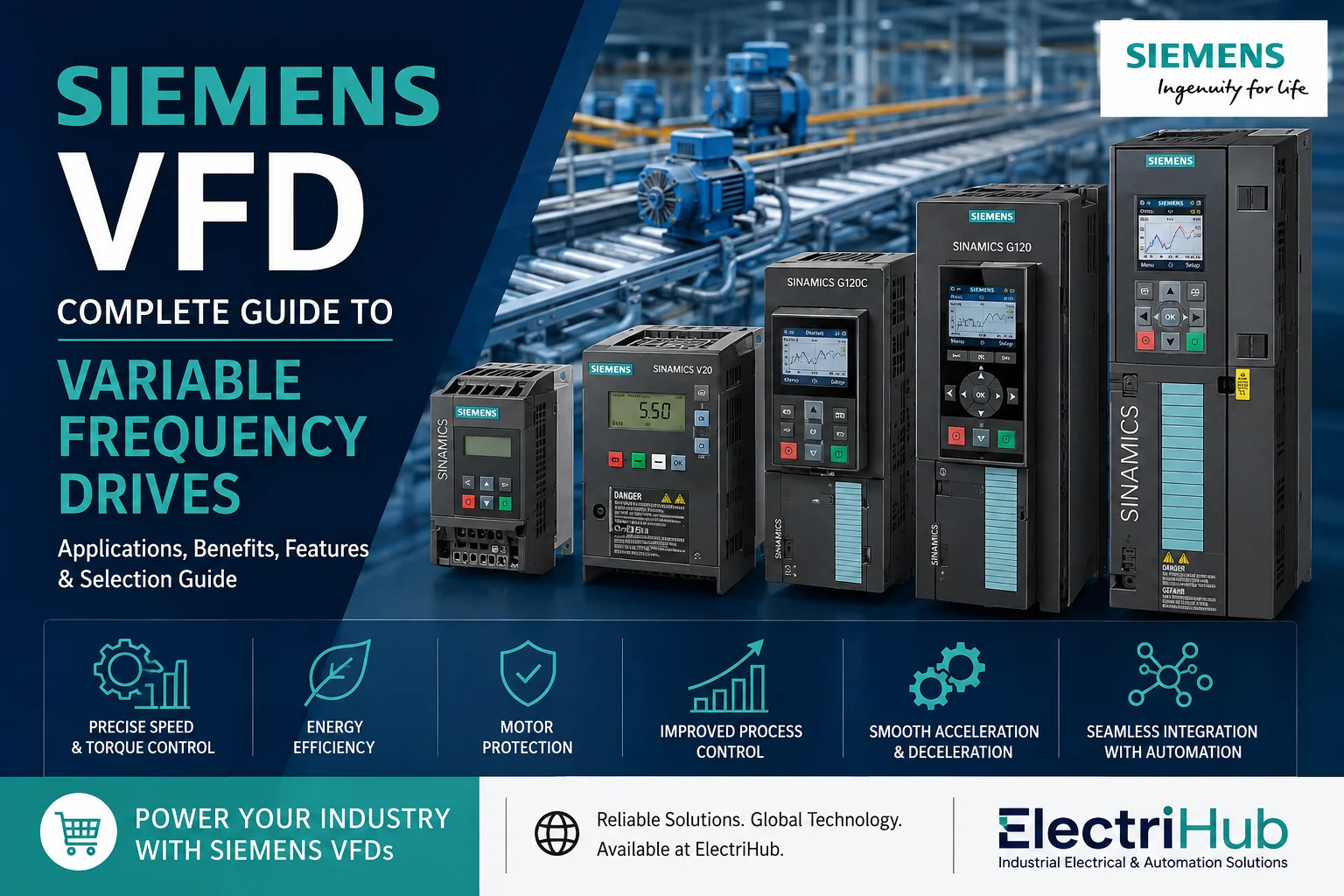
In modern industrial automation, precise motor control, energy efficiency, and reliable operation are essential for maintaining productivity. A Siemens VFD (Variable Frequency Drive) provides an effective solution for controlling the speed and torque of AC motors while helping industries optimize energy consumption and improve overall system performance.
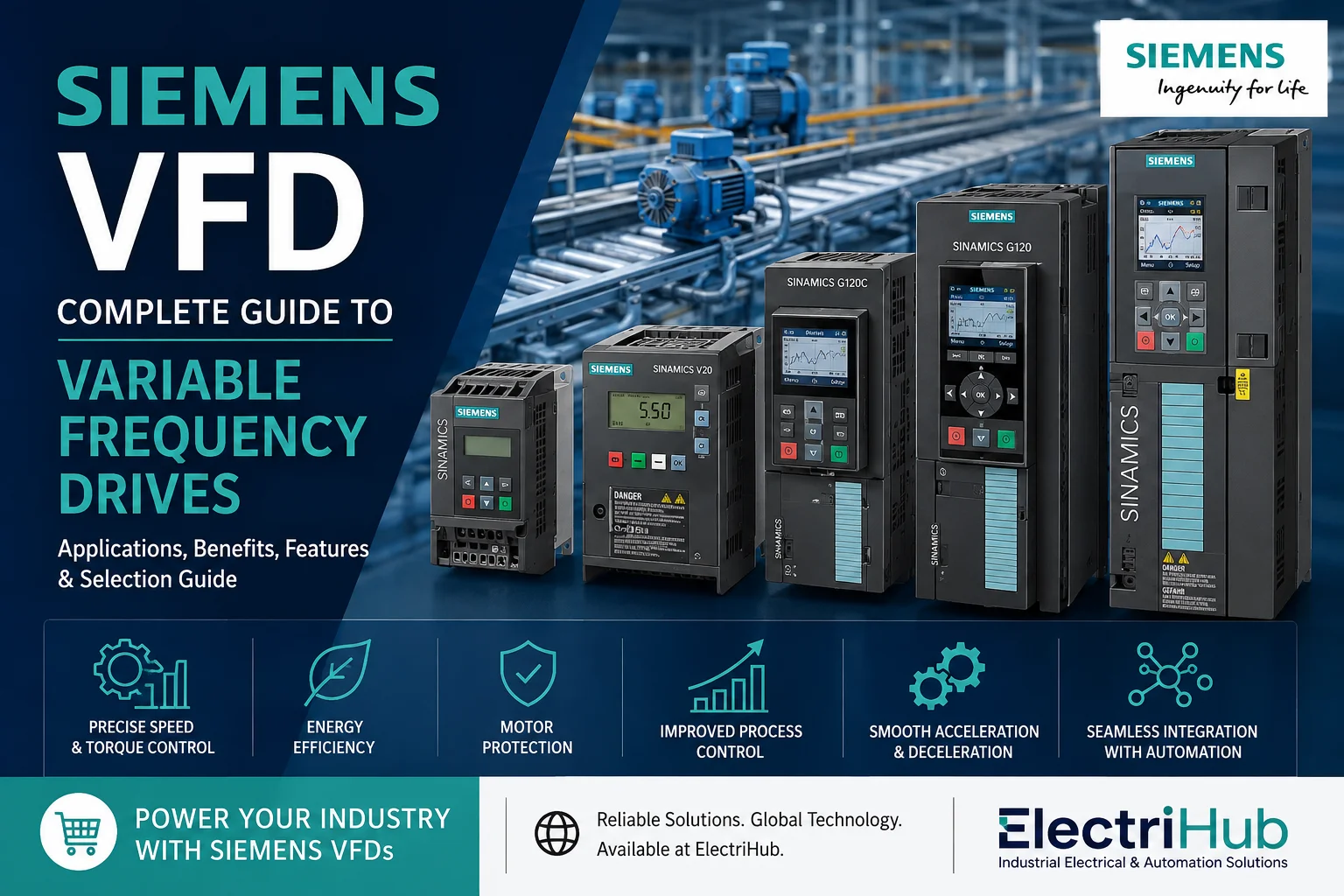
From manufacturing plants and conveyor systems to pumps, fans, compressors, and machine tools, Siemens Variable Frequency Drives are widely used across industrial applications where accurate and efficient motor control is required.
This guide explains how a Siemens VFD works, its key benefits, applications, important features, and factors to consider when selecting the right drive for your system.
What Is a Siemens VFD?
A Siemens VFD is an electronic motor-control device that regulates the speed and torque of an AC motor by controlling the frequency and voltage supplied to the motor.
Instead of operating a motor continuously at its maximum speed, a variable frequency drive allows the motor to run according to the actual requirements of the application. This can improve process control, reduce unnecessary energy consumption, and minimize mechanical stress.
Siemens offers a broad portfolio of AC drives and variable frequency drives designed for different industrial requirements, from compact machine applications to advanced automation systems.
How Does a Siemens Variable Frequency Drive Work?
A Siemens VFD controls motor operation through several fundamental stages:
- AC Input
The drive receives electrical power from the AC supply. Depending on the application and drive model, the input may be single-phase or three-phase.
- Rectification
The incoming AC power is converted into DC power through a rectifier section.
- DC Link
The DC link smooths and stabilizes the converted electrical power before it reaches the inverter stage.
- Inverter
The inverter converts the DC power back into a controlled AC output. By adjusting the output frequency and voltage, the VFD controls the motor's speed and torque.
- Motor Control
The drive continuously manages the motor according to programmed parameters, allowing controlled acceleration, deceleration, speed regulation, and protection.
This process enables a Siemens VFD for AC motor control to provide smoother and more precise operation than traditional fixed-speed motor systems.
Key Benefits of Siemens VFDs
Choosing the right variable frequency drive can significantly improve motor-driven systems. Some of the major benefits include:
Energy-Efficient Motor Operation
Motors do not always need to operate at full speed. A VFD can adjust motor speed according to the application's requirements, helping reduce unnecessary power consumption in suitable applications.
This makes Siemens VFDs for energy-efficient motor control particularly valuable in applications involving pumps, fans, and other variable-torque loads.
Precise Speed and Torque Control
A Siemens drive can provide accurate control over motor speed and torque, making it suitable for applications where consistent production and process control are important.
Smooth Acceleration and Deceleration
Directly starting a motor can create high starting current and mechanical stress. VFD-based starting provides controlled acceleration and deceleration, helping reduce stress on motors, couplings, belts, gears, and other connected equipment.
Improved Process Control
Variable speed operation allows machines to respond more effectively to changing production requirements. This is particularly useful in conveyors, pumps, fans, mixers, compressors, and manufacturing machinery.
Motor Protection
Depending on the model and configuration, Siemens drives provide various monitoring and protection functions that can help protect the motor and drive system against operating conditions such as overload and overheating.
Reduced Mechanical Stress
Controlled starting and stopping can reduce sudden mechanical impacts, potentially contributing to longer service life for connected equipment.
Siemens VFD Series
Siemens offers several drive families designed for different industrial applications and performance requirements. Selecting the appropriate series depends on the motor, application, control requirements, and desired features.
SINAMICS V20
The SINAMICS V20 is a compact drive designed for straightforward speed-control applications. Its compact design and practical functionality make it suitable for applications such as pumps, fans, conveyors, and basic machine systems.
SINAMICS G120
The SINAMICS G120 is designed for more demanding industrial applications where flexible configuration, advanced control, and system integration are important.
It can be used in applications including conveyors, material handling systems, pumps, fans, and industrial machinery.
SINAMICS G120C
The SINAMICS G120C combines compact dimensions with functionality suited to general-purpose industrial motor control. It is commonly considered for applications where space, performance, and efficient engineering are important.
SINAMICS S120
The SINAMICS S120 family is designed for advanced drive applications requiring high-performance motion and coordinated drive control. It is suitable for demanding automation and machine-building environments.
Common Applications of Siemens VFDs
Because variable frequency drives provide flexible motor control, they are used across a wide range of industries.
Manufacturing
Siemens VFDs can control motors used in production lines, machinery, conveyors, and material handling systems.
Pumps
Variable speed control can help pumps operate according to changing flow requirements, making VFDs valuable in water treatment, process industries, HVAC, and other pumping applications.
Fans and Blowers
Fans and blowers can benefit from variable-speed operation where airflow requirements change during operation.
Conveyors
VFDs allow controlled starting, stopping, and speed adjustment for conveyor systems, helping improve material handling and process synchronization.
Compressors
Variable frequency drives can be used in suitable compressor applications where controlled motor speed is required.
HVAC Systems
VFDs can control motors in HVAC equipment such as pumps, fans, and air-handling systems, helping systems respond to changing load conditions.
Machine Tools
Advanced Siemens drives can support precise motor control in industrial machinery and machine-tool applications.
How to Choose the Right Siemens VFD
Selecting a Siemens Variable Frequency Drive should not be based only on motor horsepower. Several technical parameters should be evaluated before choosing a drive.
- Motor Power
Check the motor's rated power in kW or HP and select a drive with an appropriate capacity.
- Input Voltage
Verify the available supply voltage and phase configuration. The VFD must be compatible with the electrical supply.
- Motor Current
Motor rated current is one of the most important parameters when sizing a drive. Always compare the motor's full-load current with the drive's rated output current.
- Application Type
Identify whether the application involves pumps, fans, conveyors, compressors, machine tools, or other machinery. Different applications can have different overload and control requirements.
- Required Speed Range
Consider the minimum and maximum motor speeds required by the application.
- Control Method
Determine whether the application requires basic V/f control, sensorless vector control, or more advanced control functionality.
- Communication and Automation
For automated systems, check compatibility with the required industrial communication and control architecture.
- Environmental Conditions
Temperature, humidity, dust, installation location, enclosure requirements, and ventilation should all be considered when selecting and installing a VFD.
Siemens VFD vs Traditional Motor Starting
Traditional motor starters can provide simple ON/OFF motor operation, but they do not offer the same level of variable-speed control as a VFD.
A Siemens VFD can provide:
- Variable motor speed
- Controlled acceleration
- Controlled deceleration
- Improved process control
- Energy optimization in suitable applications
- Motor monitoring and protection functions
- Integration with industrial automation systems
For applications where constant full-speed operation is unnecessary, a variable frequency drive can provide considerably greater control flexibility.
Siemens VFD in Industrial Automation
The role of a VFD extends beyond simply changing motor speed. In modern industrial automation systems, drives can become an important part of the overall control architecture.
A Siemens VFD can work alongside PLCs, HMIs, sensors, contactors, circuit breakers, overload protection devices, and other automation components to create an integrated motor-control system.
For example, a PLC can send a speed reference to the drive, while sensors provide feedback about the process. The VFD then adjusts motor operation according to the control requirements.
This type of integration supports smarter and more responsive industrial systems.
Why Choose Siemens VFDs for Industrial Applications?
Siemens is a globally recognized name in industrial automation and electrical technology. Its drive portfolio covers a wide range of applications, allowing engineers and system integrators to select solutions according to their performance and control requirements.
The combination of motor control, automation integration, protection functions, and application flexibility makes Siemens VFDs suitable for many industrial environments.
However, the best drive is always the one correctly matched to the motor and application—not simply the one with the highest specification.
Siemens VFD Maintenance Tips
Proper installation and maintenance can help maintain reliable drive operation.
Consider the following practices:
- Keep the VFD and surrounding panel clean and adequately ventilated.
- Check cooling fans and ventilation paths regularly.
- Inspect electrical connections for signs of looseness or overheating.
- Monitor drive alarms and fault history.
- Follow the manufacturer's installation and maintenance instructions.
- Maintain suitable environmental conditions.
- Verify motor and drive parameters during commissioning.
- Back up important drive parameters where applicable.
Regular preventive maintenance can help identify potential issues before they affect production.
Frequently Asked Questions About Siemens VFDs
What is a Siemens VFD used for?
A Siemens VFD is primarily used to control the speed and torque of AC motors. It is commonly used in pumps, fans, conveyors, compressors, manufacturing machinery, HVAC systems, and industrial automation applications.
Does a Siemens VFD save energy?
A VFD can help reduce energy consumption in suitable variable-speed applications by allowing the motor to operate at the speed required by the process rather than continuously running at full speed. Actual savings depend on the application and operating conditions.
How do I select a Siemens VFD?
Consider the motor power, rated current, supply voltage, application type, required speed range, overload requirements, control method, communication requirements, and installation environment.
Which Siemens VFD is suitable for general-purpose applications?
The appropriate model depends on the motor and application requirements. Siemens offers several drive families, including SINAMICS V20, G120C, G120, and S120, covering different levels of functionality and performance.
Can Siemens VFDs be integrated with PLC systems?
Yes. Depending on the specific drive and configuration, Siemens drives can be integrated into industrial automation architectures and communicate with control systems using supported communication technologies.
Conclusion
A Siemens VFD is more than a device for adjusting motor speed. It is an important component of modern motor control and industrial automation, providing precise speed regulation, controlled acceleration and deceleration, protection functions, and opportunities for improved energy efficiency.
From compact general-purpose machines to advanced industrial automation systems, Siemens Variable Frequency Drives offer solutions for a wide range of motor-control requirements.
The key to achieving reliable performance is selecting the correct drive based on motor specifications, application requirements, load characteristics, control strategy, environmental conditions, and automation architecture.
For businesses and engineers looking for reliable industrial automation and motor-control solutions, Electrihub provides access to Siemens VFDs and a wide range of electrical and automation products to support modern industrial applications.