Sign up with Google
 Sign in with Zoho

In modern industrial electrical systems, maintaining an efficient power factor is essential for reliable power distribution, reduced reactive power demand, and improved overall system performance. L&T capacitors are designed for power factor correction applications where reactive power compensation is required in industrial, commercial, and electrical distribution systems.
L&T capacitor solutions are available in different kVAR ratings, voltage ratings, capacitor constructions, and duty classes, allowing engineers to select a suitable capacitor according to the electrical system and application requirements.
For example, L&T/Lauritz Knudsen capacitor models are available in cylindrical and box-type constructions, including standard-duty and heavy-duty variants. A typical L&T heavy-duty cylindrical capacitor such as the LTCCH305B2 is rated at 5 kVAR, 440 V and three-phase, making it suitable for low-voltage power factor correction applications.
What Is an L&T Capacitor?
An L&T capacitor is a power factor correction capacitor used to supply reactive power locally to electrical loads such as induction motors, transformers, compressors, pumps, HVAC systems, and industrial machinery.
Many industrial loads are inductive and consume both active power and reactive power. This reactive power increases current in the electrical network without directly producing useful mechanical work.
A capacitor connected to the electrical system supplies reactive power and helps reduce the reactive component drawn from the supply.
This can contribute to:
- Improved power factor
- Reduced reactive current
- Better utilization of transformers and cables
- Reduced electrical losses
- Improved power-system efficiency
- Better voltage regulation
- More effective APFC panel operation
L&T's own industrial applications also demonstrate the use of capacitor banks and APFC systems for power-factor and energy-efficiency improvements.
Key Technical Features of L&T Capacitors
- Multiple kVAR Ratings
The kVAR rating is one of the most important parameters when selecting a power capacitor.
L&T capacitor ranges are available in different kVAR ratings so that capacitor banks can be configured according to the reactive power requirement of the installation.
Common applications may require ratings such as:
- 2.5 kVAR
- 5 kVAR
- 10 kVAR
- 15 kVAR
- 20 kVAR
- 25 kVAR
- 30 kVAR
- 50 kVAR
- Higher-capacity capacitor banks
The required kVAR should be calculated based on the existing load, present power factor, and desired target power factor.
A commonly used calculation is:
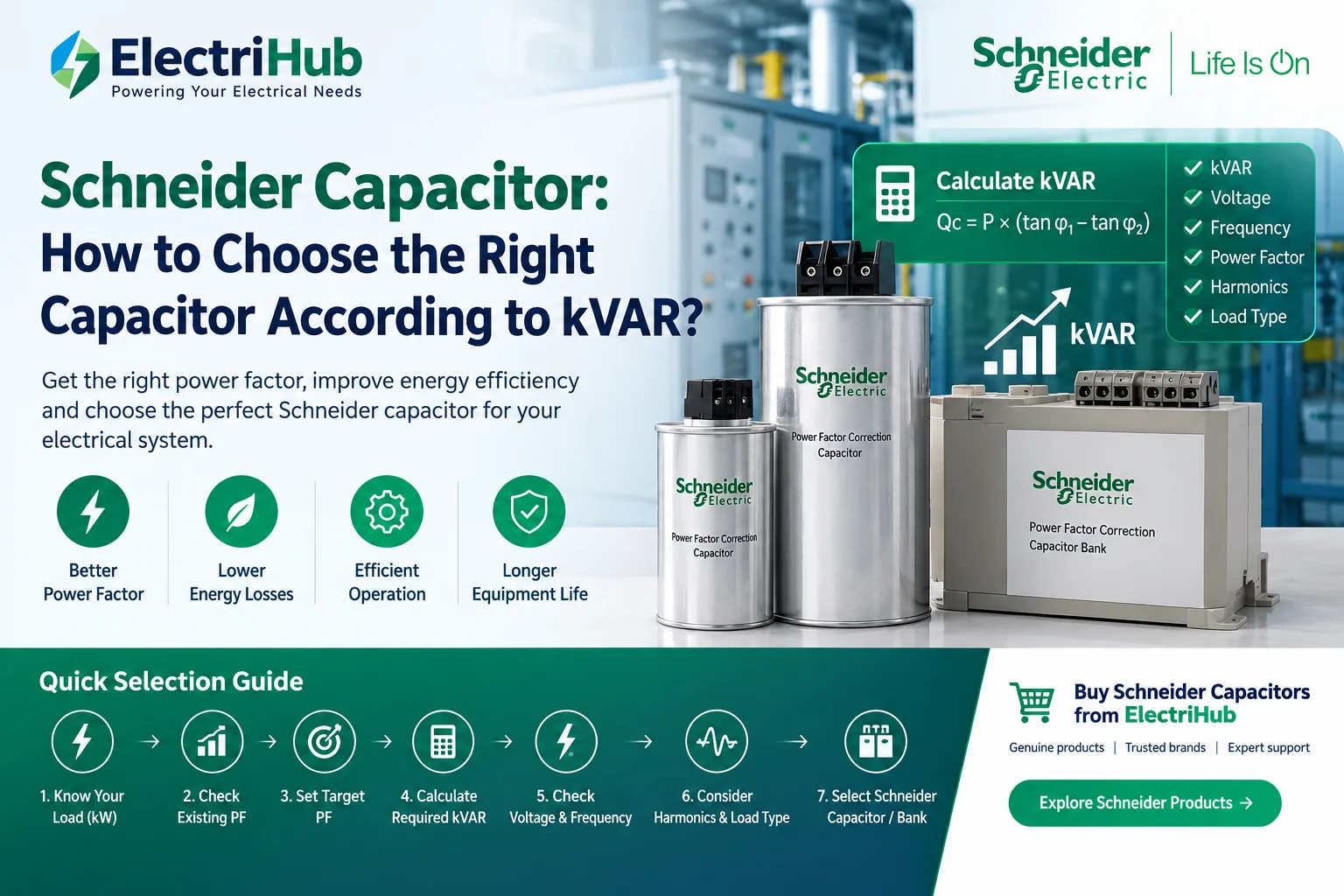
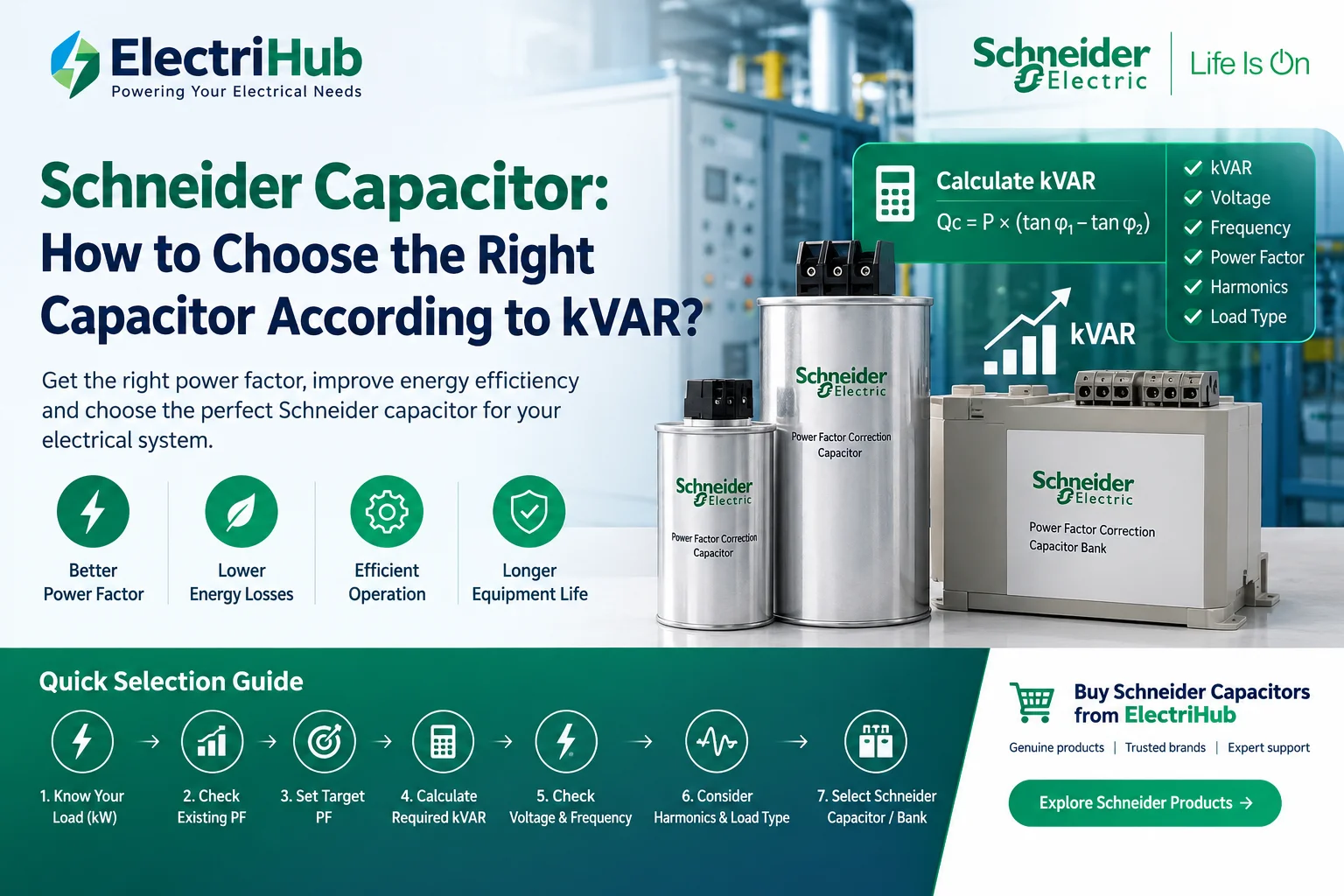
Required kVAR = kW × (tan φ₁ − tan φ₂)
where:
- kW = active power
- φ₁ = angle corresponding to the existing power factor
- φ₂ = angle corresponding to the desired power factor
ElectriHub's capacitor selection guidance also uses this approach for determining required reactive power compensation.
- 440 V Rated Voltage
L&T capacitors are commonly available in 440 V AC versions for low-voltage industrial applications.
For example, the L&T LTCCH305B2 is specified as a 5 kVAR, 440 V, three-phase heavy-duty cylindrical capacitor.
The voltage rating must be selected carefully according to the actual electrical network.
Typical considerations include:
A capacitor should not simply be selected based on kVAR alone. The rated voltage and operating conditions must also be considered.
- Cylindrical and Box-Type Construction
L&T capacitor ranges include different physical constructions designed for different installation requirements.
Cylindrical Capacitors
Cylindrical capacitors are commonly used in:
- APFC panels
- Capacitor banks
- Industrial power distribution
- Motor compensation
- Commercial electrical systems
Box-Type Capacitors
Box-type capacitors can provide a practical solution for capacitor-bank and APFC panel installations where the enclosure and mounting arrangement are important.
Available L&T product references show both cylindrical and box-type capacitor configurations across different duty classes.
- Heavy-Duty Capacitor Design
Industrial electrical systems can experience demanding operating conditions because of voltage fluctuations, temperature, frequent switching, and nonlinear loads.
L&T heavy-duty capacitor models are designed for demanding power-factor correction applications.
For instance, the LTCCH305B2 is described as a heavy-duty resin-filled capacitor using metallized polypropylene construction, with self-healing characteristics and safety provisions including an over-pressure disconnector and finger-proof termination.
These features can help improve operational reliability and safety when the capacitor is correctly selected and installed.
- Self-Healing Technology
Self-healing is an important feature found in many modern metallized-film power capacitors.
If a localized dielectric fault occurs, the affected area can isolate itself while the remaining capacitor continues operating.
This helps support:
- Longer operational life
- Improved reliability
- Better fault tolerance
- Reduced risk of complete capacitor failure
The self-healing characteristic is specifically listed for the L&T LTCCH305B2 capacitor.
- Safety Features
Power capacitors must be designed with appropriate protection because they operate at significant electrical energy levels.
Depending on the model, L&T capacitor designs can incorporate safety mechanisms such as:
- Over-pressure disconnection
- Finger-proof terminals
- Self-healing metallized film
- Resin-filled construction
- Robust terminal arrangements
These features are intended to provide additional protection during abnormal internal capacitor conditions.
- 50 Hz / 60 Hz Applications
Frequency is another important parameter when selecting a capacitor.
Capacitor specifications should match the frequency of the electrical system. L&T capacitor references are available for applications around standard industrial frequencies, while individual product datasheets should always be checked for the exact rated frequency.
For projects involving special frequencies, harmonic filtering, or detuned capacitor banks, engineers should verify the manufacturer's technical documentation before final selection.
- Compatibility with APFC Panels
One of the most common applications of L&T capacitors is in Automatic Power Factor Correction (APFC) panels.
An APFC system automatically switches capacitor steps according to the reactive power demand of the electrical load.
A typical APFC system consists of:
Power Supply → APFC Relay → Capacitor Duty Contactor → Capacitor Bank → Electrical Load
As the load changes, the APFC controller switches capacitor steps ON or OFF to maintain the required power factor.
This makes L&T capacitors suitable for applications where the electrical load varies throughout the day.
L&T Capacitor Applications
L&T capacitors can be used across a wide range of electrical installations.
Industrial Applications
- Manufacturing plants
- Steel plants
- Cement industries
- Textile industries
- Automotive factories
- Chemical plants
- Process industries
Commercial Applications
- Commercial buildings
- Shopping centers
- Office complexes
- Hospitals
- Hotels
- Large HVAC installations
Electrical Distribution Applications
- LT panels
- Main distribution boards
- APFC panels
- Capacitor banks
- Industrial substations
- Motor control systems
L&T Capacitor Technical Specification Example
The following is an example of the type of technical specification engineers should review before selecting an L&T capacitor.
Important: Technical specifications can vary between L&T capacitor models. Always verify the exact part number and manufacturer's datasheet before installation or procurement.
How to Choose the Right L&T Capacitor?
Selecting the correct capacitor requires more than simply choosing a kVAR rating.
Step 1: Check the System Voltage
Determine whether the electrical system operates at 415 V, 440 V, 480 V, 525 V, or another voltage.
The capacitor's rated voltage should be suitable for the actual operating conditions.
Step 2: Calculate Required kVAR
Determine the existing power factor and the target power factor.
Use:
kVAR = kW × (tan φ₁ − tan φ₂)
This provides an estimate of the reactive power compensation required.
Step 3: Determine the Duty
Choose between:
- Standard-duty capacitor
- Heavy-duty capacitor
- Higher-duty capacitor for demanding applications
The correct choice depends on operating conditions and the nature of the electrical load.
Step 4: Check Harmonics
Modern electrical systems frequently contain nonlinear loads such as:
- VFDs
- UPS systems
- Variable-speed drives
- Rectifiers
- Switching power supplies
These loads can introduce harmonics.
If harmonic distortion is significant, a detuned reactor/capacitor combination may be more appropriate than a conventional capacitor bank.
For example, L&T/Lauritz Knudsen offers detuned reactor solutions for APFC applications, with different detuning factors and kVAR ratings.
Step 5: Check Physical Installation
Before installation, verify:
- Available panel space
- Mounting arrangement
- Terminal configuration
- Ventilation
- Ambient temperature
- Required clearances
- Protection devices
Correct installation is essential for reliable capacitor operation.
Why Power Factor Correction Matters
Poor power factor causes an electrical system to draw higher current for the same useful power.
By providing reactive compensation close to the load, capacitors can reduce the reactive current supplied by the upstream electrical network.
This can help:
Improve Power Factor → Reduce Reactive Current → Reduce System Loading → Improve Electrical Efficiency
For industrial facilities with large inductive loads, effective power factor correction can therefore be an important part of overall electrical energy management.
L&T Capacitor for Industrial Power Quality
For industrial users, choosing the correct capacitor is not only about reactive power compensation.
The complete system should be evaluated for:
- Voltage stability
- Harmonic distortion
- Load variation
- Switching frequency
- Ambient temperature
- Capacitor duty
- APFC control
- Detuned reactor requirements
- Protection and maintenance
When these parameters are properly considered, an L&T capacitor bank can become an important component of an effective power-factor correction system.
Buy L&T Capacitors Online from ElectriHub
Looking for L&T capacitors for APFC panels, capacitor banks, industrial power factor correction, or electrical distribution systems?
ElectriHub offers L&T/Lauritz Knudsen capacitor solutions with different kVAR ratings and configurations for industrial electrical applications.
The available L&T capacitor range includes options such as cylindrical and box-type capacitors, with standard-duty and heavy-duty solutions depending on the application. ElectriHub also provides capacitor-related products such as detuned reactors for power-quality applications.
You can explore the L&T capacitor range on ElectriHub, check product specifications, verify part numbers, and submit an enquiry for your electrical project.
Why Choose ElectriHub?
- Genuine industrial electrical products
- Detailed technical specifications
- Multiple kVAR and voltage options
- Product datasheet support
- Online enquiry and ordering
- Support for industrial and project requirements
- Worldwide supply capabilities
Choose the right kVAR. Match the voltage. Check the duty. Control the power factor.
ElectriHub — Your Trusted Source for Industrial Electrical & Automation Products.
Frequently Asked Questions About L&T Capacitors
What is an L&T capacitor used for?
L&T capacitors are primarily used for power factor correction and reactive power compensation in industrial and commercial electrical systems.
What voltage ratings are available?
L&T capacitor ranges include different voltage ratings depending on the product family and application. 440 V AC is a common rating in low-voltage industrial capacitor applications. Always verify the exact product datasheet before selection.
What is the purpose of kVAR in a capacitor?
kVAR represents the reactive power compensation provided by the capacitor. A higher kVAR rating provides greater reactive power compensation at the specified operating conditions.
Can L&T capacitors be used in APFC panels?
Yes. Power-factor correction capacitors are commonly used as capacitor steps in APFC panels. The correct capacitor duty, kVAR, voltage, and switching arrangement should be selected according to the system requirements.
Are L&T capacitors suitable for systems with harmonics?
They can be used in systems with appropriate engineering consideration, but systems with significant harmonic distortion may require detuned reactors or harmonic-filter solutions to protect the capacitor bank and improve power quality.
How do I select the right L&T capacitor?
Check the required kVAR, system voltage, frequency, phase, duty class, harmonic conditions, load profile, and installation environment. For critical applications, consult the product datasheet and a qualified electrical engineer before final selection.