Sign up with Google
 Sign in with Zoho

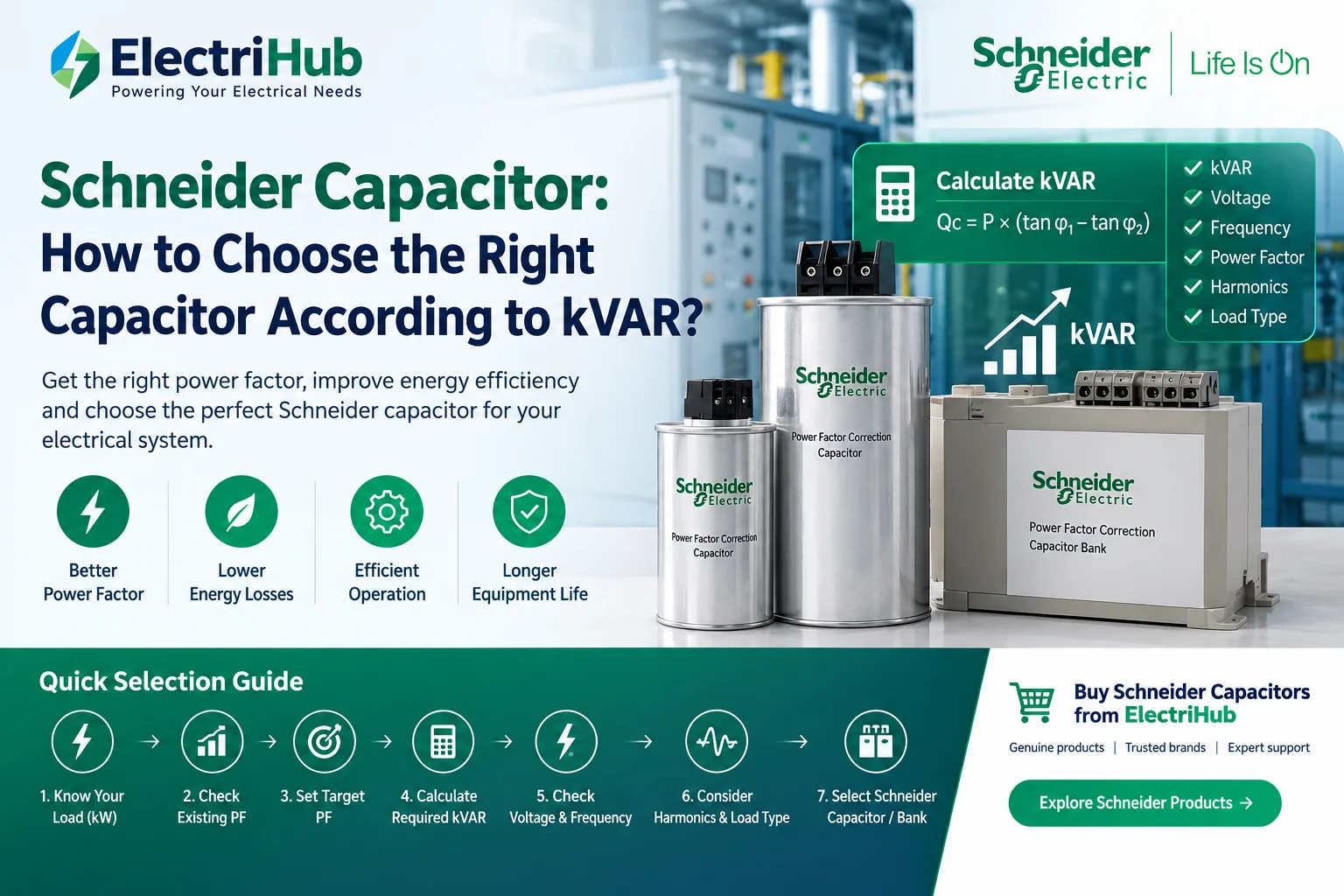
In modern electrical systems, maintaining the right power factor is essential for improving energy efficiency, reducing reactive power demand, and supporting reliable operation of industrial and commercial equipment. One of the most effective ways to achieve power factor correction is by installing the right power factor correction capacitor.
When selecting a Schneider capacitor, one of the most important specifications to consider is its kVAR rating. Choosing a capacitor with the appropriate kVAR capacity ensures that the capacitor bank can deliver the required reactive power without causing overcorrection or unnecessary electrical stress.
In this guide, we will explain what kVAR means, how to calculate the required capacitor kVAR, how to select the appropriate Schneider capacitor, and what factors should be considered before installation.
What Is kVAR in a Capacitor?
kVAR (kilovolt-ampere reactive) represents the reactive power supplied or absorbed by an AC electrical system.
Inductive loads such as:
- Electric motors
- Transformers
- Pumps
- Compressors
- HVAC systems
- Industrial machinery
- Welding equipment
consume reactive power. This reactive power contributes to a lower power factor.
A capacitor supplies reactive power locally, helping compensate for the reactive power consumed by inductive equipment.
In simple terms:
The capacitor's kVAR rating indicates how much reactive power the capacitor can provide for power factor correction.
For example:
The exact capacitor size should always be selected based on the actual electrical load and required power-factor correction rather than simply choosing a larger kVAR rating.
Why Is Correct kVAR Selection Important?
Selecting the correct kVAR rating is critical for effective power factor correction.
- Prevents Under-Correction
If the capacitor kVAR is too low, it may not provide enough reactive power compensation.
This can result in:
- Low power factor
- Higher reactive power demand
- Increased current
- Higher electrical losses
- Possible power-factor penalties
- Prevents Over-Correction
Installing a capacitor with excessive kVAR can push the system toward a leading power factor.
Over-correction may cause:
- Voltage fluctuations
- Resonance problems
- Increased system stress
- Unstable operation
- Harmonic-related issues
Therefore, bigger is not always better when selecting a capacitor.
How to Calculate the Required Capacitor kVAR?
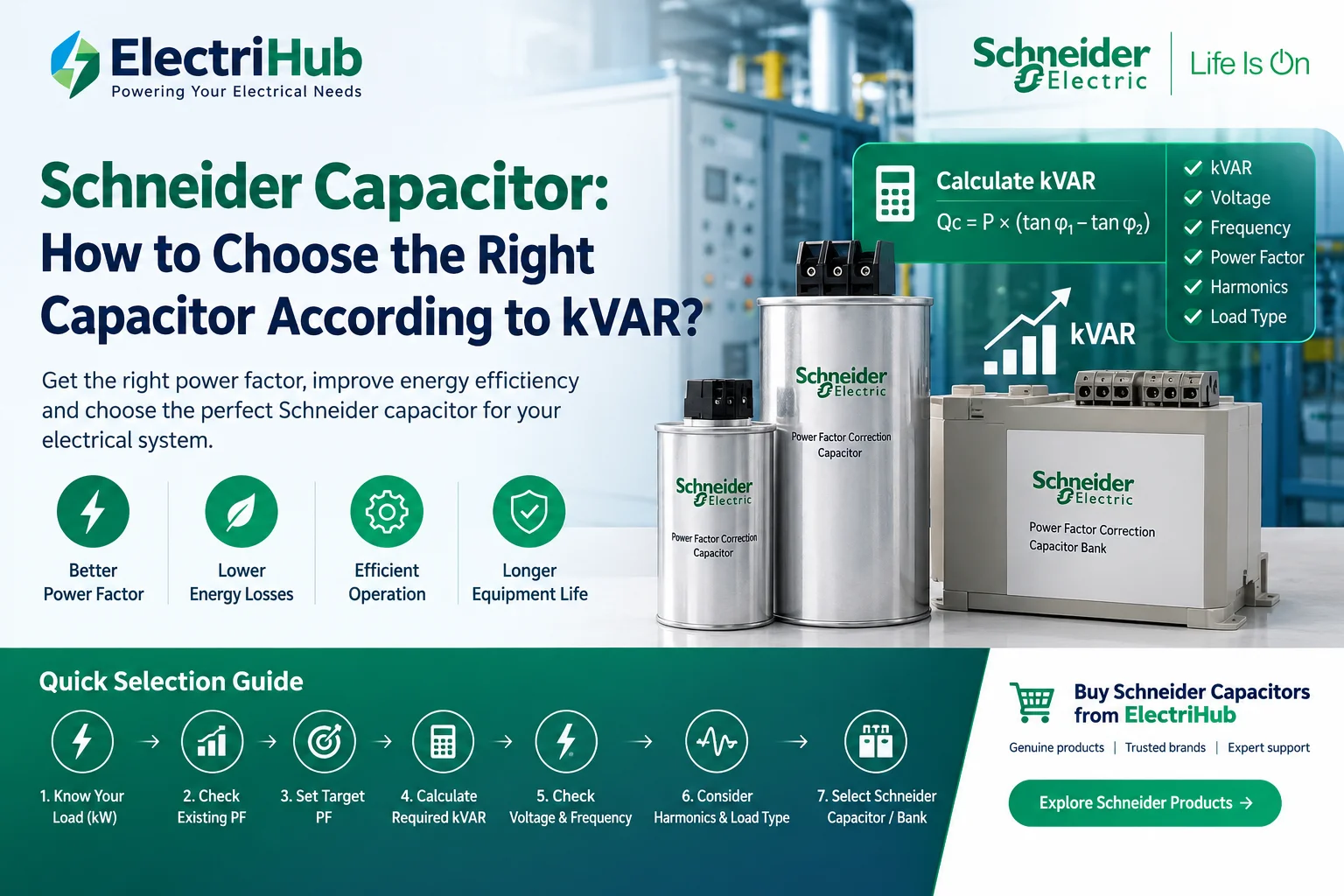
The required capacitor rating can be calculated using the following formula:
Qc = P × (tan φ₁ − tan φ₂)
Where:
- Qc = Required capacitor rating in kVAR
- P = Active power in kW
- φ₁ = Existing power-factor angle
- φ₂ = Desired power-factor angle
- cos φ₁ = Existing power factor
- cos φ₂ = Target power factor
Example
Suppose an industrial facility has:
- Load = 100 kW
- Existing power factor = 0.75
- Desired power factor = 0.95
The required capacitor kVAR can be calculated using:
Qc = 100 × (tan cos⁻¹(0.75) − tan cos⁻¹(0.95))
The result is approximately 55 kVAR.
In practice, the required compensation may be provided using a suitable combination of capacitor steps rather than installing one capacitor of exactly 55 kVAR.
For example, a capacitor bank could be configured using combinations such as:
5 + 10 + 10 + 15 + 15 kVAR
The actual configuration depends on the load profile, switching requirements, harmonics, and power-factor controller settings.
Schneider Capacitor Selection According to kVAR
When selecting a Schneider Electric capacitor, start by determining the amount of reactive power compensation required by your electrical system.
A simple selection process is:
Step 1: Determine the Load in kW
Identify the active power consumed by the electrical installation.
For example:
Load = 250 kW
Step 2: Check the Existing Power Factor
Use an energy meter, power-quality analyzer, or power-factor controller to determine the current power factor.
For example:
Existing PF = 0.78
Step 3: Set the Desired Power Factor
Determine the target power factor according to the application's requirements.
A common target may be around:
0.95–0.99
The ideal target depends on the installation and utility requirements.
Step 4: Calculate Required kVAR
Use:
Qc = P × (tan φ₁ − tan φ₂)
This provides an estimate of the reactive power compensation required.
Step 5: Select the Schneider Capacitor Rating
Once the required kVAR is known, select a Schneider capacitor or capacitor-bank configuration that provides the required compensation.
For example:
For fluctuating loads, an automatic capacitor bank with multiple stages is generally more suitable than one fixed capacitor.
Fixed Capacitor vs Automatic Capacitor Bank
Choosing the correct capacitor arrangement is just as important as choosing the kVAR rating.
Fixed Capacitor
A fixed capacitor provides a constant amount of reactive power compensation.
It can be suitable when:
- Load remains relatively stable
- Motor operation is consistent
- Reactive power demand does not fluctuate significantly
For example, a dedicated motor with a relatively constant operating profile may use a fixed capacitor arrangement.
Automatic Capacitor Bank
An automatic capacitor bank uses multiple capacitor stages that are switched according to the reactive power demand.
It is suitable for:
- Manufacturing plants
- Commercial buildings
- Large HVAC systems
- Variable industrial loads
- Facilities with changing motor loads
For example, a bank may use:
10 + 10 + 20 + 20 + 40 kVAR
The controller can switch different stages ON or OFF depending on the system requirement.
Important Factors Beyond kVAR
Although kVAR is one of the most important specifications, it should not be the only parameter used to select a Schneider capacitor.
- System Voltage
Check the operating voltage of the electrical system.
Common industrial voltages include:
- 380 V
- 400 V
- 415 V
- 440 V
- 480 V
The capacitor voltage rating must be appropriate for the application.
- Frequency
Verify whether the electrical system operates at:
- 50 Hz
- 60 Hz
The capacitor must be suitable for the system frequency.
- Power Factor
Know both the existing and desired power factor.
Without this information, selecting the correct kVAR can be inaccurate.
- Harmonics
Harmonics are particularly important in modern industrial installations.
Loads such as:
- VFDs
- UPS systems
- Rectifiers
- Variable-speed drives
- Switching power supplies
can introduce harmonic distortion.
In such applications, simply installing a standard capacitor may not be the best solution. A detuned capacitor bank with reactors may be required to reduce the risk of resonance and harmonic amplification.
- Load Variation
Determine whether the electrical load is:
Constant or Variable.
For constant loads, fixed compensation may be appropriate.
For variable loads, an automatic capacitor bank with multiple kVAR steps can provide better control.
Schneider Capacitor kVAR Selection: Quick Guide
A practical selection workflow looks like this:
Electrical Load → Existing PF → Target PF → Calculate kVAR → Check Voltage → Check Frequency → Assess Harmonics → Select Capacitor/Bank
This approach helps avoid selecting a capacitor solely based on the size of the electrical load.
Common Mistakes When Selecting Capacitors
Choosing kVAR Without Checking Power Factor
Two facilities with the same kW load can require different capacitor ratings because their existing power factors may be different.
Selecting an Oversized Capacitor
An oversized capacitor can lead to over-correction and potentially undesirable operating conditions.
Ignoring Harmonics
Capacitors connected to systems containing significant nonlinear loads can interact with system inductance and create resonance problems.
Ignoring Load Fluctuations
A fixed capacitor may not be suitable for a facility where reactive power demand changes significantly throughout the day.
Selecting Only by Physical Size
Capacitor selection should consider kVAR, voltage, frequency, harmonics, duty conditions, and application requirements, not just physical dimensions.
Benefits of Choosing the Right Schneider Capacitor
The correct capacitor selection can help an electrical installation achieve:
- Improved power factor
- Reduced reactive power demand
- Lower electrical losses
- Improved utilization of electrical infrastructure
- Better voltage performance
- More efficient operation of electrical equipment
- Reduced risk of power-factor penalties
- Improved overall energy efficiency
The actual savings and performance improvements depend on the electrical installation, load profile, utility tariff, and operating conditions.
Why Schneider Capacitors Are Used for Power Factor Correction
Schneider Electric offers a broad portfolio of electrical and power-management solutions, including equipment used for power factor correction and capacitor-bank applications.
For an installation, the appropriate Schneider solution should be selected according to the system voltage, required kVAR, frequency, load characteristics, harmonics, and installation requirements.
Buy Schneider Capacitors from ElectriHub
Looking for the right Schneider capacitor for your electrical application?
ElectriHub provides an online platform for sourcing electrical and industrial automation products from leading brands.
When selecting a Schneider capacitor through ElectriHub, make sure you have the key specifications ready:
✓ Required kVAR✓ System Voltage✓ Frequency✓ Existing Power Factor✓ Target Power Factor✓ Fixed or Automatic Compensation✓ Harmonic Conditions
This information makes it easier to identify the appropriate capacitor or capacitor-bank solution for your application.
Need help finding the right Schneider capacitor? Explore the available Schneider electrical products on Electrihub and select the solution that matches your system requirements.
Final Takeaway
Choosing a Schneider capacitor according to kVAR starts with understanding the electrical system's actual reactive-power requirement. Instead of selecting a capacitor based only on the kW rating, calculate the required compensation using the existing and target power factor.