Sign up with Google
 Sign in with Zoho

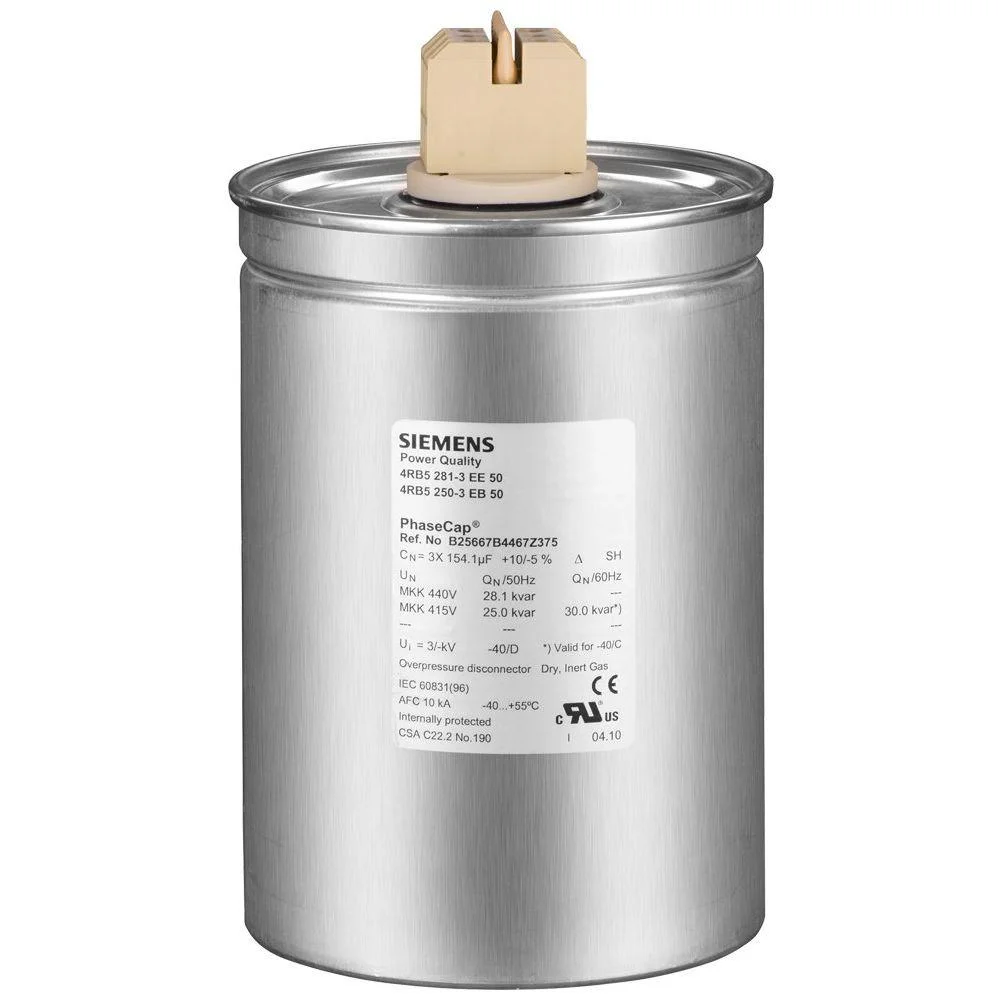
In modern industrial and commercial electrical systems, maintaining a good power factor is essential for efficient power utilization. Motors, transformers, pumps, compressors, HVAC systems, and other inductive loads consume reactive power, which can increase electrical losses and place additional loading on the power distribution system.
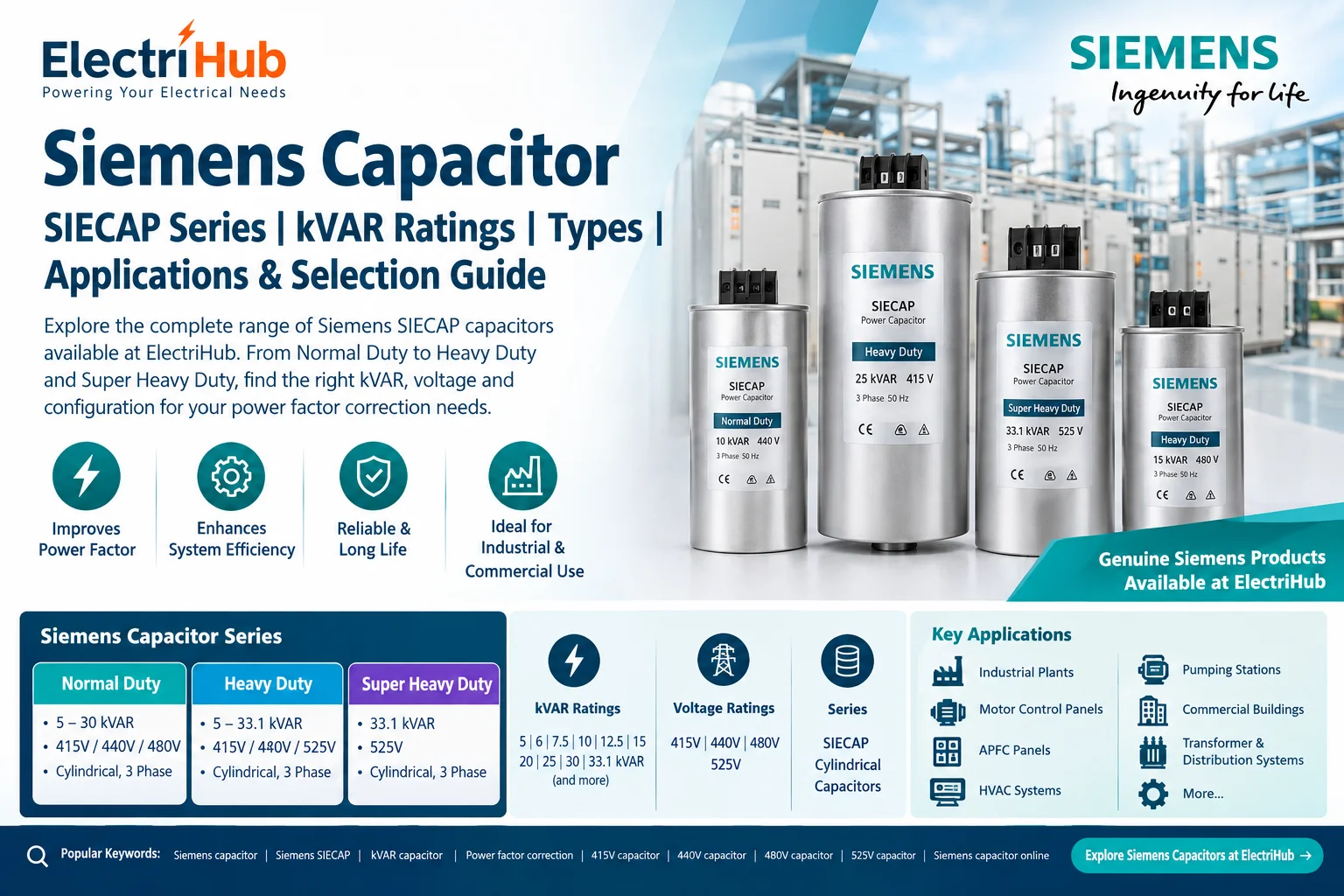
A Siemens capacitor is designed to provide reactive power compensation and support power factor correction (PFC) in electrical installations. Siemens power capacitors are available for applications such as fixed power factor correction, automatic capacitor banks, detuned PFC systems, and dynamic PFC applications. Siemens documentation describes its PhiCap range as using metallized polypropylene (MKP) technology for PFC applications.
For businesses, OEMs, panel builders, and industrial facilities looking for reliable power factor correction equipment, selecting the right capacitor rating, voltage, duty class, and application type is critical.
What Is a Siemens Capacitor?
A Siemens capacitor is an electrical power capacitor used primarily for reactive power compensation and power factor correction.
Inductive equipment such as motors and transformers requires both active and reactive power. While active power performs useful work, reactive power supports the magnetic fields required by inductive equipment.
A properly selected capacitor supplies part of the required reactive power locally. This can improve the overall power factor and reduce unnecessary reactive power flow through the electrical distribution system.
Siemens power capacitors can be used in:
- Automatic power factor correction panels
- Capacitor banks
- Industrial electrical panels
- Commercial buildings
- Motor compensation systems
- LT distribution systems
- Manufacturing plants
- HVAC installations
- Pumping systems
- Transformer installations
- Detuned PFC systems
- Dynamic PFC applications
How Does a Siemens Capacitor Work?
The basic operating principle is reactive power compensation.
When an inductive load operates, it draws reactive power from the electrical network. A capacitor connected to the system supplies capacitive reactive power, which offsets part of the inductive reactive power demand.
The result can include:
Inductive load → Reactive power demand → Capacitor compensation → Improved power factor
For an automatic power factor correction system, multiple capacitor steps can be switched into or out of the circuit according to the reactive power requirement.
This allows the system to maintain the desired power factor under changing loads.
Why Is Power Factor Correction Important?
Poor power factor can cause increased current for the same useful power demand. Higher current can contribute to increased losses and greater loading on cables, transformers, and other distribution equipment.
Power factor correction helps optimize the electrical system by compensating reactive power close to the loads that require it.
Key advantages include:
- Improved Power Factor
A correctly sized capacitor can improve the overall power factor of an electrical installation.
- Reduced Reactive Power Demand
Capacitors compensate reactive power locally, reducing the amount of reactive power that needs to flow through the upstream distribution network.
- Lower Electrical Losses
Reducing unnecessary current flow can help minimize resistive losses in electrical distribution equipment.
- Better Transformer Utilization
Improved power factor can reduce the apparent-power burden on transformers, helping utilize available transformer capacity more effectively.
- Improved System Efficiency
Power factor correction supports more efficient operation of industrial electrical systems.
- Support for APFC Systems
Siemens capacitors can be integrated into automatic power factor correction panels where capacitor steps are switched according to load requirements.
Siemens Capacitor Technology
Siemens power capacitor documentation identifies metallized polypropylene (MKP) technology for its PhiCap range. The documented range includes capacitor designs intended for PFC applications, including fixed and automatic capacitor banks.
Some important design characteristics include:
- MKP dielectric technology
- Compact cylindrical construction
- Self-healing technology
- High pulse current withstand capability
- Overpressure disconnector
- Low-loss operation
- Maintenance-friendly construction
- Applications across industrial and semi-industrial environments
The exact specifications vary by Siemens capacitor model and application.
Siemens Capacitor Ratings
Before selecting a capacitor, engineers should consider several important electrical parameters.
Voltage Rating
The capacitor's rated voltage must be compatible with the electrical system.
Common ratings may include:
- 415 V
- 440 V
- 480 V
- 525 V
The correct voltage rating should always be selected according to the actual application and system conditions.
kVAr Rating
The kVAr rating indicates the reactive power compensation provided by the capacitor.
Different installations require different compensation levels.
For example, ElectriHub currently lists Siemens capacitor models including a 9 kVAr, 440 V, three-phase model and a 25 kVAr, 480 V, three-phase model.
Phase Configuration
Capacitors may be designed for:
- Single-phase applications
- Three-phase applications
Three-phase power capacitors are commonly used in industrial power factor correction systems.
Duty Class
The application environment determines the appropriate capacitor duty.
Depending on the installation, engineers may select:
- Normal Duty
- Heavy Duty
- Super Heavy Duty
For example, ElectriHub lists Siemens 4RB2090-3EE52-8K as a Normal Duty, three-phase, 440 V, 9 kVAr capacitor and Siemens 4RB1250-3EJ50-8K as a Super Heavy Duty, three-phase, 480 V, 25 kVAr capacitor.
Where Are Siemens Capacitors Used?
Industrial Manufacturing
Factories with large numbers of induction motors can experience significant reactive power demand. Capacitor banks can help compensate this demand.
Commercial Buildings
HVAC systems, pumps, elevators, and other inductive loads can benefit from suitable power factor correction.
Pumping Systems
Water treatment plants and industrial pumping stations often operate multiple motors, making power factor management important.
HVAC Systems
Large air-conditioning and ventilation systems can include motors and compressors that require reactive power compensation.
Automatic Power Factor Correction Panels
Siemens capacitors can be used as individual steps in APFC panels, where a controller switches capacitor stages according to changing load conditions.
Electrical Distribution Systems
Power capacitors can support reactive power management in industrial and commercial distribution networks.
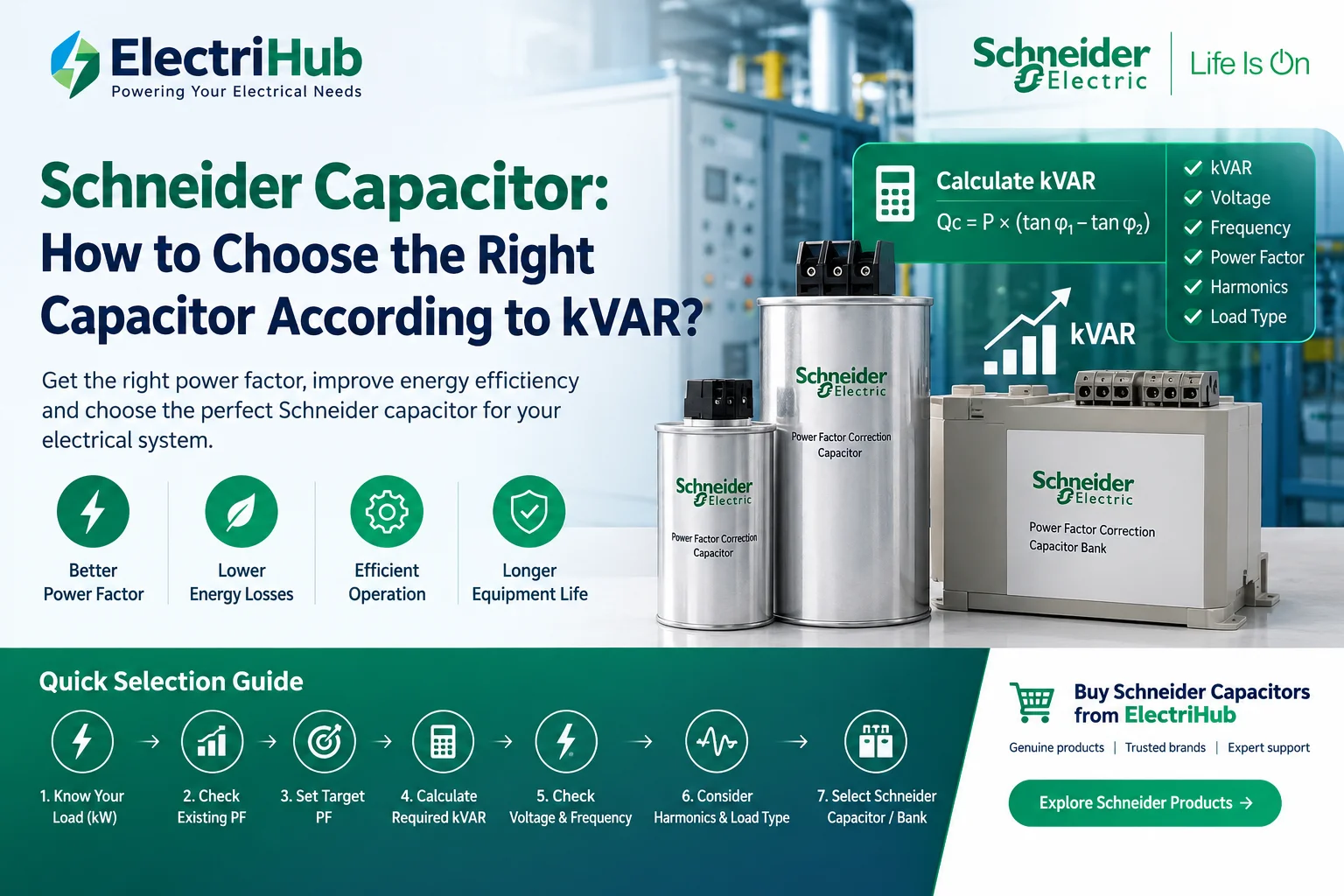
How to Select the Right Siemens Capacitor
Selecting a capacitor should not be based only on the kVAr rating.
Consider the following parameters:
- Determine the Required kVAr
Calculate the reactive compensation required based on the existing and target power factor.
A commonly used relationship is:
Qc = P × (tan φ₁ − tan φ₂)
Where:
- Qc = required capacitor rating in kVAr
- P = active power in kW
- φ₁ = angle corresponding to existing power factor
- φ₂ = angle corresponding to desired power factor
- Check System Voltage
Select a capacitor with an appropriate voltage rating for the electrical system.
- Check Frequency
Confirm compatibility with the system frequency, such as 50 Hz or 60 Hz.
- Consider Harmonics
Harmonic-producing equipment such as VFDs, UPS systems, and power electronic converters can influence capacitor selection.
In installations with significant harmonics, a detuned capacitor bank or suitable harmonic mitigation strategy may be required.
- Select the Correct Duty
Choose normal, heavy-duty, or super-heavy-duty capacitors according to the application conditions and engineering requirements.
- Check Temperature and Installation Conditions
Ambient temperature, ventilation, enclosure design, and mounting conditions can affect capacitor performance and service life.
- Verify Protection and Switching Equipment
Capacitor installations should use suitable protection and switching equipment, including capacitor-duty contactors where required.
Siemens Capacitor Maintenance & Safety
Power capacitors require appropriate installation and safety procedures.
Siemens installation guidance emphasizes using the correct capacitor type, effective grounding, isolation provisions, and proper handling because capacitor units can remain electrically charged after disconnection.
Important precautions include:
- Follow the manufacturer's installation instructions.
- Verify the capacitor rating before installation.
- Ensure proper grounding.
- Provide appropriate isolation.
- Allow adequate discharge time.
- Do not assume a disconnected capacitor is immediately safe.
- Inspect terminals and connections periodically.
- Check for abnormal heating, swelling, or physical damage.
- Ensure adequate ventilation.
- Use suitable protective devices.
- Consider harmonic conditions before installing capacitor banks.
Electrical installation and maintenance should always be performed by qualified personnel following applicable electrical standards and manufacturer instructions.
Siemens Capacitor vs. Conventional Power Factor Correction Capacitors
When selecting a power capacitor, engineers should consider more than the brand name.
Important evaluation parameters include:
Siemens Capacitor for APFC Panels
An Automatic Power Factor Correction (APFC) panel automatically controls capacitor stages to maintain the desired power factor.
A typical APFC system may include:
- Power factor controller
- Siemens capacitors
- Capacitor-duty contactors
- HRC fuses or suitable protection
- CTs
- Busbars
- Discharge resistors/devices
- Harmonic detuning reactors where required
As the electrical load changes, the controller can connect or disconnect capacitor stages to maintain the target power factor.
This makes Siemens capacitors suitable for industrial installations where reactive power demand varies throughout the day.
Why Choose Siemens Capacitors?
Siemens is a well-known electrical engineering brand, and its power capacitor portfolio is designed for applications involving reactive power compensation.
Depending on the selected model, users can benefit from features such as:
- Reliable power factor correction
- MKP technology
- Self-healing dielectric technology
- Compact construction
- High pulse-current capability
- Long service life
- Multiple kVAr options
- Multiple voltage ratings
- Applications in fixed and automatic PFC systems
The exact specifications should always be verified against the relevant Siemens datasheet before installation.
Buy Siemens Capacitor Online from ElectriHub
Looking for a Siemens capacitor for power factor correction, APFC panels, capacitor banks, or industrial electrical systems?
ElectriHub offers Siemens capacitor products for industrial and commercial applications, including different voltage, kVAr, phase, and duty configurations.
For example, ElectriHub currently lists Siemens capacitor models such as:
- Siemens 4RB2090-3EE52-8K – 3-phase, 440 V, 9 kVAr, Normal Duty
- Siemens 4RB2125-3EE53-8K – 3-phase, 415 V, 12.5 kVAr, Heavy Duty
- Siemens 4RB1250-3EJ50-8K – 3-phase, 480 V, 25 kVAr, Super Heavy Duty
Specifications and availability can vary by model.
Why Buy Siemens Capacitors from ElectriHub?
With ElectriHub, customers can explore Siemens capacitor options for:
- Industrial power factor correction
- APFC panels
- Capacitor banks
- Motor compensation
- Commercial electrical systems
- OEM applications
- Panel-building projects
- Industrial automation and electrical projects
ElectriHub product listings provide technical specifications, product codes, datasheets, and purchasing/inquiry options to help customers identify the appropriate product.
Explore Siemens Capacitors at ElectriHub and select the right kVAr, voltage, phase, and duty rating for your application.
Frequently Asked Questions About Siemens Capacitors
What is a Siemens capacitor used for?
A Siemens power capacitor is primarily used for reactive power compensation and power factor correction in electrical systems.
How does a capacitor improve power factor?
A capacitor supplies capacitive reactive power that offsets part of the reactive power drawn by inductive loads, helping improve the overall power factor.
What is kVAr in a capacitor?
kVAr represents the reactive power compensation capacity of the capacitor.
Can Siemens capacitors be used in APFC panels?
Yes. Siemens power capacitors can be used in automatic capacitor banks and APFC systems when the selected capacitor is properly matched to the panel design and system requirements.
How do I choose a Siemens capacitor?
Consider the required kVAr, system voltage, phase, frequency, duty class, harmonic conditions, temperature, and installation requirements.
Where can I buy Siemens capacitors online?
Siemens capacitor models are available through Electrihub, where users can check product specifications and submit orders or inquiries for applicable models.
Final Thoughts
A properly selected Siemens capacitor can play an important role in improving power factor and managing reactive power in industrial and commercial electrical systems.
From APFC panels and capacitor banks to motor compensation and industrial distribution systems, Siemens power capacitors offer solutions across a wide range of power factor correction applications.
However, capacitor selection should always be based on the actual electrical system requirements. Voltage, kVAr rating, duty class, harmonics, operating temperature, and protection requirements should all be evaluated before installation.
For businesses, OEMs, panel builders, and industrial users looking for Siemens capacitors online, ElectriHub provides a convenient platform to explore available Siemens models and their technical specifications.
Choose the right Siemens capacitor. Improve power factor. Optimize your electrical system with ElectriHub.