Sign up with Google
 Sign in with Zoho

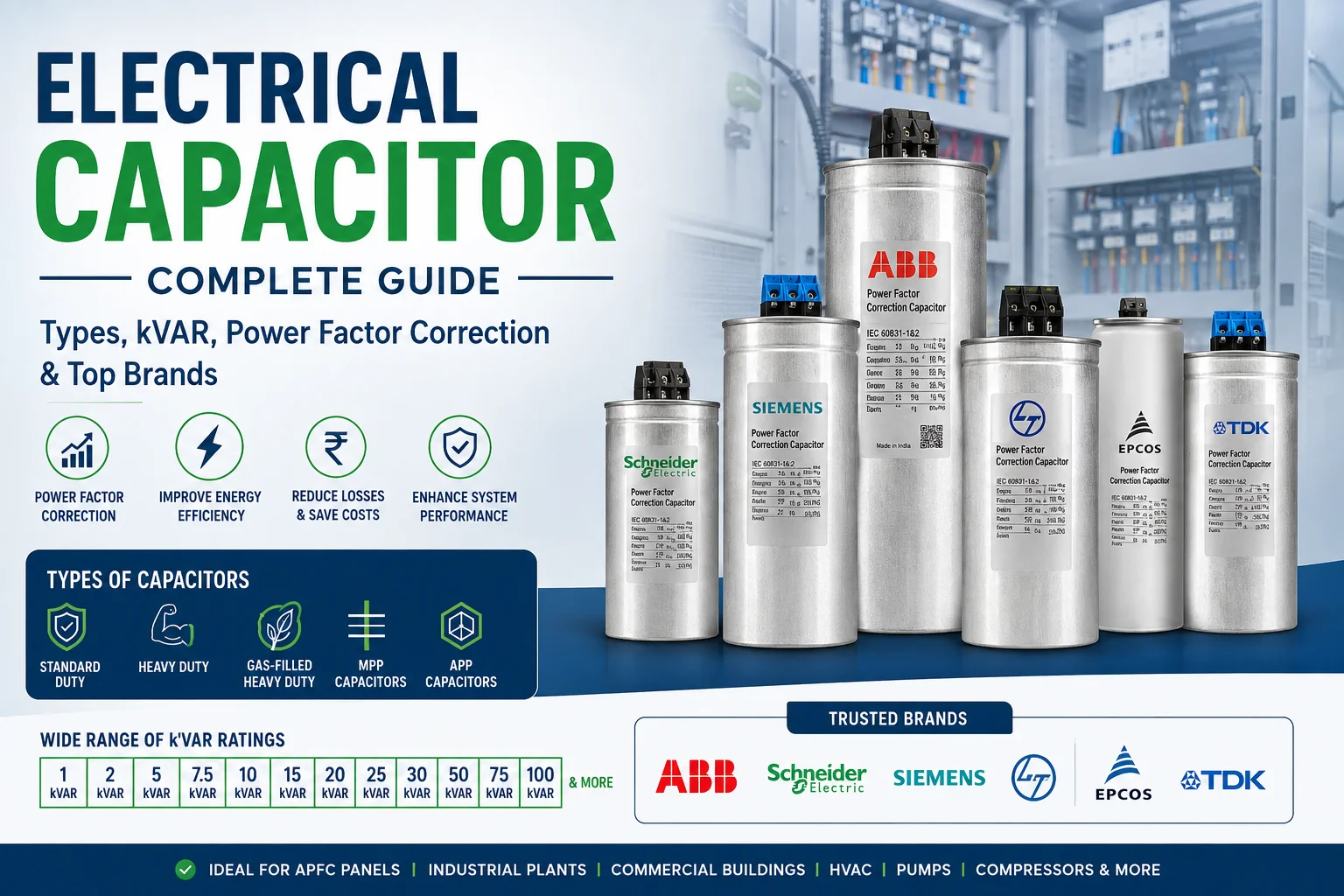
In modern electrical and industrial systems, power efficiency, reliable power distribution, and effective energy management are essential for maintaining smooth operations. One of the most widely used solutions for improving electrical efficiency is a power factor correction capacitor.
Electrical systems containing induction motors, transformers, compressors, pumps, HVAC equipment, welding machines, and other inductive loads can consume significant amounts of reactive power. This reactive power increases the current flowing through the electrical network without directly contributing to useful mechanical work. Power factor correction capacitors help compensate for this reactive power and improve the overall power factor of the system.
Whether you are designing an APFC panel, upgrading an industrial electrical system, or replacing an existing capacitor bank, selecting the correct kVAr capacitor, voltage rating, duty class, and capacitor type is important for reliable performance.
ElectriHub offers a range of electrical capacitors designed for power factor correction applications, including different kVAr ratings, voltage ratings, duty classifications, and construction types. The capacitor category includes options such as cylindrical capacitors and box-type capacitors for different electrical requirements.
What Is a Power Factor Correction Capacitor?
A power factor correction capacitor is an electrical component used to compensate for the reactive power consumed by inductive electrical loads.
Inductive loads such as motors and transformers require reactive power to establish their magnetic fields. When reactive power demand increases, the electrical system may draw higher current from the supply.
A capacitor produces reactive power with an opposite characteristic to that of an inductive load. When appropriately connected to an electrical system, the capacitor compensates for part of the reactive power demand.
The result can include:
- Improved power factor
- Reduced reactive power demand
- Lower electrical losses
- Better utilization of electrical equipment
- Improved system efficiency
- Reduced loading on transformers and cables
- Improved power quality when properly engineered
For industrial facilities, capacitor banks and automatic power factor correction systems are commonly used where the reactive power requirement changes with the operating load.
Why Is Power Factor Important?
Power factor indicates how effectively an electrical system converts supplied electrical power into useful work.
In a simplified AC electrical system:
Power Factor = Active Power / Apparent Power
A power factor closer to 1 indicates more efficient utilization of apparent power.
A low power factor means that a larger amount of current may be required to deliver the same useful active power. This can increase losses and place additional loading on electrical infrastructure.
Common causes of low power factor include:
- Induction motors
- Transformers
- Pumps
- Compressors
- HVAC systems
- Welding equipment
- Industrial machinery
- Fluorescent lighting systems
- Other inductive electrical loads
A properly designed power factor correction capacitor bank can compensate for reactive power and help improve the overall power factor of the installation.
How Does a Power Factor Correction Capacitor Work?
The operating principle is relatively straightforward.
An inductive load consumes reactive power. A capacitor supplies reactive power locally, reducing the amount of reactive power that needs to travel through upstream electrical equipment.
For example, consider an industrial motor connected to a distribution system. Without power factor correction, the motor may draw both active and reactive power from the supply.
When a suitable capacitor is connected:
Motor → Reactive Power Demand
Capacitor → Reactive Power Compensation
This reduces the reactive power supplied by the upstream network.
In an automatic system, an APFC relay continuously monitors the electrical system and switches capacitor stages according to the reactive power requirement. This allows the system to add or remove capacitor steps as the load changes.
What Is a Capacitor Bank?
A capacitor bank is an arrangement of multiple capacitors connected together to provide the required reactive power compensation.
Instead of using a single capacitor for a large industrial load, several capacitor stages can be combined.
For example, an APFC panel could contain multiple capacitor stages such as:
- 5 kVAr
- 10 kVAr
- 20 kVAr
- 25 kVAr
- 30 kVAr
- 50 kVAr
The actual configuration depends on the electrical system and required compensation.
Capacitor banks are widely used in:
- Manufacturing plants
- Commercial buildings
- Data centers
- Industrial facilities
- Process industries
- Pumping stations
- HVAC installations
- Infrastructure projects
- Electrical distribution systems
Types of Electrical Capacitors Used for Power Factor Correction
Selecting the correct capacitor type is important because electrical installations have different operating conditions.
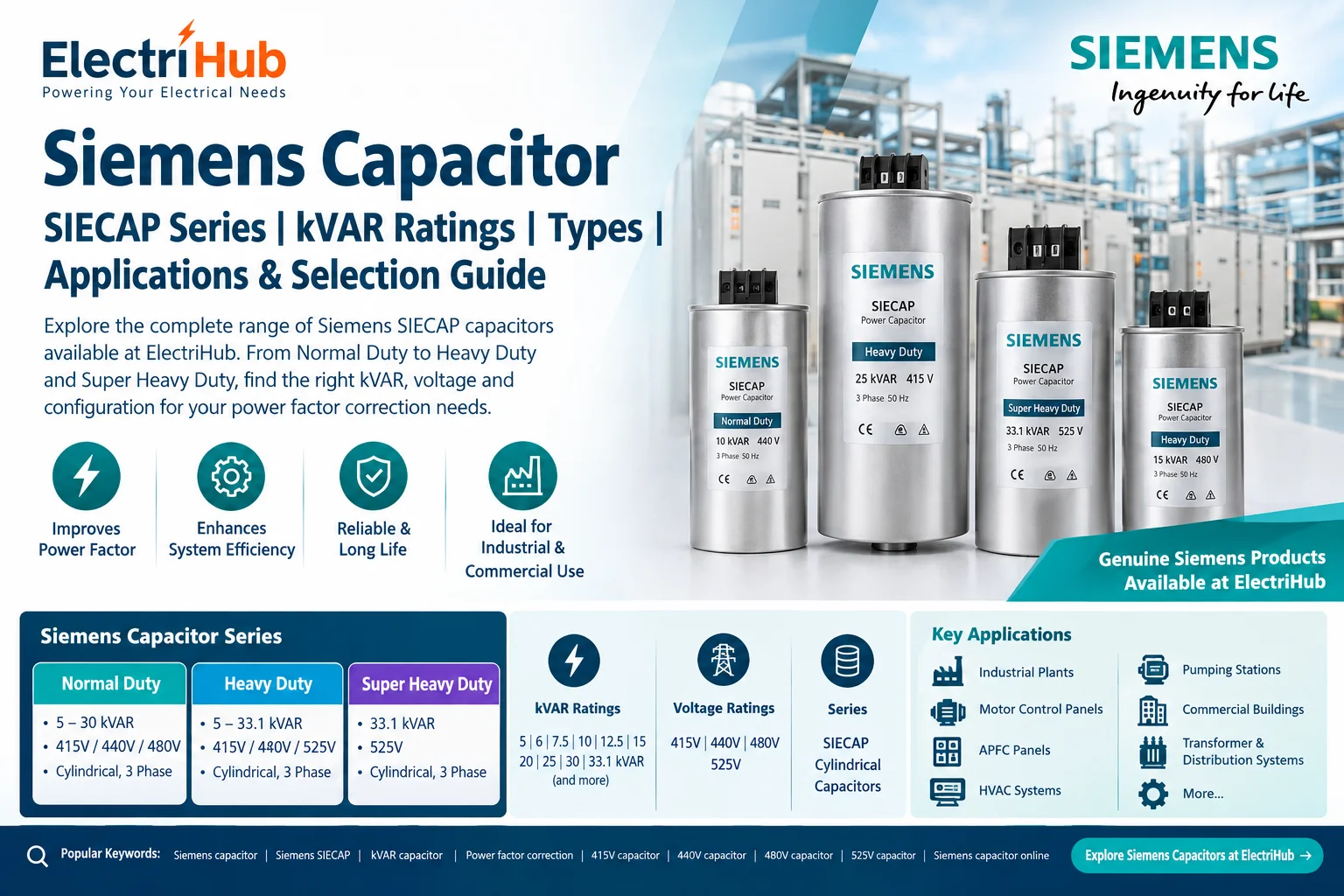
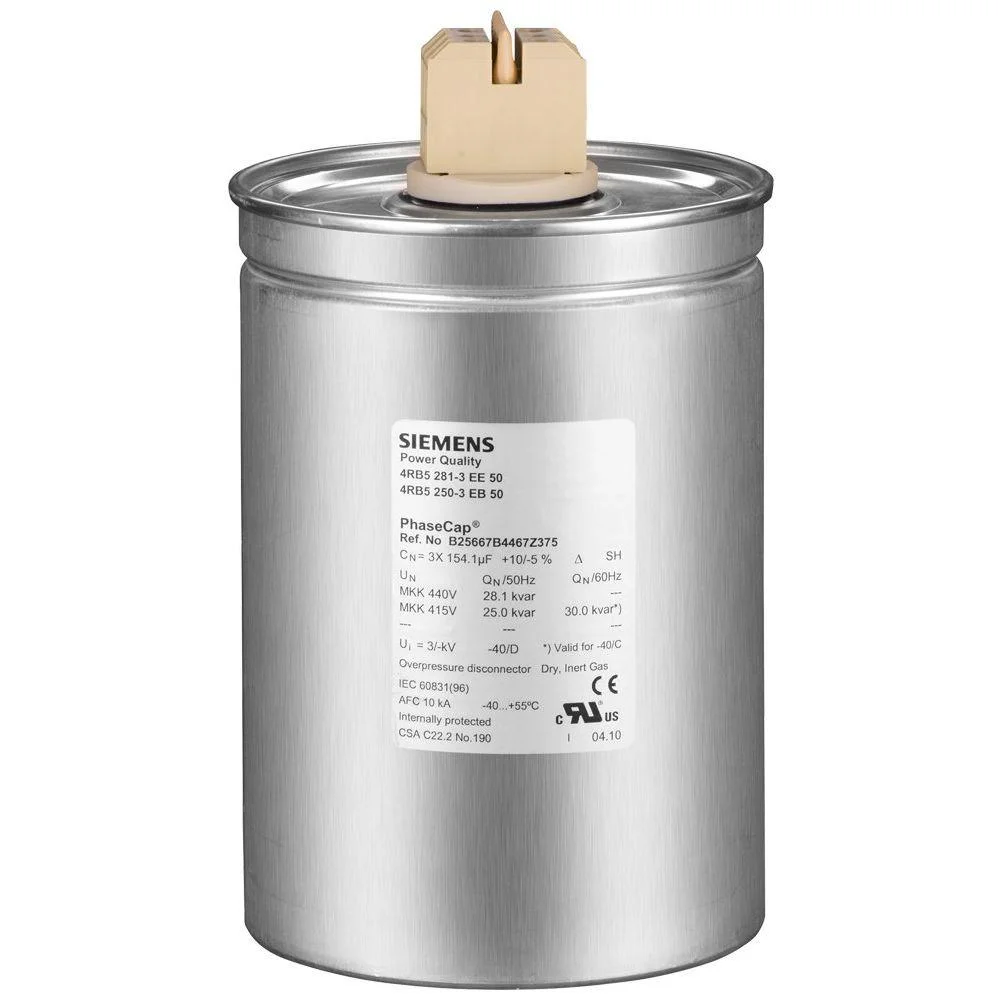
- Cylindrical Capacitors
Cylindrical capacitors are widely used in power factor correction systems and capacitor banks.
Their cylindrical construction provides a compact solution for panel installation and industrial applications.
Depending on the application, cylindrical capacitors may be available in different:
- kVAr ratings
- Voltage ratings
- Duty classes
- Frequencies
- Capacitor technologies
ElectriHub's capacitor category includes cylindrical capacitor options with different power ratings and voltage specifications.
- Box-Type Capacitors
Box-type capacitors provide an alternative construction suitable for specific panel and power factor correction applications.
They can be integrated into capacitor banks and APFC systems depending on the required electrical specifications and installation configuration.
The ElectriHub category includes box-type capacitor products alongside cylindrical capacitor options.
- Heavy-Duty Capacitors
Heavy-duty capacitors are designed for applications where operating conditions require enhanced capability compared with standard-duty applications.
Industrial environments may experience:
- Variable loads
- Higher operating temperatures
- Frequent switching
- Harmonic currents
- Long operating hours
Therefore, capacitor duty selection should be based on the actual electrical environment rather than simply selecting a capacitor based on its kVAr rating.
Understanding kVAr in Capacitors
One of the most important specifications when selecting a power factor correction capacitor is its kVAr rating.
kVAr represents kilovolt-amperes reactive and indicates the amount of reactive power compensation provided by the capacitor.
Capacitors are available in a wide range of kVAr ratings. The ElectriHub category includes various ratings, ranging from small capacitor ratings to significantly higher ratings for industrial power factor correction applications.
The required kVAr depends on:
- Existing power factor
- Desired power factor
- Active power consumption
- Load profile
- Operating voltage
- Frequency
- Motor and transformer loading
- Harmonic conditions
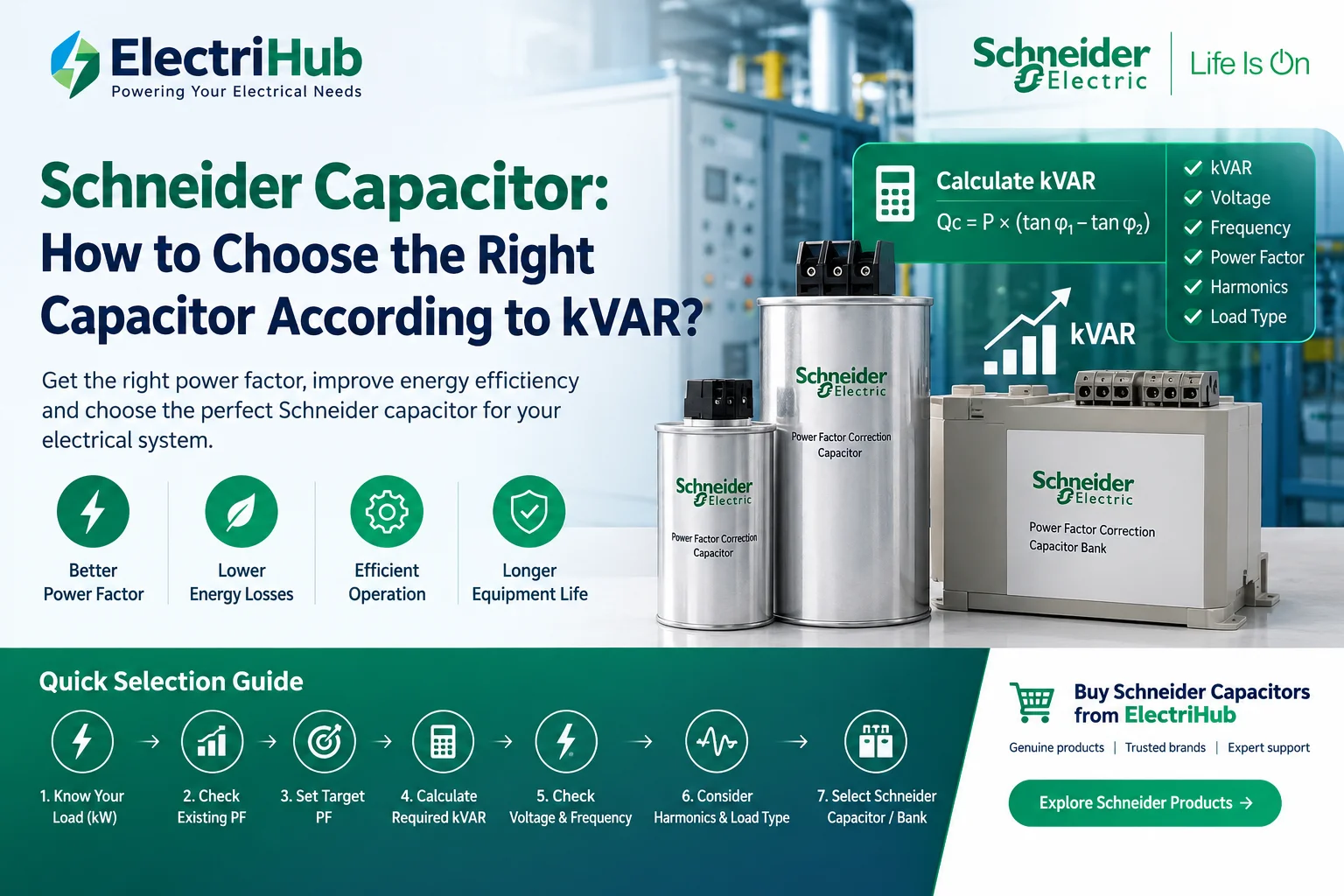
Power Factor Correction Calculation
A commonly used calculation for estimating the required capacitor compensation is:
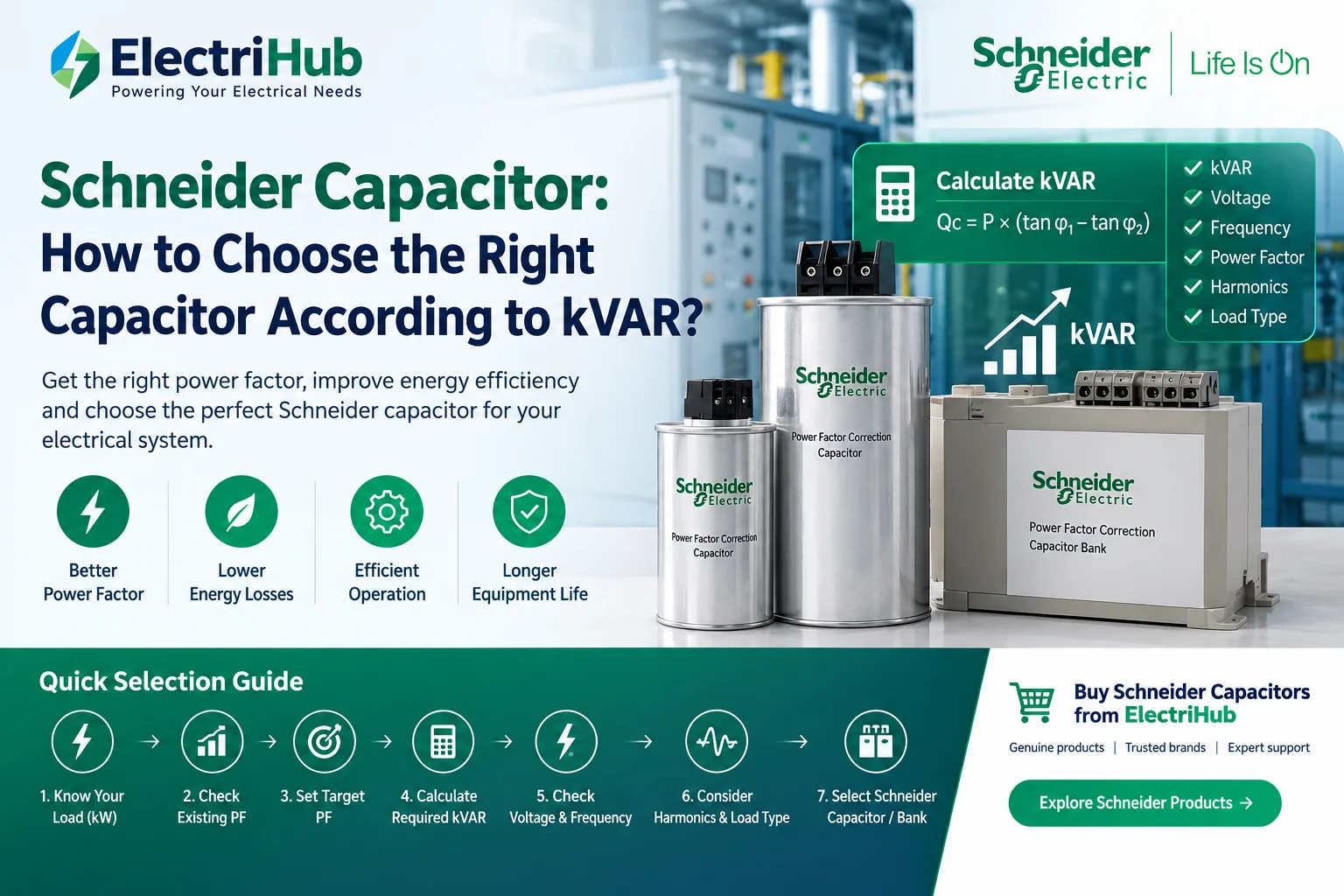
Qc = P × (tan φ₁ − tan φ₂)
Where:
- Qc = Required capacitor rating in kVAr
- P = Active power in kW
- φ₁ = Existing power factor angle
- φ₂ = Desired power factor angle
This calculation provides an engineering starting point, but final capacitor selection should consider actual operating measurements and system conditions.
Important Capacitor Specifications to Check
Before selecting an electrical capacitor, consider the following specifications.
- Rated Voltage
The capacitor's rated voltage must be appropriate for the electrical system.
Common capacitor voltage ratings include:
- 415 V
- 440 V
- 480 V
- 525 V
- 690 V
- Other application-specific ratings
The ElectriHub capacitor category includes multiple voltage options, including 415 V, 440 V, 480 V, 525 V and 690 V variants.
- kVAr Rating
The kVAr rating determines the reactive power compensation provided by the capacitor.
Choosing too little capacitance may result in insufficient power factor correction, while excessive capacitance can create an overcompensation condition.
- Duty Rating
Capacitors can be selected according to application requirements such as:
- Standard Duty
- Heavy Duty
- Super Heavy Duty
- Ultra Heavy Duty
The appropriate duty rating depends on the electrical environment and expected operating conditions. ElectriHub's category includes multiple duty classifications.
- Capacitor Type
Depending on the application, you may need:
- Cylindrical capacitor
- Box-type capacitor
- Heavy-duty capacitor
- Standard-duty capacitor
- Specialized power capacitor
- Frequency
The capacitor must be suitable for the system frequency, such as 50 Hz or 60 Hz, depending on the electrical installation.
- Harmonic Environment
Harmonics are particularly important when capacitors are installed alongside nonlinear loads such as:
- Variable frequency drives
- UPS systems
- Rectifiers
- Switching power supplies
- Industrial electronic equipment
In harmonic-rich systems, engineers may consider detuned reactors with capacitor banks to reduce the risk of unwanted resonance and protect the power factor correction system.
Capacitors in APFC Panels
One of the most common applications of power factor correction capacitors is an Automatic Power Factor Correction (APFC) panel.
An APFC panel generally includes:
- Capacitor stages
- APFC relay/controller
- Capacitor-duty contactors or switching devices
- Protection devices
- Busbars
- Fuses or circuit protection
- Current transformer
- Control wiring
The APFC controller measures the system's power factor and determines when capacitor stages need to be connected or disconnected.
For example:
Low Power Factor → APFC Controller Detects Demand → Capacitor Stage Energized → Reactive Power Compensated
As the load changes, the controller can adjust the number of capacitor stages in operation.
This makes APFC systems particularly useful for industrial facilities where electrical loads vary throughout the day.
Benefits of Power Factor Correction Capacitors
Installing the correct power factor correction capacitor can provide several electrical and operational benefits.
Improved Power Factor
The primary purpose of a capacitor is to compensate for reactive power and improve the power factor.
Reduced Reactive Power Demand
Local reactive power compensation reduces the reactive power that needs to be supplied through upstream distribution equipment.
Reduced Current
For a given active power requirement, improving power factor can reduce the current required from the supply.
Reduced I²R Losses
Lower current can help reduce resistive losses in cables and other electrical conductors.
Better Equipment Utilization
Improved power factor can help utilize transformer, cable, and distribution capacity more effectively.
Improved Energy Efficiency
Power factor correction supports more efficient operation of electrical distribution systems.
Potential Reduction in Utility Charges
Depending on the electricity tariff and utility structure, improving power factor may help reduce reactive-power-related or power-factor-related charges.
Actual savings depend on the local tariff structure, load profile, and existing system performance.
Where Are Power Factor Correction Capacitors Used?
Industrial capacitors are used in a wide range of electrical installations.
Manufacturing Plants
Factories with large numbers of motors, pumps, compressors, and machines can benefit from properly engineered power factor correction.
Commercial Buildings
Large commercial buildings use electrical equipment such as HVAC systems, elevators, pumps, and ventilation systems that may contribute to reactive power demand.
HVAC Systems
Large HVAC installations often contain motors and compressors that can create reactive power requirements.
Water and Wastewater Plants
Pumps and motors are major electrical loads in water treatment and pumping applications.
Data Centers
Data centers use complex electrical infrastructure and require careful power-quality and power-factor management.
Process Industries
Steel, cement, chemical, textile, paper, and other process industries often use large motor-driven equipment where power factor correction can be important.
Power Factor Correction Capacitor vs Capacitor Bank
Although the terms are sometimes used interchangeably, they describe different configurations.
A capacitor is an individual reactive power compensation component.
A capacitor bank is a combination of multiple capacitors used together to provide a larger or adjustable amount of compensation.
A fixed capacitor may be suitable for a relatively constant load, while an APFC capacitor bank is more appropriate where the reactive power requirement changes significantly.
Fixed Capacitor vs APFC Capacitor Bank
Fixed Capacitor
A fixed capacitor remains connected to the electrical system while the associated load is operating.
It can be suitable where the reactive power requirement is relatively stable.
APFC Capacitor Bank
An APFC system automatically switches capacitor stages according to the system requirement.
It is generally more suitable for installations with:
- Variable loads
- Multiple motors
- Changing production schedules
- Fluctuating reactive power demand
- Different operating conditions
The choice should be based on load characteristics and engineering requirements.
How to Choose the Right Capacitor
Selecting the right electrical capacitor for power factor correction requires more than looking at the price or kVAr rating.
Consider these factors:
- Determine the existing power factor.
- Identify the desired power factor.
- Measure the actual electrical load.
- Calculate the required reactive power compensation.
- Select the appropriate kVAr rating.
- Check the system voltage.
- Verify the operating frequency.
- Evaluate harmonic distortion.
- Select the appropriate duty rating.
- Choose the correct capacitor construction.
- Verify compatibility with the APFC panel.
- Consider required switching frequency and operating conditions.
For larger industrial installations, capacitor selection should be validated by a qualified electrical engineer using actual system measurements.
Why Choose L&T Capacitors?
L&T capacitors, including products associated with the Lauritz Knudsen portfolio, are available in different configurations and ratings for power factor correction applications.
The ElectriHub category currently lists several L&T/Lauritz Knudsen capacitor products, including super heavy-duty cylindrical capacitors, APP box capacitors, heavy-duty cylindrical capacitors, and standard-duty cylindrical capacitors.
The listed products also cover different kVAr and voltage combinations, allowing users to select a capacitor according to their specific electrical system requirements.
Buy Capacitors Online from ElectriHub
Choosing the right power factor correction capacitor is essential for improving electrical system efficiency and maintaining reliable power distribution.
ElectriHub provides a dedicated range of electrical capacitors for power factor correction, with options categorized according to manufacturer, phase, duty, type, rated voltage, and kVAr rating.
Whether you are looking for a kVAr capacitor, industrial capacitor, cylindrical capacitor, box-type capacitor, heavy-duty capacitor, or capacitor for an APFC panel, reviewing the technical specifications before selection can help ensure compatibility with your electrical system.
Explore the capacitor range at ElectriHub and select the appropriate power factor correction capacitor for your application.
Frequently Asked Questions About Power Factor Correction Capacitors
What is a power factor correction capacitor?
A power factor correction capacitor is an electrical component used to compensate for reactive power in AC electrical systems and improve power factor.
What is kVAr in a capacitor?
kVAr indicates the reactive power compensation capability of a capacitor. A higher kVAr rating generally means the capacitor can provide more reactive power compensation.
What capacitor is used in an APFC panel?
APFC panels typically use power capacitors arranged in multiple stages. The required capacitor type and kVAr rating depend on system voltage, load profile, power factor, harmonics, and required compensation.
How do I calculate the capacitor size for power factor correction?
The required compensation can be estimated using the active power and existing and desired power factors. A commonly used formula is:
Qc = P × (tan φ₁ − tan φ₂)
Actual capacitor selection should also consider measured system conditions and harmonic content.
Can capacitors reduce electricity bills?
Power factor correction can potentially reduce power-factor-related or reactive-energy charges where such charges are included in the applicable utility tariff. Savings depend on the electrical system and local billing structure.
What is the difference between a cylindrical and box-type capacitor?
The primary difference is their physical construction and design configuration. Both can be used for power factor correction, but the appropriate choice depends on the panel design, electrical specifications, installation requirements, and manufacturer recommendations.
What voltage rating should I select for a power capacitor?
The capacitor's voltage rating should be compatible with the electrical system and the application. Common ratings include 415 V, 440 V, 480 V, 525 V and 690 V, among others. ElectriHub's current category provides multiple voltage options.
Are heavy-duty capacitors suitable for industrial applications?
Heavy-duty and super-heavy-duty capacitors can be appropriate for demanding industrial environments, but selection should be based on the actual load, operating conditions, harmonics, switching requirements, and manufacturer's specifications.
Conclusion
A power factor correction capacitor is an important component for improving the efficiency and utilization of AC electrical systems. By compensating for reactive power, properly selected capacitors can help improve power factor, reduce current, minimize distribution losses, and make better use of electrical infrastructure.
From industrial capacitors and kVAr capacitors to cylindrical and box-type capacitors, the correct selection depends on system voltage, reactive power requirements, duty rating, harmonics, load profile, and installation conditions.
For businesses searching to buy capacitors online, ElectriHub provides a dedicated capacitor category with multiple manufacturers, ratings, voltage options, duty classifications, and capacitor types.
Choose the right capacitor based on your actual electrical requirements and explore the available power factor correction capacitors at Electrihub for industrial and commercial applications.