Sign up with Google
 Sign in with Zoho

Blockchain has a reputation for making simple things complicated.
And sometimes, that reputation is deserved.
If a business only needs to store customer records, manage employees, process orders, or run a standard SaaS application, a conventional database will usually do the job better.
The interesting cases are different.
Consider a supply chain where manufacturers, distributors, logistics providers, and retailers all need to verify the same information. Each organization maintains its own systems, and reconciling those records takes time.
Or consider a digital asset platform where ownership needs to be transferred according to rules that should execute automatically rather than depending on a central administrator.
These are the situations where blockchain starts becoming more than a technology trend.
The Real Question Isn't "Should We Use Blockchain?"
It is:
Where does trust become a technical problem?
When several independent parties need to work together, questions around ownership, verification, transaction history, and control can become difficult to solve with a single centralized system.
Blockchain can provide a shared infrastructure where transactions are recorded and independently verifiable.
But that doesn't mean everything needs to live on-chain.
In many practical products, the blockchain is one part of the architecture while the application, database, APIs, authentication, and cloud infrastructure continue to operate normally.
That hybrid approach is often more practical than trying to turn an entire product into a decentralized system.
Smart Contracts Change the Equation
The most useful part of blockchain for many businesses isn't simply the distributed ledger.
It is programmable logic.
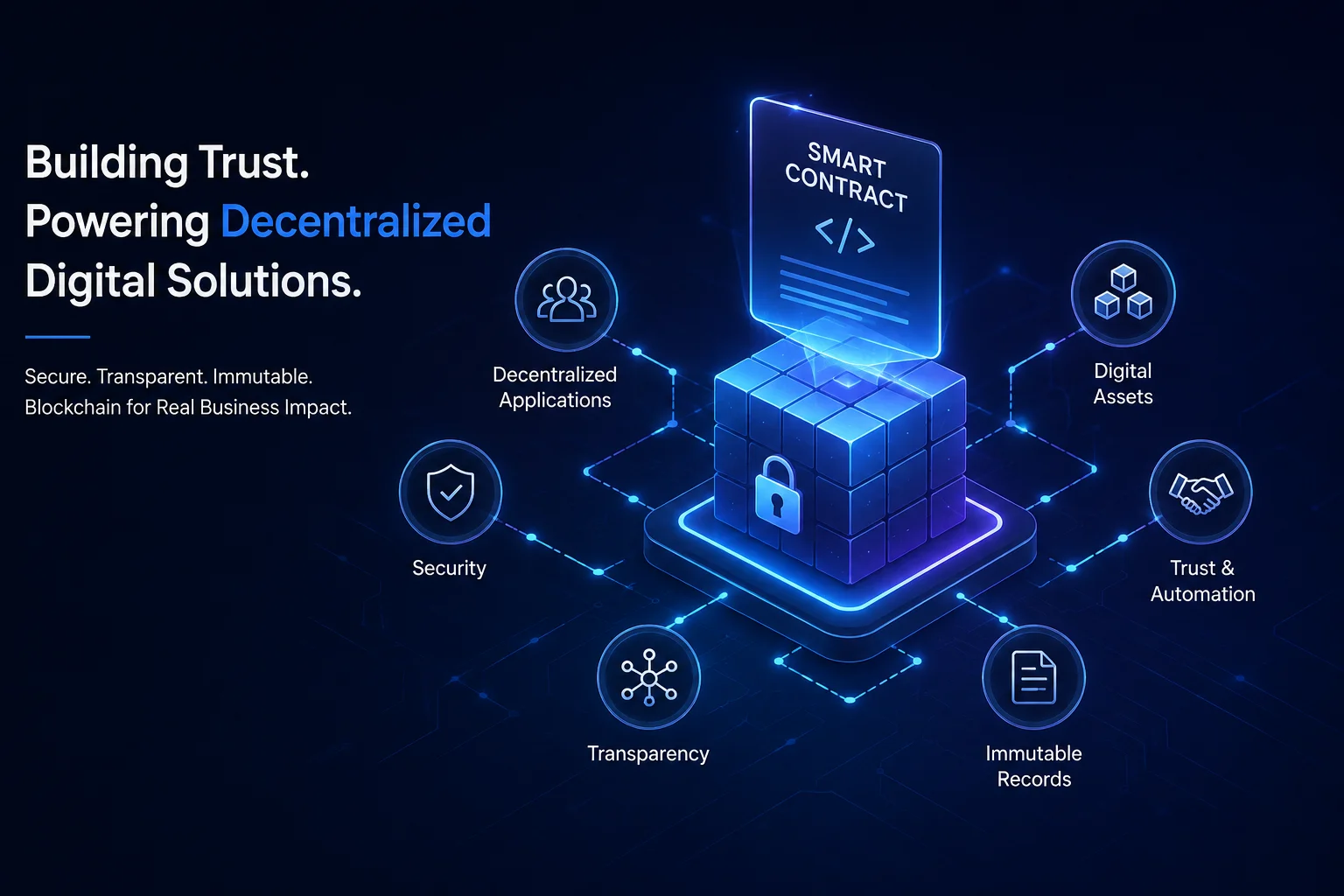
A smart contract can define what should happen when specific conditions are satisfied.
Imagine a marketplace where payment is released automatically after the required delivery conditions are confirmed. Or a digital asset platform where ownership changes only after a predefined transaction has been completed.
The business rule becomes part of the system itself.
This is why smart contract engineering needs to be treated differently from ordinary application development.
A small mistake in conventional application code can often be corrected through a deployment.
A poorly designed smart contract can create a much more serious problem once it is deployed and handling real transactions.
What We Look at Before Writing a Smart Contract
At Ultrashield Technology, we don't begin a blockchain project by asking which framework or network should be used.
We first map the transaction.
Who is involved?
What information needs to be shared?
Which actions require verification?
What needs to happen automatically?
What should remain private?
What belongs on-chain?
What should stay in the application's backend?
These decisions determine the architecture.
Only after that does the technology stack start becoming clear.
This approach also helps prevent a common problem in blockchain projects: putting too much functionality on-chain simply because the technology allows it.
Blockchain Development Is Still Product Development
A blockchain product still needs a good interface.
Users need to log in, understand what is happening, see transaction status, manage permissions, and recover from errors.
They shouldn't need to understand consensus mechanisms or blockchain architecture to complete a simple transaction.
The best blockchain experiences make the technology almost invisible.
Behind the interface, however, the engineering can involve smart contracts, wallet integrations, APIs, backend services, databases, blockchain nodes, security controls, and monitoring.
This is where experienced blockchain development services become valuable. The objective is not to build something that merely works on a blockchain. It is to build a complete product around the blockchain component.
Security Changes the Development Process
There is very little room for casual development when a system controls valuable digital assets or executes financial transactions.
Smart contracts need careful testing. Access permissions need to be explicit. Wallet interactions need to be handled securely. Transaction failures need to be considered.
The development team also needs to think about what happens when users behave unexpectedly—or when someone actively tries to exploit the system.
For businesses building serious blockchain products, security should influence the architecture from the first technical discussion.
Why the Right Development Partner Matters
Choosing a smart contract development company shouldn't be based only on whether the team knows Solidity or has built a few decentralized applications.
The bigger question is whether the team understands the product surrounding the contract.
A smart contract might be technically correct and still be part of a poorly designed application.
The stronger approach combines blockchain engineering with backend development, application architecture, cloud infrastructure, security, and product thinking.
That is how blockchain becomes useful to an actual business rather than remaining an isolated technical experiment.
Where Ultrashield Fits
Ultrashield Technology approaches blockchain as part of broader digital product engineering.
We help businesses assess whether blockchain is genuinely appropriate for their use case, design the architecture, develop smart contracts, connect blockchain functionality with applications and backend systems, and build the surrounding product experience.
The goal isn't to put blockchain everywhere.
It is to use it where it creates an advantage.
For one company, that might mean automating agreements through smart contracts. For another, it could involve digital ownership, transaction verification, decentralized applications, or a shared ecosystem connecting multiple business participants.
The technology should serve the business—not the other way around.
If you're considering blockchain for a new product or an existing business workflow, talk to Ultrashield Technology to evaluate the architecture before development begins.