Sign up with Google
 Sign in with Zoho

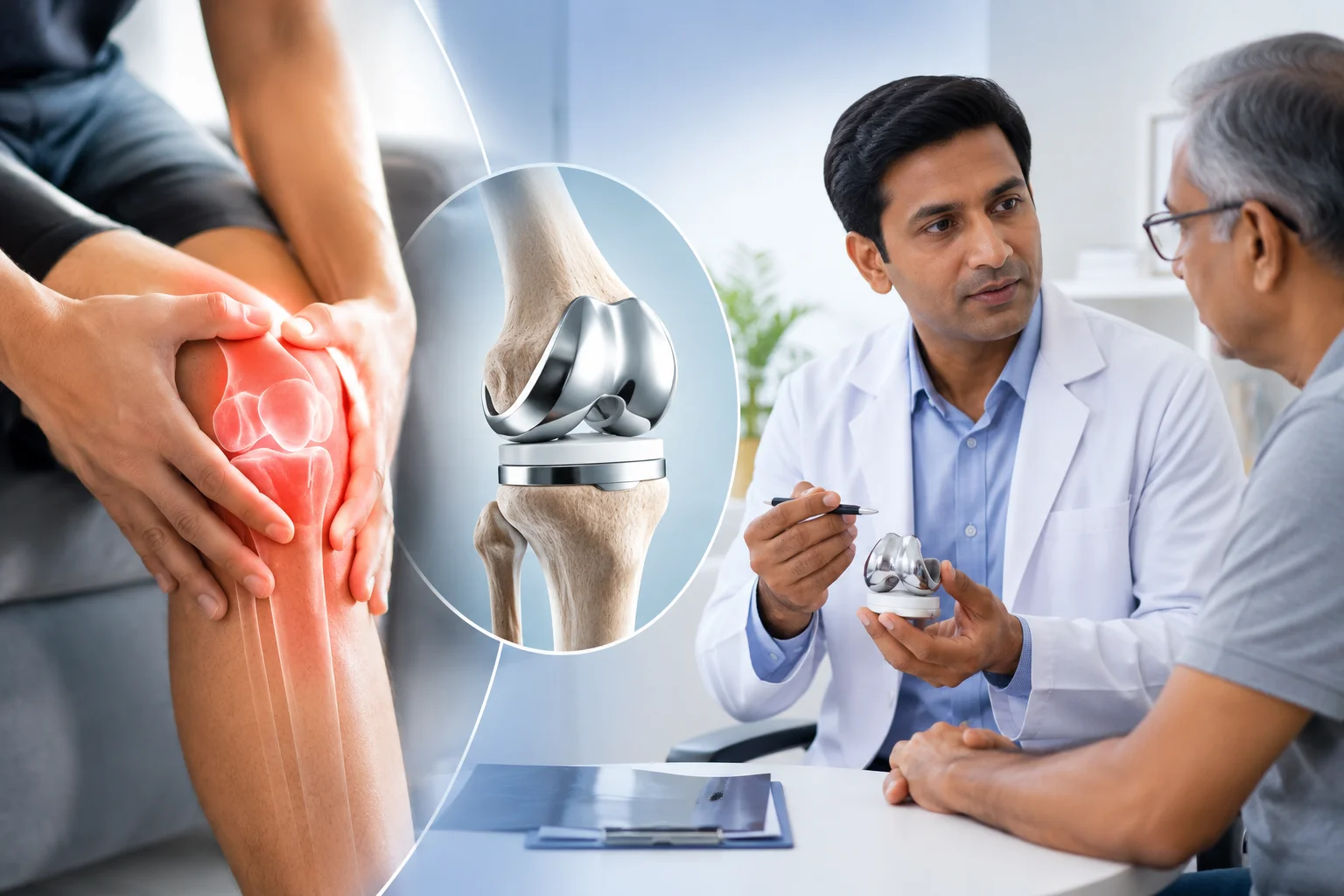
Knee pain rarely announces itself as a crisis. It builds quietly — a stiff morning here, a skipped walk there — until stairs, long drives, or a simple squat to pick something off the floor become genuine obstacles. Patients often ask the same question at this stage: is surgery really necessary, or is there still time to manage things conservatively? There's no blanket answer. It depends on how much joint damage has already occurred, how the pain is affecting daily function, and what non-surgical options have already been tried. This blog walks through that decision-making process the way we'd explain it in clinic.
What's Actually Happening Inside the Knee
The knee joint relies on cartilage — a smooth, shock-absorbing layer — to let the femur and tibia glide against each other without friction. Once this cartilage thins beyond a certain point, movement stops being smooth and starts being painful.
A few structural changes tend to occur together as the joint deteriorates:
- Loss of cartilage thickness, eventually exposing bone
- Reduced joint space visible on X-ray
- Bone spurs (osteophytes) forming at the joint margins
- Mild to moderate swelling from ongoing inflammation
- Gradual change in leg alignment in advanced cases
Symptoms Worth Paying Attention To
Not every ache signals structural damage. But a consistent pattern of the following symptoms usually warrants a proper orthopaedic assessment:
- Pain that persists even at rest, not just with activity
- Morning stiffness lasting more than 15–20 minutes
- Swelling around the joint that doesn't fully settle
- A limp, or a noticeably slower walking pace
- Difficulty climbing stairs or standing up from low chairs
- A grinding or catching sensation during movement
- Night pain that interrupts sleep
Common Causes Behind Knee Deterioration
Osteoarthritis remains the leading cause, driven largely by age-related cartilage wear and cumulative joint stress.
Rheumatoid arthritis, an autoimmune condition, causes the immune system to attack the joint lining, gradually damaging cartilage from the inside out.
Post-traumatic arthritis can surface years after an old fracture, ligament tear, or meniscus injury that wasn't fully rehabilitated.
Mechanical deformities, such as bow legs or knock knees, shift body weight unevenly across the joint and accelerate one-sided wear.
Obesity and repetitive joint stress from certain occupations or sports also contribute meaningfully to long-term cartilage breakdown.
How the Diagnosis Is Confirmed
A reliable diagnosis is built on a few concrete steps, not on symptoms alone:
- Clinical examination assessing range of motion, alignment, and joint stability
- Digital X-rays to measure joint space narrowing and bone changes
- MRI scans when ligament, meniscus, or soft-tissue involvement is suspected
- Blood tests, when an inflammatory or autoimmune cause is suspected
- A detailed history covering pain pattern, prior injuries, and functional limitations
Two patients with near-identical complaints can have very different X-ray findings — which is exactly why imaging, not guesswork, guides the final treatment decision.
Treatment Options: Surgery Isn't Always Step One
Conservative Management
For early to moderate arthritis, non-surgical treatment genuinely works for a meaningful stretch of time:
- Structured physiotherapy to strengthen quadriceps and hamstrings
- Weight reduction to lower load on the joint
- Anti-inflammatory medication for symptom control
- Activity modification and supportive footwear
- Intra-articular injections in select, appropriate cases
When Surgery Becomes the Right Call
Once cartilage loss reaches the point of bone-on-bone contact, no medication or exercise program can reverse it. This is the stage where patients typically begin consulting the Best Knee Replacement Surgeon In Chennai they can find, rather than continuing to manage symptoms that no longer respond to conservative care.
Types of Knee Replacement Surgery
- Total Knee Replacement (TKR): resurfaces the entire joint for advanced, widespread arthritis
- Partial Knee Replacement (PKR): treats only the damaged compartment, preserving healthy bone
- Bilateral Knee Replacement: both knees treated in one sitting or as staged procedures
- Revision Knee Replacement: corrects or replaces a worn or failed earlier implant
The right category depends on imaging findings, bone quality, and activity level — decided only after a full clinical workup.
What Recovery Typically Involves
- Day 1–3: Supported standing and first assisted steps, alongside structured pain control
- Week 1–6: Physiotherapy intensifies; knee bending and muscle strength improve steadily
- Week 6–12: Reduced dependence on walking aids; noticeably steadier gait
- Month 3–6: Return to work and gradual resumption of light activity for most patients
Recovery outcomes depend heavily on how closely rehabilitation is followed, which is why post-operative physiotherapy is treated as part of the treatment plan, not an afterthought.
Practical Tips Before Making a Decision
- Get proper imaging done before assuming surgery is unavoidable
- Ask which implant type and surgical technique are being recommended, and why
- Clarify realistic recovery timelines specific to your health profile, not generic averages
- Continue physiotherapy even after pain reduces — it protects long-term joint function
- Seek a second clinical opinion if any part of the recommendation feels unclear
Recent Advances in Joint Replacement Care
Joint replacement surgery has evolved considerably over the past decade. Robotic-assisted total knee arthroplasty, using systems such as the Velys platform, now allows for more precise implant alignment and bone preparation in trained hands. Enhanced recovery protocols — including early mobilization within a day of surgery and structured, milestone-based physiotherapy — have also shortened hospital stays for many patients. These advances don't replace sound clinical judgment, but they do give surgeons more precise tools to work with.
About Dr. Jeshwanth Netaji
Dr. Jeshwanth Netaji is an AIIMS-trained orthopaedic and joint replacement surgeon, holding MS Ortho (AIIMS), DNB, and FNB (Arthroplasty) qualifications. His fellowship training in arthroplasty was completed at Ganga Hospital, Coimbatore, one of Asia's leading joint replacement centres, with additional training in robotic total knee arthroplasty. At Jeshwanth Orthopaedics, this training translates into surgical planning that's built around each patient's bone structure, activity level, and long-term goals rather than a fixed protocol.
His clinical approach centres on matching treatment to the individual rather than following a fixed protocol:
- Detailed pre-operative planning and implant selection specific to bone structure
- Evidence-based decisions between conservative care and surgery
- Minimally invasive techniques used wherever clinically appropriate
- Structured rehabilitation support that continues well after discharge
- Long-term follow-up to monitor implant health over the years
For patients in and around Chrompet dealing with persistent knee or joint symptoms, consulting an Ortho Doctor Near Chromepet Chennai early can often prevent months of avoidable discomfort and narrow down the actual cause faster than self-management alone.
Frequently Asked Questions
1. How do I know if I need knee replacement or can still manage with medication?
If pain, stiffness, or deformity is significantly affecting daily function and conservative treatment has stopped helping, it's time for a formal evaluation.
2. Is knee replacement surgery painful?
Some discomfort during early recovery is expected, but it's actively controlled with medication and monitored closely by the care team.
3. How long does the surgery usually take?
Typically one to two hours, depending on the complexity of the individual case and the type of replacement performed.
4. Can both knees be treated in a single surgery?
Yes, for suitable candidates. It can be done together or as two separate, staged procedures based on overall health.
5. When can I expect to walk again after surgery?
Most patients take their first assisted steps within a day or two, often earlier than they anticipate.
6. Should I consult a specialist even if my knee pain still feels mild?
Yes — early consultation with an Ortho Doctor Near Chromepet Chennai helps identify the underlying cause before it progresses to a stage where options become more limited.
Still unsure whether your case needs surgery or can wait? That's exactly the kind of question worth taking to the Best Knee Replacement Surgeon In Chennai you can find, rather than deciding based on symptoms alone.
Final Word
Knee replacement isn't a first resort, and no responsible surgeon presents it that way. It becomes the right decision only when conservative treatment has been genuinely exhausted and joint damage is advanced enough to limit daily life. If that sounds like where you are, a proper clinical evaluation at Jeshwanth Orthopaedics is the most reliable way to know for certain — rather than living with a knee that keeps getting harder to trust.