Sign up with Google
 Sign in with Zoho

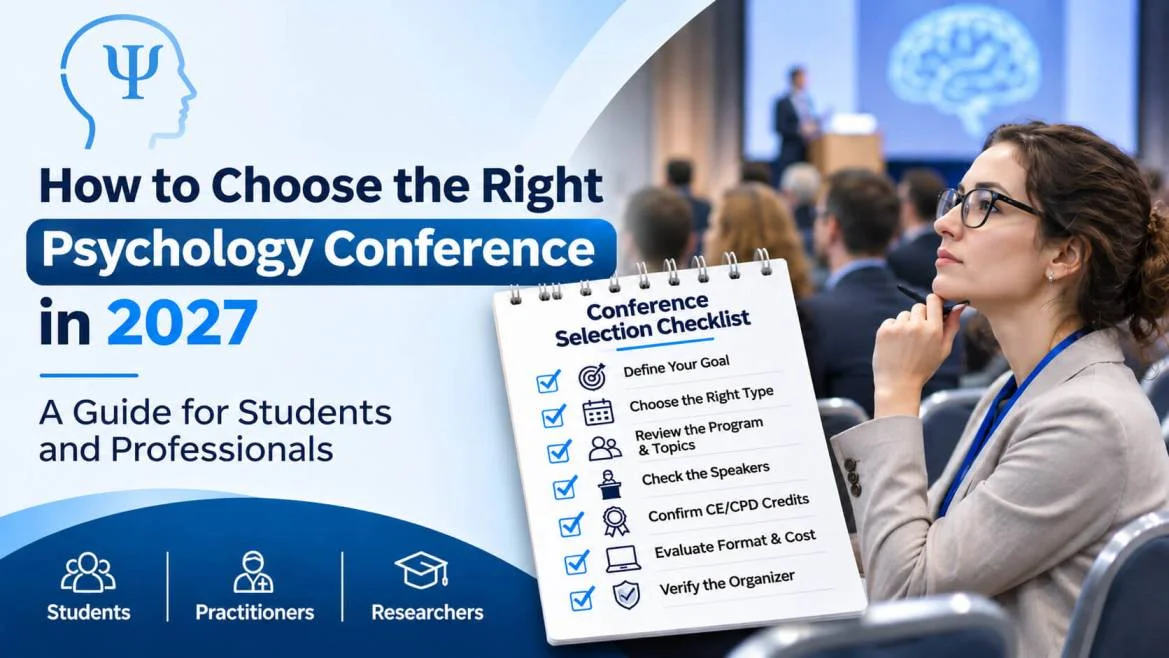
Psychology conferences are one of the fastest ways to see new research, practice your presentation skills and meet people who can shape your career, but the sheer number of events makes picking one harder than it should be. Whether you are an undergraduate hoping to present your first poster, a graduate student building a research profile, or a licensed practitioner keeping up with the evidence, the right psychology conference 2027 choice depends on your goals, your budget and how much you can trust the organizer. This guide walks through a clear decision process using published research, official event information and current data.
One platform you will see in many searches is run by pubscholars, an organizer of international scientific meetings. We use its published psychology listing as a worked example next to the large association conventions, and every step below applies equally to any event you are considering.
Why Your Choice of Psychology Conference Matters
Psychology's workload keeps growing. The World Health Organization's World mental health today report, released on 2 September 2025, found that more than one billion people live with a mental health condition. The same release reported that median government spending on mental health is about 2% of health budgets, unchanged since 2017, and WHO's workforce data show a global median of 13 mental health workers per 100,000 people.
For students and professionals, that gap is both a responsibility and an opportunity: the field needs well-trained, well-connected people, and conferences are one place that training and connection happen. They are also expensive in time and money, so a deliberate choice pays off. Below is a nine-step process you can follow for any international psychology conference 2027 or later listing.
Step 1: Start With Your Stage and Your Goal
The best psychology conference for a first-year student is rarely the best one for a clinical director. Name your stage and your main goal before you open a single event page.
If you are an undergraduate or early graduate student, you probably want to learn what the field looks like, practice presenting and meet potential supervisors. Smaller, regional and student-friendly events are often better for a first presentation than very large conventions.
If you are a PhD student or postdoctoral researcher, you probably want feedback on data, collaborators, and visibility for your work. Look for events with strong research programs, clear abstract review and a route to publication.
If you are a practitioner, you probably want applied updates, supervision-relevant skills and continuing education that your licensing body recognizes.
If you are an academic or program leader, you may be scouting talent, collaborations and policy conversations.
Write your top two goals on a card. Every later step is a test against that card.
Step 2: Know the Types of Psychology Conferences
Not all events are built the same. Knowing the categories saves time.
The APS lists its 2027 convention for 27–30 May 2027 in Seattle, with a call-for-submissions deadline of 1 December 2026 and a financial assistance deadline of 16 December 2026, which makes it a timely target if you are planning to present next year. The APA's future conventions page lists Chicago on 3–5 August 2028 and later cities, and links a call for proposals for 2027, but it did not give 2027 dates when I checked. The same page showed conflicting dates for the 2026 convention, a reminder to confirm every date on the organizer's own site. Regional dates should be confirmed with each association, since most were not yet published for 2027.
Step 3: Read the Scientific Program and Check the Topics
A psychology conference should publish more than a slogan. Check that the scientific program, session list and theme are visible and specific, and that the topics match your goal.
The latest psychology listing on the organizer's site (the 2026 edition, since no 2027 edition was posted when I checked) states a two-day hybrid format on 20 to 21 November 2026 at the Hilton Garden Inn Boston Canton in Massachusetts, under the theme "Next-Generation Neuropsychiatry & Mental Health: Integrating AI, Genomics and Clinical Excellence." Its session list includes clinical psychology and psychotherapy, artificial intelligence and machine learning in psychology, digital mental health, trauma, PTSD and resilience, suicide prevention and crisis intervention, cognitive psychology and neuroscience, child and adolescent psychology, and educational and school psychology. It also publishes a sample accepted abstract, a CBT intervention for caregivers of young people with psychosis, which gives you a concrete sense of the work presented.
Questions to ask of any program:
- Are sessions listed by topic, with titles and presenters, or only broad categories?
- Is there a mix of keynote talks, symposia, workshops and posters?
- Does the program include methods and applied content, or only theory?
- Is there a student or early-career track?
Step 4: Weigh In-Person, Virtual and Hybrid Formats
Format changes your costs, your learning and your carbon footprint.
Cost and access. Virtual access removes flights and hotels, which matters for students and for people in lower-income regions.
Environmental impact. A 2021 life-cycle assessment in Nature Communications found that moving from in-person to virtual conferences can reduce carbon footprint by 94%, and energy use by 90%. Hybrid conferences with carefully selected hubs can cut footprint by roughly two-thirds. The same paper noted that earlier studies of in-person events found per-participant footprints ranging from 92 to 3,540 kg of CO2 equivalent, with transportation the largest contributor.
Networking quality. In-person events generally make spontaneous conversation easier. Virtual attendance can be more limited for informal meetings, so ask the organizer how virtual participants can ask questions, join discussions and present.
A simple rule: pick in-person when relationships are your top goal, virtual when budget or schedule is, and hybrid when you want flexibility or your collaborators are in different countries. The Boston listing above is hybrid, with the organizer stating that remote delegates can access keynotes, sessions, workshops and materials, but you should confirm exactly what virtual presenters and attendees receive.
Step 5: Verify the Organizer Before You Pay
Because conferences are a business, quality varies. The Think. Check. Attend. initiative exists to help researchers separate trustworthy events from misleading ones. Its checklist asks, among other things, whether you know the society or association organizing the event, whether you can easily identify the venue, and whether proceedings are published by a member of a recognized initiative such as COPE, DOAJ or OASPA.
Add these practical checks:
- Search the organizer independently. Look for third-party mentions, reviews and past-event evidence.
- Confirm contact and location details. Pubscholars lists an office in Gurgaon, Haryana, India, with email and phone contacts on its sites, which gives you something to verify.
- Look at past editions. Dated photos, attendance figures and abstract books are useful signals. The pubscholars neurology page, for example, describes a 2025 edition in Orlando with 40+ participants and 15+ speakers from 10+ countries, and earlier editions in Toronto and San Diego. Treat such figures as organizer-reported until you can confirm them elsewhere.
- Compare listings. Dates and venues should match across the official page and third-party calendars. When we compared listings during research, one third-party page showed conflicting date sets for the same numbered edition of an unrelated event, which is exactly why you should confirm details on the organizer's own site.
- Ask who reviews abstracts and what the review criteria are.
Step 6: Plan Your Abstract and Your Publication Path
Many students attend primarily to present, so understand how abstracts work.
A large Cochrane methodology review examined 425 reports covering 307,028 abstracts from biomedical and social science meetings. It found that 37.3% of abstracts were later published in full. Over ten years, the estimate rose to 46.4% overall and 68.7% for randomized trials. Oral presentations were associated with a higher chance of full publication than posters, as were multi-site studies and studies with larger samples.
What to do with that:
- Write the paper as you write the abstract. A conference slot is a step toward publication, not the end.
- Choose oral or poster deliberately. Posters are less intimidating for first-time presenters and often generate good one-on-one feedback. Orals may give more visibility.
- Ask about proceedings and indexing. An abstract book is not the same as a peer-reviewed journal article, and employers and graduate committees will treat them differently.
- Check dates early. Abstract rounds usually run in stages (early, second, final). Confirm the current round on the official Important Dates page, because deadlines move.
On the Boston psychology listing, speaker, listener and poster participation are the three registration categories, with abstract submission, an e-book of abstracts and certification described among the benefits. Review the guidelines page to see what each category includes.
Step 7: Build a Realistic Budget
Registration is rarely the largest expense. Add flights, accommodation, meals, visas and any lost income or clinical hours.
For reference, the registration section of the Boston psychology listing showed three participation types with prices that, when we checked, ranged from about $749 to $999 depending on category and round. Fees and rounds change, so confirm on the registration page.
Ways to lower your costs:
- Register in the early round if your plans are firm.
- Ask your department, lab, employer or professional association about travel awards and fee waivers.
- Look for volunteer, student or young-researcher options. The Boston listing mentions volunteer and young researcher benefits, which are worth asking about directly.
- Consider the virtual option if flights and lodging would be your biggest cost.
- Split costs with a lab or colleagues who are presenting a joint study.
Create a simple one-page budget and compare it to the benefit you wrote on your goal card in Step 1. If you cannot name a concrete benefit that justifies the cost, keep looking.
Step 8: Check Credentials, Continuing Education and Recognition
For practitioners, continuing education is often non-negotiable. For students, recognition matters for applications and CVs. In both cases, ask direct questions.
For practitioners:
- Which continuing education requirements does my licensing board set, and does it accept this event's credit?
- Who is the approved provider, and can I see the credit statement in writing?
- Is the certificate a participation certificate only, or does it carry accredited credit?
For students and researchers:
- Will my abstract appear in a published book or proceedings, and is it indexed anywhere?
- Will I receive a certificate for presenting?
- Does my program recognize this event for travel funding or credit?
Participation certificates are useful, but they are not the same as board-approved continuing education. Do not assume equivalence.
Step 9: Make the Most of the Event
Choosing well is only half the work. Evidence on continuing education helps set realistic expectations. A Cochrane review of 215 studies involving more than 28,000 healthcare professionals concluded that educational meetings, alone or as the main part of a larger strategy, probably slightly improve professional practice and patient health, with moderate certainty. A 1999 JAMA review found that interactive and mixed sessions had a significant effect on practice, while traditional lecture-style formats did not show a significant overall effect. These studies are about healthcare professionals, so apply them to clinical psychologists and counsellors rather than to every attendee, but the lesson is useful for everyone: take part in workshops, ask questions and plan what you will do afterwards.
Before the event:
- Pick three sessions you cannot miss and two people you want to meet.
- Prepare a 30-second introduction describing your work.
- Bring or prepare a short summary of your research.
During the event:
- Ask at least one question in a session each day.
- Take notes tied to decisions: "I will try X in my study" or "I will contact Y about Z."
- Exchange contact details and note one specific thing to follow up on.
After the event:
- Send follow-up messages within a week.
- Share what you learned with your lab or team.
- Start the manuscript or the next abstract.
Psychology and Psychiatry: Why the Overlap Matters
Many modern events deliberately mix disciplines. The Boston psychology listing names psychologists, psychiatrists, therapists, counsellors, neuroscientists, educators and students among its intended audience, and the same organizer lists a parallel psychiatry conference 2026 with a similar theme and dates. If your work touches medication, neuroscience or integrated care, an event that includes psychiatrists can give you perspectives that a psychology-only meeting may not. If your focus is purely behavioral or educational, a narrower psychology conference may be a better use of your time. This is also a good moment to look at an international psychiatry conference 2027 calendar if your research or practice crosses that boundary.
Quick Decision Guide: Students vs Professionals
Your Psychology Conference Checklist
Score each event from 0 to 2 on each line:
- Goal match: Does it serve my top two goals?
- Program: Are the sessions, speakers and schedule published?
- Relevance: Do topics fit my subfield and level?
- Format: Is in-person, virtual or hybrid right for me?
- Organizer: Does it pass the Think. Check. Attend. questions?
- Abstracts: Is the review process clear, and is the publication route stated?
- Credentials: Do I know exactly what certificate or credit I will receive?
- Cost: Does the total cost fit my budget and funding?
- Networking: Will I be able to meet the people I need to meet?
- Follow-up: Do I have a plan for after the event?
A total of 16 or more is a strong candidate. Under 12, ask more questions before paying.
Frequently Asked Questions
What is a psychology conference? A psychology conference is a scientific meeting where researchers, students and practitioners present findings, discuss methods and practice, and network.
How do I choose the best psychology conference 2027 for me? Define your goal, check the program and speakers, verify the organizer, compare formats and costs, and confirm what certificate or credit you will receive.
Are international psychology conferences worth the cost? They can be, particularly for networking and exposure, but only when the program and speakers fit your goals. A hybrid or virtual option can reduce cost.
Can students present at a psychology conference? Yes. Many conferences accept student abstracts, often as posters. Check the guidelines for categories, deadlines and fees.
How can I tell whether a psychology conference is legitimate? Use the Think. Check. Attend. checklist, verify the organizer and venue independently, and confirm dates across official and third-party sources.
Conclusion: Choose Deliberately, Then Show Up Prepared
The right psychology conference is the one that matches your stage and goals, publishes a clear program, comes from an organizer you can verify, fits your budget and gives you a plan for what happens next. Research suggests that educational meetings help most when they are interactive and part of a bigger plan, and that many conference abstracts never reach full publication unless the author plans for it.
When you are ready to compare upcoming events, browse the sessions, abstract guidelines, registration options and dates on psychology conferences, and learn more about the organizer's wider program of scientific meetings and publications at pubscholars. Confirm current dates, fees and credit details directly with the organizer before you register for your next psychology conference 2027.
Sources
- World Health Organization, Over a billion people living with mental health conditions (2 September 2025)
- PAHO, Over a billion people living with mental health conditions
- Medical Dialogues, WHO releases landmark reports on global mental health and suicide estimates
- Scherer RW, et al. Cochrane Database of Systematic Reviews 2018, Full publication of results initially presented in abstracts
- Forsetlund L, et al. Cochrane Database of Systematic Reviews 2021, Continuing education meetings and workshops
- Davis D, et al. JAMA 1999, Impact of formal continuing medical education
- Tao Y, et al. Nature Communications 2021, Trend towards virtual and hybrid conferences
- Think. Check. Attend.
- Association for Psychological Science, 2027 APS Annual Convention; American Psychological Association, Future conventions; Middle Tennessee State University, Psychology conferences calendar; University of Texas, 2026–2027 conference calendar
- Psychology Conferences and pubscholars (organizer pages, accessed 1 November 2026)