Sign up with Google
 Sign in with Zoho

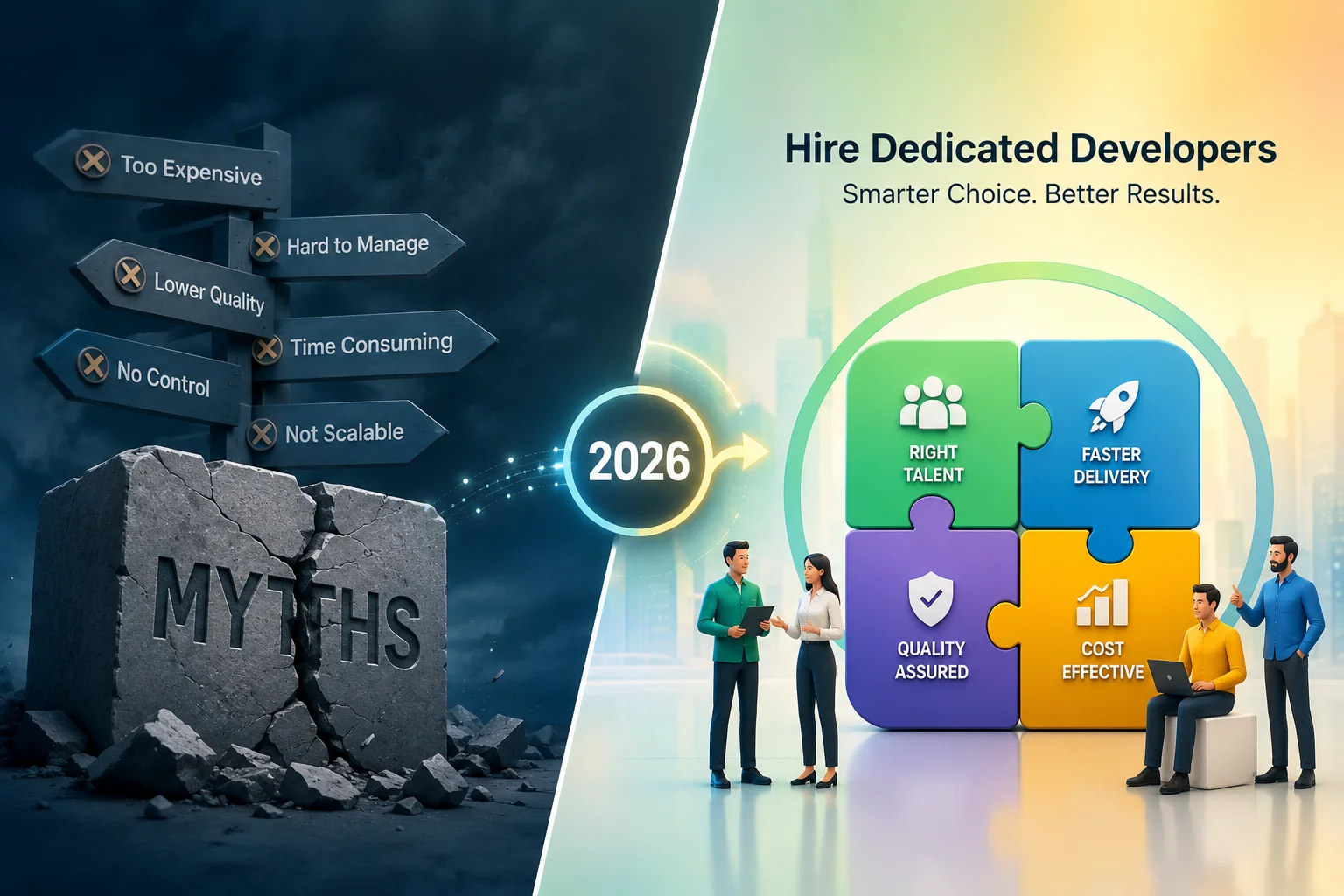
That's the backdrop every conversation about hiring a dedicated development team is happening against in 2026 — not "should we outsource," but "how fast can we access the right skills before a competitor does."
And yet most of the advice circulating about how to hire dedicated developers is still built on assumptions from five years ago. Here are the six myths doing the most damage, and what's actually true right now.
Myth #1: "A dedicated development team is just outsourcing with a nicer name"
Reality: This confusion costs companies real money, because dedicated teams and staff augmentation solve different problems.
Staff augmentation plugs individual engineers into a team you already manage — your PM, your process, your accountability. A dedicated development team is a self-contained unit with its own project management, QA, and delivery ownership, working against your roadmap rather than your day-to-day instructions.
The most common failure pattern, according to recent staff augmentation research, happens in both directions: companies hire augmented developers expecting a fully managed team and get frustrated when nobody's directing them, or they hire a "dedicated team" and then micromanage it, creating two competing chains of command and paying for a management layer they never use. Some vendors also sell "dedicated developers" that are really just augmentation in disguise — individual engineers with no PM, QA, or self-management built in. Before signing anything, ask exactly who owns delivery.
Myth #2: "It's cheaper to hire in-house"
Reality: It depends entirely on what you're comparing — and most comparisons leave out the parts that hurt.
Direct salary comparisons miss recruiting costs, benefits overhead, ramp-up time, and the cost of a bad hire sitting in a role for six months before anyone acts on it. Newer AI-first engineering models are shifting this calculus further: some dedicated teams built around AI-augmented senior engineers now substitute for three to four traditional developers on a single monthly retainer, which changes the "cheaper in-house" math considerably when the comparison is output per dollar rather than headcount per dollar.
Myth #3: "Offshore or nearshore dedicated teams can't handle complex, senior-level work"
Reality: This was a fair concern a decade ago. It's outdated now, and the market has moved on from it.
Offshore staff augmentation and dedicated teams now account for over 52% of the global IT staff augmentation market, a dominance driven largely by a talent shortage so severe that nine out of ten organizations report critical skill gaps, particularly in generative AI and cloud-native development. That shift didn't happen because offshore teams got cheaper — it happened because specialized AI and cloud talent became scarce enough everywhere that geography stopped being the deciding factor. Complex systems — computer vision platforms, NLP applications, predictive analytics, production-grade LLM applications — are now routinely built by distributed dedicated teams, not despite their location but because the talent pool for that expertise is inherently global.
Myth #4: "You lose control over quality and process when you hire a dedicated team"
Reality: You lose control when you hire the wrong dedicated team — not because the model itself is inherently loose.
A properly structured dedicated development team operates with the same engineering discipline you'd expect internally: code review standards, CI/CD pipelines, sprint cadences, and direct visibility into velocity and quality metrics. What actually determines control isn't the org chart — it's whether the provider gives you a dedicated PM you can talk to daily, transparent reporting, and the ability to swap or scale team members without renegotiating a contract from scratch. If a vendor can't clearly answer "how do I see what my team did this week," that's the real red flag — not the engagement model itself.
Myth #5: "AI coding tools mean we barely need to hire developers anymore"
Reality: AI hasn't reduced the need for skilled developers — it's raised the bar for what "skilled" means, and reshaped what dedicated teams look like.
Job market data shows the shift clearly: 71% of current development job listings reference Python, and 66% reference large language models, with over half asking for both together. Meanwhile, Gartner projects that by 2030, 80% of engineering teams will operate as smaller, AI-augmented units rather than traditional large teams. That doesn't mean fewer developers matter — it means the developers who matter are the ones who know how to direct AI tools effectively, not just write code from scratch.
This is exactly why "dedicated development team" now means something different than it did three years ago. The teams delivering the most value combine senior engineering judgment with AI-accelerated execution — fewer people, faster delivery, higher technical ceiling per engineer.
Myth #6: "Dedicated teams only make sense for large enterprises"
Reality: SMBs are actually one of the fastest-growing segments using this model, and the data shows why.
Around 56% of SMEs used augmented or dedicated developer models in the past year for cloud migration, mobile app development, ERP integration, and automation — reporting a 34% reduction in project timelines and a 27% increase in productivity as a direct result. For a startup or mid-sized company without the budget to build a full internal engineering org, a dedicated development team is often the only realistic way to access senior-level, multi-disciplinary talent (backend, AI engineering, DevOps, QA) without a year of hiring.
What This Actually Looks Like: A Composite Scenario
A healthcare SaaS company needed to add AI-powered clinical documentation features to its existing platform. Hiring in-house would have meant recruiting an ML engineer, a backend developer familiar with HIPAA-compliant architecture, and a QA specialist — a process realistically taking three to four months before anyone wrote production code, in a market where AI talent is already scarce.
Instead, a dedicated development team was assembled in under three weeks: a senior AI engineer, a backend developer, and a QA lead, working against the product roadmap with a dedicated PM as the single point of contact. The team operated as an extension of the internal product organization rather than a disconnected vendor — same sprint cadence, same reporting visibility, same accountability for outcomes. This is the practical difference between hiring individuals and hiring a team: the second one starts producing coordinated output in weeks instead of building coordination from scratch after everyone's already hired.
The Real Decision: 5 Questions to Ask Before You Hire
Run your situation through these before choosing a model:
- Do you need a specific skill gap filled inside a team you already manage, or an entire capability you don't have yet? (Staff augmentation vs. dedicated team)
- Can you clearly name who owns delivery, quality, and reporting if you hire a "dedicated team"? If not, you may be buying augmentation at dedicated-team prices.
- Is the work isolated and short-term, or sustained and evolving with your product? Freelancers suit the former; dedicated teams suit the latter.
- Does this work require AI/ML expertise specifically? If so, factor in that only around 300,000 skilled AI engineers exist globally against roughly 28 million software developers — plan your sourcing strategy accordingly.
- What does "productive" look like in week one versus month three? A dedicated team should show coordinated output fast; if the timeline looks like a slow in-house ramp, you're not getting the benefit of the model.
How Ultrashield Builds Dedicated Development Teams
Ultrashield Technology isn't a staffing agency assembling resumes against a job description. As an AI-powered digital product engineering company, every dedicated development team we build is structured around the same principle: senior engineers who combine core software development expertise with hands-on AI, LLM, and cloud-native experience — not generalists learning AI concepts on your project timeline.
Each dedicated team includes a dedicated PM, built-in QA, and direct reporting visibility from week one, whether you're building an AI agent, modernizing a legacy platform, or scaling a SaaS product. You get engineering ownership without the multi-month hiring cycle — and without losing the visibility and control that made you consider hiring in-house in the first place.
Frequently Asked Questions
What's the difference between hiring dedicated developers and using staff augmentation? Dedicated developers come as part of a self-contained team with its own PM and QA, taking ownership of delivery against your roadmap. Staff augmentation adds individual engineers into a team you continue to manage directly. The right choice depends on whether you need a capability or a headcount top-up.
How long does it take to build a dedicated development team? With an experienced partner, a fully staffed dedicated team can typically be assembled and productive in two to four weeks — significantly faster than the 8–16 weeks typical for in-house hiring, plus ramp-up time.
Is it more expensive to hire a dedicated development team than to hire in-house? Not when you account for total cost: recruiting, benefits, onboarding time, and the risk of a mis-hire. Many dedicated team models, especially AI-augmented ones, also deliver higher output per engineer, which changes the cost comparison from headcount-based to outcome-based.
Can a dedicated development team handle AI and LLM development, not just traditional software? Yes, provided the partner specifically staffs for it. Given that only a small fraction of the global developer population has genuine AI/ML expertise, it's worth confirming the team includes engineers with direct LLM, RAG, or AI agent development experience — not developers picking it up as they go.
How do I know if I need a dedicated team versus individual freelancers? If the work is ongoing, evolves with your product, and needs coordinated delivery across multiple disciplines (engineering, QA, AI, DevOps), a dedicated team is the better fit. Freelancers work well for isolated, well-defined, short-term tasks.
Key Takeaways
- The global talent shortage — 85.2 million people by 2030 — has made hiring a dedicated development team a speed and access strategy, not just a cost-saving one.
- Dedicated teams and staff augmentation are not interchangeable; confusing them is the most common and costly mistake companies make.
- AI hasn't reduced the value of skilled developers — it's changed what "dedicated team" means, favoring smaller, AI-augmented senior teams over large traditional ones.
- Offshore and nearshore dedicated teams now handle enterprise-grade, complex AI and cloud-native work as standard practice, not an exception.
- The real evaluation criteria aren't location or price alone — they're clarity of ownership, reporting visibility, and whether the team includes genuine AI/ML expertise where your project needs it.
Ready to see what a dedicated development team built around AI expertise actually looks like? Talk to Ultrashield's engineering team about your project.