Sign up with Google
 Sign in with Zoho
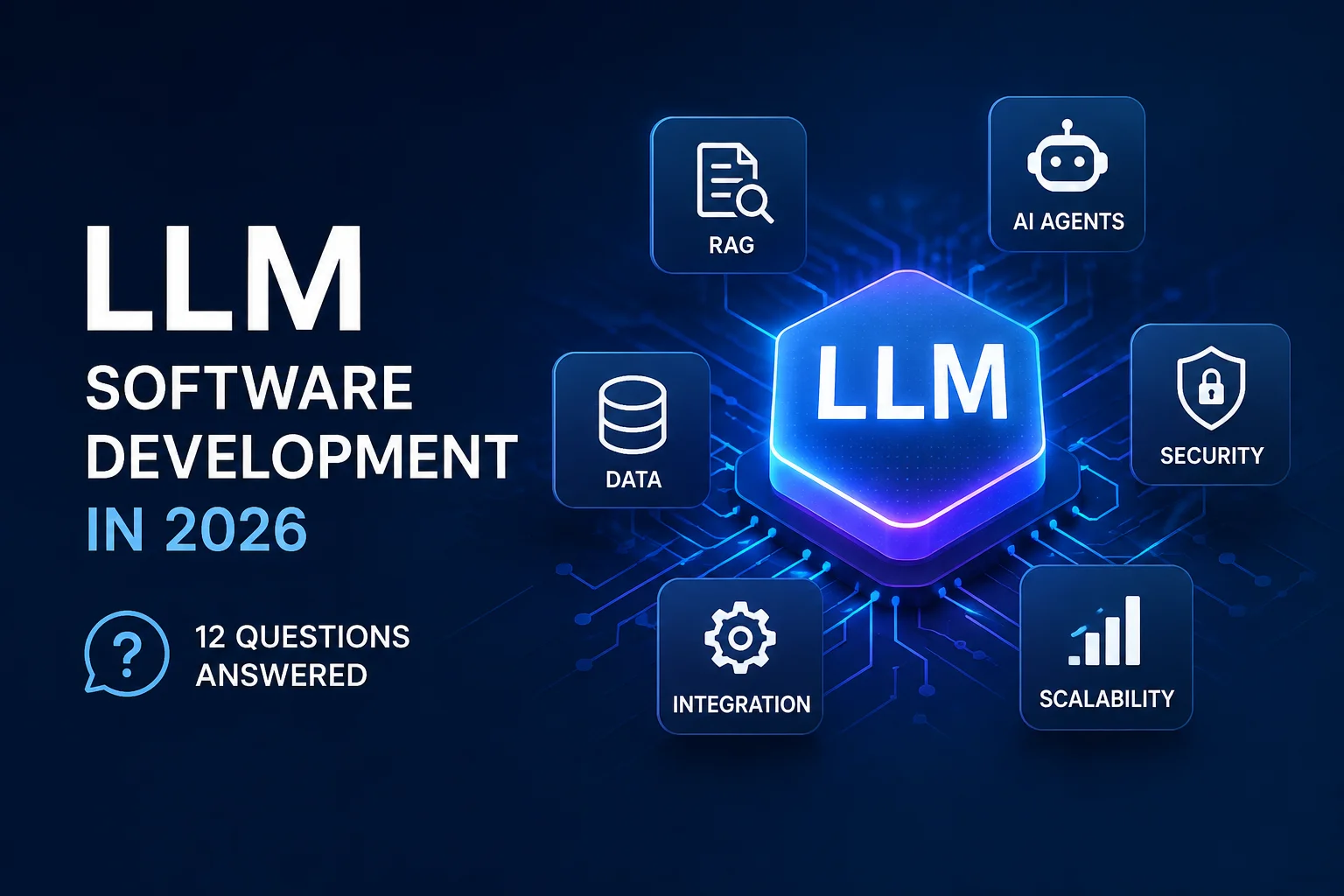
Search any forum, LinkedIn thread, or procurement doc right now and the questions around AI have gotten a lot more specific than "should we use AI?" Teams evaluating LLM software development and shopping for LLM development services are asking sharper, more practical questions — about cost, timelines, security, and what actually goes wrong.
Here are the twelve questions that come up most, answered directly.
1. What's the difference between "using AI" and LLM software development?
Using AI usually means adopting an existing tool — ChatGPT, Copilot, an off-the-shelf assistant. LLM software development means building a custom application on top of a language model: a support tool trained on your knowledge base, an internal assistant wired into your CRM, or an agent that executes multi-step business processes. One is a subscription. The other is a product built around your data, your workflows, and your users.
2. Do we need our own model, or can we build on an existing one?
Almost no business needs to train its own foundation model — that's a resource-intensive undertaking reserved for a handful of AI labs. Nearly all enterprise LLM software development today builds on top of existing models (via API) and customizes behavior through prompting, retrieval, and fine-tuning where needed. The engineering value is in the application layer, not the model itself.
3. How long does a typical LLM development project take?
It depends heavily on scope, but a useful rule of thumb: a focused MVP — a single well-defined use case like a knowledge assistant or a support triage tool — often takes 6 to 12 weeks from discovery to a working pilot. Full enterprise deployment with deep integrations, governance, and testing typically extends that to a few months, not weeks. Any LLM development services provider quoting a fully integrated enterprise system in two weeks is setting an unrealistic expectation.
4. What does "RAG" mean, and do we need it?
Retrieval-Augmented Generation (RAG) lets a model pull real, current information from your own documents and databases before generating a response, instead of relying only on what it learned during training. If your use case involves company-specific knowledge — policies, product data, case history — you need RAG. It's the difference between an AI that gives generic answers and one that gives answers grounded in your actual business.
5. Is our data safe if we build an LLM application?
It can be, but it depends entirely on how the system is architected. Data safety comes down to a few concrete things: where your data is processed and stored, whether it's used to train third-party models (it shouldn't be, by default, in enterprise agreements), who has access, and whether there's an audit trail. Ask any LLM development services partner to walk through data flow end to end before you sign — not just describe security in general terms.
6. What's the real cost of building a custom LLM application?
Costs vary widely by scope, but the biggest cost driver usually isn't the model itself — API costs for most business use cases are relatively modest. The real cost is engineering: integration work, RAG pipeline development, testing, and ongoing optimization. A narrow, well-scoped MVP is a meaningfully different investment than a multi-system enterprise deployment, so be wary of any quote given before a discovery phase has actually happened.
7. Why do so many AI pilots never make it to production?
The most common reason isn't the model underperforming — it's integration. A pilot that works in a sandbox often stalls when it needs secure, reliable access to production systems, real user data with edge cases, and IT/security sign-off. Teams that plan for integration and governance from day one, not as an afterthought, are the ones that actually reach production.
8. What's an AI agent, and how is it different from a chatbot?
A chatbot answers questions. An AI agent can take multi-step action — check a policy, update a record, escalate a case, and notify the right person — often coordinating with other specialized agents to complete a task end to end. If your use case is "answer a question," you need a chatbot. If it's "handle this process," you need an agent, which is a meaningfully more complex piece of LLM software development.
9. Should we build in-house or hire an LLM development company?
That depends on whether you have existing AI/ML engineering talent, how core this capability is to your product, and your timeline. Companies with strong in-house engineering teams often bring in an LLM development company for the initial build and knowledge transfer, then maintain it internally. Companies without that bench typically get to production faster and with fewer costly mistakes by working with a partner from the start.
10. How do we know if a vendor is actually good at LLM development, or just good at demos?
Ask about production systems, not prototypes: how many of their AI builds are actually running with real users today, not just in a pilot? Ask specifically about integration work with systems like CRM and ERP platforms, not just model or prompt expertise. And ask how they handle security, permissions, and monitoring after launch — a vendor who can only talk about the build, not what happens after go-live, is a red flag.
11. What happens after launch? Does the system just keep working?
No — and this catches a lot of teams off guard. Models get updated, usage patterns shift, costs need monitoring, and accuracy needs periodic evaluation against real outputs. A serious LLM development services engagement includes a plan for post-launch monitoring and optimization, not just a handoff document.
12. What's the single biggest mistake businesses make with LLM projects?
Treating it as a one-off feature instead of a product. The businesses getting real value in 2026 approach LLM software development the way they'd approach any core product investment — with proper discovery, architecture, testing, and a plan for iteration — rather than a quick add-on bolted onto an existing system.
Still Have Questions?
If your question isn't on this list, it's probably specific to your data, your systems, or your industry — which is exactly the kind of thing worth a real conversation rather than a generic article.
Ultrashield Technology provides LLM development services for enterprises across healthcare, financial services, legal, retail, and manufacturing — from MVP builds to full production deployment with integration and governance included.
Have a specific question about your use case? Book a free AI strategy call and get a straight answer within 24 hours.








.webp)