Sign up with Google
 Sign in with Zoho

Look at almost any AI failure story and you'll find the same line somewhere in it: the model was confident, and it was wrong. Not broken. Not throwing an error. Just wrong, in a way that looked correct right up until someone noticed the damage.
That's the part people don't expect until it happens to them. When an AI system fails in production, it usually doesn't crash. It keeps running, keeps sounding sure of itself, and keeps doing the wrong thing at full speed. A normal piece of software fails loudly — it stops, it throws an error, someone sees it right away. An AI agent can fail quietly, which is exactly what makes it dangerous.
The teams that don't get burned by this aren't the ones with the smartest model. They're the ones who planned for the model being wrong before it ever went live. That mostly comes down to two simple questions:
- When should the system stop and ask for help?
- What happens automatically the moment something breaks anyway?
Teach the System When to Stop and Ask
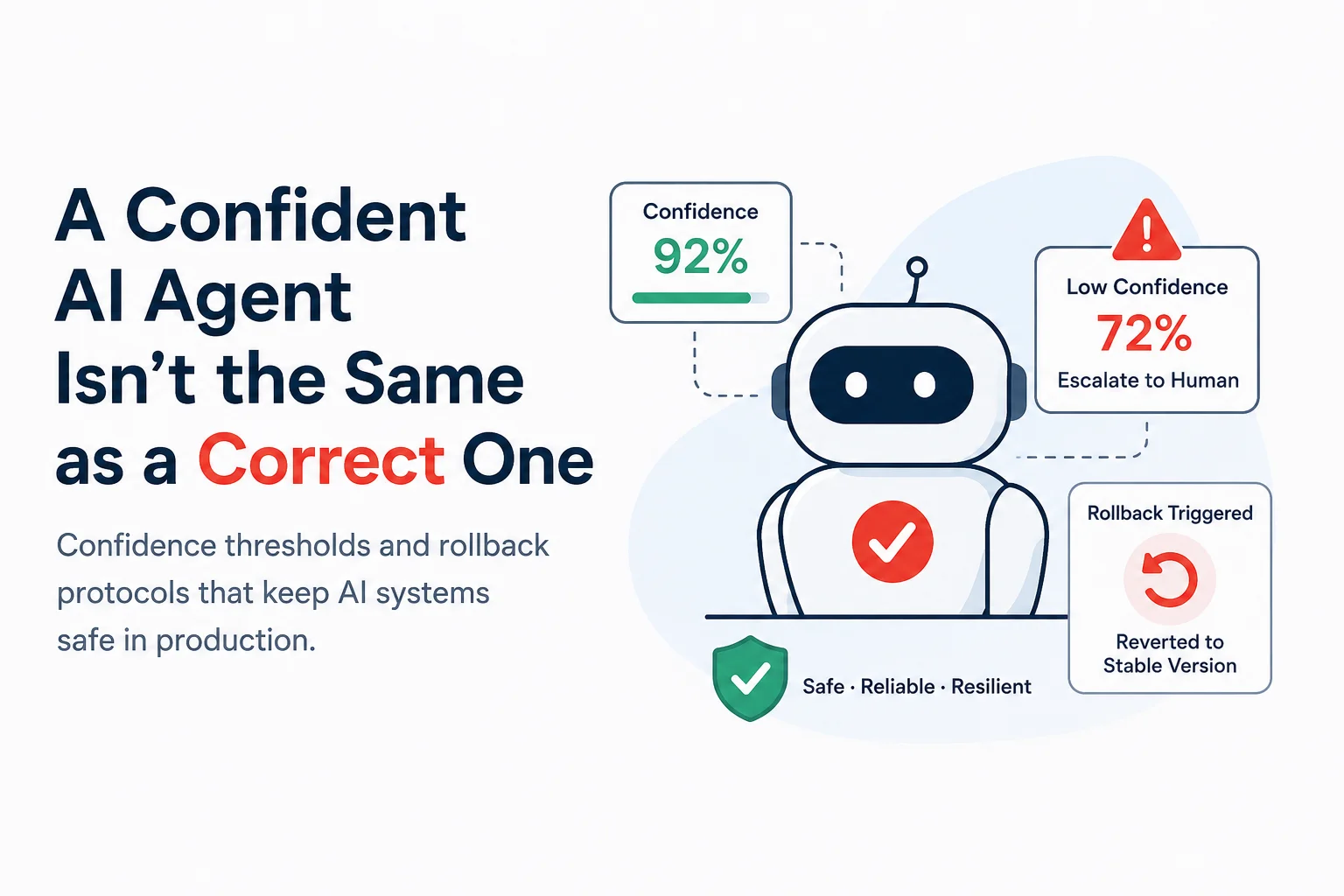
Every time an AI model makes a decision, it also has a rough sense of how sure it is. A lot of early AI projects ignore that number completely — they treat every answer the same, whether the model is almost certain or barely guessing. That's how one shaky, low-confidence answer ends up carrying the same weight as a routine, easy one, and gets acted on just as automatically.
The fix is simple to describe, even if it takes real work to build well: set a line.
- Above the line → the model acts on its own.
- Below the line → the system stops and sends it to a person before it touches anything important — a customer's account, a payment, a message going out under the company's name.
Where you draw that line depends on what's at stake. A system suggesting a product to a shopper can afford to be looser. A system approving a payment or flagging a compliance issue can't. Using one single confidence rule for every part of the business is a common shortcut, and it usually backfires — either people get buried in unnecessary manual checks on low-risk stuff, or genuinely risky decisions slip through because the line was set for the average case, not the important one.
Plan for the Bad Day, Not Just the Bad Answer
A confidence threshold deals with one decision at a time. But sometimes the problem isn't one answer — it's the whole system. A bad update goes out. The data feeding the model quietly changes. An integration starts sending broken responses and nobody notices for an hour. That's a different kind of failure, and it needs a different kind of plan.
The teams who handle this well share one habit: they don't trust a new version of anything with all their traffic right away.
- Send it a small slice first — a fraction of real users.
- Watch it closely — errors, slow responses, the model's own confidence dropping more than usual.
- If any of that crosses a line set in advance, the system switches back to the old, working version on its own.
No one has to notice a dashboard at 2am and scramble to fix it.
That automatic part is the whole point. The real damage in most AI incidents happens in the gap between something going wrong and a person noticing it — failed transactions pile up, bad messages keep sending, wrong records keep getting written. A system that can catch its own problem and switch back by itself shrinks that gap from "however long it takes a tired engineer to get paged and figure it out" down to "however long an automatic check takes to run."
Two Different Problems Need Two Different Fixes
There are two common ways to protect a system, and they solve different problems, so it's worth knowing the difference.
Cut off the whole thing. The moment a service is clearly unhealthy, stop sending it traffic and fall back to something simple and safe while the real issue gets fixed.
Check each request on its own. Let the easy, confident ones through, and quietly hold back the unsure ones for a person to check — without shutting the whole thing down over one shaky case.
Neither replaces the other:
- Cutting everything off makes sense when the whole system is struggling and the priority is to stop things from getting worse.
- Checking each request makes sense when the system mostly works fine, but a few specific cases need extra care.
Most real production systems end up using both — broad protection for when things go seriously wrong, and closer attention for the individual decisions that actually carry risk. Lean too hard on the first and you create outages for cases that would have been fine. Lean too hard on the second and you slow everything down checking things that never needed checking.
Why This Is a Business Question, Not Just a Technical One
It's easy to file all of this under "engineering detail," but the real cost is simple to explain: how long does a broken AI system keep running before anyone notices. An agent that quietly makes bad calls for an hour does far more damage than the exact same bug in a system that catches itself and fixes it in minutes. This isn't really about clean engineering for its own sake — it's about controlling how much damage a mistake gets to do before someone, or something, stops it.
The teams that skip this don't usually skip it on purpose. It's the part of an AI project that doesn't show up in a demo, doesn't make a roadmap look exciting, and keeps getting pushed down the list — right up until the first real incident makes it impossible to ignore. By then, it's a much harder problem. Adding safety nets to a system that's already live and already trusted with real decisions is a lot more work than building them in from day one.
What This Means If You're Building AI Agents for Production
- Set your confidence line per use case, not company-wide. What's an acceptable risk for a product suggestion is not acceptable for a financial decision.
- Decide the human backup plan before you need it. If "what happens when the model isn't sure" only gets figured out after something goes wrong, it isn't a plan.
- Make the fallback automatic. Don't count on someone spotting the problem in time — that gap is where most of the real cost happens.
- Use the right tool for the right failure. Broad protection for system-wide problems, closer checks for individual risky decisions. Most systems eventually need both.
Where Ultrashield Fits
As an AI development company in the USA, this is a part of AI agent development and custom AI software development that we don't treat as optional. Building an agent that looks good in a demo isn't the hard part anymore. Building one that knows when to ask for help, and can catch and fix its own mistakes without waking someone up at 2am, is the real work — and it's usually the difference between an AI project that keeps running and one that quietly gets switched off after its first bad week.
Where This Leaves You
If you're putting AI agents into work where a wrong answer actually costs something, it's worth building the "what if it's wrong" plan in from the start, not adding it later. If it would help to talk through what that looks like for your own systems, Ultrashield Technology's team can walk through it with you before anything goes live.







.webp)