Sign up with Google
 Sign in with Zoho

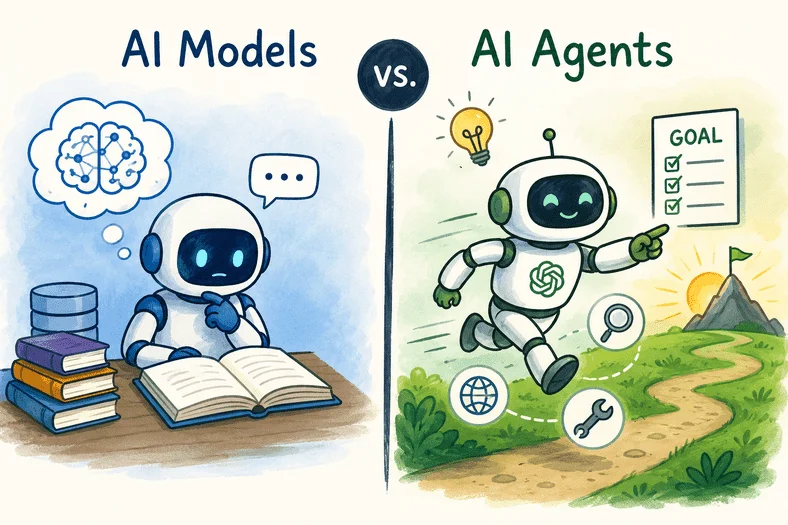
Every week, new headlines emerge claiming some company has deployed an artificial intelligence agent or model, often at considerable expense to operations and productivity. Most readers mistake these terms as being interchangeable; but mistaking one for another costs businesses millions annually through misguided investments, failed pilot programs and wasted engineering hours.
This post simplifies things; here you'll learn exactly what distinguishes an artificial intelligence model and an AI agent and why this distinction matters for business decision-making, and which option your organization truly requires today.
1. What Is an AI Model?
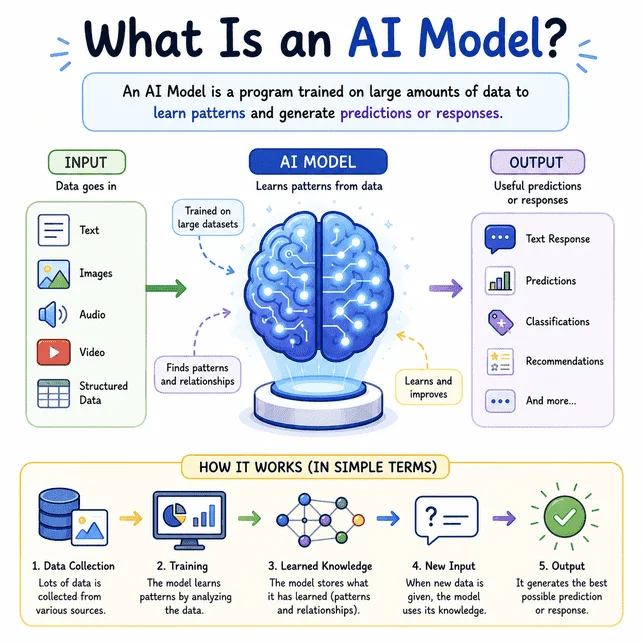
At its core, an AI model is a mathematical system trained on large datasets to recognize patterns or predictions or produce outputs based on inputs. Think of an AI as being like having access to an exceptionally capable brain - reading, analysing text generation or classification images while forecasting trends without taking independent actions itself.
Common examples of AI models include:
- Large Language Models (LLMs), such as GPT-4, Claude, and Gemini trained to comprehend and generate human speech
- Image Recognition Models trained to detect objects such as faces or medical anomalies within photos
- Recommending models used by Netflix, Amazon and Spotify to predict what you want to watch or buy next
- Forecasting models - used in finance and logistics to predict demand, price or supply chain disruption.
An AI model's distinguishing characteristic: it responds only when asked. No roving through websites on its own or sending emails automatically are permitted - rather, only respond when requested to do so by someone interacting directly with it.
Imagine it this way: An AI model is like having access to an incredible consultant within an office building: When asked, they offer back answers before returning back into their chamber until another question arrives.
2. What Is an AI Agent?
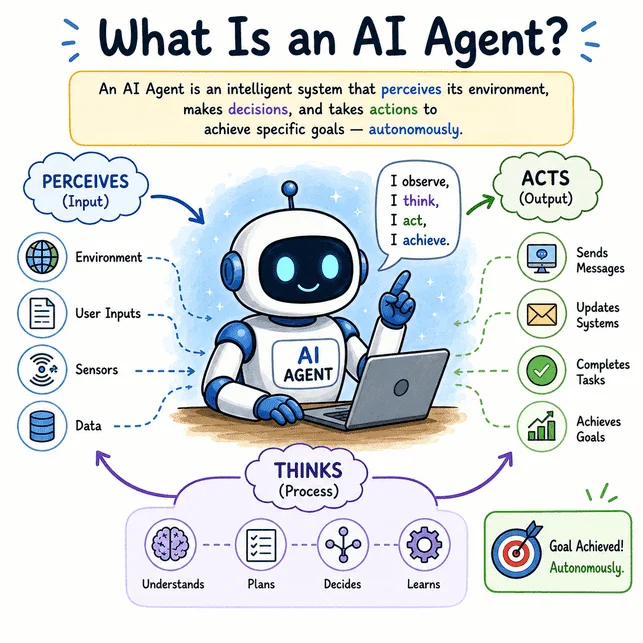
AI agents are autonomous systems which use AI models as reasoning engines and combine these with tools, memory storage capacity and planning skills so as to take real world actions without human input. AI agents do more than generate text; they execute tasks, interact with external systems and pursue goals step-by-step without constant human oversight.
- An AI agent typically comprises five layers:
- Foundation model] (the reasoning brain),
- Memory layer (for short and long-term context retention), umplut
- Tool set (APIs, databases, browsers and code execution environments).
- An integrated planning module capable of breaking goals down into subtasks; And an orchestration layer which coordinates across tools, data sources and even agents
Real-world examples of AI agents in production include:
- An automated customer service agent that reads inbound complaints, checks order statuses in CRM systems, processes refunds without human interaction and sends personalized follow up emails all without human input is now a reality.
- Coding agents that take feature descriptions, write the code to implement them, run tests on that code to detect bugs and debug errors as part of its validation, debug errors that arise as they go along and create pull requests are known as Coding Agencies.
- Financial agent that monitors invoices arriving via email, matches them against purchase orders in an ERP system and approves payments that meet policy thresholds.
- Think about an AI agent this way: you give them your goal; they figure out the steps, use whatever tools are necessary and report back with results - or act directly if required.
3. The Core Differences: A Side-by-Side View
The table below summarises the fundamental distinctions between AI models and AI agents:
4. Why Businesses Keep Confusing the Two and What It Costs
Between 2023-2025, enterprises scrambled to integrate AI into every workflow, showing impressive proof-of-concept demonstrations that looked promising at first. Unfortunately, 6-12 months after deployments took place many were hit a brick wall; even with impressive outputs nothing actually got done automatically: tickets still needed human action while reports required somebody's time and attention before forwarding or reading outright.
Root cause was conceptual: teams used artificial intelligence models instead of AI agents; asking an abstraction without hands to carry out tasks which required hands for completion.
This error costs in three specific ways.
- Engineering debt - Developers often create custom glue code manually connecting model outputs with downstream systems, creating fragile pipelines which break with every model update. This creates engineering debt which leads to expensive brittle pipelines which become less reliable with every change to the model itself.
- Productivity plateau -- teams experience impressive AI outputs but must still take steps to implement them, thus only realizing a fraction of potential efficiency gains.
- Return of Investment Failure -- the business case for AI investment never closes as labour savings loop is never closed successfully.
Key insight: Models dictate, while agents execute. If your AI implementation still requires human involvement to read out its output and take appropriate actions, that indicates your AI implementation has only created models instead of agents - leaving most of its potential value unsustained.
5. Real-World Business Impact: What the Data Shows
Correct AI implementation has led to tangible business benefits across numerous industries: deployment numbers in enterprise deployments.
Klarna implemented an AI customer service agent which, within its first month, processed roughly 2.3 million conversations or the workload equivalent of 853 full-time employees saving approximately $60 Million over 2025, according to research done on customer experience leaders who reported on AI implementation within support functions. 9/10 customer experience leaders also reported positive return from using these types of technologies within customer care support functions.
Finance & Accounts Payable (AP)
Companies using AI agents for invoice processing have reported significant cost reductions of 76% with processing times cutting from 48 hours down to under 4 hours without incurring an increased headcount cost. These agents take away business hours restrictions while following consistent approval rules that speed cycle times significantly without additional headcount overhead costs.
Healthcare
Healthcare Providers that utilize AI agents for post-consultation note generation have reported a 42% reduction in documentation time per physician per shift - time that previously consumed anywhere from one to two hours daily and left less room for patient care activities.
Supply Chain
General Mills implemented an AI-powered supply chain optimisation agent which analyzes over 5,000 daily shipments and has produced savings totalling $20 Million since fiscal 2024. Manufacturing companies using similar solutions report 30% improvements in efficiency improvements for their supply chains.
Overall Enterprise ROI
Industrywide, enterprise AI agent deployment was estimated to bring an average return on investment (ROI) of 171% by 2025 across industries; 74% of companies reaching positive ROI within one year and 39% recording productivity increases of at least doubled productivity levels versus traditional automation, which typically delivers only fractional results.
6. When Should Your Business Use a Model vs. an Agent?
The choice is not about which is better it is about which is right for the task. Here is a practical decision guide:
Use an AI Model When:
- Your task involves analysis, summarisation, classification or content generation as decision support;
- A human will always review and act upon any output before anything happens in your systems;
- It involves one input with only one possible output
- You need to embed AI in a product feature (e.g. search bar, writing assistant or recommendation engine); without human review being feasible
Use an AI Agent When:
- Your task involves multiple steps, tools or systems requiring human involvement at each step, creating bottlenecks;
- It is important for AI to take actions (send emails, update records, process payments or write and deploy code) autonomously
- High volumes or speeds make human interaction impractical (e.g. processing hundreds of invoices or support tickets daily)
- You have clear approval rules with minimal deviation acceptable and autonomous execution within them within acceptable boundaries for autonomous execution within those boundaries.
- Finally you want to close the loop from insight to action without incurring additional headcount costs
Rule of Thumb: If your AI implementation requires human interaction for reading output and taking appropriate actions on it, that makes your system a model; otherwise if AI itself takes over that task and performs all actions autonomously then you have an agent.
7. The Risks of Getting Agents Wrong
AI agents are powerful but pose unique risks compared to AI models. Since agents take real actions within real systems, misconfiguration could send wrong emails, approve payments without authorization or delete records that shouldn't have been deleted - something so true it accounts for why as of early 2025 only 15% of IT leaders actively piloting or deploying fully autonomous AI agents. To deploy agents responsibly, businesses should:
- Define clear action boundaries: outline which actions the agent can undertake without needing human approval and which require human input
- Establish human-escalation paths: every agent needs an easy route out when confronted by situations outside its purview
- Implement full audit logging; Agent actions should be recorded so errors can be traced and rectified * Start small, expand gradually: For successful deployments, starting small with one high-volume, well-defined workflow can often prove more successful than expanding rapidly
- Focus on outcomes rather than activity: keep tabs on resolution time, error rate and frequency of escalated problems to identify when an agent may be taking too long in getting things done or being ignored altogether. This way you will know when they start drifting.
8. The Road Ahead: Where Models and Agents Converge
The line between models and agents is becoming ever more tenuous as modern frontier models increasingly include tool-use capabilities as part of their functionality, while agent frameworks become ever more sophisticated, creating multi-agent systems in which individual agents hand off work like human specialists in collaboration on projects.
Gartner predicts that by 2026, 40% of enterprise applications will utilize task-specific AI agents compared with less than 5% today; McKinsey notes 62% of organisations already utilize some form of artificial intelligence agents; this trend indicates an evolution from AI as tool you query to infrastructure that acts on behalf of individuals is already taking shape.
As business leaders, their most pressing strategic question regarding AI no longer concerns whether to employ it; rather, the question should focus on where intelligence ends and execution begins - have we created the necessary system that bridges this divide?
Conclusion
AI models and agents do not compete; rather they form complementary layers within one system. Models provide intelligence while agents handle execution. A model without an agent would simply act as an intelligent advisor without authority to take actions while an agent without good intelligence leads to autonomous systems which reason poorly.
Businesses generating real ROI from AI by 2025 will be those which have clearly answered this question: which tasks require human action while others should be automated processes managed solely by AI?
Locating and making this distinction are both complex challenges, yet now you have the framework necessary for making them.