
 Sign up with Google
 Sign in with Zoho

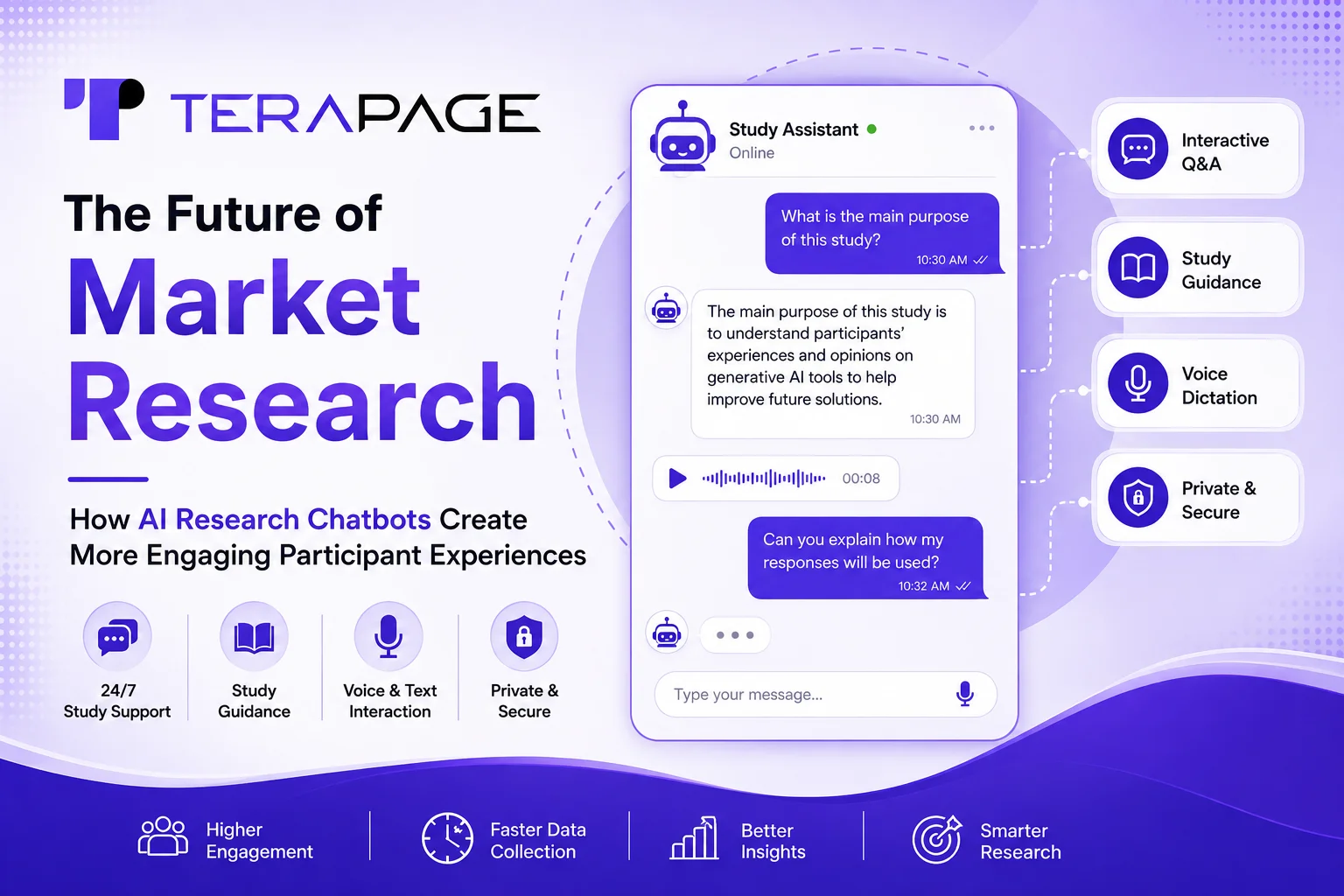
Table of Contents
- A Real Research Study: Why 24/7 AI Support Wins
- What Is an AI Research Chatbot?
- How Terapage's AI Research Chatbot Creates More Engaging Participant Experiences
- The Future of Market Research Is Conversational AI
- Frequently Asked Questions
A Real Research Study: Why 24/7 AI Support Wins
A research firm approved two studies with the same two-month deadline. Team A completed data collection within 1.5 months and presented its findings ahead of schedule, while Team B had to request a deadline extension.
What made the difference? Conversational AI — specifically, a Study Assistant research chatbot.
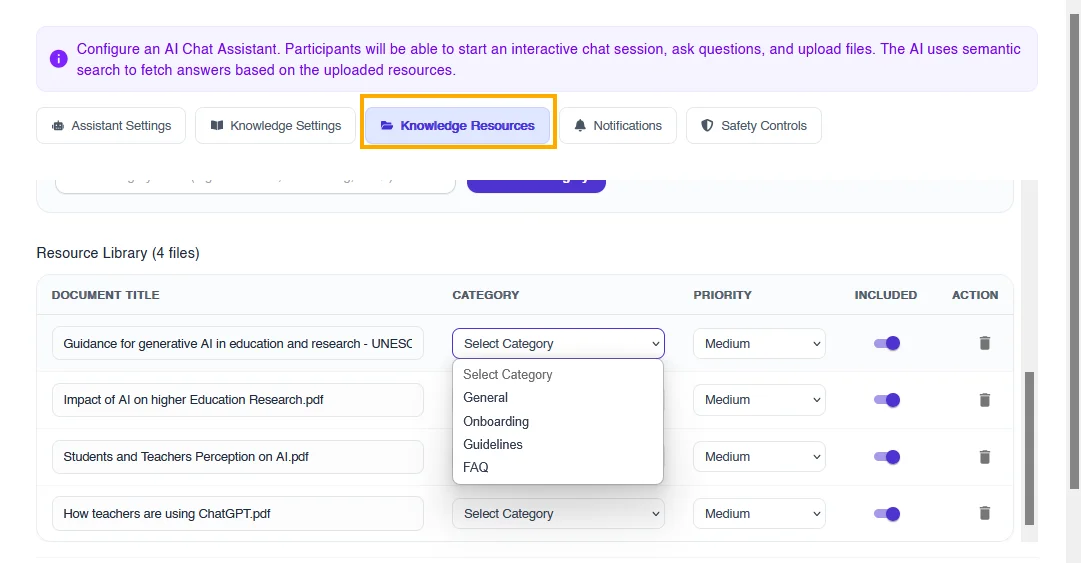
Team A equipped its Study Assistant (Research Chatbot) with extensive knowledge resources, including guidelines, FAQs, and general study information. Participants could ask questions and receive immediate, context-aware assistance whenever they needed it. With 24/7 conversational support, participants were less likely to get stuck, abandon a task, or wait for a researcher to respond.
Team B, however, relied on human assistance available only during 9–5 working hours, with no support on weekends. Any participant who ran into a question outside those hours had to wait, slowing both the research process and data collection.
Team A had a real advantage because of conversational AI: continuous, on-demand participant support that kept the study moving, even when the research team was offline.
What Is an AI Research Chatbot?
A chatbot is an artificial intelligence (AI) agent — a sophisticated AI system that enables users to engage in interactive conversations via instant messaging. Unlike search engines, chatbots can provide personalised and complex responses to user queries, making them a promising tool for human-machine interaction.
An AI research chatbot is a conversational AI system designed specifically to support research activities. Instead of functioning primarily as a customer-service assistant, it becomes an interface between the researcher, the research materials, and the participant. Participants can interact with the chatbot to answer research questions, ask for clarification, explore a topic, and provide information in their own words.
Unlike traditional chatbots, AI research chatbots have become part and parcel of conversational research itself. Conversational research has always been about allowing people to express ideas in their own words — AI chatbots are simply what makes that approach scalable, consistent, and available around the clock.
Research doesn't always happen during working hours. Participants may be in different countries or prefer to take part at a time that works for them. AI research chatbots are available 24/7, answering questions and helping participants even when researchers or moderators are offline or in another time zone. This means participants don't have to wait for a researcher to become available — they can continue their research activity whenever it's convenient for them, making the overall experience more flexible and accessible.
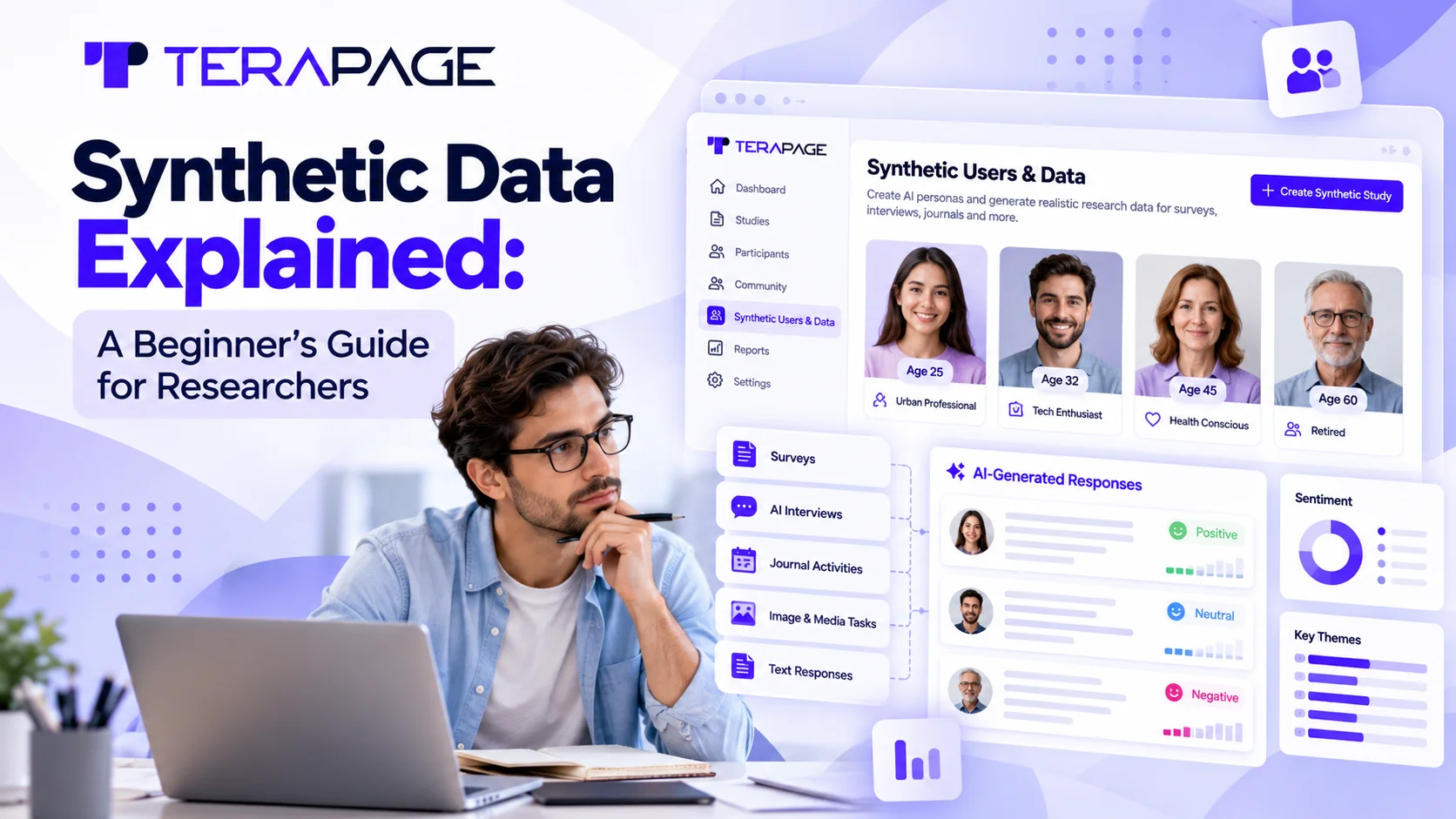
Terapage's Study Assistant (Research Chatbot) uses conversational AI to understand researcher and participant queries, maintain context, and deliver relevant, real-time responses — enhancing research study outcomes with better insights.
How Terapage's AI Research Chatbot Creates More Engaging Participant Experiences
1. Interactive Study Assistant
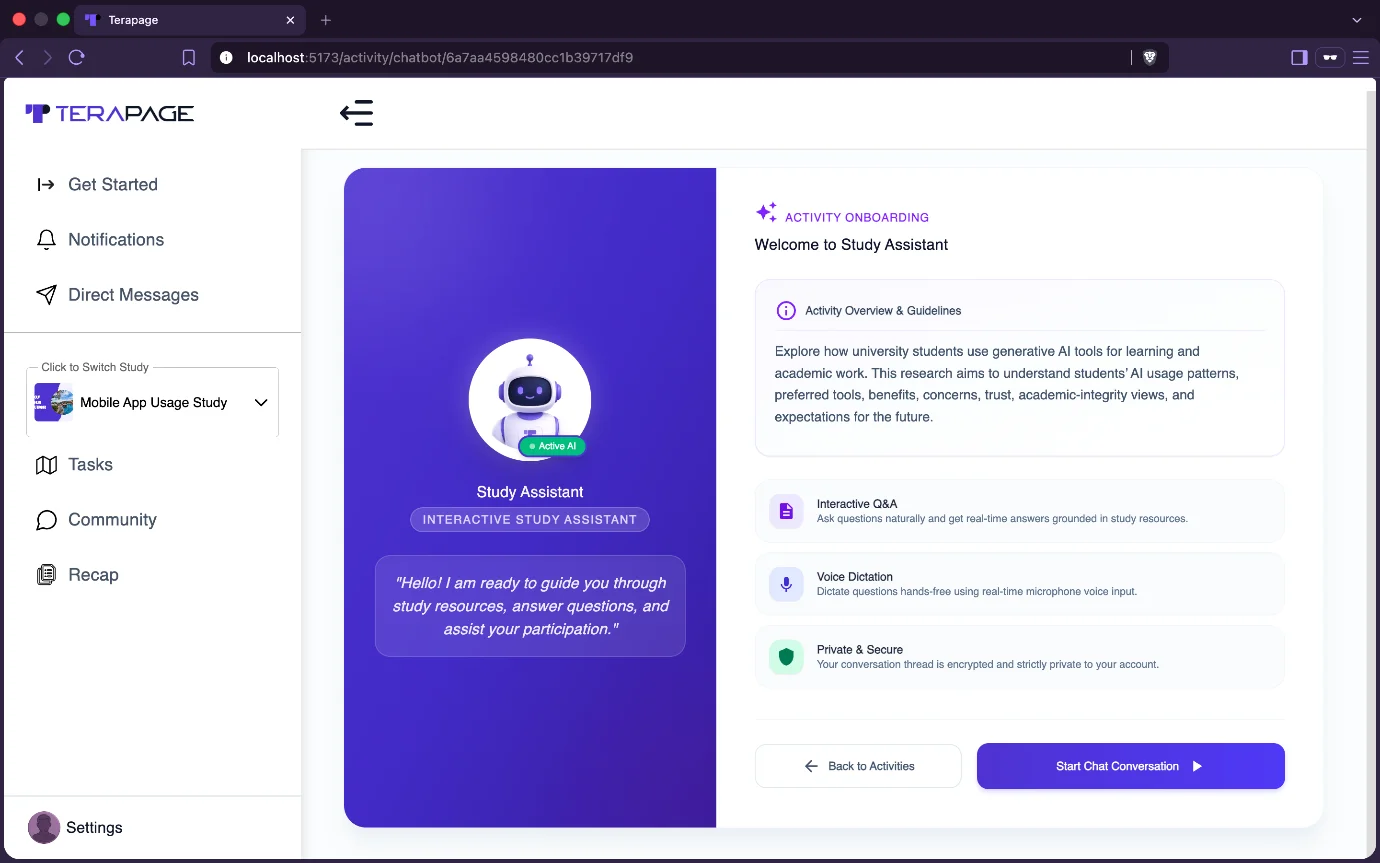
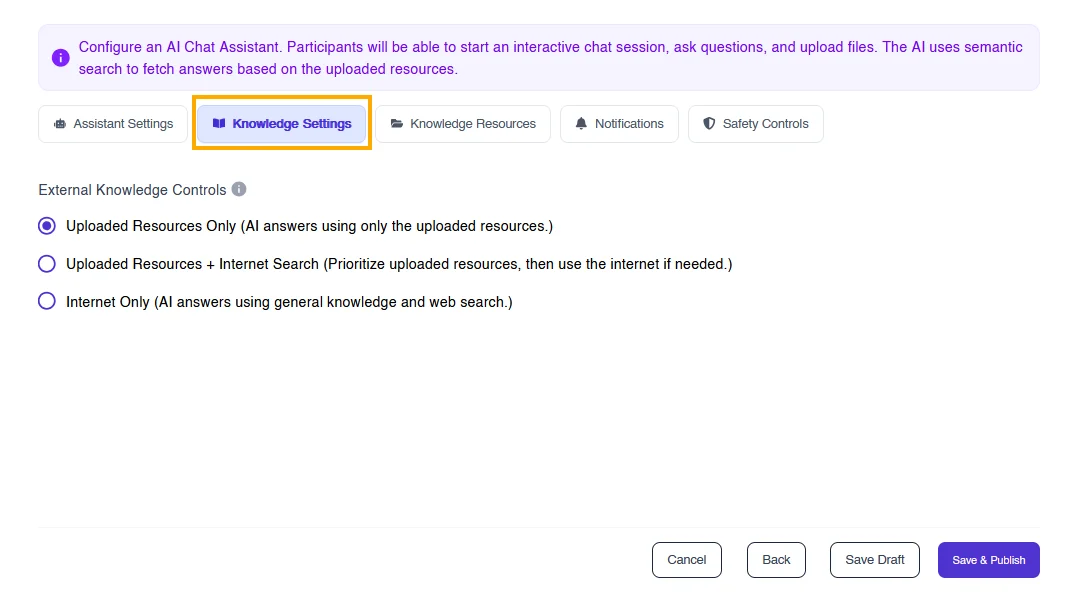
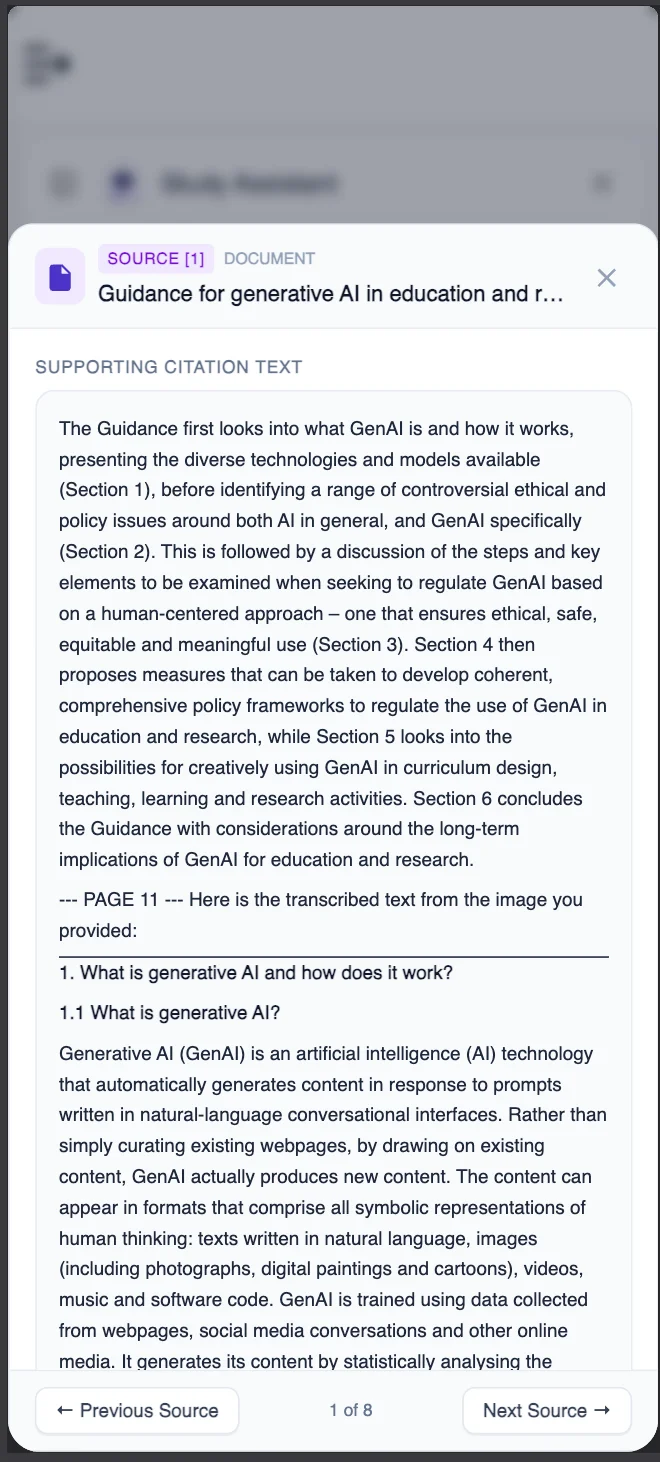
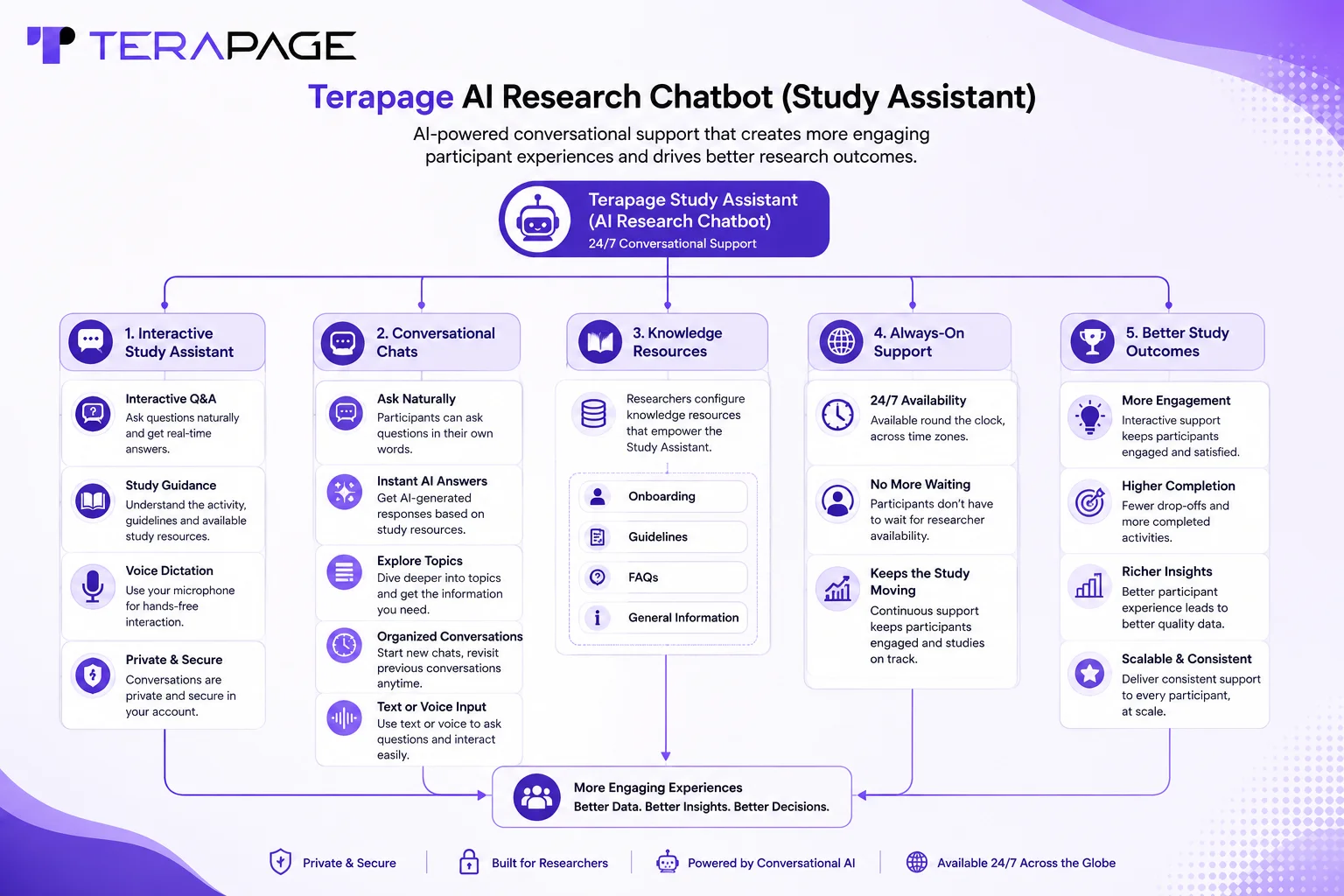
Terapage's Interactive Study Assistant provides participants with an AI-powered chatbot that guides them throughout their research activity. Instead of navigating study resources on their own, participants can interact with the assistant using natural-language questions and receive real-time answers grounded in the study materials, configured through Terapage's onboarding and Task Guidance tools.
- Interactive Q&A: Participants can ask questions naturally and receive real-time responses.
- Study Guidance: The chatbot helps participants understand the activity, guidelines, and available study resources.
- Voice Dictation: Participants can use their microphone for hands-free interaction.
- Private & Secure: Conversations are presented as private to the participant's own account.
2. Conversational Chats
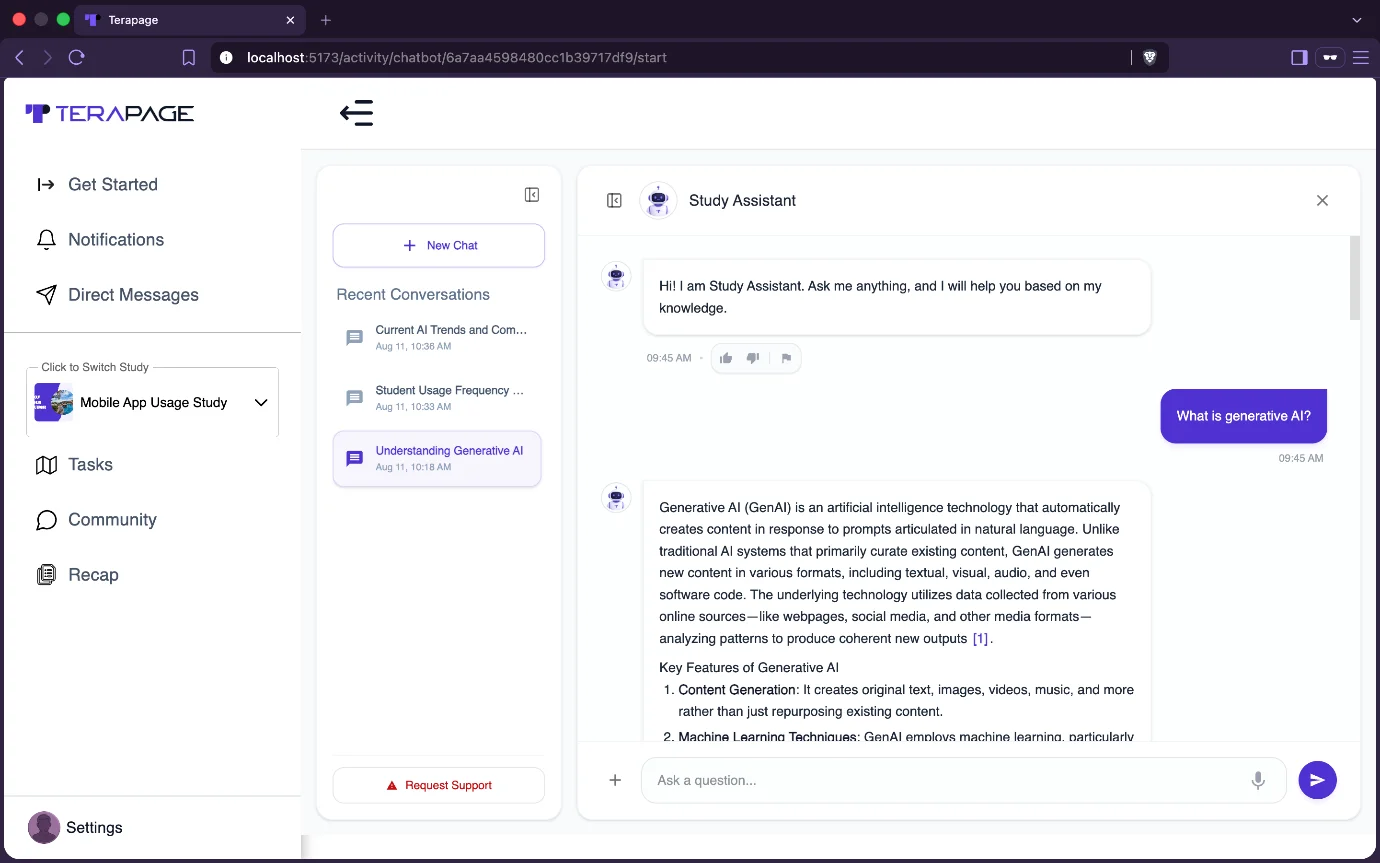
The Terapage Study Assistant enables participants to interact with an AI chatbot through natural, conversational questions. Participants can ask about the study topic, receive instant AI-generated answers, and explore information without leaving the research activity. The assistant provides responses based on the study's available resources, making the experience more interactive and participant-friendly.
Participants can also start new conversations, revisit previous chats, and use text or voice input to ask questions, letting them explore topics at their own pace while keeping their interactions organised within the study.
3. Conversations Are Multimedia Supported
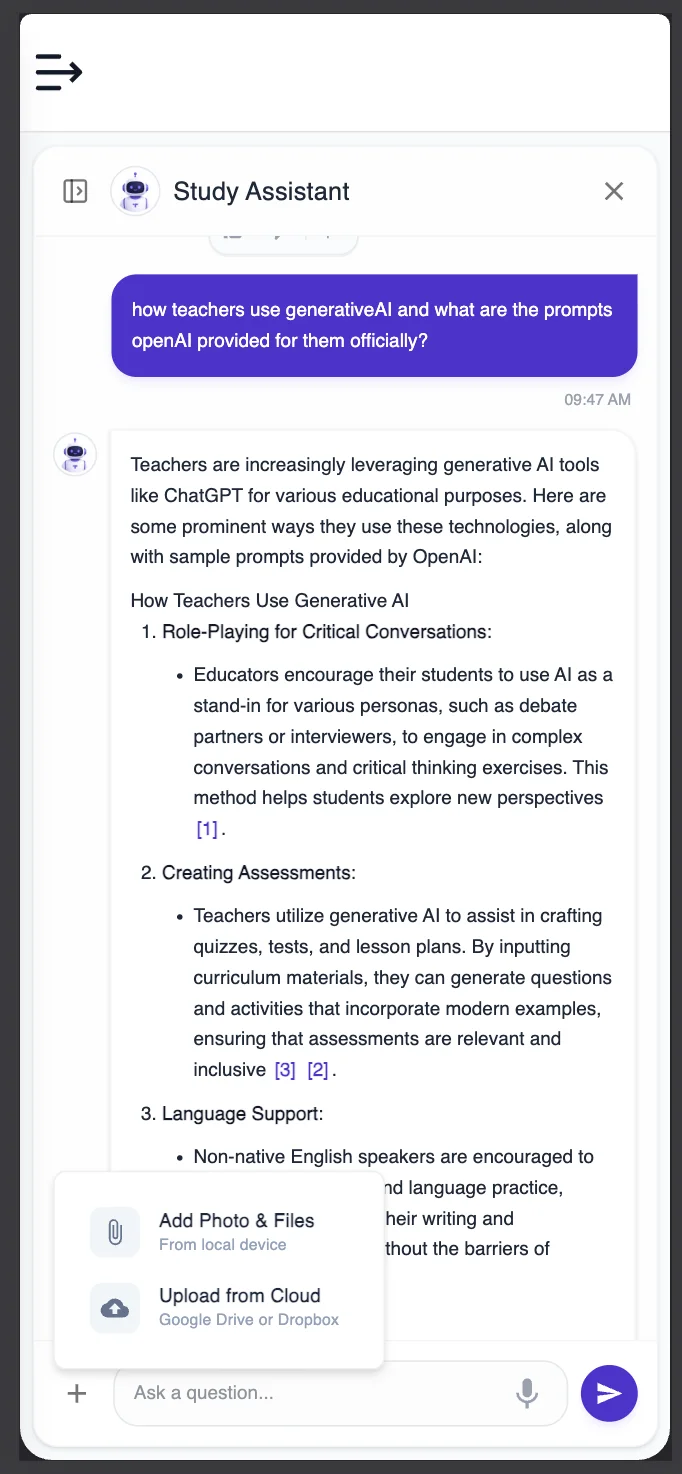
Research is not always about words. Participants can show a product, share a document, provide an image, or upload supporting information. Terapage's conversational interface supports adding photos and files from a local device and from cloud storage through the same upload task tools used across the platform, creating a multimodal research conversation where text is combined with additional participant-provided material.
4. Mobile-Compatible Conversational Research Experience
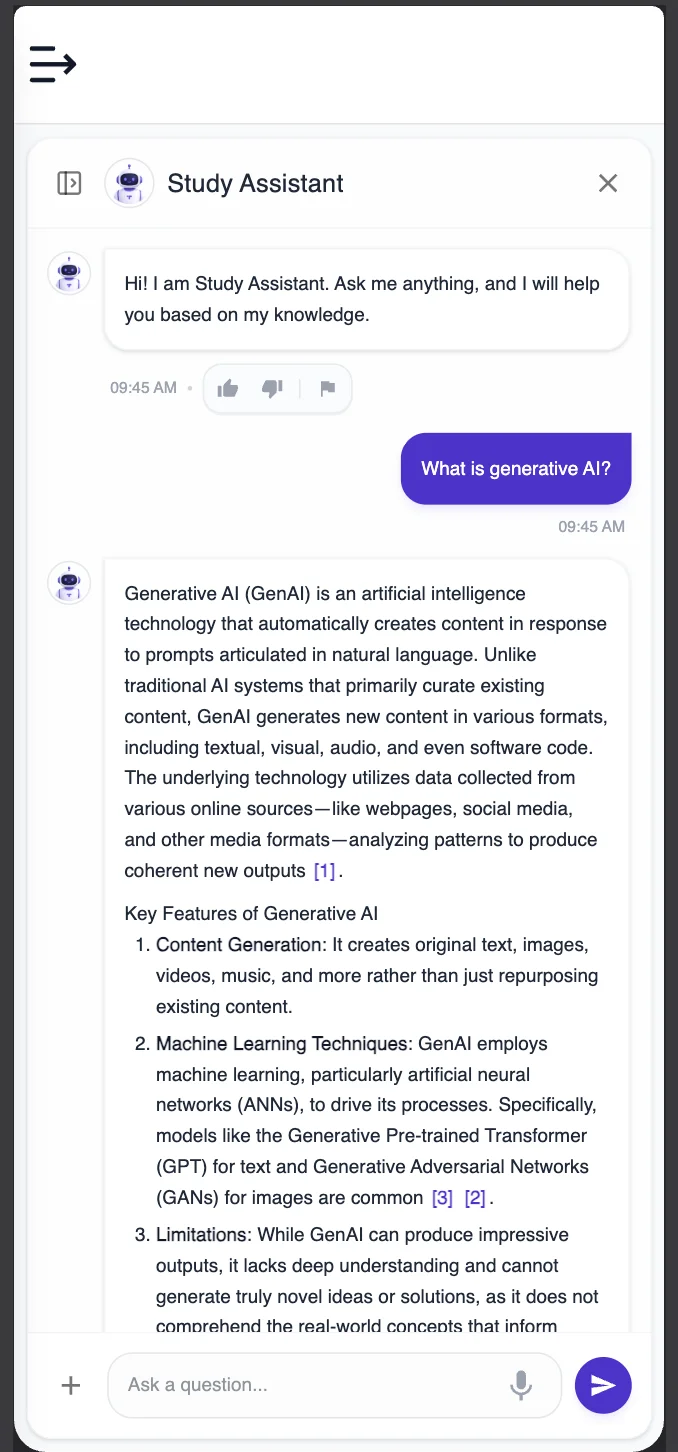
At Terapage, the conversational research experience is fully mobile compatible , allowing participants to access and complete research activities directly from their smartphones. Participants can interact with the Study Assistant, ask questions, and share responses anytime and anywhere, without being limited to a desktop computer. This flexibility is especially valuable for studies that capture participants' experiences, behaviours, and feedback in their everyday environments.
5. Question Analysis: Discover What Participants Want to Know
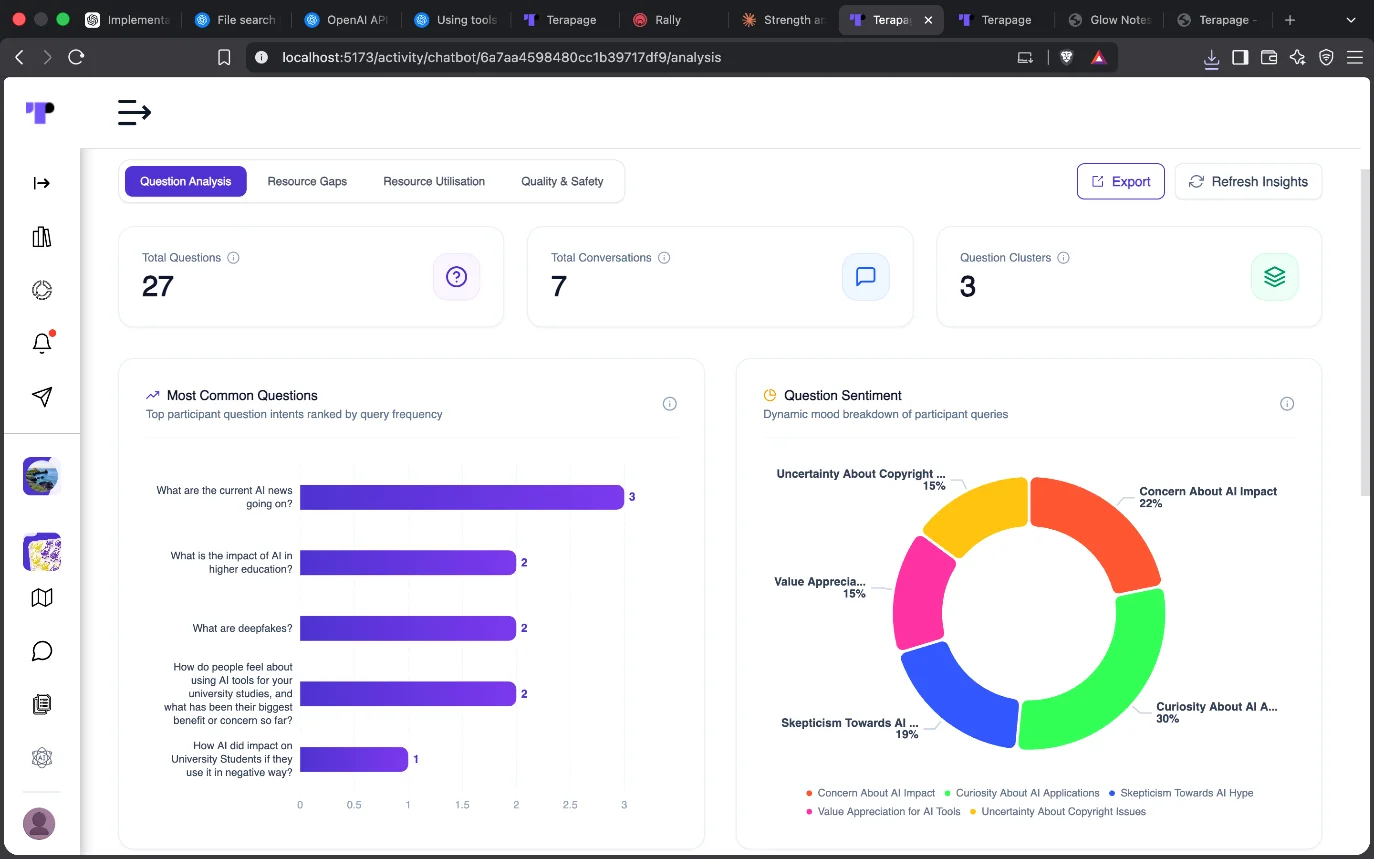
Once the conversations are over, researchers can view the Analytics and Insight tab to understand the distribution of questions during those conversations. In the Questions Analysis tab, researchers can examine total questions, total conversations, question clusters, most common questions, and question sentiment. This way, researchers can uncover unexpected concerns, emerging themes, information needs, or areas not considered when the study was designed.
6. AI-Powered Analysis of Chatbot Conversations
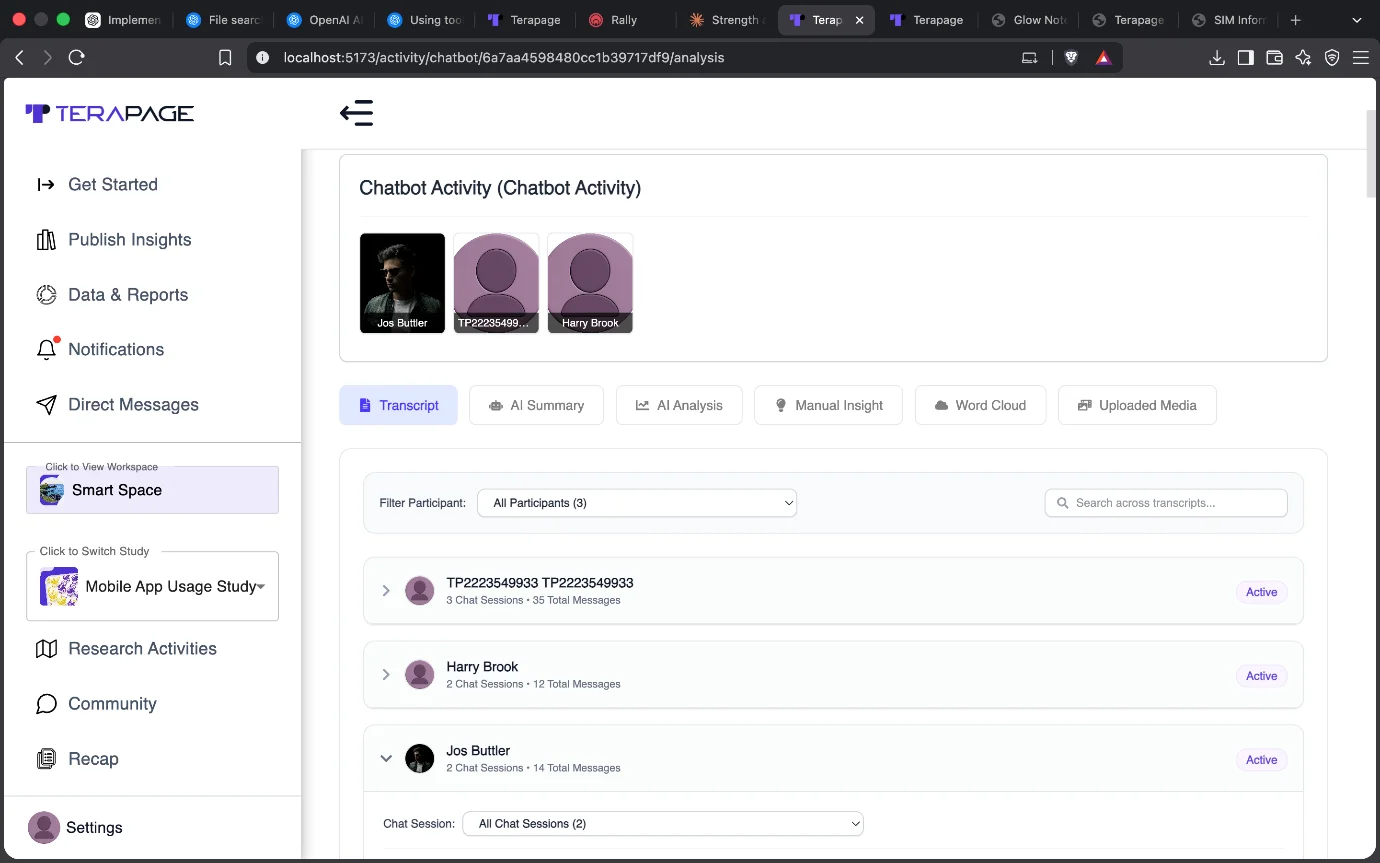
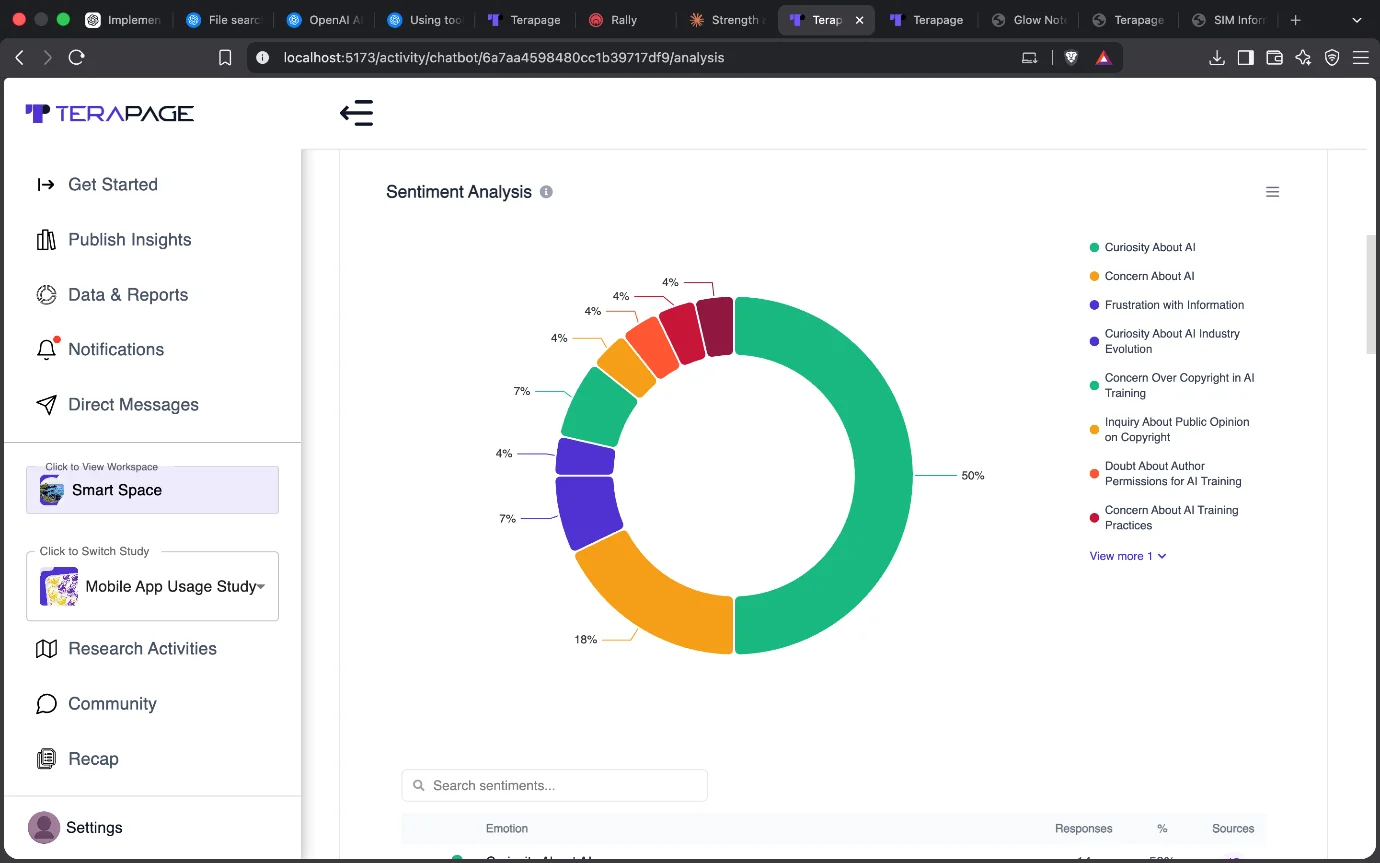
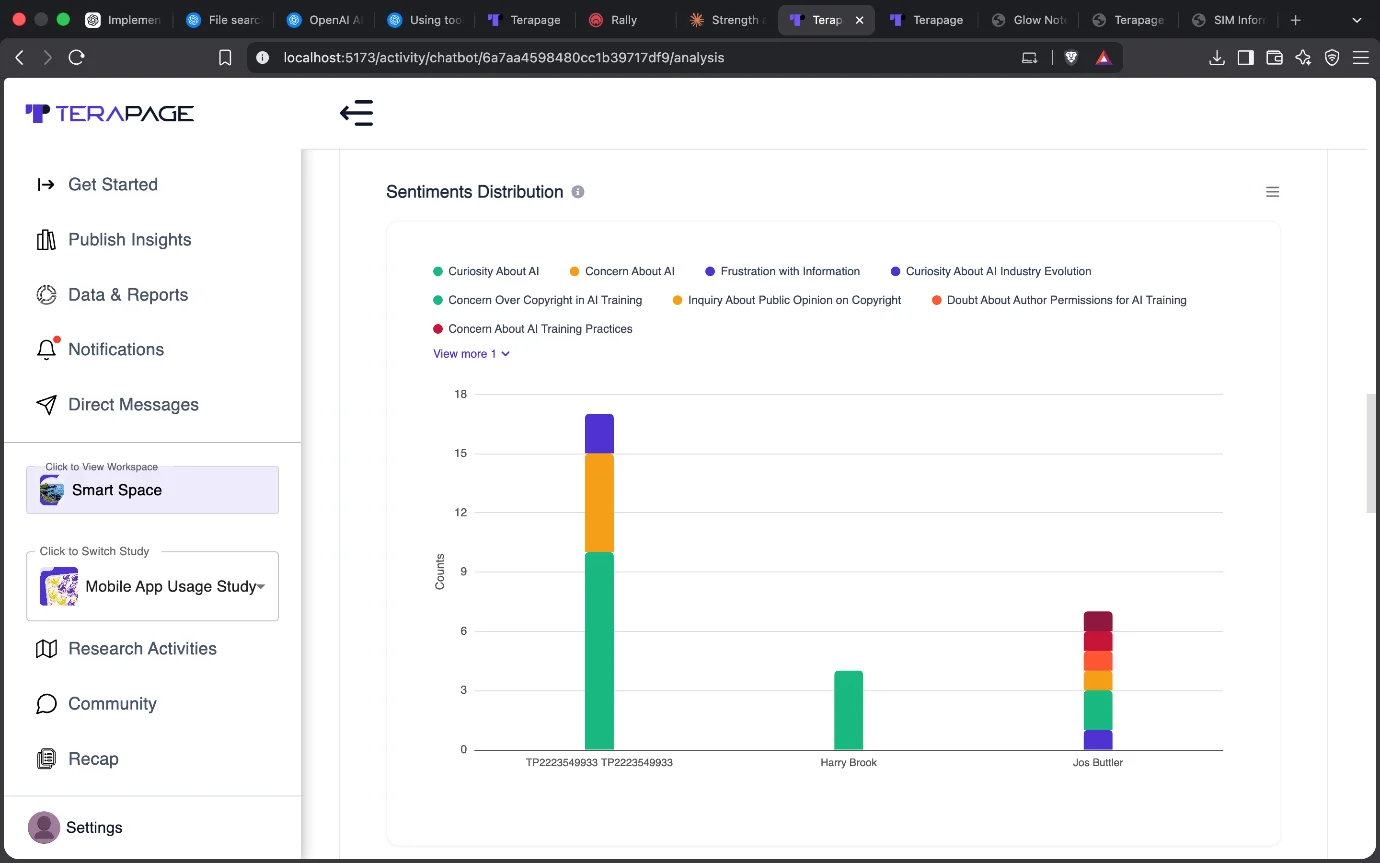
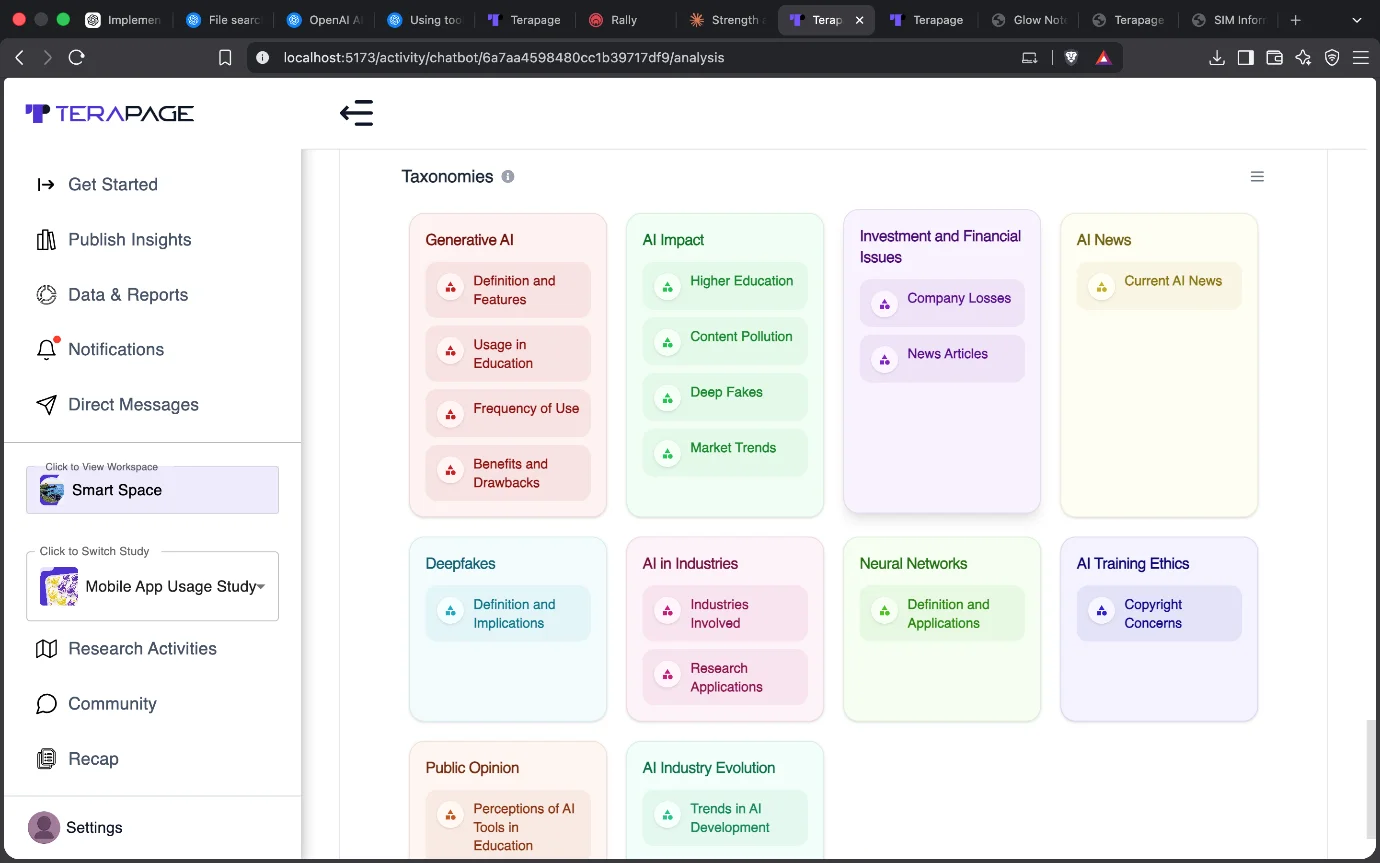
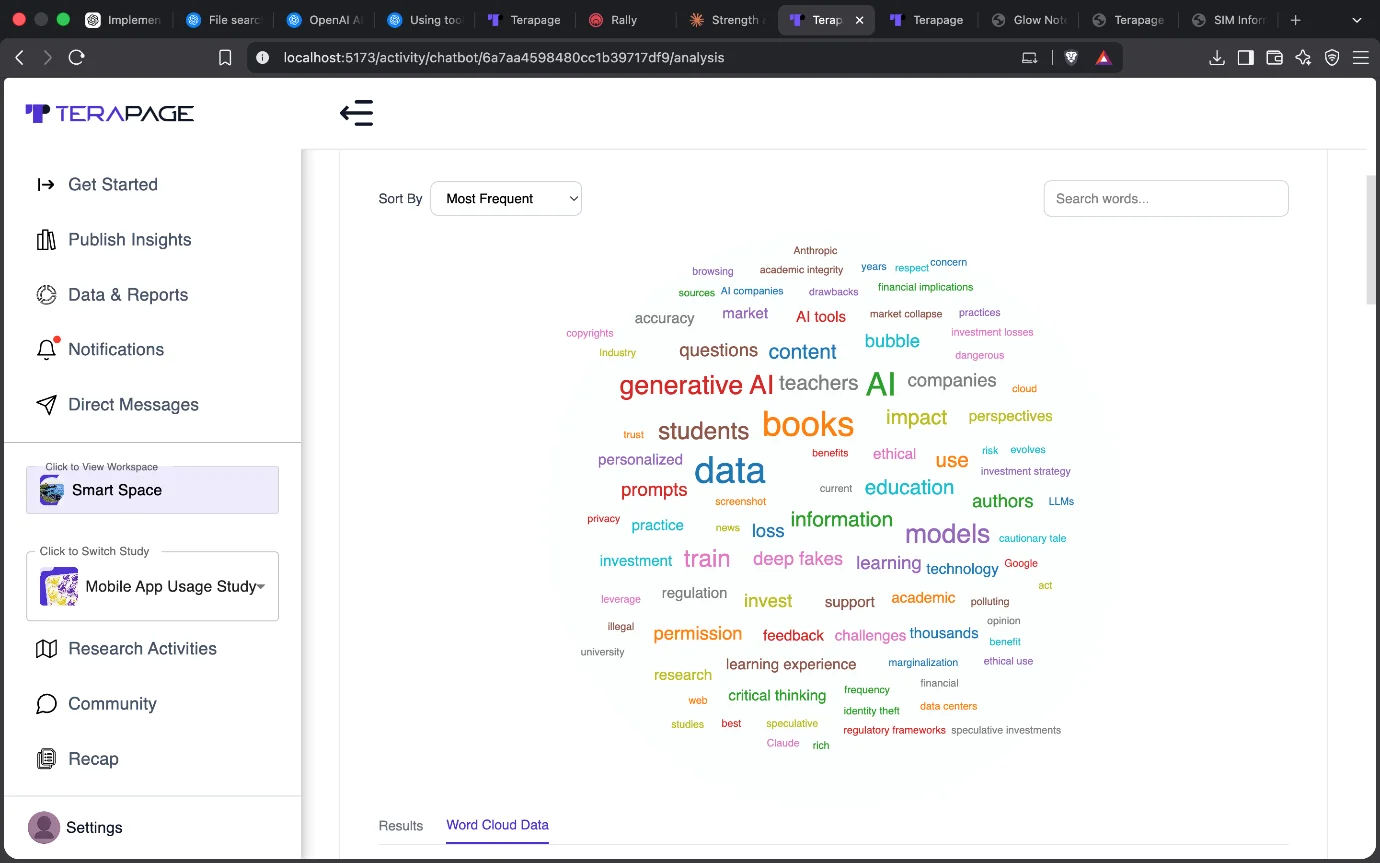
Words alone do not always tell the complete story. Terapage's AI-powered insight tools also analyse the conversations and provide transcripts, sentiment patterns, sentiment distributions, word clouds, quote analysis, and taxonomies — giving researchers a fuller, more nuanced picture than a manual read-through ever could.
7. AI-Powered Summaries for Faster Analysis
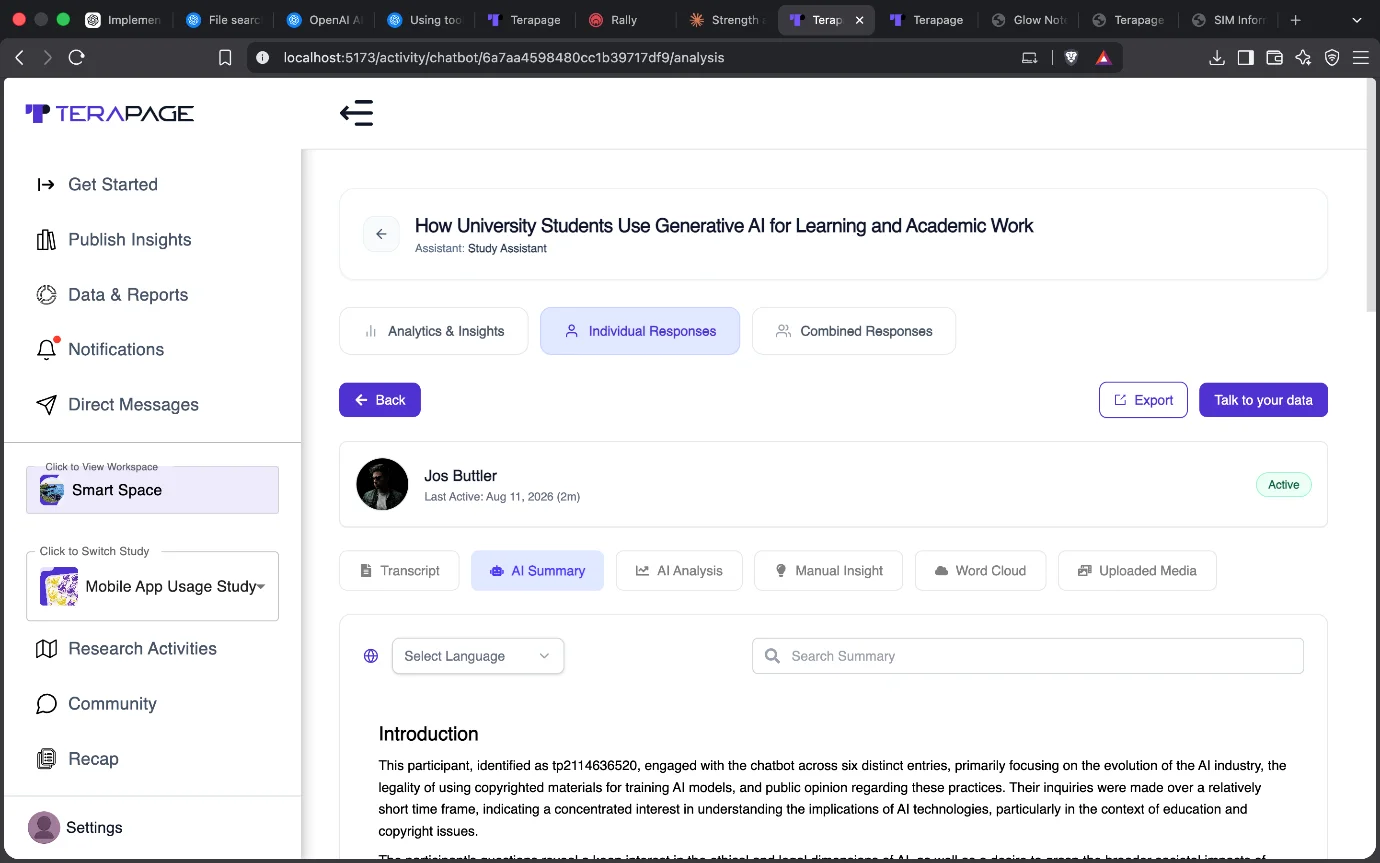
As the number of conversations grows, manually reading every interaction becomes difficult. Terapage'sAI-powered insight tools summarise whole conversations to help researchers quickly understand individual participant exchanges. This creates a workflow where researchers can start with an automated overview and return to the original conversation only when deeper investigation is required.
8. Resource Gaps: Find What Your Study Is Missing
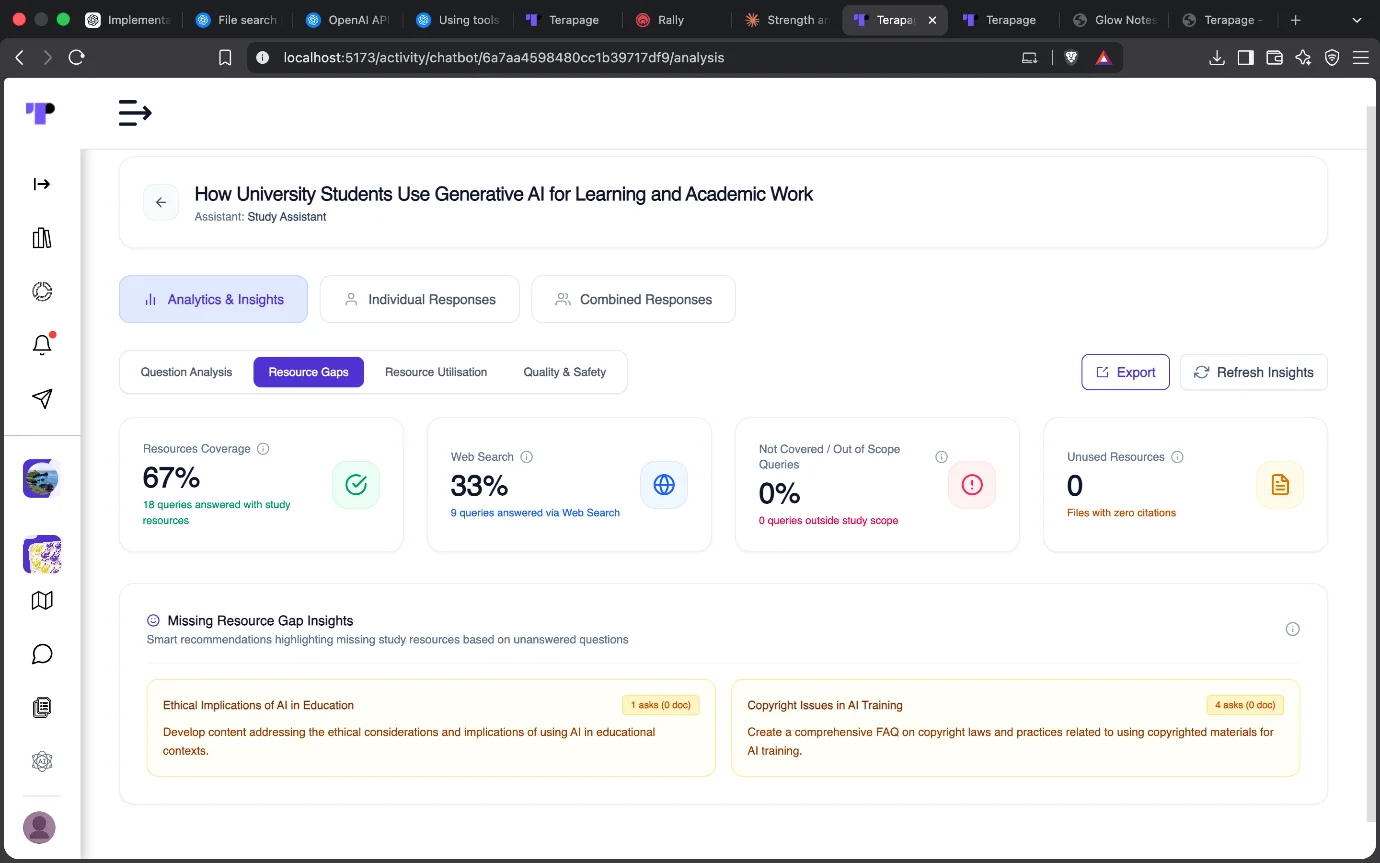
One of the more distinctive capabilities of the Terapage Study Assistant is Resource Gap Analysis. Participants may ask questions that cannot be adequately answered using the resources available to the chatbot. Rather than treating those questions as failures, researchers can treat them as gaps — Terapage highlights missing resource areas based on unanswered participant questions. In other words, participants help researchers discover what the study itself is missing.
9. Resource Utilisation: Which Information Matters the Most?
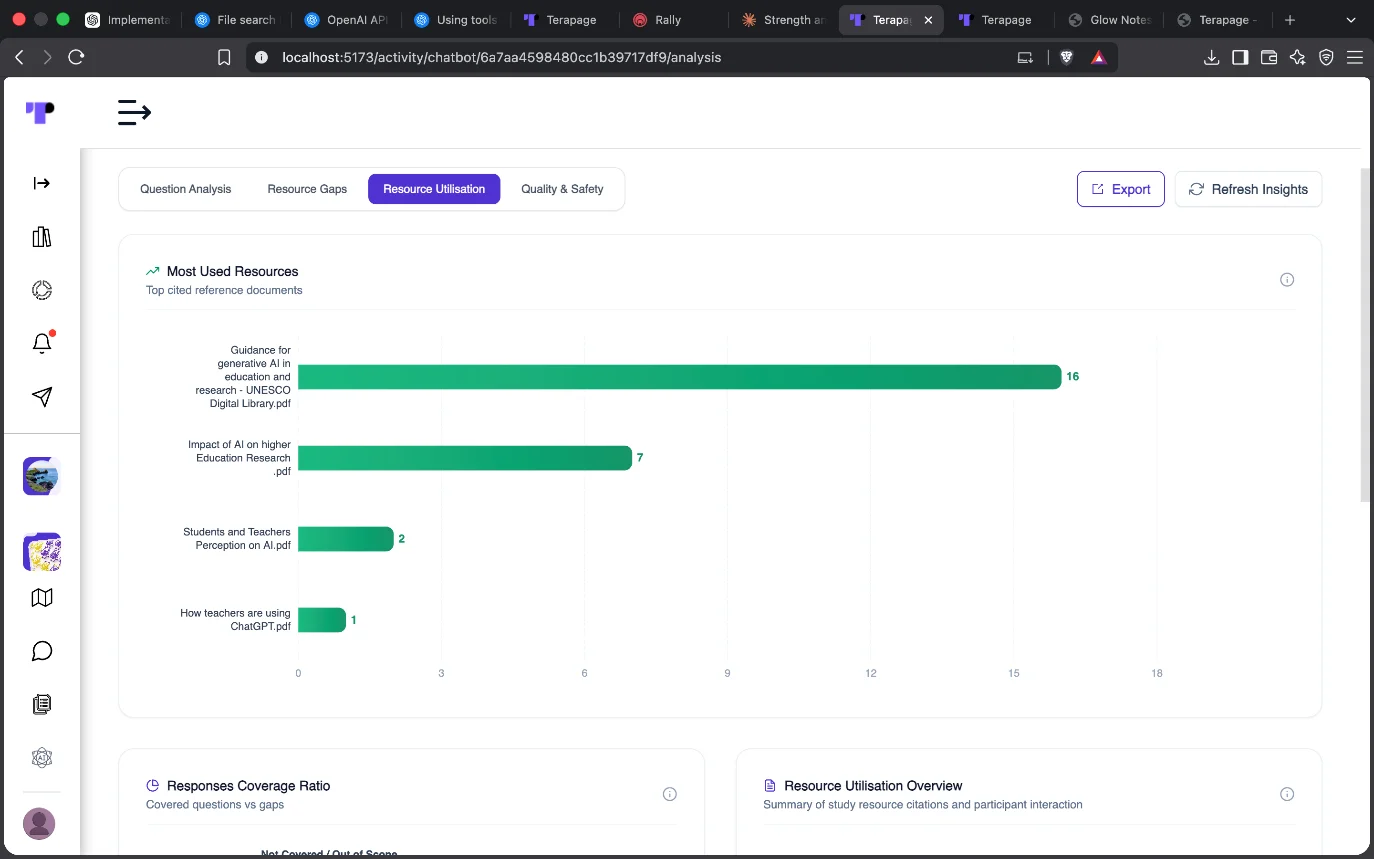
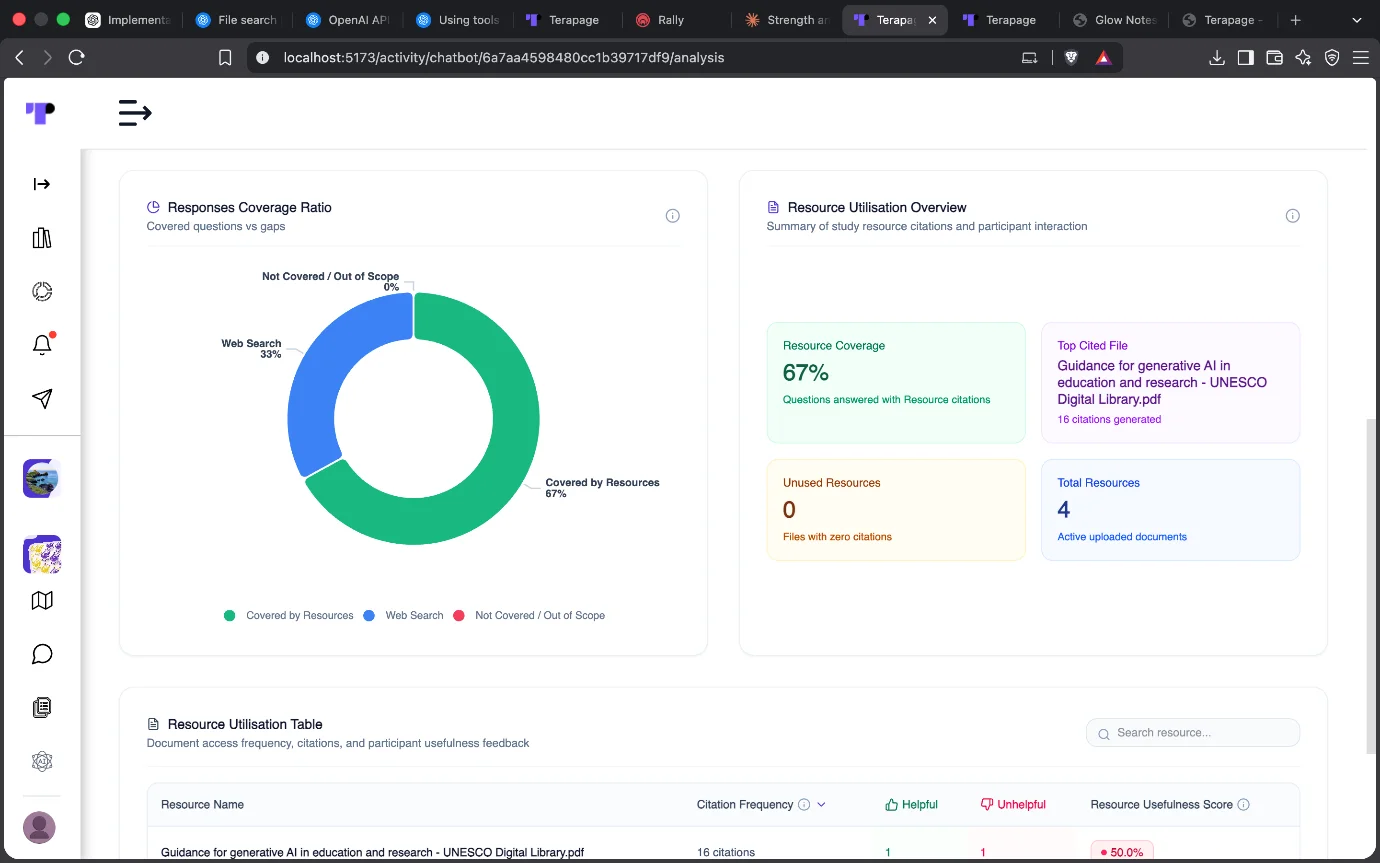
An AI research chatbot can also reveal how participants interact with the information provided to the study. Terapage's Resource Utilisation analysis, part of Reports and Analysis, shows which study resources are cited most frequently during responses. This helps researchers understand which documents, materials, or sources are actually contributing to participant conversations, instead of simply uploading material and assuming it's useful.
10. AI-Powered Recommendations for Study Materials
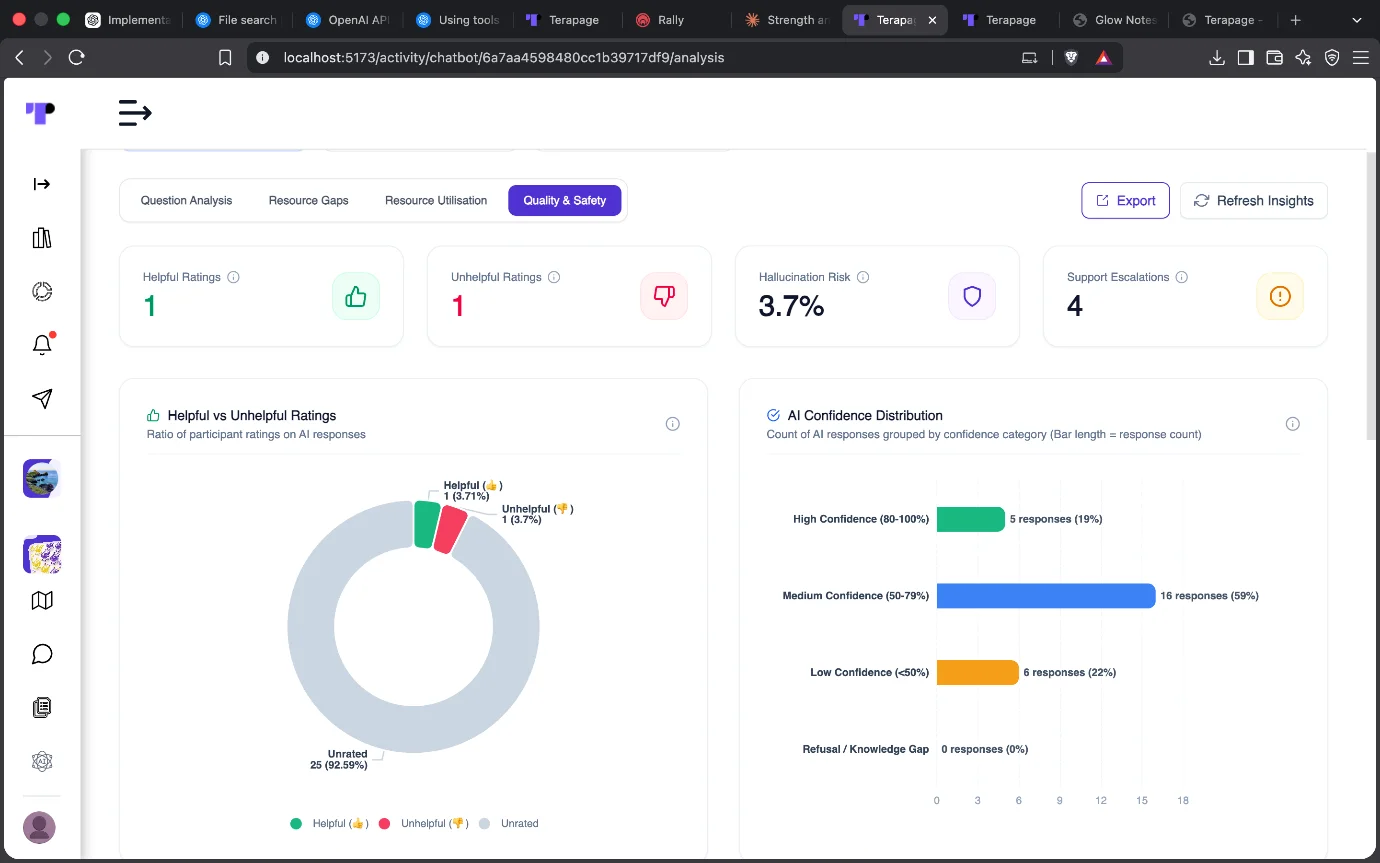
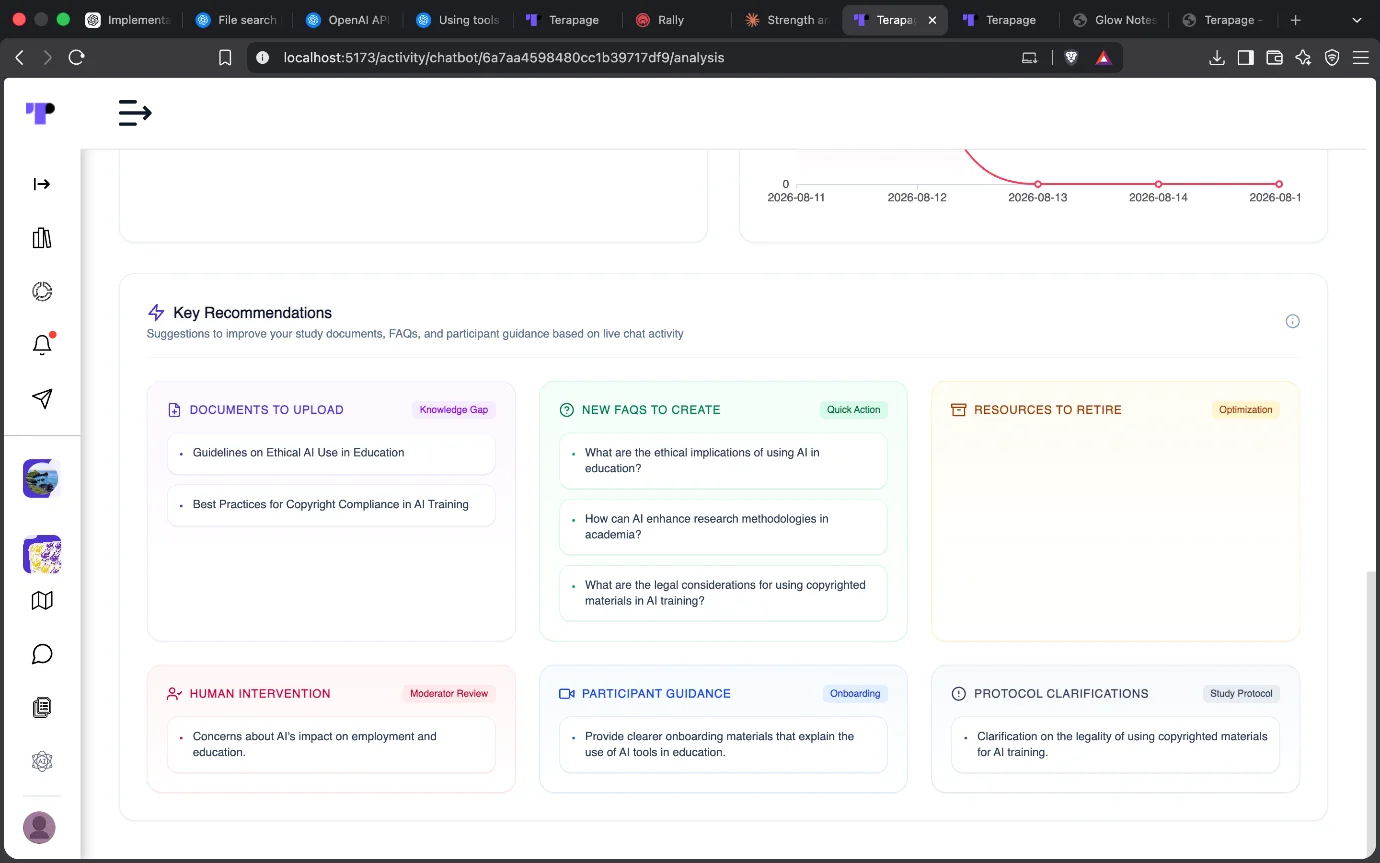
Beyond flagging gaps and usage patterns, Terapage's AI also turns those findings into action. By analysing Study Assistant and participant conversations together, it surfaces concrete recommendations for improving study documents, uploaded files, FAQs, and other research materials — helping researchers close resource gaps before they affect the next study.
11. Exportable Research Data
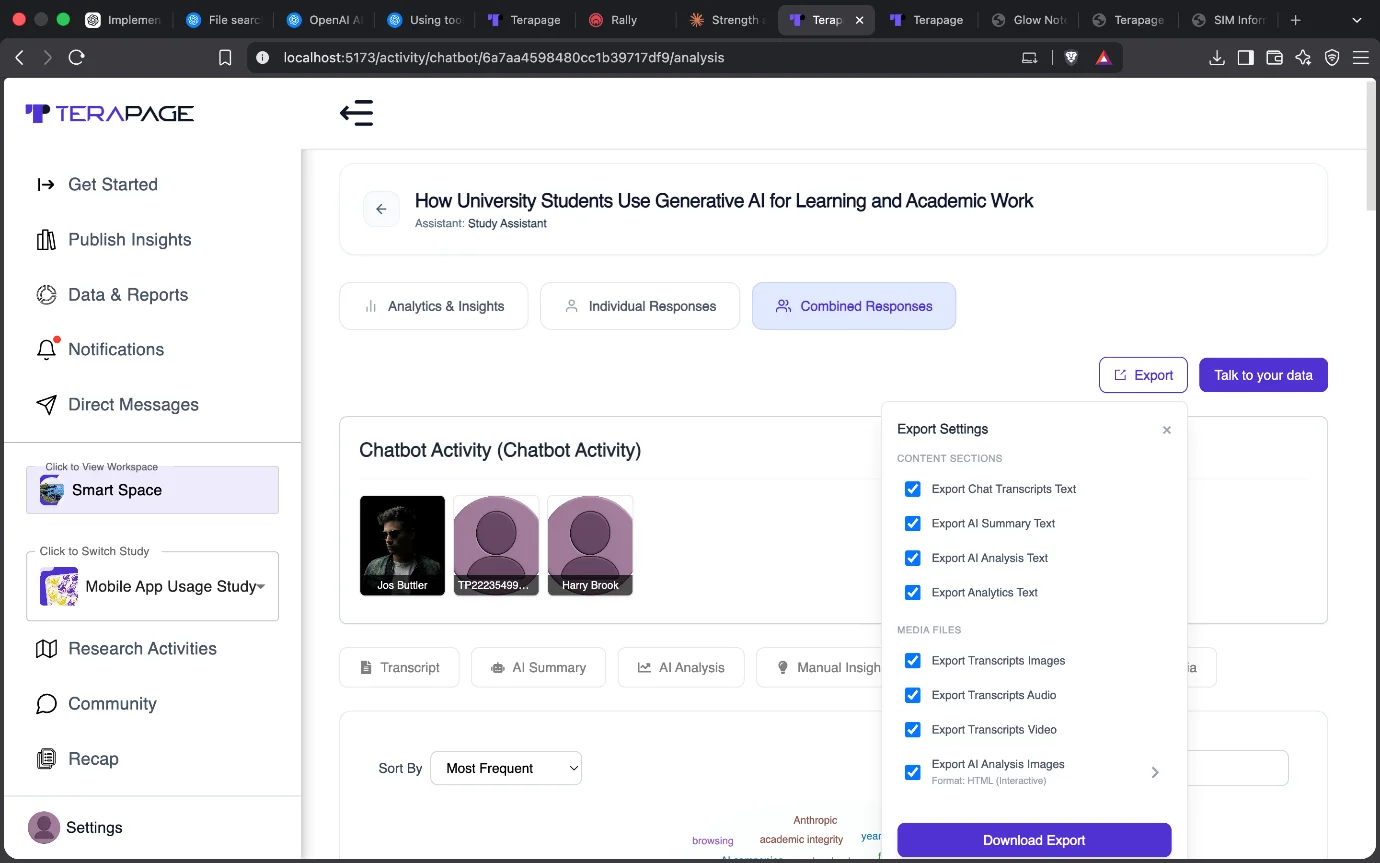
Terapage makes it easy for researchers to export collected research data for further analysis, reporting, and sharing through Reports and Analysis . Responses and chatbot interactions can be organised and downloaded in usable formats, helping researchers pinpoint what points were confusing for participants during the research journey — making it easier to review feedback, conduct deeper analysis, identify gaps, and act on recommendations.
The Future of Market Research Is Conversational AI
Market research has traditionally worked in an isolated way, where participant-researcher interaction was scarce. AI research chatbots change this with two-way interaction. Let participants talk. Let AI chatbots (study assistants) understand. Let researchers discover.
The future of market research is conversational AI. For studies that still rely only on scheduled live interviews or automated interviews during set hours, an always-on Study Assistant closes the gap between participant availability and researcher support — while keeping every conversation private and secure.
Ready to turn your next research study into better conversations? Terapage AI Study Assistants (Research Chatbots) guide participants throughout their research journey through two-way conversations, helping researchers uncover richer responses and meaningful insights.
Start a free trial with Terapage or book a demo today. Need help planning your setup? Our support services team is here for you.













.webp)