Sign up with Google
 Sign in with Zoho
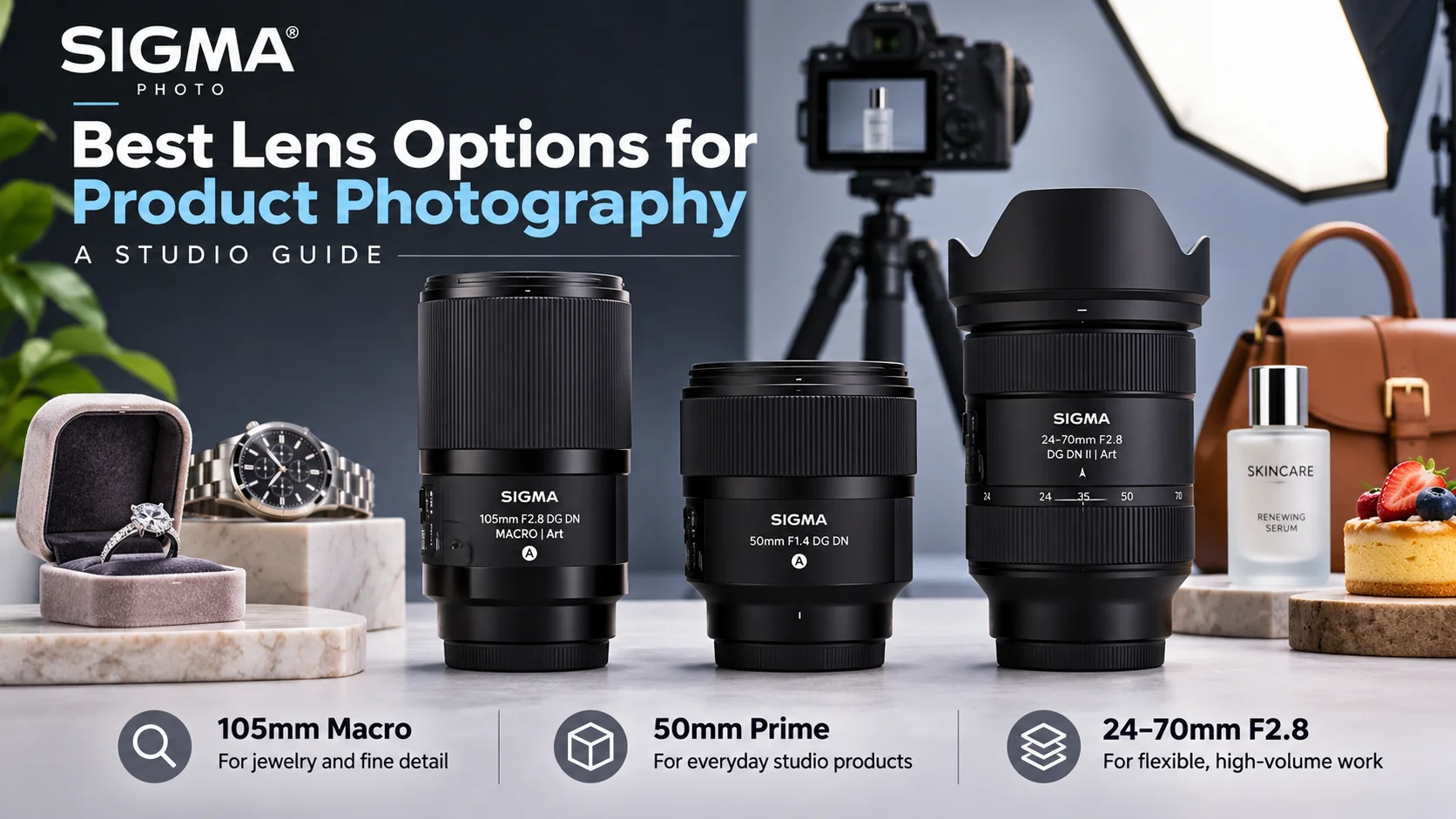
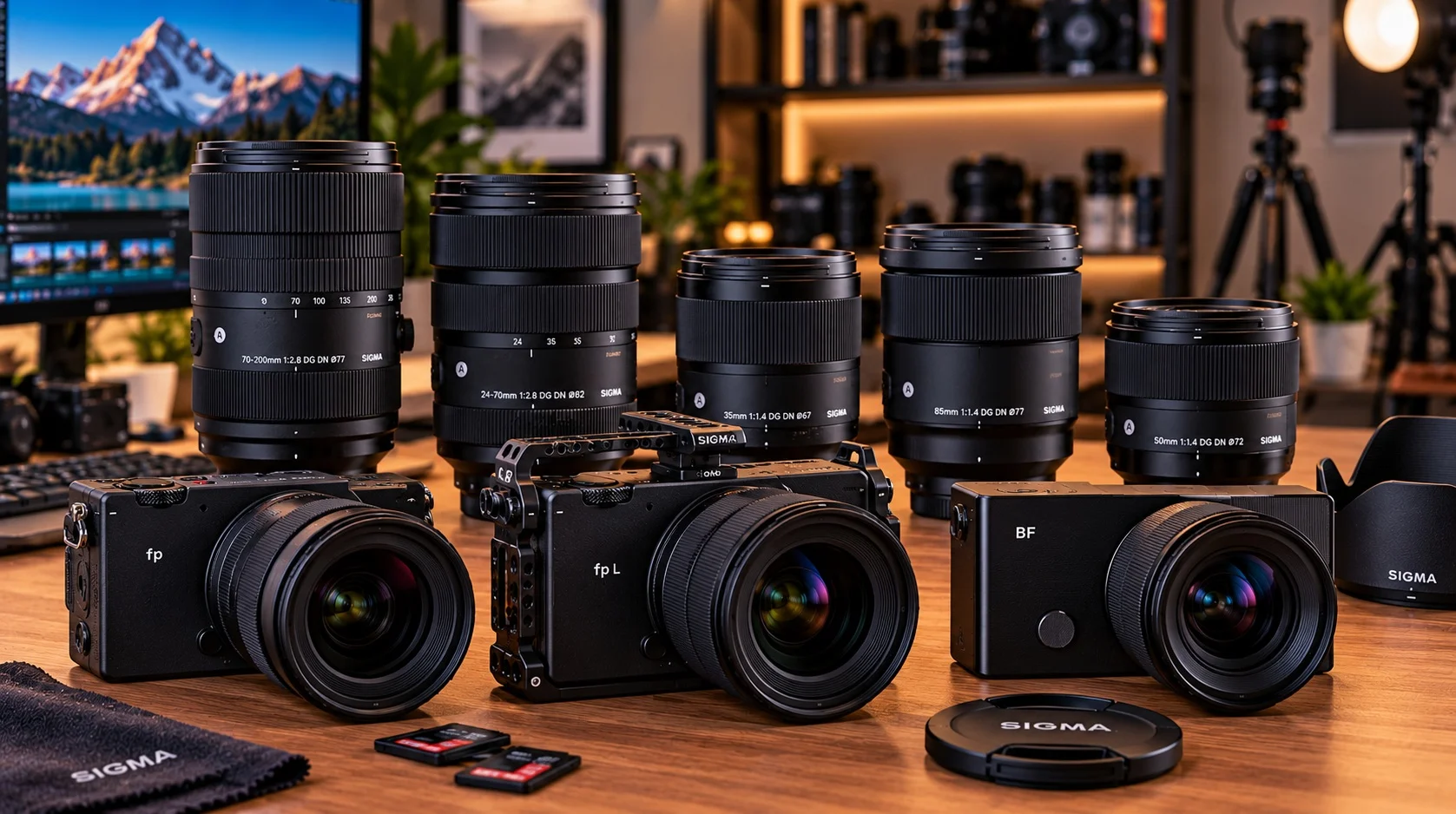
Professional product photography is less about owning the widest-aperture lens and more about controlling shape, texture, scale, perspective, and consistency. A studio may photograph jewelry in the morning, skincare bottles in the afternoon, food for a campaign, and larger ecommerce products the next day. Each subject places different demands on focal length, working distance, magnification, distortion, and depth of field.
For photographers building a Sigma Photo setup for studio work, the best approach is to match the lens to product size and final image use. Macro lenses are valuable for tiny details, standard primes give a natural perspective for medium-size products, and flexible zooms can speed up high-volume catalog work. The strongest studio kit is therefore a small group of lenses with clearly different jobs.
What Makes a Good Product Photography Lens?
Product photography rewards precision. In a controlled studio, photographers can concentrate on geometry, reflections, texture, color, and depth.
Important lens characteristics include:
- High detail across the frame
- Low visible distortion
- Appropriate working distance
- Close-focusing capability and useful magnification
- Predictable focus behavior
- Correct camera compatibility
- A focal length suited to the studio space
Maximum aperture is usually less important than it is for weddings or events because studio lighting can provide the required exposure. Product photographers often stop the lens down for more depth of field.
Start With Product Size, Not Lens Popularity
The first question should be: what are you photographing?
A ring and a sofa need different lens strategies. Small objects need magnification and comfortable working distance, while larger objects need enough space for natural proportions without excessive wide-angle distortion.
A useful studio can divide assignments into three groups:
Small products: jewelry, watches, cosmetics, electronics, food details and textures.
Medium products: shoes, bags, bottles, appliances, tabletop products and ecommerce items.
Large products: furniture, fashion products, bicycles, large appliances and room-scale commercial sets.
This classification makes lens selection much easier.
105mm Macro: The Specialist for Jewelry and Fine Detail
For small products, a true macro lens is one of the most valuable tools in a professional studio.
The SIGMA 105mm F2.8 DG DN Macro Art provides 1:1 magnification, allowing very small subjects to be reproduced at life-size scale on the camera sensor. That matters when a client needs to see engraving, gemstone facets, watch details, cosmetic textures or small engineering components.
The longer focal length also provides useful working distance. Instead of placing the camera extremely close to the product, the photographer can leave space for lights, reflectors, diffusion material and flags.
This makes a 105mm macro particularly suitable for jewelry, watches, small cosmetics, electronic components, detailed crafts and close-up commercial imagery.
A macro lens is not automatically the best option for every product. If an assignment is mainly clothing, furniture or full-size packaging, 1:1 magnification may offer little practical benefit.
Why Working Distance Matters in a Studio
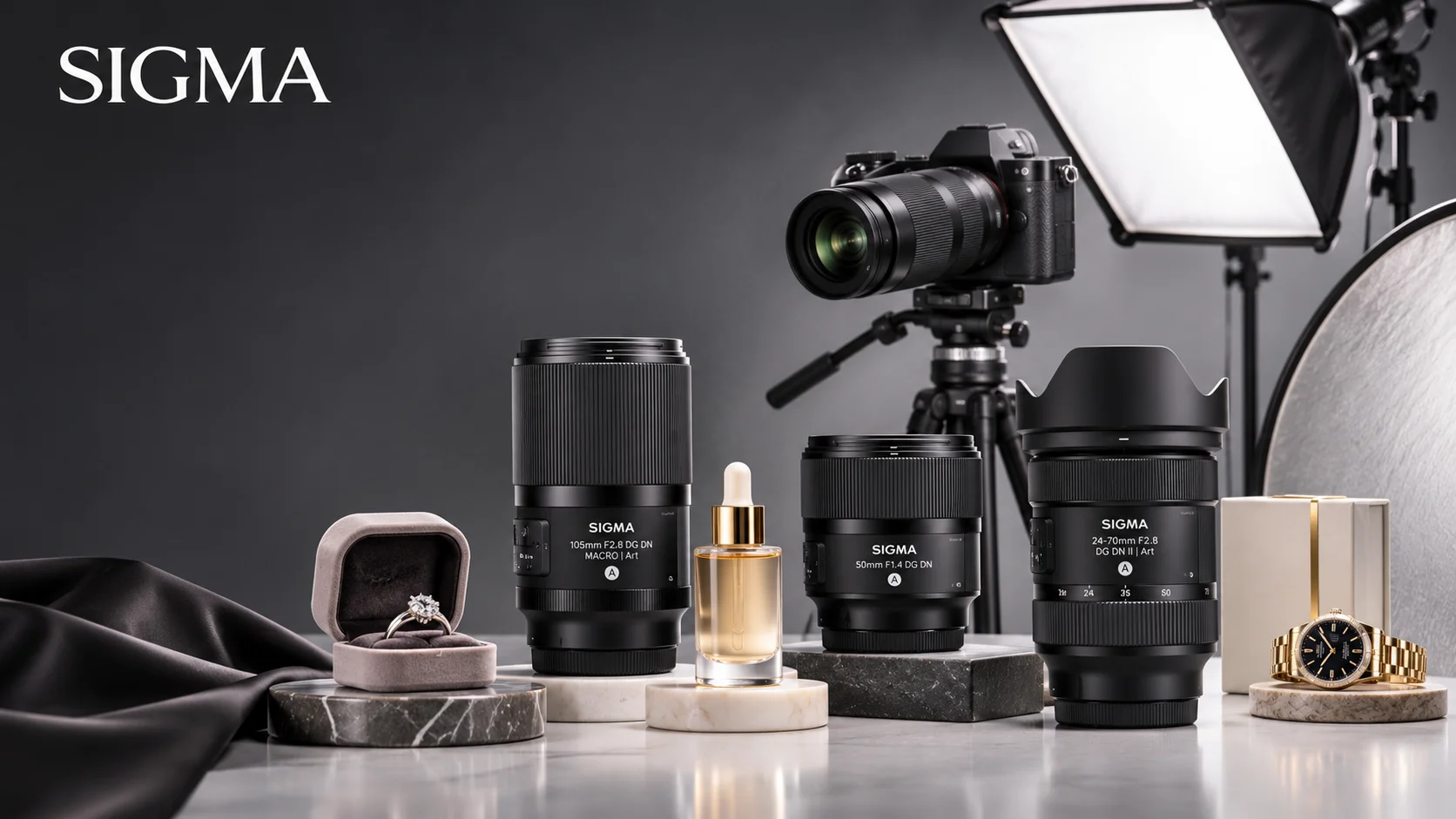
Working distance is often ignored when photographers compare lenses, but it becomes important around reflective products.
Move too close to a watch, perfume bottle or polished metal object and the camera itself can appear in the reflection. The lens may also block part of the lighting setup.
A longer focal length lets the photographer maintain greater separation from the product, creating more room to shape reflections and control light.
Working distance also affects perspective. A photographer forced extremely close with a wide lens may exaggerate the nearest part of the product. Moving farther back with a standard or short-telephoto focal length often produces more natural proportions.
50mm Prime: Natural Perspective for Everyday Studio Products
A 50mm-class prime is useful when the product does not require true macro magnification.
On a full-frame camera, 50mm provides a natural-looking field of view that works well for medium-size subjects and styled commercial scenes.
It can suit food, bottles, shoes, handbags, small appliances, packaging, restaurant imagery and lifestyle product scenes.
A 50mm prime also makes it easier to build repeatable lighting and camera positions. Wide apertures can help with lifestyle shots, but clean ecommerce photography usually benefits from stopping down so more of the item remains sharp.
24–70mm F2.8: The Flexible Choice for High-Volume Studio Work
Commercial studios often need speed as much as optical quality.
When dozens or hundreds of products must be photographed, constantly changing primes can slow production. A standard zoom such as the SIGMA 24–70mm F2.8 DG DN II Art provides greater framing flexibility.
It can move from wider compositions to tighter product frames without relocating the camera dramatically. This makes it useful for ecommerce catalog work, clothing, home décor, product groups, flat lays, larger tabletop items and mixed-size sessions.
Zooming also helps when the camera is fixed on a tripod and product size changes repeatedly. For accurate-looking products, avoid using an unnecessarily wide focal length at very close distance.
Macro vs Standard Lens: Which Should a Studio Choose?
A macro lens is designed for close focusing and high magnification. A standard lens is designed for more general framing.
Use a macro lens when the client needs tiny details to occupy a large part of the frame.
Use a standard prime or zoom when the full product, packaging or styled environment matters more than microscopic detail.
Distortion Can Matter More Than Background Blur
Product photographs often need to represent an object accurately.
Excessive perspective distortion can make packaging look wider, bottles appear to lean, or change the proportions of furniture and electronics. This is especially noticeable when shooting close with a wide-angle lens.
The solution is not simply software correction. Camera position and focal length should be appropriate before editing begins.
For many studio products, standard and short-telephoto focal lengths provide a useful balance between natural perspective and practical working distance.
Depth of Field: Why F1.4 Is Not Always the Goal
Product photographers often own lenses with wide maximum apertures, but studio work frequently requires smaller apertures.
If a bottle is photographed at F1.4 from close distance, only a narrow section may be sharp. That can look attractive for a lifestyle campaign, but it may be unsuitable for an ecommerce listing where customers need to inspect the complete package.
Apertures around F5.6, F8 or sometimes smaller can be useful when more product depth needs to remain sharp. The exact setting depends on subject size, camera distance, focal length, sensor format and desired output.
Controlled studio lighting allows photographers to stop down without relying on unnecessarily high ISO.
Focus Stacking for Products That Need Maximum Detail
Macro and close-up photography can create extremely shallow depth of field even at smaller apertures.
When jewelry, watches or detailed products must appear sharp from front to back, photographers can use focus stacking. Several photographs are made while the focus point moves through different parts of the product, then combined in post-production.
This technique is particularly useful for rings, gemstones, electronics, watches and intricate crafts.
A stable tripod, stationary subject and consistent lighting make the process more reliable.
Catalog Work vs Advertising Work
Catalog photography prioritizes repeatable scale, perspective, crop and color. A standard zoom can be efficient when product sizes vary, while a prime works well when products are similar and the camera position stays fixed.
Advertising images may prioritize atmosphere, selective focus and stronger background separation. The lens should follow the commercial objective rather than automatically producing the shallowest depth of field possible.
Build a Studio Kit Around Jobs, Not Numbers
A professional studio does not need several lenses that produce nearly identical images.
A practical full-frame product kit might include:
- A 105mm macro for jewelry and small details
- A 50mm-class prime for styled products and food
- A 24–70mm zoom for general ecommerce and mixed-size catalog work
That combination covers three different production problems: magnification, natural-perspective creative work, and high-volume flexibility.
Studios should expand only when a new lens solves a repeated limitation.
Lighting and Support Still Matter
Lens choice alone does not create professional product photography. A sturdy tripod maintains framing, while controlled lighting, diffusion, flags and reflectors shape texture and reflections. Tethered shooting can also help teams inspect focus, dust and composition on a larger screen.
Check Compatibility Before Buying a Sigma Studio Lens
Before purchasing, confirm:
- Exact camera model
- Camera mount
- Sensor format
- Exact SIGMA lens model
- Correct mount version
- Autofocus and electronic compatibility
- Minimum focusing distance and magnification requirements
Compatibility should be confirmed before choosing a lens based only on focal length.
Final Thoughts
Product photography requires a different lens strategy from portraits, weddings or wildlife.
Small products benefit from macro capability and comfortable working distance. Medium products are often easier to photograph with a standard prime, while studios producing varied ecommerce catalogs can gain efficiency from a flexible standard zoom.
For a professional Sigma Photo studio setup, the 105mm macro serves detailed close-up work, a 50mm-class prime provides a natural perspective for styled products, and a 24–70mm F2.8-class zoom offers flexibility for high-volume commercial sessions.
The best lens is determined by product size, studio space, working distance, magnification, distortion control and final image requirements.
Build the kit around repeatable jobs rather than collecting lenses. When every lens has a clear purpose, the studio becomes faster, more consistent and easier to scale.
FAQs
Which Sigma lens type is best for product photography?
It depends on the product. A macro lens is best for tiny details, a standard prime works well for medium products and lifestyle scenes, and a standard zoom is useful for mixed-size ecommerce work.
Do I need a macro lens for ecommerce product photography?
Not always. Macro capability is most valuable for jewelry, watches and very small details. Clothing, packaging, décor and larger products can usually be photographed effectively with standard lenses.
Is 50mm good for studio product photography?
Yes. On full frame, a 50mm-class lens provides a natural perspective and can work well for food, bottles, shoes, packaging and styled commercial images.
What aperture should I use for product photography?
There is no universal setting. Studio photographers often stop down when they need more of the product sharp. The correct aperture depends on product depth, focal length, camera distance and creative intent.
Why is working distance important in product photography?
Adequate working distance creates room for lighting, diffusion and reflection control. It can also help photographers maintain natural product proportions and avoid blocking light with the camera.