Sign up with Google
 Sign in with Zoho

You send a text to a customer.
They don't reply.
You send another one. Still nothing.
Is your offer bad? Is your timing off? Or is the message itself the problem?
Here's something most businesses never stop to check: the kind of text you're sending might be working against you.
A plain grey text from an unknown number doesn't exactly scream "trust me." No photo, no logo, no way to tap a button and act right away. It just... sits there.
That's where this whole RCS vs SMS conversation comes in.
Both are texting. Both land in the same inbox on your customer's phone. But they behave very differently and for a business, that difference can be the reason a campaign flops or flies.
So let's break it down properly. No tech jargon. No confusing definitions. Just a simple, honest look at RCS vs SMS, what each one actually does, and which one deserves your money and attention.
By the end, you'll know exactly when to use which and why the smartest businesses in 2026 aren't picking a side at all.
What Is SMS?
SMS stands for Short Message Service. It's the plain text message you've been sending and receiving since the 2000s.
Think about it no images, no fancy buttons, just words. Usually capped at 160 characters.
But here's the thing: SMS is old, yes. Boring, maybe. Unreliable? Never.
It works on literally every mobile phone, on every network, in every country. No internet needed. No app needed. No smartphone even needed.
If you've ever gotten an OTP to log into your bank account, or a "your order has shipped" alert, that was probably SMS doing its job quietly in the background.
What Is RCS?
RCS stands for Rich Communication Services. Think of it as SMS's smarter, better-dressed younger sibling.
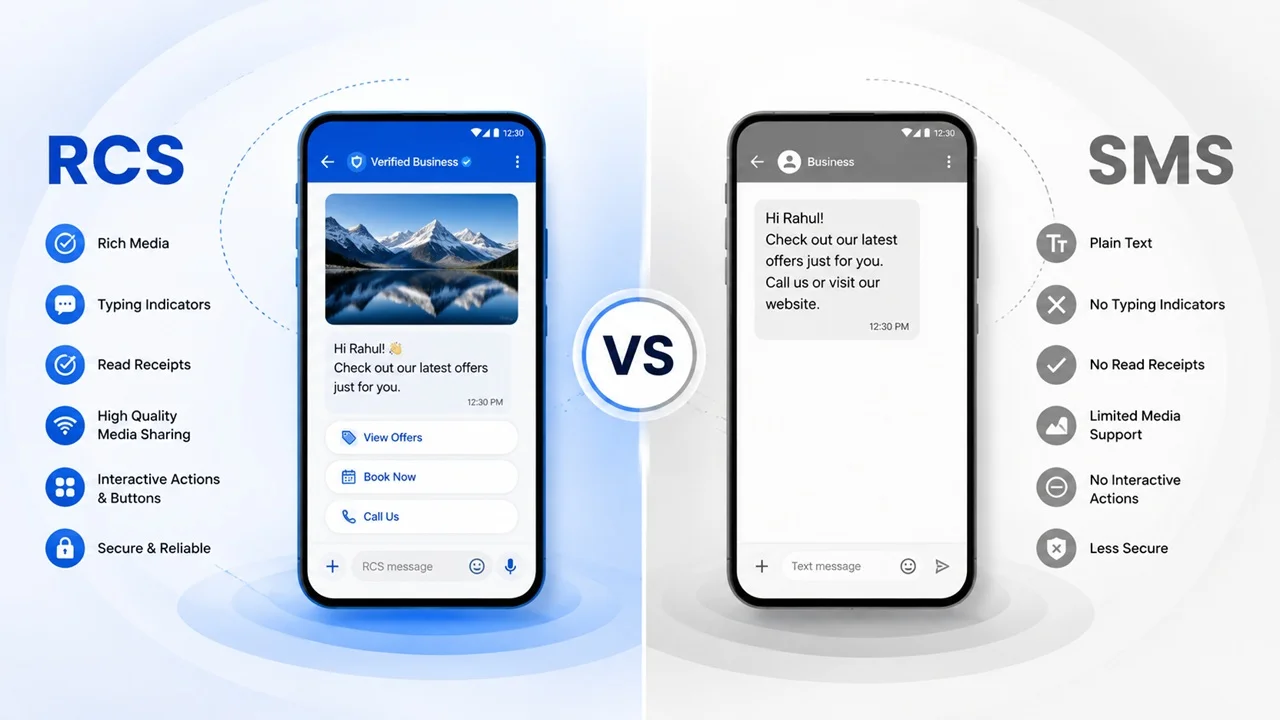
Instead of plain text, RCS lets you send:
- High-quality images and videos
- Read receipts ("seen at 10:42 AM")
- Typing indicators (those three little dots)
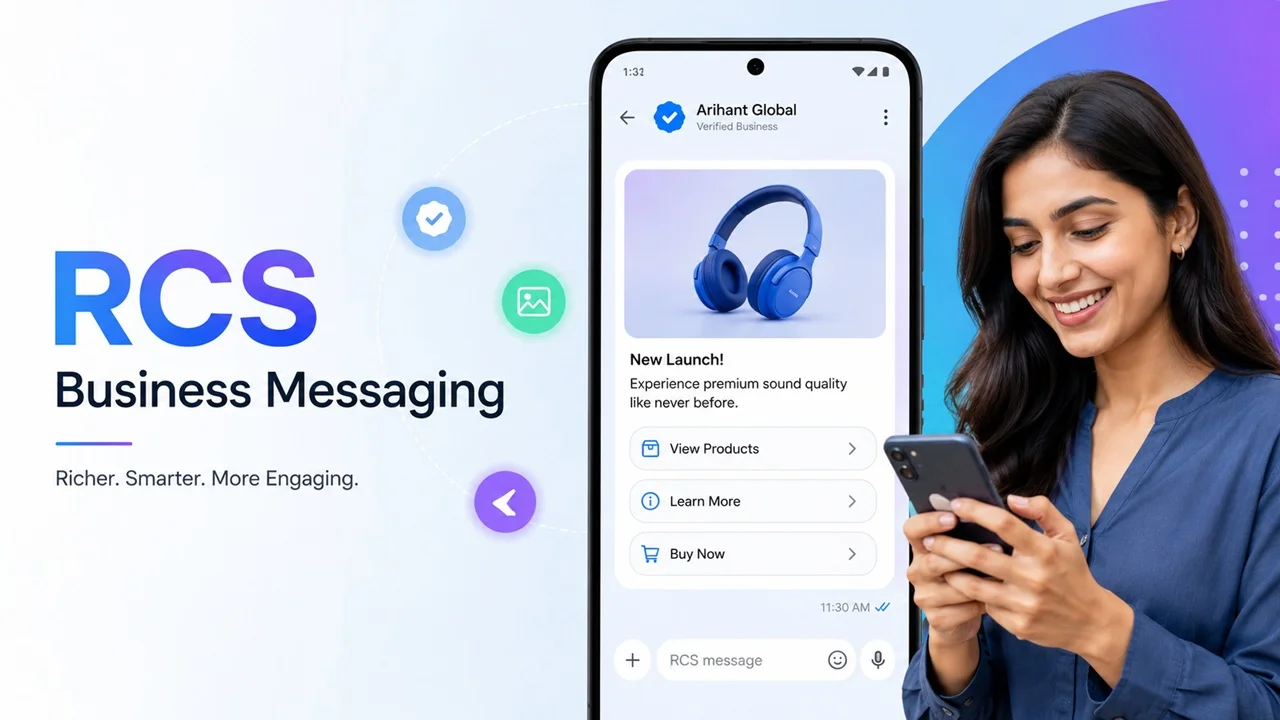
- Buttons like "Book Now" or "Track Order" right inside the chat
- A verified business profile with your logo and brand name instead of a random 10-digit number
In short, RCS makes a text message feel like a mini app experience, without the customer ever leaving their messaging app.
The catch? RCS needs an internet connection (Wi-Fi or mobile data), and both the sender and the receiver need a device and carrier that support it. Where RCS isn't available, it quietly falls back to plain old SMS so the message still reaches the customer either way.
RCS vs SMS: The Real Difference, Side by Side
Let's put it in one place so it's easy to scan.
Notice something? These two aren't really competing for the same job. SMS wins on reach. RCS wins on experience.
RCS vs SMS for Business: Why This Actually Matters
Here's the part most guides skip how this difference actually plays out when you're running a business, not just chatting with a friend.
Trust and Brand Recall
Imagine getting a message from a random number saying "50% off today only." Would you tap it? Probably not.
Now imagine the same offer, but it comes from a message thread showing the brand's actual name, logo, and a blue verified tick.
That's the real value of RCS business messaging. People engage more with messages when they can see, instantly, who's talking to them.
Customer Engagement
With SMS, if you want someone to take action, you drop a link and hope they click it. That means one extra step, one extra chance for them to lose interest.
With RCS, the button is right there "Reserve a Table," "Track My Order," "Yes/No" no link, no leaving the app. Less friction almost always means more action.
Reach the One Thing SMS Still Wins At
Here's the honest truth: not every customer has a phone or carrier that supports RCS. Some are on older devices. Some are on networks that haven't rolled it out yet.
SMS, on the other hand, reaches practically everyone, every time, instantly. If you're sending something time-sensitive an OTP, a payment alert, an appointment reminder you cannot afford for that message to not go through.
This is exactly why comparing RCS messaging vs SMS isn't about crowning a winner. It's about knowing which job each one is built for.
RCS vs SMS Cost: Which One Is Cheaper?
This is where a lot of businesses get surprised.
SMS is simple, cheap, and predictable. You pay per message, the pricing has been around for years, and there's very little complexity involved in sending it out.
RCS, especially the business version (often called RCS Business Messaging or RBM), usually costs more per message. Why? Because you're not just sending text you're sending rich media, using verified branding, and often working with a messaging platform to set it all up. There's also more work involved in designing the interactive content itself.
So if you're running:
- A quick appointment reminder → SMS is more cost-effective.
- A festive sale campaign with product photos and a "Shop Now" button → RCS might justify the extra cost through better engagement and higher conversions.
The smarter question isn't "which is cheaper" it's "which one gives me better return for what I'm trying to achieve?"
SMS vs RCS: Which Is Better for Marketing?
If your goal is to grab attention, look premium, and drive action RCS clearly has the edge for marketing.
Rich images, carousels of products, one-tap replies all of this tends to pull in higher click-through rates compared to a plain SMS with a link.
But and this is important RCS marketing only works if your audience's devices actually support it. If a big chunk of your customer base is on basic phones or carriers without RCS, your beautifully designed campaign quietly turns into... plain SMS, or worse, might not deliver the intended rich experience at all.
That's why many businesses now use a cascade approach: try sending RCS first, and if it's not supported for that customer, the platform automatically sends a plain SMS instead. Best of both nobody misses the message, and those who can see the rich version, do.
When Should You Use SMS, and When Should You Use RCS?
Let's make this practical with real business situations.
Use SMS when:
- You're sending OTPs or two-factor authentication codes
- You need urgent, time-sensitive alerts (payment failed, flight delayed)
- You want to reach the widest possible audience, including older phones
- Budget is tight and volume is high
Use RCS when:
- You're running a promotional or seasonal sales campaign
- You want customers to take action without leaving the chat (book, buy, confirm)
- Brand trust and visual appeal matter for the message
- You're targeting an audience largely on modern smartphones
Use both together when:
- You want maximum reach with the best possible experience for supported devices
- You're building a long-term customer messaging strategy, not just a one-off campaign
The Smartest Businesses Aren't Choosing Sides
Here's the shift happening quietly in 2026: businesses have stopped asking "RCS or SMS?" and started asking "which one, for which message, to which customer?"
A delivery update? SMS. A festive sale with a product carousel? RCS. An OTP for login? SMS, always. A personalized offer to a loyal, smartphone-using customer? RCS, easily.
Used this way, RCS and SMS aren't rivals. They're two tools in the same toolbox one built for speed and certainty, the other built for experience and engagement.
Frequently Asked Questions About RCS vs SMS
Is RCS replacing SMS completely?
No. RCS is built to work alongside SMS, not replace it. In fact, whenever RCS isn't supported on a customer's device or network, the message automatically falls back to SMS. So SMS stays as the reliable safety net underneath everything.
Which is better for small businesses RCS or SMS?
It depends on what you're sending. For appointment reminders, order updates, or anything urgent, SMS is simpler and more cost-effective. For promotions or campaigns where you want a branded, richer look, RCS can bring noticeably better engagement as long as your customers' devices support it.
Does RCS cost more than SMS?
Generally, yes. RCS business messaging usually costs more per message than SMS because it involves richer content, verified branding, and platform setup. It's best used for messages where that extra engagement is worth the extra cost not for high-volume, routine alerts.
Do I need a special app to send or receive RCS messages?
No separate app is needed. RCS runs through the default messaging app already on the phone (like Google Messages or the Messages app on newer iPhones). The customer doesn't have to download anything new to see a rich RCS message.
Is RCS secure for business messaging?
RCS messaging includes verified sender profiles, which helps customers tell real businesses apart from spam or scam numbers. Encryption and security features continue to improve as more carriers and devices adopt the standard, but businesses should always use a trusted, compliant messaging platform to send RCS campaigns.
Why do some of my RCS messages still show up as plain text?
That usually means the recipient's device, carrier, or messaging app doesn't currently support RCS. In that case, the message automatically falls back to standard SMS so the customer still receives it just without the rich formatting.
In Short
RCS vs SMS was never really a fight to begin with.
SMS is the dependable, universal messenger that never lets a critical message go undelivered. RCS is the newer, richer experience that makes your brand look and feel more credible, more interactive, and more clickable.
The businesses winning at customer messaging in 2026 aren't obsessing over which one is "better." They're matching the right message, to the right channel, for the right customer — and letting SMS and RCS quietly work together in the background.
That one decision, made well, can be the difference between a text that gets ignored and one that gets a reply.
If you're still not sure which mix of SMS and RCS makes sense for your business, you don't have to figure it out alone. Arihant Global, a Jaipur-based digital marketing company, helps businesses build messaging and marketing strategies that actually match their audience and budget. Get in touch with the team at Arihant Global to plan a messaging strategy that gets real replies, not just delivery receipts.


.webp)