Sign up with Google
 Sign in with Zoho
Artificial intelligence is becoming part of everyday business operations. Companies use AI for customer support, recruitment, fraud detection, analytics, software development, content generation, and product features.
As AI adoption grows, compliance cannot remain a one-time documentation exercise. Organisations need a repeatable process for identifying their AI systems, understanding their regulatory position, documenting relevant decisions, and monitoring changes over time.
This is where an EU AI Act compliance lifecycle can help.
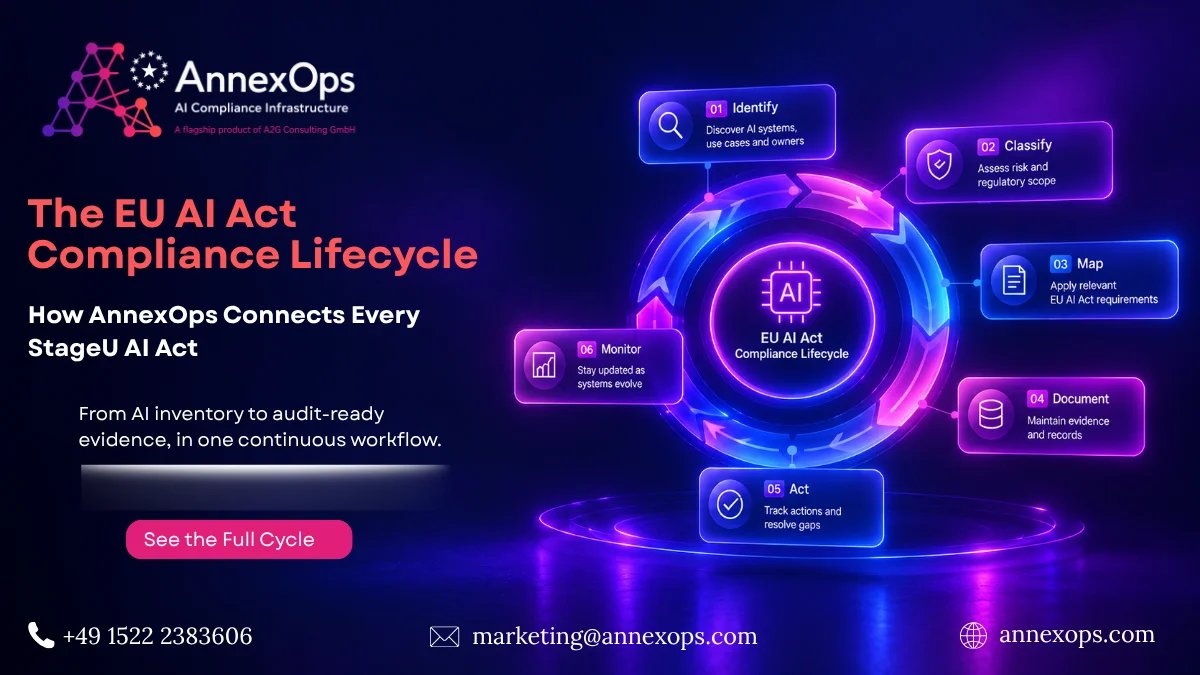
Rather than treating compliance as a single checklist, businesses can manage it as a connected operational process: identify AI systems, assess their regulatory position, determine applicable obligations, document the required information, collect evidence, address gaps, and review the systems as they change.
What Is the EU AI Act Compliance Lifecycle?
The EU AI Act compliance lifecycle refers to the ongoing process of managing the governance and regulatory requirements associated with an organisation's AI systems.
The exact requirements depend on factors such as the AI system's intended purpose, the organisation's role, its regulatory classification, and how the system is deployed.
A practical lifecycle can include:
Identify → Assess → Classify → Map → Document → Act → Evidence → Monitor → Review
The important part is the connection between these stages.
For example, changing the intended purpose of an AI system could affect its regulatory classification. A classification change could lead to additional obligations, which may require new documentation, controls, or evidence.
A connected workflow makes these relationships easier to manage.
1. Identify Every AI System
The first step in AI governance is understanding what AI systems an organisation actually uses.
Large organisations may have AI across multiple departments. Engineering teams may develop models internally, while HR, marketing, sales, customer service, and operations may use third-party AI tools.
An AI inventory can help bring this information together.
Useful information can include:
- AI system name
- Intended purpose
- Business owner
- Technical owner
- Provider or vendor
- Deployment environment
- Users and affected groups
- Data involved
- Organisation's role
- Risk classification
- Documentation status
- Review date
A complete inventory provides the foundation for the rest of the compliance process.
Without visibility into the AI systems being used, it becomes difficult to determine which requirements apply or where compliance gaps may exist.
2. Determine the Organisation's Role
The next step is to understand the organisation's role in relation to each AI system.
The EU AI Act distinguishes between roles such as providers and deployers, and their responsibilities can differ.
A company can also have different roles for different AI systems.
For example, a SaaS business might develop an AI feature as part of its own product while deploying a third-party AI service internally. Treating both systems in exactly the same way could overlook important differences in their regulatory responsibilities.
For this reason, role information should be connected to the individual AI system within the organisation's inventory.
3. Assess AI Risk and Regulatory Classification
Once AI systems have been identified, organisations need to understand their regulatory position.
The EU AI Act follows a risk-based framework. Different AI systems can therefore have different requirements depending on their use and context.
The assessment may consider:
- Intended purpose
- Use case
- Deployment environment
- Organisation's role
- Product relationship
- Applicable legislation
- Relevant EU AI Act provisions
For systems that may fall within high-risk categories, a structured assessment is particularly important because additional requirements may apply.
The assessment should also be traceable. Teams should be able to understand why a particular classification or conclusion was reached and review it when the system changes.
4. Map the Applicable Obligations
Classification is not the end of the process.
Once an organisation understands the regulatory position of an AI system, it needs to identify what actions are required.
Depending on the system, this may involve areas such as risk management, documentation, record-keeping, human oversight, transparency, data governance, testing, cybersecurity, or other applicable requirements.
A generic checklist can become difficult to maintain when an organisation manages many AI systems.
Instead, businesses can map obligations to individual systems and assign responsibility for each compliance activity.
This creates a more practical structure:
AI system → classification → obligation → owner → action → evidence
Such a structure helps teams see what needs to be completed and who is responsible for it.
5. Manage AI Compliance Documentation
Documentation is an important part of AI governance.
Depending on the AI system and applicable requirements, organisations may need to maintain technical documentation, risk assessments, impact assessments, policies, testing records, approvals, and other compliance information.
The challenge is often not simply creating these documents. It is keeping them connected to the AI systems they describe.
For example, if an AI system changes its intended purpose or deployment environment, teams may need to determine whether its existing documentation remains accurate.
An organised AI compliance documentation process makes it easier to identify the relevant records and determine when they need review.
6. Collect and Organise Compliance Evidence
Compliance activities need evidence.
A completed assessment is more useful when an organisation can also show who completed it, what information was considered, which controls were implemented, and what approvals were provided.
Evidence may include:
- Risk assessments
- Testing records
- Approval records
- Technical documentation
- Policies
- Review results
- Monitoring records
- Corrective actions
Keeping these materials in disconnected folders and email threads can make audit preparation more difficult.
A centralised AI compliance platform can connect evidence to the relevant AI system, obligation, control, and review activity.
7. Track Compliance Actions
Identifying a compliance gap is only the beginning.
If a required document is missing or an assessment needs to be reviewed, the organisation needs to assign an owner and track the work through completion.
A practical workflow can include:
- Responsible person
- Compliance action
- Priority
- Due date
- Review status
- Supporting evidence
- Completion record
This turns AI governance into an operational process rather than a static checklist.
It also allows legal, compliance, privacy, security, product, and engineering teams to coordinate around the same AI system.
8. Monitor AI Systems Continuously
AI systems do not remain static.
A vendor may update an API. A model may be replaced. A product team may introduce a new feature. The intended purpose of an AI system may expand. A system may also move from internal testing into customer-facing deployment.
These changes can affect the information used during the original compliance assessment.
This is why continuous AI compliance monitoring matters.
The goal is not to repeat the entire compliance process every time a minor change occurs. Instead, organisations need a way to identify relevant changes and determine whether an existing assessment, classification, obligation, or document needs to be reviewed.
9. Review and Update the Compliance Position
The final stage of the lifecycle is review.
A compliance assessment should reflect the current state of the AI system rather than its state several months ago.
Regular reviews can help organisations verify:
- Whether the AI system's purpose has changed
- Whether ownership has changed
- Whether the provider or model has changed
- Whether new requirements apply
- Whether documentation remains current
- Whether required evidence is available
- Whether previous compliance actions remain valid
This creates a continuous loop rather than a process that ends after the initial assessment.
Why Manual AI Compliance Becomes Difficult
For a small AI portfolio, spreadsheets and shared folders may appear manageable.
As the number of AI systems increases, however, the amount of information that needs to remain aligned also increases.
Teams may maintain one spreadsheet for AI inventory, separate documents for risk assessments, folders for technical documentation, email threads for approvals, and another tracker for compliance actions.
This can create three common problems:
Fragmented Information
Important information is distributed across multiple tools and teams.
Repetitive Work
Teams repeatedly collect the same information, update records, and prepare evidence.
Limited Visibility
It becomes harder to determine which AI systems have been assessed, which obligations apply, and which compliance actions remain open.
A structured AI governance software solution can help connect these activities into a single workflow.
How AnnexOps Supports the AI Compliance Lifecycle
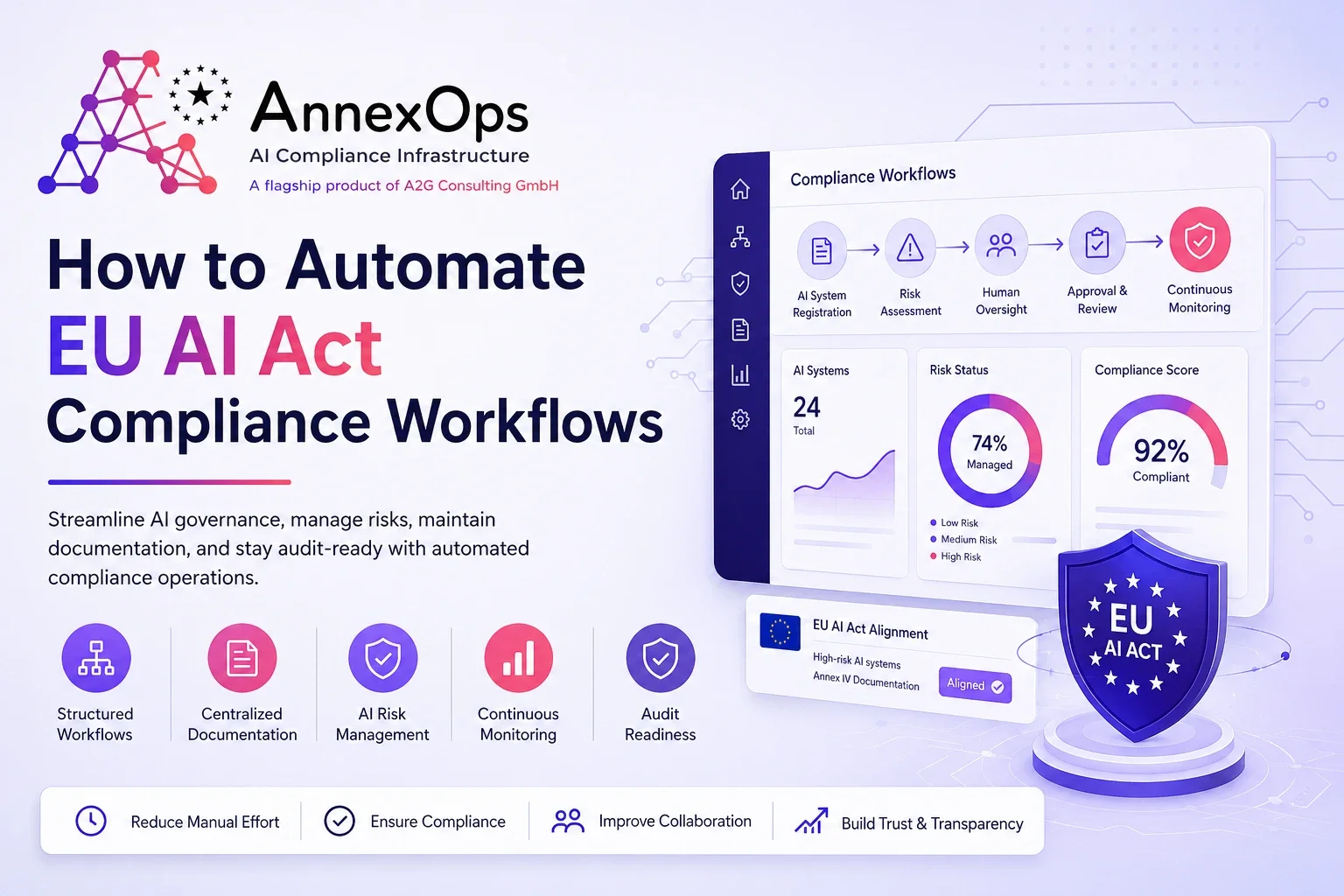
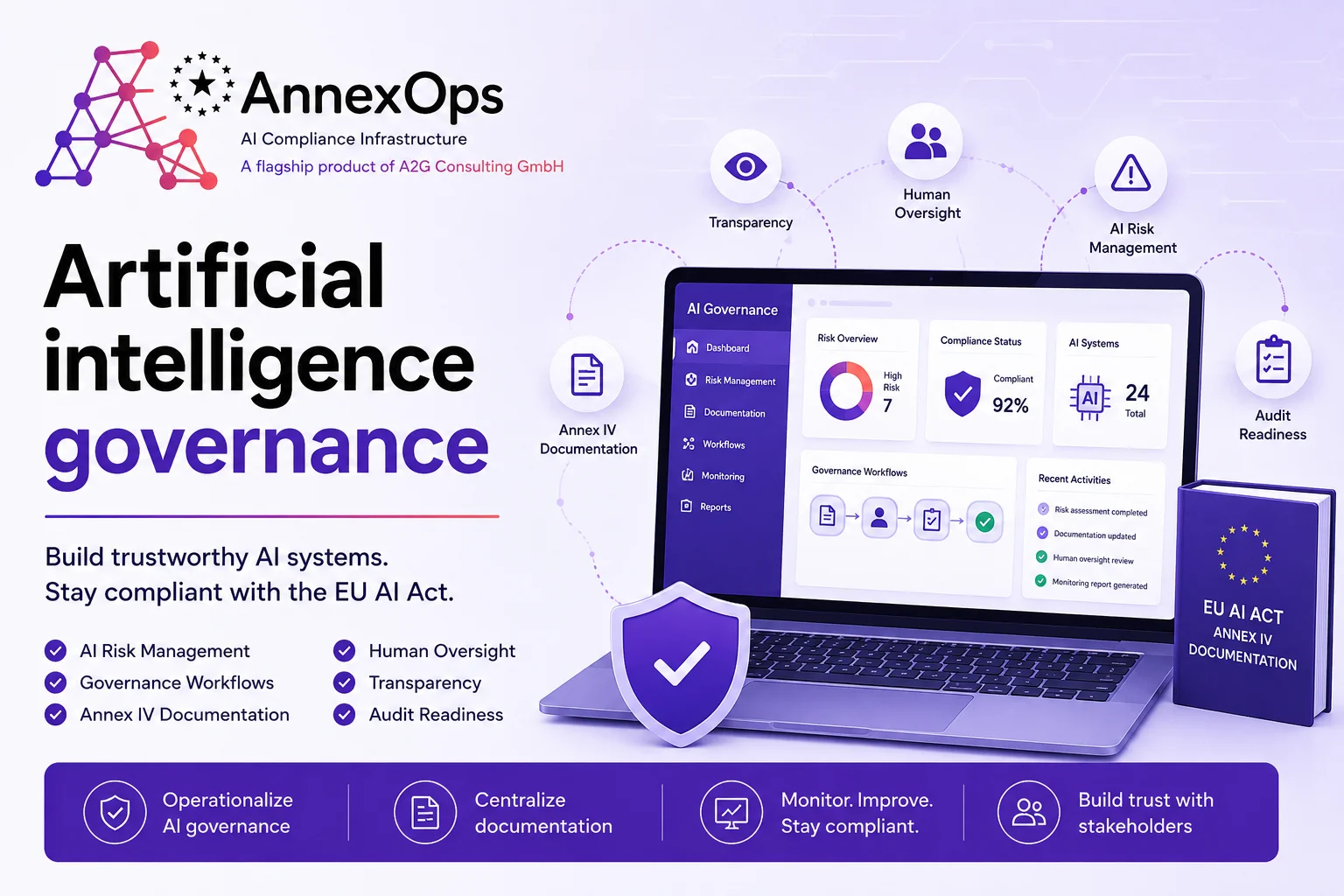
AnnexOps AI Compliance Software is designed to help organisations manage AI governance and EU AI Act compliance operations through a connected workflow. Its capabilities include AI system discovery, risk classification, obligation mapping, documentation, evidence management, continuous monitoring, and audit readiness.
The workflow can support several stages of the AI compliance lifecycle.
AI System Discovery
AnnexOps helps organisations maintain a structured view of their AI portfolio, including relevant information about individual AI systems.
Risk Classification
The Risk Classification Engine supports structured assessment of AI systems, including relevant Annex III use cases.
Obligation Management
The Obligation Engine connects regulatory requirements with AI systems and compliance activities, helping teams move from classification to practical actions.
Documentation
AnnexOps provides AI-assisted documentation capabilities, including support for Annex IV technical documentation, QMS documentation, DPIAs, conformity assessments, and EU declarations of conformity, with generated material intended for legal review.
Evidence Management
The Evidence Vault provides a central location for compliance evidence, approvals, and audit trails, helping organisations maintain traceable records.
Continuous Monitoring
Continuous monitoring helps teams keep track of compliance information as AI systems and governance conditions change.
Audit Readiness
The AI Auditor Engine supports readiness checks and gap analysis across relevant EU AI Act obligation areas.
AI Compliance Should Be an Ongoing Process
The EU AI Act compliance lifecycle is not simply about preparing documents before a regulatory deadline.
AI systems evolve continuously. New models are introduced, vendors change their services, product features are updated, and organisations enter new markets.
A sustainable governance process therefore needs to remain connected to the AI systems it covers.
A practical model is:
Know your AI systems → Understand their regulatory position → Map requirements → Assign actions → Maintain evidence → Monitor changes → Review
For organisations with growing AI portfolios, dedicated AI compliance software can help turn these activities into a repeatable operational workflow.
AnnexOps brings these activities together to help organisations manage AI discovery, risk classification, obligations, documentation, evidence, monitoring, and audit readiness in one connected environment.
Conclusion
Effective AI governance requires more than a policy document or a one-time assessment.
Organisations need to know which AI systems they use, understand their regulatory position, identify applicable obligations, maintain relevant documentation, track compliance actions, and review their systems as they change.
A structured EU AI Act compliance lifecycle provides a practical way to manage these activities.
For businesses looking to move away from disconnected spreadsheets and manual compliance processes, AnnexOps AI Compliance Software provides a workflow for managing AI governance from discovery through ongoing monitoring and audit readiness.