Sign up with Google
 Sign in with Zoho
Why Manual Compliance Won't Scale with AI
Artificial intelligence is moving from experimentation into everyday business operations.
Companies are using AI to answer customer questions, review documents, support financial decisions, improve recruitment, detect fraud, and automate internal processes. What once began as a small pilot can quickly become a collection of models, third-party tools, APIs, and AI-enabled products used across several departments.
The growth creates a practical problem.
It becomes difficult to know which AI systems are being used, who is responsible for them, what risks they create, and whether the required documentation is complete.
For a company working with only one or two AI applications, spreadsheets and shared folders may appear sufficient. A product manager can maintain a list of models, engineers can update technical notes, and compliance teams can request information when needed.
The approach becomes far less reliable when the company starts scaling.
Model versions change. New datasets are introduced. Different teams use different documentation formats. Approval decisions remain buried in email conversations. In some cases, a business may not even have a complete record of the third-party AI tools being used by its employees.
This is why manual compliance processes often fail to keep pace with AI adoption.
The Problem Is Not a Lack of Effort
Compliance difficulties are not always caused by careless teams.
In many businesses, engineering, product, security, legal, and compliance teams are already working hard. The real issue is that they are working through systems that were not designed for coordinated AI governance.
A typical process may involve:
- An AI inventory maintained in a spreadsheet
- Risk assessments saved in shared folders
- Technical documentation stored in engineering tools
- Approval requests sent through email
- Monitoring data available on a separate dashboard
- Governance decisions recorded in meeting notes
Each source may contain useful information, but nobody has a complete view.
When a customer, auditor, senior manager, or procurement team asks for evidence, employees must collect information from several departments. This can take days or even weeks, especially when records are incomplete or outdated.
The larger the AI portfolio becomes, the more time teams spend searching for evidence instead of managing actual risks.
Manual Processes Create Blind Spots
One of the first questions a company should be able to answer is simple:
Which AI systems are currently being used?
Surprisingly, many growing businesses cannot answer this with confidence.
One department may be developing an internal model. Another may be using an AI recruitment tool. The marketing team may be using generative AI software, while customer support relies on a third-party chatbot.
Without a shared inventory, these systems remain disconnected from the company’s governance process.
The problem becomes more serious when decision-makers need to understand:
- What each system is used for
- Which data it processes
- Whether it affects customers or employees
- Who owns the system
- Which model version is currently active
- Whether a risk assessment has been completed
- Whether human review is required
- What changes have been made since approval
A spreadsheet can store some of this information, but it cannot easily manage dependencies, reminders, reviews, version changes, and supporting evidence across a growing number of systems.
Documentation Becomes a Last-Minute Exercise
Technical documentation is another common source of pressure.
During development, engineers naturally focus on making the system work. Documentation may be postponed because a product launch, client delivery, or performance issue feels more urgent.
Months later, the compliance team may ask for details about the model, training data, intended purpose, testing results, limitations, or monitoring procedures.
By that point, the people involved may have moved to another project. Important decisions may no longer be easy to reconstruct.
This leads to a familiar pattern: documentation is prepared shortly before a review rather than maintained throughout development.
Last-minute documentation creates several risks. Information may be incomplete, records may not match the current model version, and teams may describe what they believe happened rather than what was actually recorded at the time.
A stronger approach is to collect documentation as the AI system develops.
That does not mean forcing engineers to complete long forms after every minor change. It means connecting documentation requirements to the normal development process so that relevant information is captured when it is still available.
Why the EU AI Act Changes the Conversation
The EU AI Act introduces a risk-based approach to AI regulation. The obligations applying to an AI system depend partly on how the system is used and the level of risk associated with that use.
This makes early classification important.
A company cannot wait until deployment to decide whether a system requires additional controls. The intended purpose, affected users, decision-making context, and possible consequences should be considered during planning and development.
For businesses operating across several products or markets, manual classification can become inconsistent. One team may complete a detailed assessment, while another may rely on a brief internal discussion.
Automated workflows can provide a common starting point.
For example, when a new AI project is registered, the system can request information about its purpose, users, data, deployment environment, and potential impact. Based on the answers, it can flag the project for further review or route it to the appropriate stakeholder.
The final decision may still require legal, technical, or compliance expertise. Automation simply ensures that the review is triggered consistently and that the reasoning is recorded.
What Should Be Automated?
Not every governance decision should be handed over to software.
Human judgment remains necessary, especially when an AI system could affect safety, employment, access to services, or other important interests.
The best opportunities for automation are usually repetitive administrative activities.
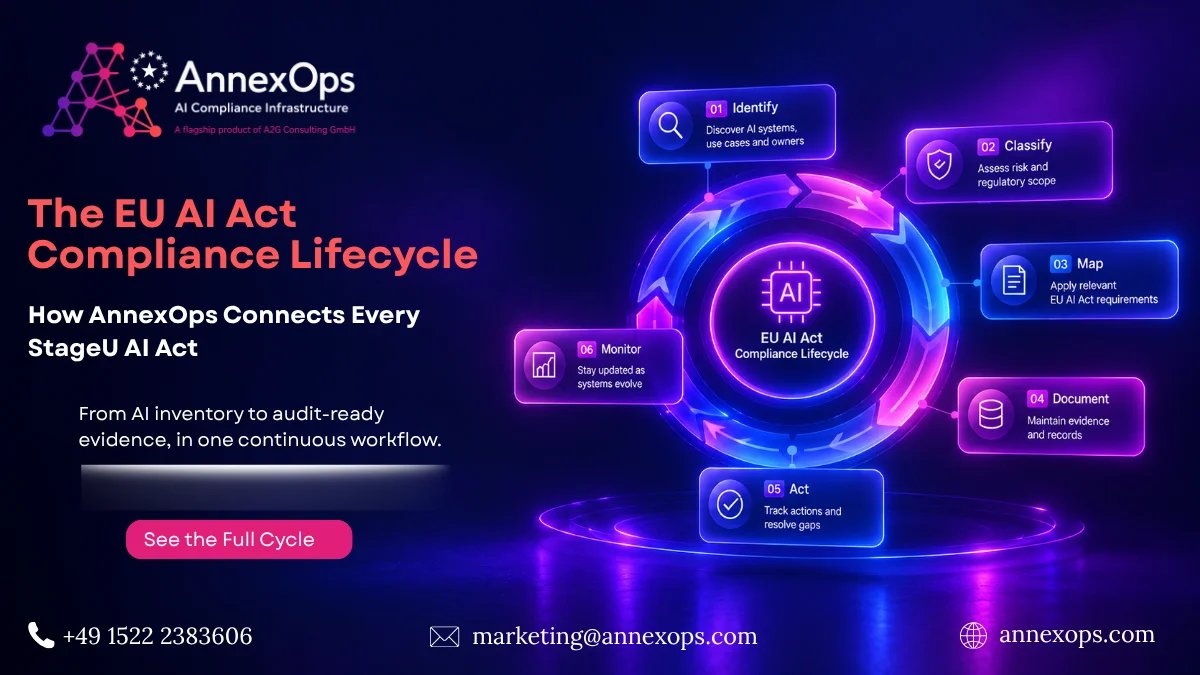
Maintaining an AI inventory
Instead of updating a spreadsheet manually, companies can create a central record for every AI system.
The record may contain the business purpose, owner, model version, provider, deployment status, risk classification, approval history, and review date.
When information changes, the responsible person can be prompted to update the record. This helps prevent the inventory from becoming outdated.
Collecting project information
Teams often answer the same questions repeatedly for security, compliance, product, and procurement reviews.
A structured workflow can collect the information once and make it available to approved stakeholders. This reduces duplicated effort and improves consistency.
Routing approvals
Approval requests frequently disappear inside long email threads.
An automated process can send a request to the correct reviewer, record the response, add a timestamp, and escalate the task when a deadline is missed.
This creates a clearer history of who reviewed the system and what conditions were attached to the approval.
Tracking documentation
A workflow can identify missing documents, assign owners, and notify teams when records need to be reviewed.
It can also connect documentation to a specific model version or release, making it easier to understand which evidence applies to which system.
Recording changes
AI systems rarely remain unchanged after launch.
Models may be retrained, providers may release new versions, datasets may be replaced, and business teams may expand the original use case.
A change-management workflow can ask whether the modification affects the system’s risk, intended purpose, performance, or oversight requirements. Significant changes can then trigger a new review.
Supporting monitoring
Monitoring tools may identify model drift, unusual outputs, reduced accuracy, security events, or data-quality issues.
Instead of leaving those alerts on a technical dashboard, an automated governance process can assign the issue, request an investigation, record the response, and track corrective action.
Preparing audit evidence
Evidence collection becomes easier when approvals, assessments, test results, monitoring reports, and change records are already connected to the relevant AI system.
Teams do not have to reconstruct the history from emails and folders every time a review takes place.
Automation Should Fit Existing Workflows
A common mistake is to introduce a new compliance platform without considering how employees already work.
If engineers must leave their development tools and manually re-enter the same information elsewhere, the new process may create resistance rather than improvement.
Compliance activities should be connected to existing product and engineering workflows wherever possible.
For example, a model release may automatically trigger a documentation review. A major code change may create a governance task. A monitoring alert may open an incident workflow. An expired approval may prevent a deployment from moving forward until the required review is completed.
The aim is not to surround every AI project with bureaucracy.
The aim is to place the right governance activity at the point where it is needed.
Good Governance Begins Before Automation
Technology cannot repair an unclear governance model.
Before automating anything, a business needs to decide who owns AI risk, who approves deployments, what information must be documented, and which changes require additional review.
At a minimum, the company should define:
- Who can register a new AI system
- Who is responsible for the accuracy of the information
- Who performs the risk review
- Who approves deployment
- Who monitors the system after launch
- Who responds when an issue is identified
- How often records must be reviewed
- What evidence must be retained
Without these decisions, automation may only make a confusing process move faster.
A useful approach is to map the current process first. Teams can identify where information is duplicated, where approvals are delayed, and where responsibilities are unclear.
The workflow should then be simplified before it is automated.
Centralization Does Not Mean One Team Controls Everything
AI governance is a shared responsibility.
Engineers understand how the model works. Product teams understand the intended use. Security teams understand technical threats. Legal and compliance professionals interpret regulatory obligations. Business leaders decide how much risk the company is willing to accept.
A centralized system should not remove these roles. It should help them work from the same information.
When a project record is updated, the relevant teams should be able to see what changed. When a reviewer raises a concern, the decision should remain visible. When monitoring identifies an issue, the response should be connected to the original system record.
This reduces the confusion created by separate departmental processes.
Human Oversight Still Matters
The phrase “compliance automation” can create the impression that software will make every decision.
That would be a mistake.
Automation is most useful when it handles reminders, routing, recordkeeping, status updates, and evidence collection. Decisions involving legal interpretation, ethical concerns, or serious consequences still require qualified people.
Human oversight should also be practical.
Simply stating that a person can intervene is not enough. The company should define who receives alerts, what information they can access, when they are expected to act, and how their decision will be recorded.
For higher-impact systems, reviewers may need authority to pause the system, override an output, request additional testing, or reject a deployment.
These responsibilities should be reflected in the workflow rather than left as general policy statements.
Continuous Compliance Is More Realistic Than Periodic Cleanup
Traditional compliance programs often focus on preparing for a scheduled audit.
AI systems do not operate on an audit schedule.
A model can change between reviews. New data can affect performance. Employees can start using a tool without formal approval. A provider can update its service. A new use case can create risks that were not considered during the original assessment.
For this reason, AI compliance needs to become a continuous operational activity.
That does not mean every system requires constant manual review. It means the company should have processes that identify meaningful changes and bring them to the attention of the right people.
Automated reminders, review dates, monitoring alerts, and change triggers make this approach more manageable.
Business Benefits Go Beyond Regulation
Preparing for the EU AI Act may be the immediate reason a company improves its governance processes, but the benefits extend further.
Enterprise customers increasingly ask vendors how AI is used, what data is processed, how models are tested, and what controls are in place. Procurement teams may request policies, risk assessments, security evidence, and documentation before approving a contract.
A business with organized records can respond faster.
Structured governance can also reduce duplicated work, improve communication between teams, and make product decisions easier to defend.
It gives leadership a clearer picture of where AI is being used and which projects require attention.
In this sense, compliance automation is not only a regulatory investment. It is also an operational improvement.
Common Mistakes to Avoid
Companies should be careful not to automate every existing process without questioning whether that process is useful.
Some common mistakes include:
Automating an unclear process
If responsibilities and approval criteria are not defined, adding software will not solve the confusion.
Collecting too much information
Long questionnaires can discourage employees from registering AI projects. Collect only the information that supports a real governance decision.
Ignoring employee adoption
A technically strong platform will fail if teams find it difficult to use. Workflows should be designed around the people completing them.
Treating all AI systems equally
A low-impact internal tool should not necessarily follow the same process as an AI system affecting employment or access to essential services.
Forgetting to review the workflow
Governance processes should evolve as the company, technology, and regulatory environment change.
Building a Practical Compliance Framework
A scalable approach can begin with a few clear steps.
First, create a reliable inventory of AI systems.
Second, define a consistent method for assessing risk.
Third, assign ownership for documentation, approval, monitoring, and incident response.
Fourth, connect governance checks to development and deployment activities.
Finally, review the framework regularly and improve it based on actual experience.
The process does not need to be perfect from the beginning.
It needs to be understandable, repeatable, and capable of growing with the business.
Final Thoughts
Manual tools can support AI governance during the early stages of adoption, but they become harder to manage as the number of systems, teams, and responsibilities increases.
Spreadsheets, emails, and shared folders do not provide the visibility or consistency required for a growing AI portfolio.
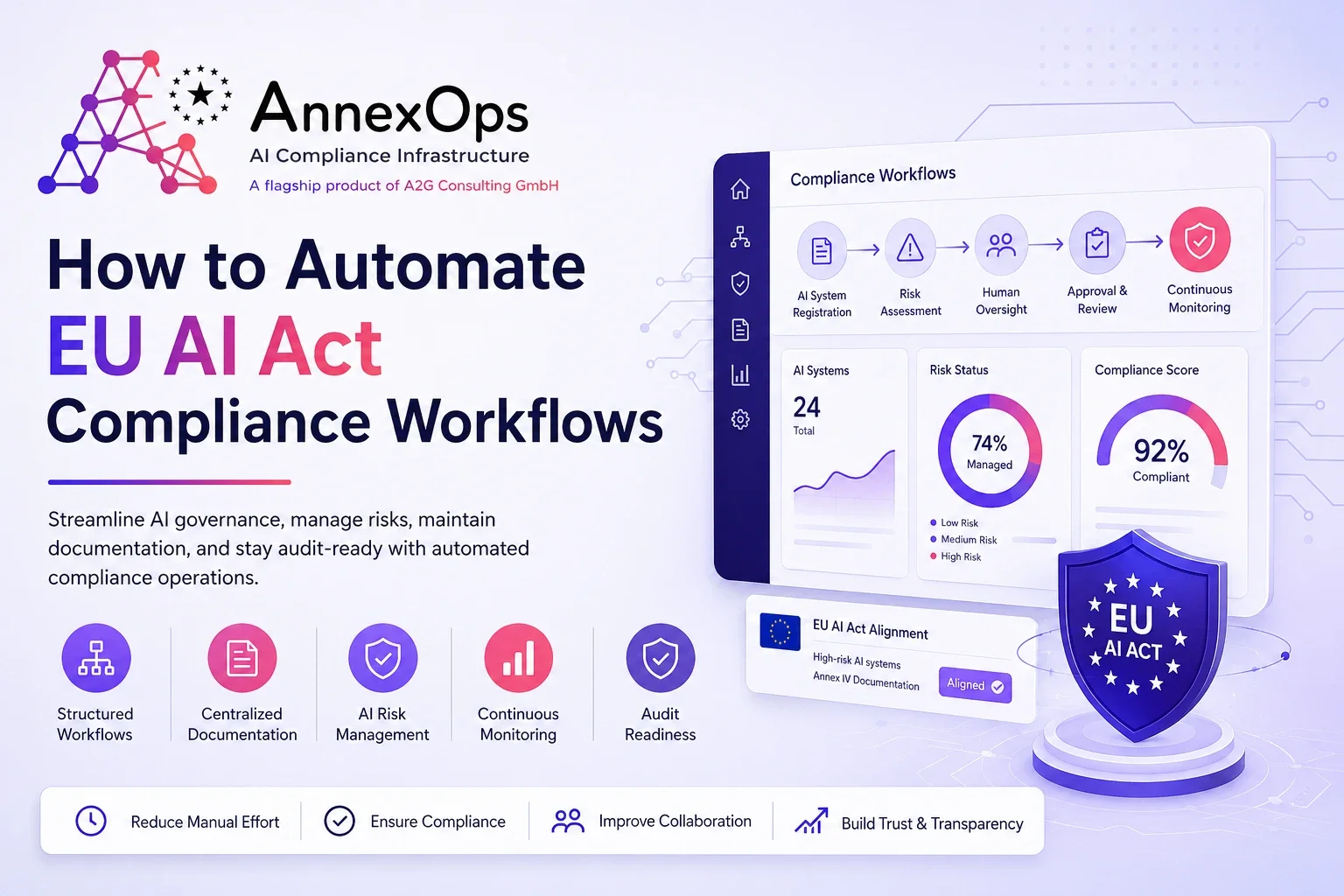
Automation can reduce this burden by maintaining records, routing reviews, tracking changes, collecting evidence, and connecting governance activities across the AI lifecycle.
The purpose is not to remove people from important decisions.
It is to give them reliable information, clearer responsibilities, and more time to focus on the issues that genuinely require judgment.
Businesses preparing for the EU AI Act should therefore look beyond one-time compliance projects. The more sustainable approach is to build governance into everyday AI operations.
A detailed explanation of how these workflows can be structured is available in this guide to automating EU AI Act compliance workflows.