Sign up with Google
 Sign in with Zoho

Introduction:
As businesses continue to embrace digital transformation, the need for secure, reliable, and legally compliant document signing has become more important than ever. From contracts and financial agreements to HR documents and legal records, organizations require a solution that protects sensitive information while ensuring document authenticity.
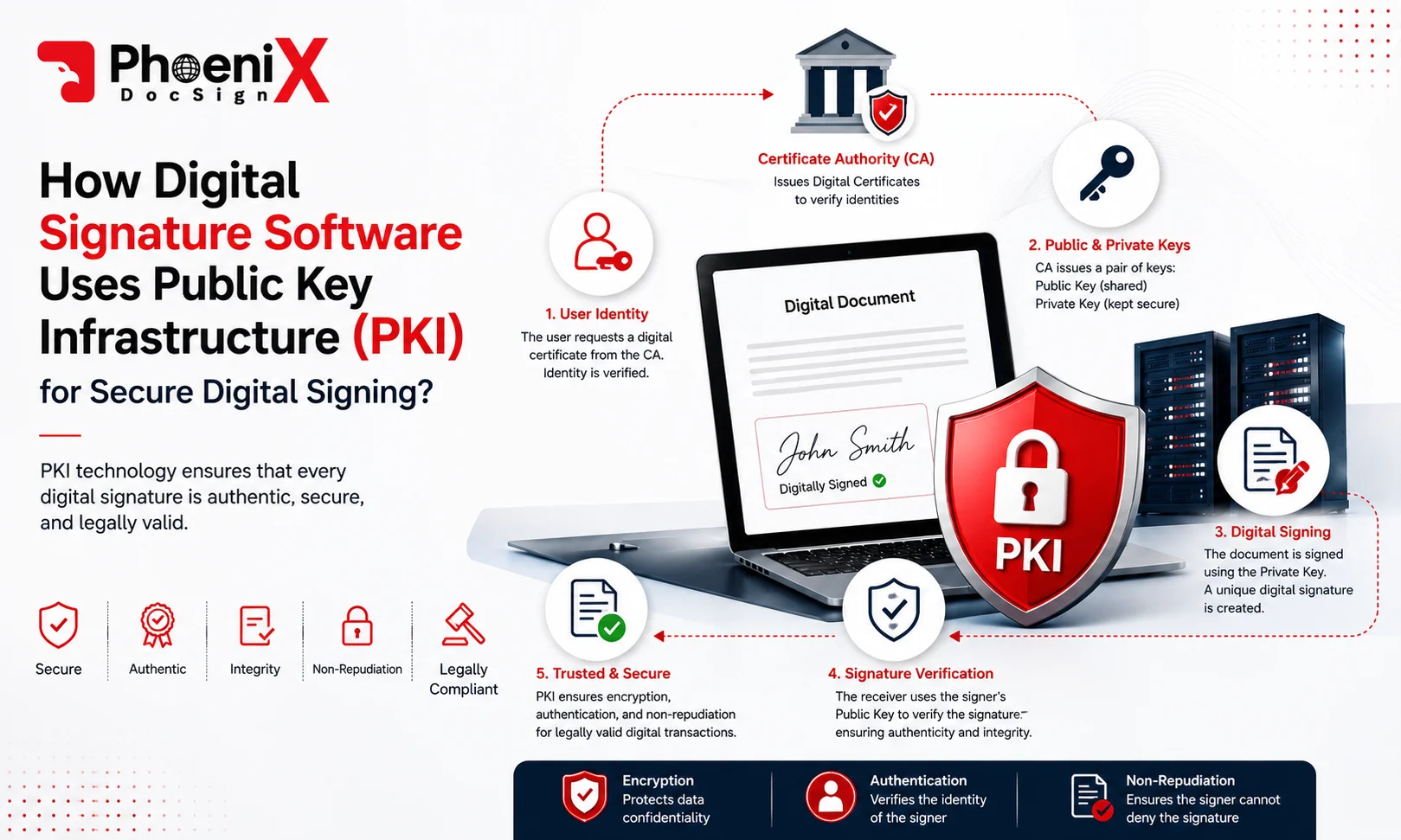
This is where digital signature software plays a important role. A digital signature technology depends on Public Key Infrastructure (PKI) to provide a advanced security, identity verification, secure encryption, and document integrity. The PKI ensures that every digitally signed document remains authentic, tamper-proof, and legally valid.
We will discuss this article; we'll explore how digital signature software uses PKI to create a secure digital signing.
What is the Public Key Infrastructure (PKI)?
The Public Key Infrastructure (PKI) is a security system that manages digital certificates and cryptographic keys. It enables secure communication and it verifies the identity of users participating in digital transactions. The PKI creates trust between the sender and recipient by ensuring that:
- The signer is authenticated.
- The document has not been altered.
- The signature is unique to the signer.
- The signed document remains legally verifiable.
How PKI Works in Digital Signature Software
The Digital signature software uses the PKI through a combination of public and private cryptographic keys.
Private Key
A private key is securely stored and accessible only by the signer. It is used to create digital signatures.
Public Key
The corresponding public key is shared with recipients and used to verify the authenticity of the signature. Together, these keys ensure that only the authorized signer can sign a document and that recipients can confidently verify its authenticity.
Step 1: Identity Verification
Before a user can digitally sign a document, the software verifies their identity. This verification establishes trust before the signing process begins. Depending on the organization's security requirements, verification may include:
- Email authentication
- Mobile OTP verification
- Multi-factor authentication (MFA)
- Government-issued identity verification
- Enterprise login credentials
Step 2: Document Hashing
Document hash is Once the document is ready for signing, the software generates a unique mathematical fingerprint known as a hash value. This hash becomes the foundation of the digital signature. The hash:
- Represents the document content.
- Changes instantly if even one character is modified.
- Ensures document integrity.
Step 3: Digital Signature Creation
The generated hash is encrypted using the signer's private key. This encrypted hash becomes the digital signature attached to the document. Because only the signer owns the private key, the signature cannot be duplicated or forged.
Step 4: Signature Verification
When the recipient receives the document, the software uses the signer's public key to decrypt the digital signature.
The system then:
- Generates a new hash from the received document.
- Compares it with the decrypted hash.
- Confirms whether both values match.
If the values are identical:
- The document is authentic.
- The signer is verified.
- No modifications have been made.
Step 5: Certificate Validation
The PKI depends on digital certificates issued by trusted Certificate Authorities (CAs). Digital signature software automatically validates these certificates during the signing and verification process. These certificates verify:
- The signer's identity
- Certificate validity
- Expiration dates
- Revocation status
Benefits of PKI in Digital Signature Software
Strong Identity Authentication
The PKI verifies the identity of every signer before documents are signed, it significantly reducing the risk of unauthorized access.
Tamper-Proof Documents
Any modification made after signing immediately invalidates the signature, ensuring document integrity.
Advanced Encryption
The Public and private key secure encryption protects sensitive information during transmission and storage.
Legal Compliance
The PKI-based digital signatures comply with many global regulations are including:
- eIDAS (European Union)
- ESIGN Act (United States)
- UETA
- Various country-specific digital signature regulations
This makes digitally signed documents legally enforceable in many jurisdictions.
Non-Repudiation
Because each signature is uniquely tied to the signer's private key, the signer cannot deny signing the document later. This creates accountability and trust.
Complete Audit Trail
Most digital signature software automatically records:
- Signer identity
- Timestamp
- IP address
- Device information
- Document status
- Signing sequence
These audit logs provide additional evidence for legal and compliance purposes.
Industries That Benefit from PKI-Based Digital Signatures
The PKI-secured digital signature software is widely used across industries, including:
- Financial Services
- Banking
- Healthcare
- Insurance
- Government
- Legal Firms
- Human Resources
- Real Estate
- Manufacturing
- Education
Why Businesses Are Choosing PKI-Based Digital Signature Software
Businesses are increasingly adopting PKI-powered digital signature software because it helps them:
- Accelerate document approvals
- Eliminate paper-based processes
- Strengthen document security
- Reduce operational costs
- Improve compliance
- Enable secure remote signing
- Enhance customer experience
- Support digital transformation initiatives
Best Practices for Secure Digital Signing
To maximize security, organizations should:
- Use trusted PKI-based digital signature software.
- Enable multi-factor authentication for signers.
- Protect private keys with strong encryption.
- Regularly monitor certificate validity.
- Maintain detailed audit logs.
- Train employees on secure document handling.
- Update security policies to align with evolving compliance requirements.
Conclusion
Modern digital signature software leverages PKI to protect sensitive business documents, prevent fraud, and simplify document workflows. As organizations continue to digitize their operations, adopting PKI-enabled digital signature solutions is no longer just a security enhancement—it's an essential component of efficient, compliant, and trustworthy digital business processes.

.webp)