Sign up with Google
 Sign in with Zoho

Ask five sales leaders whether they need a CRM or a lead generation tool and you will get five different answers. The two are often mentioned together, sold together, and sometimes bundled together, so it is easy to assume they do the same job. They do not.
This guide explains what each tool does, where they overlap, and how to decide which one your team needs first. It is written for founders, sales managers, and marketers who want a practical answer without the vendor spin.
The Short Answer
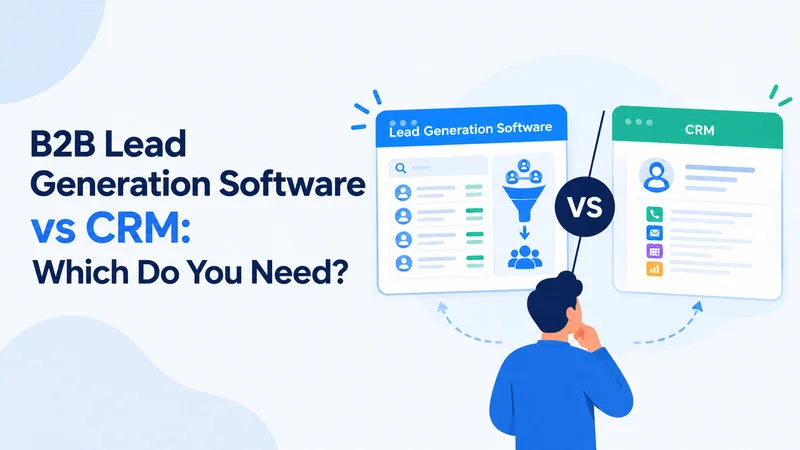
B2B lead generation software helps you find and attract new prospects. A CRM helps you track and manage the people you are already talking to. One fills the top of your pipeline. The other keeps everything after that organized.
If you have no leads, a CRM will sit empty. If you have plenty of leads but lose track of them, more lead generation will only make the mess bigger.
What B2B Lead Generation Software Does
This type of tool is built to create new sales opportunities. Depending on the product, it may help you:
- Build prospect lists with company and contact details
- Capture visitors through forms, chat, and landing pages
- Send outreach emails in sequences
- Score leads based on fit or behavior
- Identify companies that visit your website
The goal is more of the right people entering your pipeline. Most of these tools stop once a lead is ready to talk to a salesperson.
What a CRM Does
A customer relationship management system, or CRM, is the record of every relationship your company has. It stores contact details, call notes, emails, deals, and tasks in one place. It shows who owns each deal, what stage it is in, and what should happen next.
A CRM does not usually go out and find new prospects for you. Its job is to make sure nobody falls through the cracks once they are in your system, and to give managers a clear view of forecasts and performance.
Key Differences at a Glance
Where the Two Overlap
The line has blurred in recent years. Many CRMs now include email sequences, forms, and basic lead scoring. Many lead generation platforms include light contact management and deal tracking. So you may not need two separate products at first.
Still, the strengths differ. A CRM with add-on prospecting features usually does record keeping better than prospecting. A lead generation tool with built-in pipeline views usually does prospecting better than reporting. Check which side of the job matters most to you before you trust a bundle.
When to Start With a CRM
Choose a CRM first if:
- You get leads from referrals, events, or your website but track them in spreadsheets or inboxes
- Deals get lost because follow-ups slip
- Several people talk to the same customer and need a shared history
- You want reliable reports on pipeline and win rates
In these cases, your problem is organization, not supply.
When to Start With Lead Generation Software
Start with lead generation software if:
- Your pipeline is thin and reps spend hours researching prospects by hand
- You are entering a new market and need contact data quickly
- Your website gets traffic but you cannot tell who the visitors are
- Your team can follow up consistently but does not have enough leads
Here, your problem is supply.
Why Many Teams End Up Using Both
Over time, most growing companies need both. Lead generation software feeds prospects in, and the CRM keeps them moving. The important part is the connection between them.
When the two sync well, leads arrive in the CRM with source and activity data attached, so reps know where each one came from. When they do not, you get duplicate records, missing fields, and arguments between marketing and sales about lead quality. Before buying either tool, check how it integrates with the other. Native integrations or well-supported connectors save a lot of cleanup later.
Questions to Ask Before You Decide
- Where is my biggest gap: finding leads or managing them?
- How many leads do I get now, and how many do we actually follow up on?
- Who will use the tool every day, and how technical are they?
- What does it cost per user, and what does it cost to add contacts or data credits?
- Can I export my data if I change tools later?
Honest answers usually point to the right starting place.
Common Mistakes to Avoid
- Buying a large platform before you have a repeatable sales process
- Paying for contact data that is outdated or lacks consent for outreach
- Ignoring privacy and email rules such as GDPR or CAN-SPAM when sending cold emails
- Letting tool setup replace actual selling
- Skipping team training, so reps keep using their own spreadsheets
Frequently Asked Questions
1. Can a CRM replace B2B lead generation software?Ans. Not fully. Some CRMs offer basic lead capture, but they rarely match dedicated prospecting tools for finding new contacts at scale.
2. Is lead generation software worth it for small teams?Ans. It can be, if you have time to follow up. A small team that cannot handle extra leads will gain more from a CRM first.
3. Do I need to buy both at the same time?Ans. No. Fix your biggest gap first, then add the other once your process is stable.
Final Thoughts
The choice is not really about which tool is better. It is about which problem you have today. If leads are scarce, look at B2B lead generation software. If leads are plentiful but messy, start with a CRM. Run a free trial with real data, involve the people who will use it every day, and pick the one that solves your most urgent gap. You can always add the other later.