Sign up with Google
 Sign in with Zoho
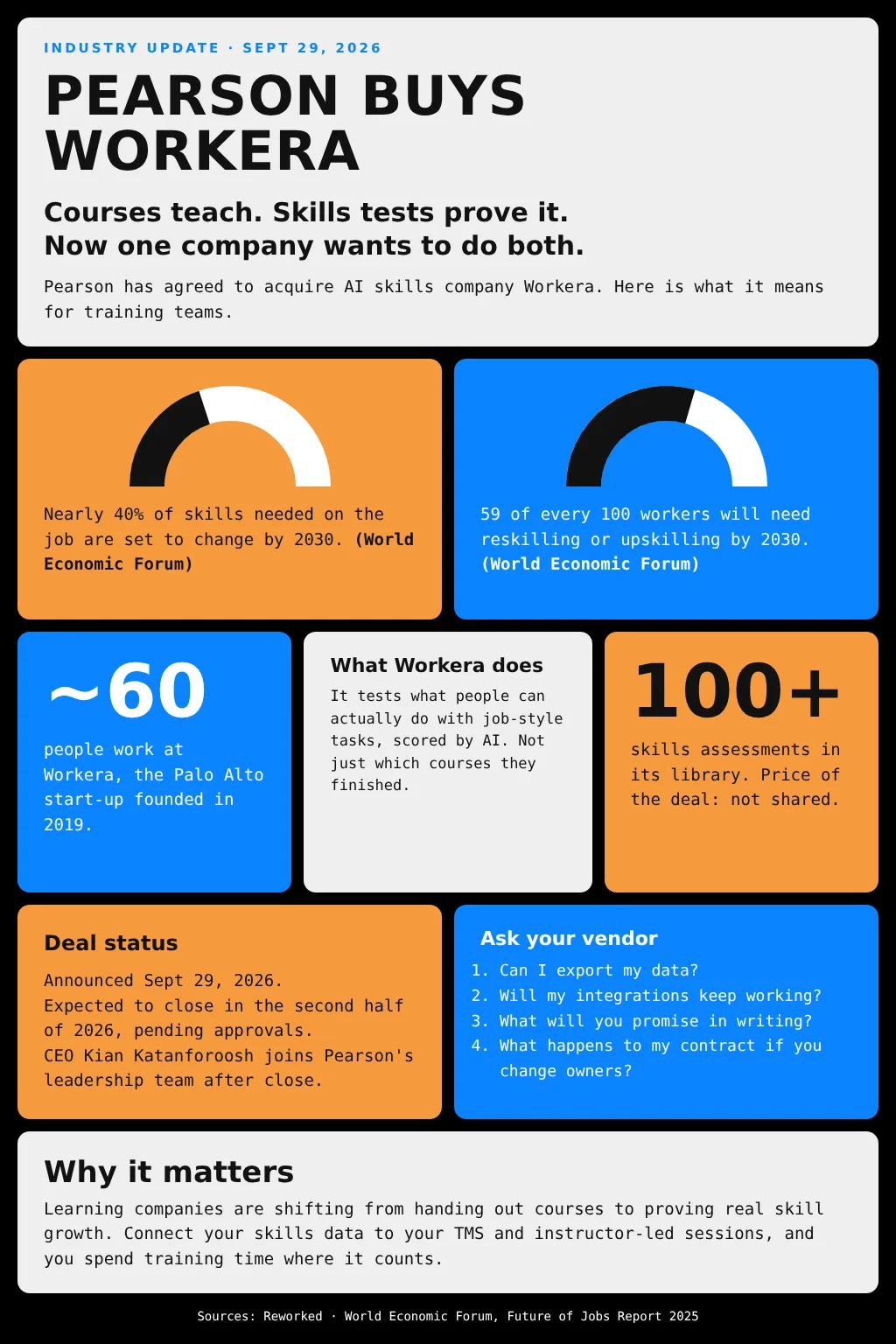
Big training companies don't often buy a 60-person startup. So when Pearson announced on September 29, 2026 that it would acquire Workera, people in learning and development (L&D) sat up.
The short version: Pearson wants to prove that training actually works. Workera helps companies find out what employees can really do, not just which courses they clicked through. Put the two together, and you get a company that can teach skills and then test them.
If you run training, buy learning tools, or manage a team's growth, this deal matters to you. Here's a plain-English breakdown of what happened, why it may be a smart move, and what you should do next.
What Pearson Announced
Pearson agreed to buy Workera, a Palo Alto company founded in 2019. Workera will join Pearson's Enterprise Learning and Skills business.
Here's what is confirmed so far:
- The price was not shared. Neither company has said what Pearson is paying.
- The deal hasn't closed. Pearson expects it to wrap up in the second half of 2026, subject to approvals. At the time of writing, we couldn't find a completion notice.
- Workera's CEO is staying involved. Founder Kian Katanforoosh is set to join the leadership team of Pearson's Enterprise Learning and Skills unit once the deal closes.
- Workera is small. It has roughly 60 employees, and its customers include ServiceNow, Accenture and the U.S. Space Force.
Vishaal Gupta, president of Enterprise Learning and Skills at Pearson, said the plan is to combine Workera's people and technology with Pearson's know-how in learning and assessment, so companies can close skills gaps faster.
So, What Does Workera Actually Do?
Think of Workera as a skills "reality check."
Most companies find out who knows what in one of three ways: a self-rating, a manager's opinion, or a course completion certificate. All three are shaky. Someone can finish a course and still struggle on the job. Someone else can skip the course and be brilliant.
Workera takes a different route. It asks people to do realistic, job-style tasks, such as a coding exercise or a role play, and then scores the results with AI. One feature lets people explain their thinking to the AI to earn partial credit, which feels a lot closer to how a good manager would judge them.
The company also offers:
- A library of more than 100 skills assessments
- Tools to build custom tests
- Hiring assessments
- A coaching tool that works inside everyday tasks
The result is a clear picture of where each person stands today, plus suggestions for what to learn next.
Why Would Pearson Buy Instead of Build?
Pearson hasn't spelled out every reason, but the logic isn't hard to guess. Keep in mind that the points below are our own read of the situation, not official statements.
Speed. Building a fair, accurate, AI-based skills test takes years. Buying one that already has paying customers is much faster.
Proof. Training vendors get asked the same awkward question again and again: "Did it work?" A testing layer gives Pearson a way to measure results before and after training.
Timing. Companies are rushing to train people on AI, and many don't know where to start. A tool that shows who needs what is a natural fit.
There's also a bigger picture here. Learning companies are slowly shifting from "we deliver courses" to "we show real skill growth." Pearson isn't the first to buy in this space, and it won't be the last.
The Numbers Behind the Rush
Why does all of this matter now? Because the work itself keeps changing.
According to the World Economic Forum's Future of Jobs Report 2025, nearly 40% of the skills needed on the job are set to change by 2030. The same report says that if you picture 100 workers, 59 will need reskilling or upskilling by then.
That's a huge amount of learning, and nobody can afford to guess who needs what. Accurate skill checks stop teams from wasting time on training people don't need and help them focus on the gaps that count.
A Quote Worth Remembering
"Education is the most powerful weapon which you can use to change the world." — Nelson Mandela
Mandela's words are a good reminder of why this matters. Education only changes things when it leads to real, usable skills. That's exactly the gap tools like Workera try to measure.
Skills Testing vs. a Simple Quiz
You might wonder: "Isn't this just a fancy quiz?"
Not quite. A normal quiz checks whether you remember facts. Skills verification checks whether you can do the work. Compare these two questions:
- Quiz: "Which of these is a good way to handle a team disagreement?"
- Skills check: "Here's a tense conversation with an employee. Handle it."
The second one is harder to fake, and it tells you far more. That's why many L&D teams are paying attention to this space.
What Could This Mean for Your Training Setup?
Here's where it gets practical. Most training teams already run a mix of classroom sessions, online courses, and tracking tools. A better skills check could improve each of them.
For instructor-led training (ILT): Skill checks can show which people truly need a live workshop and which can skip it. That saves money and protects everyone's time. Trainers can also open each session knowing exactly where the group is struggling.
For your training management system (TMS): Test results are only useful if they flow into the system where you schedule, assign, and report on learning. If assessment data stays locked in a separate tool, you lose most of the value.
That second point is the big one. It leads us to the most important section of this article.
What to Ask Your Vendor When Ownership Changes
Whenever a tool you use gets bought, the early press release sounds exciting. The details that affect you come later, and they often live in the contract. A few smart questions, asked now, can save you headaches.
1. Can you get your data out?
Ask whether you can export your assessment results in a usable format. If you ever switch vendors, you don't want years of skill data trapped in one place.
2. Will the connections still work?
Workera lists links to tools like Workday, Coursera and LinkedIn Learning. After a purchase, integrations with non-Pearson tools can change. Ask which ones are guaranteed, and for how long.
3. What will the vendor promise in writing?
A friendly email saying "nothing will change" is nice, but it isn't a commitment. Ask for roadmap, support and pricing promises in your contract.
4. What does your contract say about a change of owner?
Some contracts let you leave without penalty if the vendor is bought. Check yours. If it's silent, ask to add a clause.
Is the Deal Really Joined Up, or Just Bolted On?
After any acquisition, one of two things tends to happen. Either the new tool is blended into the parent company's products, or it sits next to them with a shared logo and little else.
Watch for these signs over the next six to twelve months:
Score your vendor on each line every quarter. It takes ten minutes and gives you a real basis for decisions.
What We Still Don't Know
Being honest about the gaps is part of being useful. Here are the open questions:
- Will Workera keep its brand, or fold into Pearson's?
- Will current customers see price or contract changes?
- Will the product keep working with tools outside Pearson's world?
- How accurate is the AI scoring? We found no independent testing of this.
Until those answers arrive, treat the announcement as a promising start rather than a finished story.
Does This Matter If You Don't Use Pearson or Workera?
Yes, and here's why. This deal is a sign of where the whole market is heading. Training providers want to prove results, and buyers are starting to expect proof.
So even if you never touch either product, ask your current vendors: "How do you show that learning changes what people can do?" If they can't answer clearly, that tells you something.
Your Next Steps
You don't need to panic or rush into anything. A calm checklist works better:
- Read your contracts. Look for data export rights and change-of-owner terms.
- Map your tools. List which systems share data with your assessments.
- Pick one skill to test. Start small, such as a skill your team needs for an AI project, and see whether a hands-on assessment tells you something a course certificate doesn't.
- Watch the closing news. Check for official updates from Pearson and Workera over the coming months.
- Talk to your vendors. Ask the four questions above before you need the answers.
Frequently Asked Questions
When did Pearson announce the Workera acquisition?
Pearson announced the agreement on September 29, 2026. The deal is expected to close in the second half of 2026, pending approvals.
How much is Pearson paying for Workera?
The price hasn't been made public.
What is Workera?
Workera is an AI-based skills assessment company based in Palo Alto. It tests what employees can actually do through job-style tasks and then suggests what to learn next.
Will Workera customers be affected?
Possibly, but nothing has been announced yet. Pearson hasn't shared details on branding, pricing, or product plans. If you're a customer, ask your account manager for written answers.
Will Workera still work with my other tools?
Workera currently lists links to tools such as Workday, Coursera, and LinkedIn Learning. Whether those stay the same after the deal is confirmed, ask your vendor directly.
Why does this deal matter to L&D teams?
It shows that learning companies are moving toward proving real skill growth, not just handing out courses. That may change what you expect from your own training vendors.
What should I ask a vendor after an acquisition?
Start with four things: Can I export my data? Will my integrations keep working? What will you promise in writing? What does my contract say if you change owners?
The Bottom Line
Pearson buying Workera is a signal, not a finish line. It shows how much the training world now cares about one question: can people actually do the job?
The deal is still pending, and many details are unknown. That's okay. Use the time to review your contracts, ask sharp questions, and test your own approach to measuring skills. The teams that do this now will be ready, whichever way the market moves.