Sign up with Google
 Sign in with Zoho
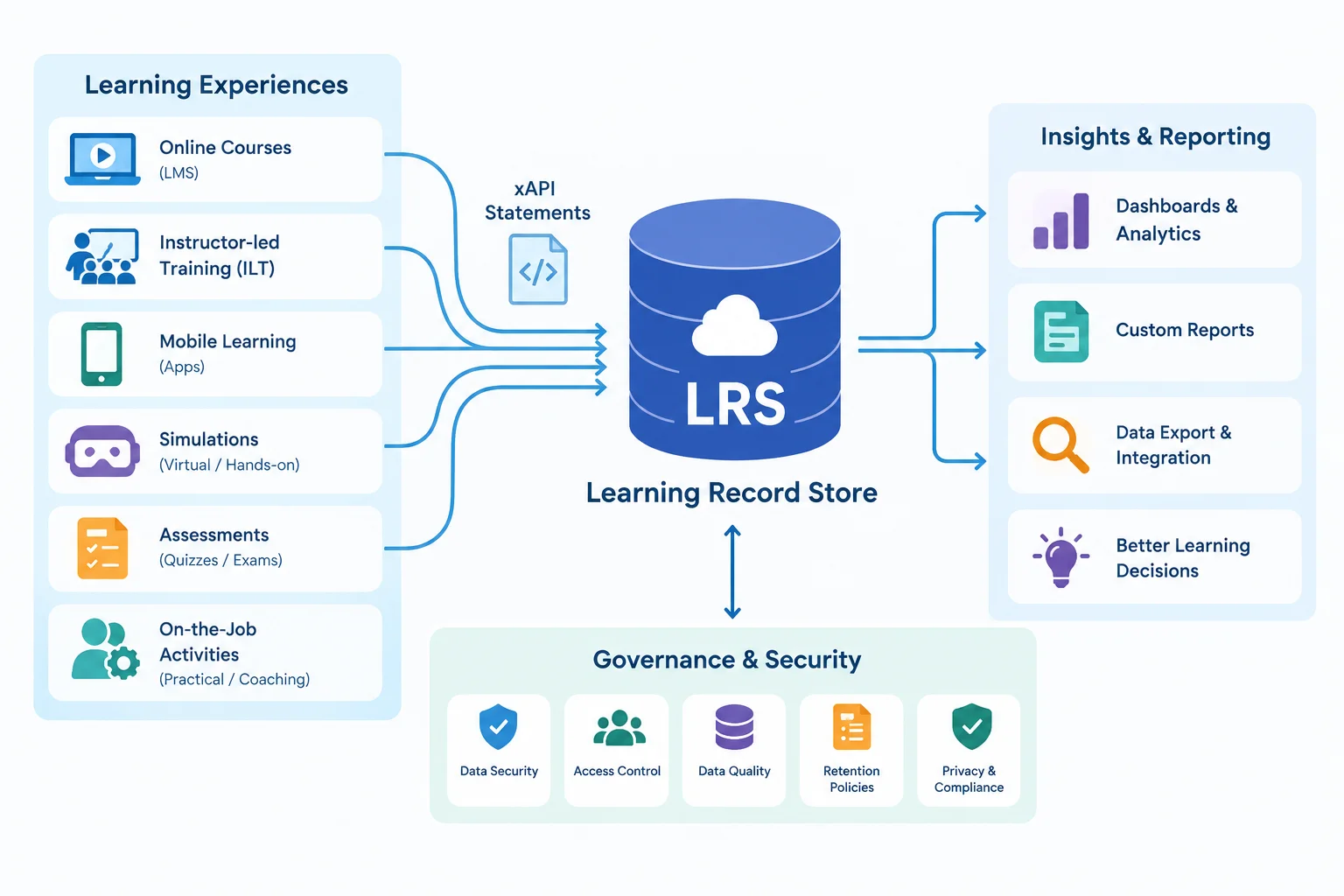
The Learning Story Is Bigger Than a Completion Report
Imagine a company preparing employees to work safely with new equipment. People read a short online lesson, practise in a simulation, attend a live demonstration, and complete a supervised task. A manager wants to know whether the programme is working. The course platform shows who finished the lesson, the simulation tool records attempts, and a trainer has practical observations in a separate system.
Every tool holds a piece of the story. None necessarily shows the whole picture.
A Learning Record Store (LRS) can help connect those pieces by collecting structured records of learning experiences. It is often used with the Experience API, or xAPI, which lets different applications describe activities in a consistent format. The technology is useful, but it is not magic: it cannot repair unclear definitions, prove that an assessment is valid, or decide what a manager should do next. Those tasks still require thoughtful design.
This guide walks through the idea in practical terms, from architecture and governance to the everyday choices that determine whether the data is genuinely useful.
What an LRS Actually Records
A learning statement describes an event. At its simplest, it identifies an actor, a verb, and an object. “Sam attempted the evacuation drill” is an easy way to picture the structure. Additional details can record the outcome, time, context, or other relevant properties.
An LRS receives these statements, stores them, and makes them available to authorised systems. A mobile application might send a record after an offline activity synchronises. A simulation could send information about attempts and results. A reporting service could later retrieve the records to investigate patterns.
The source application produces the event. The store keeps the statement. The reporting layer interprets it. A well-designed setup preserves those boundaries, making it easier to trace a questionable result back to its source.
The store is not the course itself. It does not necessarily enrol learners, assign content, or manage instructors. Its purpose is to support a wider view of learning activity.
Why This Matters Beyond Online Courses
Traditional course tracking still serves a valuable purpose. SCORM-based content, for example, can report completion and assessment results within supported e-learning experiences. But learning does not always take place in a course window. People practise skills, use mobile tools, participate in coaching, work through simulations, and learn while carrying out tasks.
xAPI makes it possible for different systems to describe these experiences as statements. The LRS gives those statements a place to go. The practical benefit is not simply collecting more information; it is being able to connect the evidence that matters.
For example, a training team might compare how learners perform in a simulation before and after an instructor-led demonstration. Another team might examine whether people who struggle with one step in a process need additional practice. These are useful questions, but the answers depend on the quality of the underlying assessment and the meaning of the data fields.
The Parts of a Working System
You can think of an LRS architecture as a route from activity to decision.
- The experience: A learner completes a module, performs a task, or practises a procedure.
- The source application: The system creates a statement describing what happened.
- The connection: An authenticated API request delivers the statement.
- The store: The LRS validates and retains the record.
- The reporting service: An authorised tool retrieves and analyses the data.
- The decision: A manager, trainer, or learning designer uses the finding to improve a programme.
Each stage can introduce problems. The source might describe an event inaccurately. A connection could fail. The record might be stored with an inconsistent activity name. A report could group unrelated events together. Designing the whole route is more important than focusing only on the storage product.
Choosing Between Embedded and Standalone
An embedded LRS sits inside a larger learning platform. It may be the easiest route when most activities happen in that environment and the built-in capabilities meet the reporting need. There may be fewer systems to connect and less infrastructure for the organisation to maintain.
A standalone LRS is separate and can accept records from several applications. That can be helpful when a company uses different tools for e-learning, simulations, mobile learning, and assessment. It can create a shared data layer, but the organisation must be ready to maintain integrations and govern the information that flows through them.
Before choosing, consider the following:
- Are the required experiences contained in one product or spread across several?
- Can existing tools send the records you need?
- Does the team have technical support for integrations and monitoring?
- Do current reports already answer the important questions?
- Is the added flexibility worth the cost and maintenance?
A larger architecture is not automatically a better architecture. The best fit is the one that solves a real problem without creating responsibilities the team cannot sustain.
The Quiet Problem: Inconsistent Language
Suppose three applications record the same kind of result using “completed,” “finished,” and “done.” A person reading the records may understand the intent, but a report cannot safely assume the terms are interchangeable. Similar differences in activity names or learner identifiers can split one story into several disconnected records.
This is why governance needs to start early. Agree on a controlled vocabulary for important verbs and activities. Define what each term means, which fields are required, and how new terms are approved. Keep the rules practical enough that developers can follow them and learning teams can understand them.
Identity is especially sensitive. If the same learner uses different identifiers across tools, their records may not join correctly. Decide how identity matching will work, who can access those details, and how to avoid collecting personal data that is not needed.
A shared vocabulary should evolve carefully. If a definition changes, document the change and consider how older records will be interpreted. Without versioning and ownership, even a good initial design can gradually become inconsistent as new tools are added.
Privacy Should Be Designed In, Not Added Later
Learning data can reveal performance, behaviour, and patterns over time. Centralising it can make analysis easier, but it also means access controls matter. Not everyone who can view a course completion record needs to see detailed simulation events or individual performance histories.
Start by defining the purpose of each data collection. Ask what is needed to answer the question, who needs to see it, how long it should be kept, and what process applies when records must be corrected or deleted. Work with privacy and security specialists to establish appropriate access, authentication, retention, and monitoring practices.
It is also worth being clear about what the data can and cannot prove. A record that someone opened a resource does not prove they understood it. A completed assessment does not automatically demonstrate competence at work. Reports should explain their limits and avoid turning imperfect indicators into definitive judgments about people.
Data Storage Does Not Equal Insight
Some LRS products focus on storing and returning statements. An organisation can connect them to its own analytics or business-intelligence tools. This works well when there is an established reporting team and a clear plan for using the data.
Other products offer dashboards as part of the service. That can make early reporting easier, especially for teams without a dedicated data analyst. But a dashboard is useful only when it answers the questions people actually ask. Check whether the reports can be explained, whether underlying records are accessible, and whether the system supports the required data exports and comparisons.
A practical way to avoid overbuilding is to choose one decision first. Perhaps the team wants to know which step of a simulation causes the most failed attempts. Work backwards: what event must be recorded, what does a failed attempt mean, and how will the report distinguish practice from an assessed attempt? A clear question makes it easier to choose the right data and avoid unnecessary collection.
Planning for Scale and Messy Real Life
A short course may generate only a handful of statements. A detailed simulation can generate hundreds or thousands of events in one session. Capturing every possible interaction may be technically feasible but still be a poor choice if it adds cost without improving the analysis.
Estimate the expected number of statements, busy periods, storage growth, retention needs, and report queries. Test what happens when many devices send data at once. Monitor errors, latency, authentication problems, and API limits. If an application works offline, test delayed synchronisation and retry behaviour. A record should not quietly disappear just because a learner was disconnected.
Duplicates also deserve attention. Networks fail, applications retry, and users repeat actions. The design should make those situations understandable and testable. Clear operational ownership matters: someone needs to know when delivery is failing and how to investigate it.
The budget should include the work on product integrations, testing, support, security reviews, data governance, and report maintenance. A system that looks affordable at purchase time can become expensive if every new source requires custom engineering.
Where an LRS Can Make a Difference
An LRS is most compelling when experiences are distributed and the organisation needs to examine them together. That may include practical skills programmes, simulations, mobile field work, blended training, or multiple learning products that each hold a different part of the record.
It may be unnecessary when one platform already provides all the tracking required. A small team delivering standard courses and reviewing completion rates may not benefit from adding a separate data service. Complexity should follow the need, not the trend.
A learning management system (LMS) typically handles course delivery, enrolment, assessments, and learner progress. An LRS complements those functions by retaining activity records from multiple sources. Instructor-led training (ILT) may produce useful information such as attendance, assessment outcomes, or practical observations, but those records should be captured only when they have a clear purpose and can be interpreted consistently.
A Manageable Way to Get Started
- Choose one real problem. Avoid beginning with a vague goal such as “collect more learning data.”
- List the evidence needed. Identify the activities and fields required to answer the question.
- Map the source tools. Confirm what each system can generate and how it can send records.
- Set common definitions. Agree on verbs, activity names, identity handling, and ownership.
- Pilot a small integration. Include successful events, errors, delayed delivery, and duplicate scenarios.
- Check the meaning. Ask the people who understand the training to confirm that the records reflect reality.
- Review the report. Test whether the output helps someone make a better decision.
- Expand only when ready. Add new sources when the team can support the extra complexity.
This approach makes the project easier to explain and easier to evaluate. It also gives the organisation a chance to discover data-quality issues before they spread across the wider environment.
Conclusion: Make the Record Serve the Learner
An LRS can help bring scattered learning experiences into a more coherent view. Its real value, however, is not the amount of data it stores. It is the quality of the evidence, the consistency of its meaning, and the care with which people use it.
Start with a genuine question. Keep the architecture proportionate. Give governance and privacy the same attention as integration. Then test whether the resulting information improves a training decision. That is how a technical data layer becomes a practical tool rather than another system to maintain.
Frequently Asked Questions
1. What is an LRS in simple terms?
It is a service that stores structured records of learning activities and lets authorised systems retrieve them.
2. What does xAPI contribute?
xAPI provides a standard way for applications to describe experiences as statements, making cross-system data exchange possible when implementations are aligned.
3. Can an LRS tell whether someone has mastered a skill?
Not by itself. It stores records of activities and assessments; mastery depends on the quality of the assessment and how results are interpreted.
4. Is a standalone store always better?
No. It is useful when several sources need to share data, but a built-in option may be enough for a simpler environment.
5. What is the biggest governance risk?
Inconsistent definitions and identities can make records difficult to compare and may produce misleading reports.
6. What is the best first step?
Choose one decision to improve, then identify the records needed to support it before selecting a product or designing integrations.