Sign up with Google
 Sign in with Zoho

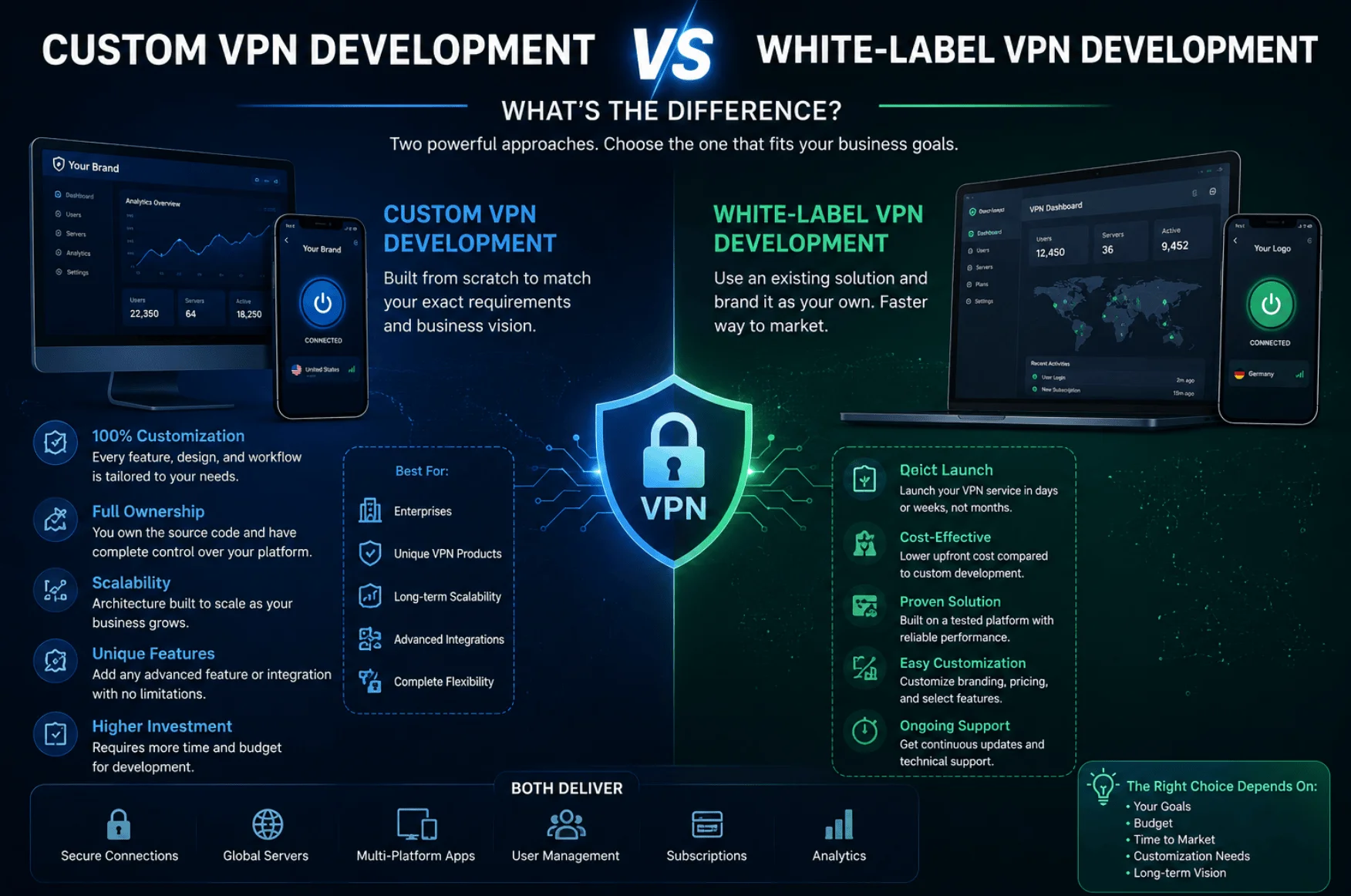
Businesses entering the VPN market have two primary development options: Custom VPN Development and White Label VPN Development. Both approaches can help organizations launch a branded VPN product, but they differ significantly in development strategy, customization, infrastructure control, investment, and time to market.
Understanding these differences helps businesses select the right approach based on their product vision, target audience, budget, technical requirements, and long term growth plans.
What Is Custom VPN Development?
Custom VPN Development involves building a VPN platform specifically around a company's requirements. The software architecture, applications, backend systems, infrastructure, security controls, and user experience are designed according to the product specification.
A custom VPN solution can include:
- Android and iOS applications
- Windows and macOS applications
- Custom VPN protocols and configurations
- User registration and authentication
- Subscription management
- Payment gateway integration
- Server management
- Administrative dashboards
- Analytics and reporting
- API integrations
- Customer management
- Multi region infrastructure
- Custom security controls
This approach provides businesses with greater control over how the VPN platform operates and evolves.
What Is White Label VPN Development?
White Label VPN Development uses an existing development foundation that can be customized and branded for another business. Instead of creating every component from the beginning, the business works with a development provider to configure the platform according to its branding and operational requirements.
A white label VPN solution can include branded applications, backend systems, user management, subscription functionality, server infrastructure, and administrative features.
The exact level of customization depends on the platform and development provider.
Custom VPN vs White Label VPN
The biggest difference is the level of control.
Custom VPN Development focuses on creating a unique product from the ground up. White Label VPN Development focuses on adapting an established platform to support a business's brand and requirements.
1. Customization
Customization is one of the most important differences.
With custom VPN development, businesses can define the product architecture, application interface, authentication system, subscription model, administrative functionality, and infrastructure.
For example, a company may want a VPN platform with a unique pricing engine, enterprise account management, custom analytics, specialized authentication, or integration with an existing SaaS platform.
Custom development can accommodate these requirements more effectively because the architecture is designed around them.
White label solutions typically provide predefined functionality that can be configured and branded. They can be suitable when the business requirements align closely with the capabilities already available.
2. Development Time
Custom development generally requires more time because the engineering team needs to analyze requirements, design architecture, develop components, integrate systems, test the platform, and deploy the infrastructure.
White label VPN development service can reduce the initial development timeline because many core components already exist.
This makes white label development attractive to businesses that want to enter the VPN market quickly without investing in a complete software platform from the beginning.
However, faster deployment does not necessarily mean that a white label platform will meet every long term requirement.
3. Cost
The total cost depends on the scope of the product.
Custom VPN development usually requires a larger initial engineering investment because the platform is developed specifically for the business.
White label development can reduce initial development requirements because the business is using an existing foundation. However, licensing, infrastructure, customization, maintenance, and provider fees should be evaluated when calculating the total cost.
Businesses should compare the complete lifecycle cost rather than looking only at the initial development price.
4. Branding
Both approaches can support branded VPN applications.
A white label platform is specifically designed to allow businesses to present the VPN product under their own brand. This may include:
- Company name
- Logo
- Application interface
- Colors
- Subscription plans
- Customer portal
- Website integration
Custom VPN development provides the same branding flexibility while allowing the business to control the complete application experience.
For companies with a strong product identity, custom development can provide greater freedom over the user experience.
5. Infrastructure Control
Infrastructure is another major consideration.
A custom VPN platform can be designed around the company's preferred infrastructure strategy. Businesses can select cloud providers, server regions, networking architecture, monitoring systems, deployment methods, and scaling strategies according to their requirements.
With white label development, infrastructure control depends on the provider and commercial arrangement.
Businesses should determine who owns the infrastructure, who manages the servers, how data is handled, and what happens if the company changes providers.
6. Security
VPN platforms handle network traffic and therefore require strong security architecture.
Custom VPN development allows security requirements to be incorporated into the application and infrastructure architecture from the beginning.
Security considerations can include:
- Authentication
- Encryption
- Secure API communication
- Access controls
- Server hardening
- Firewall configuration
- Credential management
- Application security
- Infrastructure monitoring
- Vulnerability management
White label VPN solutions can also implement strong security controls, but businesses should understand the provider's security architecture, update processes, data handling practices, and infrastructure responsibilities before deployment.
7. Scalability
A successful VPN platform may need to support users across multiple countries and devices.
Custom development allows the architecture to be designed around expected user growth, traffic patterns, geographic requirements, and infrastructure capacity.
For example, a business targeting customers in Dubai and the UAE may initially require regional infrastructure and later expand across GCC markets, Europe, Asia, and North America.
A scalable custom architecture can be designed to accommodate additional regions and infrastructure as demand increases.
White label platforms can also scale, but the available scalability depends on the underlying architecture and provider infrastructure.
8. Unique Features
Businesses often differentiate VPN products through features and customer experience.
Custom VPN development makes it possible to build specialized functionality such as:
- Enterprise account management
- Custom subscription models
- Advanced analytics
- Referral systems
- Customer dashboards
- Multi user accounts
- API integrations
- Automated billing
- Regional server selection
- Specialized authentication
- Custom administrative workflows
White label platforms generally offer a predefined feature set with configurable options.
If unique functionality is central to the business model, custom development is usually more suitable.
9. Platform Support
A VPN business may need applications for multiple operating systems.
Depending on requirements, a platform can support:
- Android
- iOS
- Windows
- macOS
- Linux
- Routers
- Selected smart devices
Custom VPN development allows businesses to determine which platforms should be supported and how the applications should behave.
White label VPN platforms may already support several major platforms, reducing development requirements. Businesses should verify compatibility before selecting a solution.
10. Subscription and Payment Systems
VPN businesses commonly use subscription based pricing.
A custom platform can integrate payment gateways, recurring billing, promotional pricing, coupons, trials, account upgrades, refunds, and subscription management according to the business model.
White label VPN solutions may already include subscription management, which can simplify initial deployment.
However, businesses requiring specialized pricing logic or integration with existing financial systems may benefit from custom development.
11. Administration and Analytics
A VPN business needs visibility into its platform.
Custom VPN development can provide an administration dashboard designed specifically around operational requirements. Administrators can manage users, subscriptions, servers, application configurations, analytics, and system settings from a centralized interface.
White label solutions may also include administrative dashboards, but the available functionality depends on the platform.
Before selecting a white label solution, businesses should review exactly which administrative functions are included.
12. Ownership and Long Term Control
Ownership is an important consideration that is sometimes overlooked.
With custom development, businesses can structure ownership around their software, source code, infrastructure, intellectual property, and technical documentation according to the development agreement.
White label arrangements may involve licensing or usage rights rather than complete ownership of the underlying platform.
Businesses should carefully review agreements covering source code, infrastructure, data, intellectual property, licensing, maintenance, and provider dependency.
Which Option Is Better for Startups?
Startups often prioritize speed, cost efficiency, and market validation.
A white label VPN solution can be attractive when the startup wants to launch a branded service quickly using established functionality.
Custom development may become more appropriate when the startup has a differentiated product strategy or requires functionality that cannot be supported effectively by an existing platform.
Some businesses can also begin with a white label solution and later transition toward custom development as the product grows.
Which Option Is Better for Enterprises?
Enterprises generally have more complex requirements around security, integration, governance, scalability, identity management, and infrastructure control.
For these organizations, custom VPN development may provide greater flexibility.
An enterprise may need to integrate the VPN platform with existing identity systems, security infrastructure, customer management platforms, cloud environments, or internal applications.
In such cases, a custom architecture can be designed around the organization's existing technology ecosystem.
When Should a Business Choose White Label VPN Development?
White Label VPN Development may be suitable when:
- Fast market entry is important
- The required functionality is relatively standard
- The business wants a branded VPN service
- Initial development resources are limited
- The company does not need extensive custom functionality
- An established infrastructure is preferred
The business should still evaluate security, scalability, infrastructure ownership, customization limits, maintenance, and commercial terms.
When Should a Business Choose Custom VPN Development?
Custom VPN development may be the better option when:
- The product requires unique functionality
- The business needs complete branding control
- Advanced integrations are required
- The platform needs specialized security architecture
- The company expects significant user growth
- Infrastructure control is important
- The business wants long term ownership and flexibility
- A differentiated VPN product is part of the commercial strategy
Can Custom and White Label VPN Development Be Combined?
Yes. Businesses do not always have to choose between completely independent development and a standard white label platform.
A hybrid approach can use established VPN components while custom developing selected areas such as applications, dashboards, subscription systems, APIs, or customer management.
This can provide a balance between development speed and customization.
The appropriate architecture depends on which parts of the product need differentiation and which components can be standardized.
How to Choose the Right VPN Development Approach
Before selecting a development model, businesses should answer several questions:
- How quickly does the VPN product need to launch?
- How many users are expected during the first year?
- Which countries and regions will be supported?
- Which platforms need applications?
- What security requirements apply?
- Does the business need custom subscription functionality?
- How much control is required over infrastructure?
- Who will own the source code and intellectual property?
- What integrations are required?
- How much customization will be needed in the future?
The answers can help determine whether custom development, white label development, or a hybrid model is appropriate.
VPN Development Services for Growing Businesses
Professional VPN Development Services can help businesses move beyond a basic VPN application and build a complete software platform.
Development can include mobile and desktop applications, backend systems, APIs, authentication, payment integration, server deployment, administration dashboards, analytics, cloud infrastructure, and cybersecurity.
For companies entering the VPN market, engineering expertise is important because the application and network infrastructure must operate as a coordinated system.
Nagorik Technologies for Custom and White Label VPN Development
Nagorik Technologies is a Software Development Company providing custom software engineering solutions for businesses in Dubai, the UAE, GCC, and international markets.
Its capabilities include Custom VPN Development, White Label VPN Development, mobile and web application development, cloud infrastructure, cybersecurity, API integration, artificial intelligence, and blockchain development.
For businesses planning to launch a VPN brand, Nagorik Technologies can support product architecture, application development, backend engineering, server infrastructure, administration systems, integrations, and ongoing software development.
Final Thoughts
The difference between custom and white label VPN development comes down to control, flexibility, development strategy, and long term product requirements.
White Label VPN Development can be a practical option for businesses that want faster market entry with established functionality and branded applications. Custom VPN Development is better suited to organizations that require unique features, specialized integrations, greater infrastructure control, and long term technical flexibility.
The right choice should be based on the complete business and technology roadmap rather than development speed or initial cost alone. A clear understanding of product requirements, target markets, security needs, infrastructure, and future growth will help businesses select the most appropriate VPN development strategy.







.webp)