Sign up with Google
 Sign in with Zoho

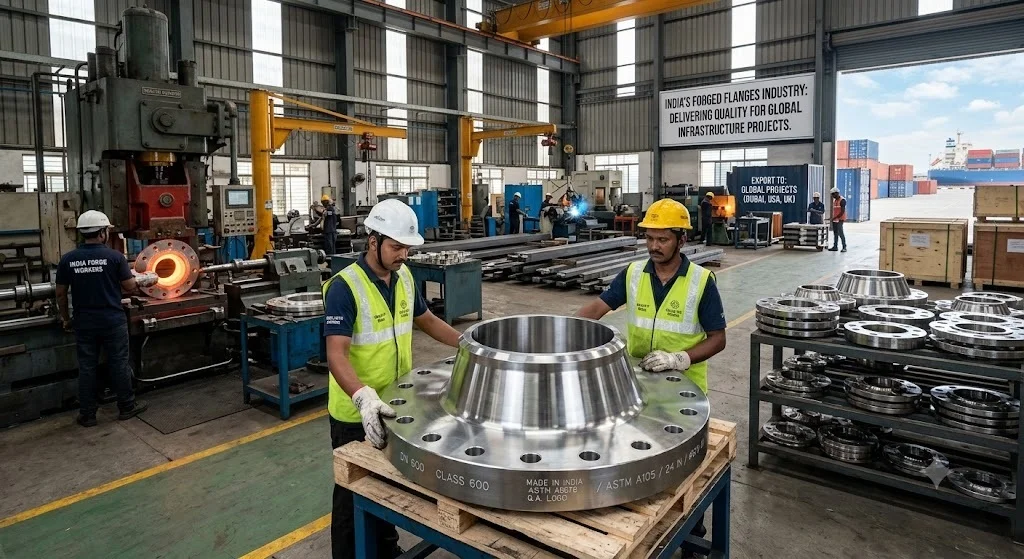
I still clearly visualize myself standing on the wet muddy platform at the offshore terminal expansion project outside Gujarat, 2018. EPC contractor was lagging by three weeks behind the schedule and was paying almost forty thousand dollars daily in idle barge fees simply because a consignment of low-cost, imported slip-on flanges failed during the hydrostatic testing at about 60%, not even reaching their pressure class.
A slice of a rejected piece of material by a metallographic technician clearly showed subsurface porosity, and significant micro-segregation occurred when the piece was cast, not being given enough time to properly cool, which results in defects in the material.
By the way, cheap component price at major industrial contracts is often the most costly mistake in the world of industrial sourcing.
To me, that project became the beginning point. We had the wrong parts scrapped and moved fully to domestic forging mills that were thoroughly checked after our supplier was changed. The replacement order of certified suppliers was completed within ten days and passed every Ultrasonic Test (UT) easily, and even when full pressure was applied, it did not result in any leaks at all.
In the present day, as pressure ratings on a global scale of infrastructure projects are reaching record levels and a thermal tolerance in materials is going to the limits, and a demand is put out for a material with a longevity of years without defects, it is now a fact that global sourcing is looking at India as the main supplier for these goods. This comprehensive guide addresses different aspects of the technical, regulatory, and operational sides of sourcing heavy-duty forged piping components from India's changing industrial scene to support procurement managers, plant engineers, and project directors.
We Have the Metallurgical Argument: How and Why Forging is Better than Casting in High-Pressure Piping
Let us think a little about an eternal question that we have encountered in technical tender discussions: why choose a piping product that is forged over a cast piping component? Why would it still be considered, even with modern casting that has been improved so much?
To put this simply, the answer is grain orientation; no matter what pressure is applied, grain is always there.
In casting, molten metal is poured into a mold followed by solidification. During this process, a metal undergoes several transformations. First, the metal tends to form small branches, also called dendrites, which leads to the trapping of a significant number of small pores, shrinkage cavities, and even local segregates. Such defects are usually acceptable if one uses the cast products for a low-pressure application, such as, for example, a distribution line. But would you trust the same quality material in a high-pressure hydrocracking unit?
The point of failure is a tiny crack. This tiny crack can lead to a massive failure as a result.
The difference in forging is that it brings a complete change to this mechanical story. In forging, the shape is completely altered when the ingot or the billet has been worked with the help of high temperature and with the help of the closed-die hammer or hydraulic press. So the entire cast structure inside is destroyed. The micro-voids, which were a big problem in the casting process, are now under compression forces that weld shut these micro-voids. But most importantly, the flow of grain inside the metal of the steel has been turned by the forging process, and now it follows the geometrical profile of the flange.
Engineering Insight: The continuous flow of the grain that has been aligned with the geometry of the component greatly enhances the strength of the steel, impact resistance, and resistance to changes in temperature in cycles. For such assemblies of bolts and flanges where there is a bolted joint, the use of forged elements greatly enhances the ability of the bolts to keep the load as well as the gasket stress over many years of the running cycle.
My main worry is, I guess, that most of them, procurement teams get fixated on the dimension tolerance while they don't give enough importance to the fatigue limitations from a mechanical standpoint. If you just consider the Forged Flanges India market options, you will end up with the manufacturing capabilities that were upgraded from the time of the iron workers' manual hammering to that of the fully automatic cold-die forging presses, the extremely accurate ring-rolled mills, and the completely computerized heat-treating furnaces.
Compliance with Standards and Selection of Material Grades
For global project procurements and the successful alignment with one another, a procurement officer will have to align completely all three: dimensional specifications, material requirements, and testing criteria. Indian major manufacturers do not have any problems with meeting the worldwide standards requirements. Their range of products is very diversified and of high quality. Still, it is the correct matching of the material grade with the pressure level and that the procurement is based entirely on that aspect, which can either help or hinder the success of a procurement technically.
Primary Dimensional Standards
● ASME B16.5: The basic guideline that encompasses flange types Pipe and Flanged Fittings of NPS 1/2, 24 in the 150, 300, 400, 600, 900, 1500, and 2500 pressure classes.
● ASME B16.47 (Series A & B): Very useful in applications with large diameters of piping, for NPS 26 to NPS 60. Series A (MSS SP-44) features heavier flange dimensions, while Series B (a variation of API standard 451, which is for large diameter piping is a light and compact type.
● EN 1092-1/DIN Standards: European standards describing flanges for pipes, valves, and pipe accessories that are PN (nominal pressure) classes with values of PN6 to PN400.
● API 6A: Essential for wellhead and production tree facilities at upstream oil and gas wells in hostile environments (up to 20,000 PSI).
Material Grade Selection Matrix
Critical Warning on Material Substitution: No matter what, never settle for both certifications (ASTM A105 / A350 LF2) on their face if their heat-treatment documentation is not reviewed. A105 is good enough for general ambient carbon steel applications only, but for the low-temperature job, only A350 LF2 is the right choice with mandatory Charpy V-Notch impact testing all the way down to -46°C. Skipping the impact test in sub-zero applications opens the way for a potential brittle fracture when the equipment gets shocked.
Quality control and its impact on the separation of top-tier mills from mediocre ones
We must move past a supplier's attractive prices and the beautiful corporate brochures. Vendor qualifications for procurement of Forged Flanges India goods should not only focus on cost but also on the quality of the products and services. If you want your products to withstand the rigors of an elite infrastructure project, go for an inspection at the premises (vendor's location) and even down to its factory (shop floor).
If it is truly a great quality assurance practice, then what does it include?
1. Raw Material Traceability and PMI Analysis
By uncovering where and the various ways industrial manufacturing occurs across the country, procurement planners can significantly boost their strategic planning and decision-making. Different industrial belts have developed over a period of time, and together they constitute the manufacturing supply environment; each belt has unique traits when it comes to types of metals that are worked, raw material availability, and export infrastructure for logistics purposes.
1. Western Industrial Belt (Maharashtra and Gujarat)
Western India is home to the largest number of flange manufacturing and exporting facilities. Industrial towns like Mumbai, Rajkot, Vadodara, Pune and Thane are home to state-of-the-art forging units with high-capacity drop hammers, seamless ring rolling mills and multi-axis CNC machine tools. Proximity to major deep-water ports like JNPT and Hazira reduces freight costs by sea as well as on land for exports and imports.
2. Northern Industrial Hub (NCR and Punjab)
Faridabad, Ghaziabad, and Ludhiana are places where large amounts of iron forging occur on a daily basis, with a heavy emphasis on carbon steel and structural alloy products. They also supply flanges for overseas shipment besides the Indian market. A large number of domestic power plants, fertilizer plants, and heavy machinery manufacturers are among the local buyers, while the flange exports mainly go to other countries.
3. Southern cluster (Tamil Nadu and Karnataka)
Niche high-precision metallurgical products such as duplex stainless steel and titanium alloy forgings are produced in the southern cluster, mostly in Chennai and Coimbatore. This cluster’s competitive advantage is based on its capability to provide regular supply of its products for the Russian defense industry, aviation, and nuclear power engineering.
Evaluating Vendors: The Procurement Auditor's Checklist
While checking the background of a business to be your future partner through your computer does help, it is not enough to rely on that as the sole basis when it comes to choosing supply partners. This audit framework is a useful tool to see if a manufacturing partner can stand by your schedule under the strict requirements of your project and how they can perform.