Sign up with Google
 Sign in with Zoho

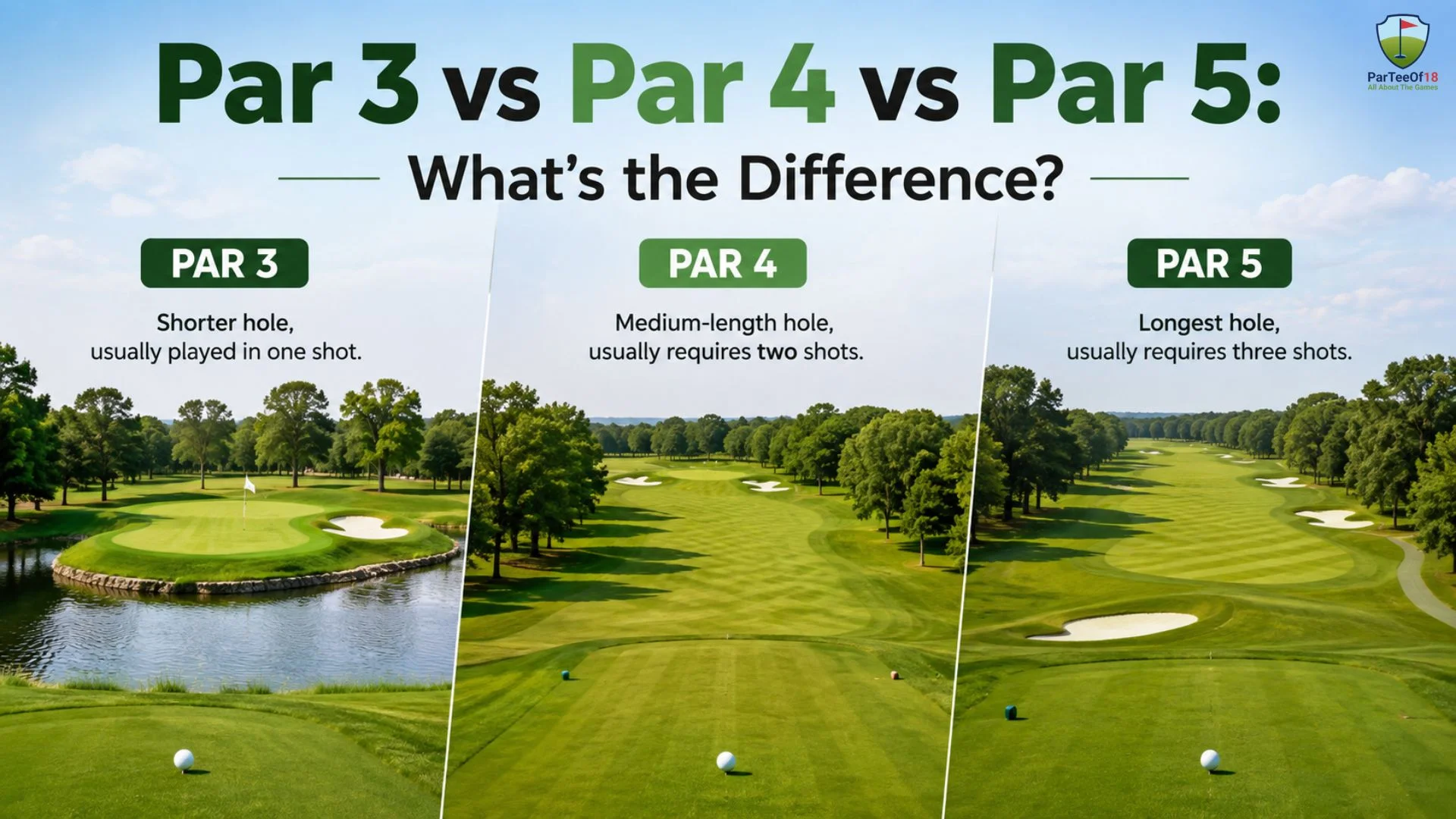
If you've ever stood on a tee box next to a buddy who casually said "this one's a par 5, save your legs," and you just nodded like you totally understood, don't worry. You're not alone. Golf has this funny way of throwing around terms that sound simple but trip up even people who've played for years.
Par is one of those words. Everyone's heard it. Fewer people can actually explain why one hole is a par 3 and the next one over is a par 5. And honestly, once you get it, the whole game starts making a lot more sense, from how you plan your shots to how you actually score better.
So let's break it down properly. No jargon overload, just a straightforward look at what separates a par 3 from a par 4 from a par 5, and why that difference matters every single time you step up to tee off.
What Is Par in Golf?
So, what is par in golf exactly? In simple terms, par is the number of strokes a skilled golfer is expected to need to finish a hole, including putts. It's not a random number either. Course designers set it based on hole length and difficulty, and it's basically your built-in scoring benchmark for the round.
Where the Term Comes From?
The word "par" was borrowed from stock market language back in the 1870s, where it meant a standard or expected value. Golf clubs adopted it to describe an expected score, and it stuck around for over a century without much change.
Why Par Matters for Scoring?
Every score you post gets measured against par. Shoot one over on a hole, that's a bogey. One under, a birdie. Without par as the baseline, there'd be no consistent way to compare a good round to a rough one, whether you're playing solo or in a tournament.
Par 3 Holes: The Short and Sharp Ones
Par 3 holes are the shortest holes on a course, typically ranging from about 100 to 250 yards. You're expected to reach the green in one shot and then take two putts. Sounds easy on paper, but these holes are often where scorecards fall apart fast.
Typical Yardage and Setup
Most par 3s sit somewhere between 130 and 220 yards depending on the tee box you're playing from. There's no fairway to speak of, no layup zone, just tee, hazard, and green. It's a one-shot test of accuracy more than power.
Why Par 3s Feel Deceptively Tricky?
Here's the thing nobody tells beginners: a shorter hole doesn't mean an easier one. Par 3s often have tiny greens, deep bunkers, or water guarding the front, so one mishit and you're chipping from the rough or worse, fishing your ball out of a pond.
Real Course Example
Think of the famous 17th hole at TPC Sawgrass, the island green. It's barely 137 yards on the scorecard, but pros have watched their ball splash into water on live television. That's a par 3 humbling even the best players in the world.
Par 4 Holes: The Bread and Butter of Golf
Par 4 holes are the most common hole type on any standard course, usually running between 250 and 470 yards. The expected play is a tee shot, an approach shot, then two putts. Most 18 hole courses have around ten of these, making them the true test of a golfer's all-around game.
Standard Yardage Range
You'll typically see par 4s starting around 300 yards for shorter, more strategic holes and stretching past 450 yards on tougher championship courses. That range gives designers room to mix things up with doglegs, elevation changes, and hazards along the way.
The Two-Shot Strategy
A par 4 asks you to think in stages. First, position your drive somewhere manageable. Second, control your approach shot to give yourself a fair putt. Golfers who rush the first shot often pay for it with a tricky second one.
Real Course Example
The 18th at Pebble Beach is a par 5 in most listings now, but plenty of iconic par 4s like the 10th at Riviera Country Club show how a shorter, drivable hole can still wreck a scorecard if you get greedy off the tee.
Par 5 Holes: The Long Haul
Par 5 holes are the longest on the course, often stretching from 470 yards all the way past 600 on modern layouts. These holes typically require three shots to reach the green, plus two putts, giving golfers a real shot at scoring low if they play it smart.
Length and Layout
Par 5s can wind through doglegs, cross water twice, or climb elevation changes that make them feel even longer than their yardage suggests. Course designers use them to test patience as much as power, since one poor decision can turn a birdie chance into a double bogey.
To Go for It or Lay Up
This is where par 5s get interesting. Big hitters sometimes try to reach the green in two shots, a move called "going for it." Others play it safe with a controlled layup before their approach. Both strategies are valid, it just depends on your game and how much risk you're comfortable taking.
Real Course Example
The 13th hole at Augusta National, part of Amen Corner, is a par 5 that tempts players to cut the corner over Rae's Creek for a shot at eagle. Some players pull it off beautifully. Others end up with a wet ball and a ruined Sunday.
Quick Comparison: Par 3 vs Par 4 vs Par 5
Here's a simple side by side look so you can see exactly how these holes stack up against each other.
- Par 3: Roughly 100 to 250 yards, one shot to the green, two putts expected.
- Par 4: Roughly 250 to 470 yards, tee shot plus approach shot, two putts expected.
- Par 5: Roughly 470 to 600+ yards, three shots to reach the green, two putts expected.
How Course Designers Decide Par for Each Hole?
Par isn't picked at random. Designers factor in yardage, elevation, hazards, and how far an average skilled golfer hits the ball. A hole that plays uphill or into constant wind might get bumped up in difficulty even if the yardage alone doesn't scream par 5.
The Role of Yardage
Yardage is the starting point for almost every par decision. Governing bodies like the USGA publish yardage guidelines, and course architects generally stick close to them, though local terrain always plays a role in the final call.
Elevation, Wind, and Hazards
A hole with a steep uphill approach or constant crosswind might need an extra club or two to reach, even if the flat yardage looks like a standard par 4. Designers account for these real-world factors when setting the final par number.
Why Understanding Par Types Improves Your Game?
Once you know what to expect from each hole type, you can actually plan your round instead of just reacting hole by hole. Knowing a par 5 gives you room to recover from a bad drive, or that a par 3 punishes sloppy iron play, changes how you approach club selection and risk.
Smarter Club Selection
On a par 3, club choice is everything since you only get one shot at the green. On a par 4 or 5, you've got room to adjust after your first swing, so early mistakes aren't always fatal to your score.
Better Course Management
Understanding par types helps you decide when to play aggressive and when to play safe. A weekend golfer trying to muscle a 3 wood over water on a par 5 is often better off laying up and taking a guaranteed par instead of a risky double bogey.
Common Mistakes Golfers Make With Par
Even experienced players misjudge par-related strategy sometimes. Chasing birdies on holes that don't suit their game, ignoring wind on short par 3s, or getting overly aggressive on tight par 4s are all mistakes that quietly inflate scorecards round after round.
Underestimating Short Holes
Golfers often relax on par 3s because the yardage looks small. That mental letdown leads to careless swings, and suddenly a "gimme" hole turns into a double bogey because nobody respected the tiny green or hidden bunker.
Overestimating Their Own Distance
Plenty of golfers try to reach par 5s in two shots when their actual swing speed doesn't support it. The result is usually a mishit from the rough instead of a clean approach, turning a potential birdie hole into a bogey.
Final Thoughts
At the end of the day, par 3, par 4, and par 5 holes aren't just numbers on a scorecard. They're different puzzles, each demanding a different kind of shot, patience, and decision making. A par 3 rewards precision. A par 4 rewards balance. A par 5 rewards patience and smart risk taking.
The next time you walk up to a tee box, take a second to actually think about what the hole is asking of you instead of just swinging away. That small shift in mindset is often the difference between a frustrating round and one where you walk off the 18th green actually proud of how you played.
Frequently Asked Questions
1. What is the difference between par 3, par 4, and par 5?
The main difference is hole length and expected number of strokes. Par 3 holes need one shot to the green, par 4s need two, and par 5s need three, with two putts expected on each.
2. Is a par 5 always harder than a par 3?
Not necessarily. Par 5s give you more room to recover from mistakes since you have extra shots. Many golfers find short par 3s harder because there's zero margin for error on a single tee shot.
3. Can a par 4 be reached in one shot?
Yes, on shorter par 4s, especially those under 300 yards, some golfers with long drives attempt to reach the green off the tee. It's a common and exciting strategy, though risky if hazards guard the green.
4. Why do some courses have more par 4s than par 3s or par 5s?
Most standard 18 hole courses use around ten par 4s because they offer the best balance of challenge and variety. Too many short or long holes would make the course feel repetitive or unbalanced.
5. How is par determined for a golf hole?
Course designers set par based on yardage, elevation changes, wind exposure, and hazards, generally following guidelines from golf governing bodies while adjusting for the specific terrain and layout of each hole.
6. Does par change based on which tees you play?
Yes, sometimes. Playing from forward tees can shorten a hole enough to lower its par, especially on longer par 5s that become reachable in fewer shots from a closer distance.