Sign up with Google
 Sign in with Zoho

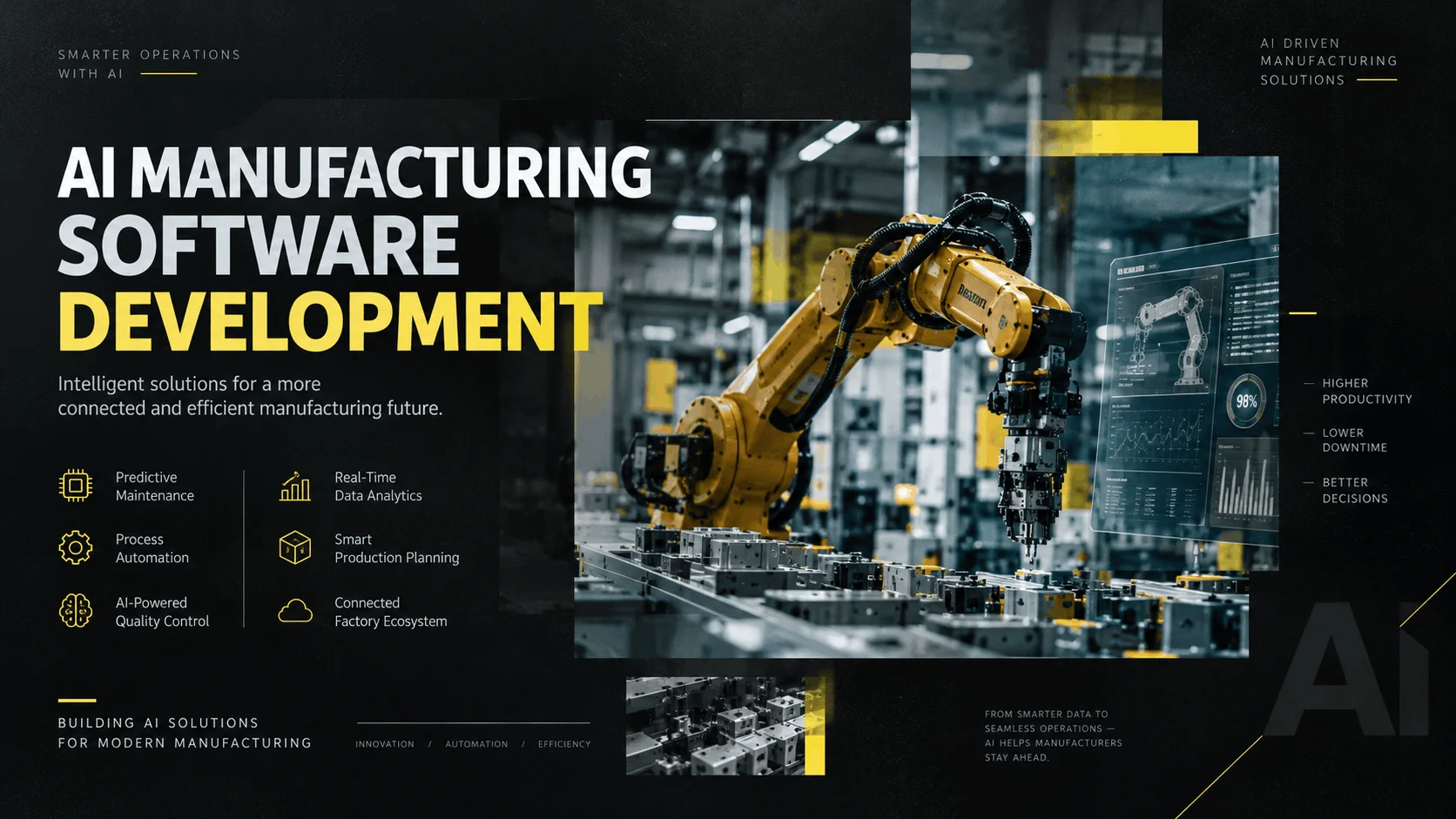
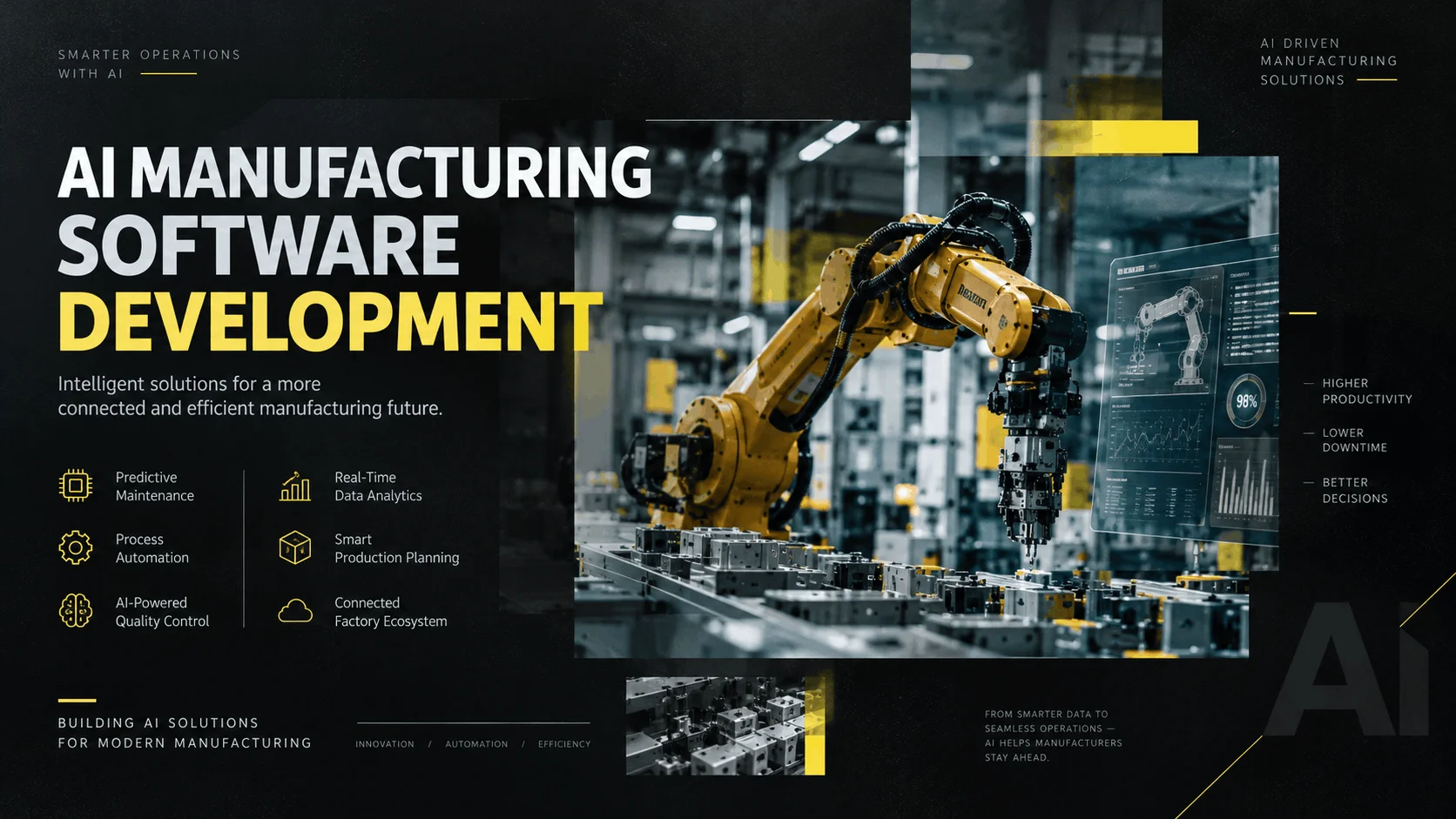
Manufacturing companies need to maintain product quality, control operating costs, and meet production schedules while responding to changing demand. When production data is spread across machines, spreadsheets, and disconnected business systems, identifying problems early becomes difficult. AI Manufacturing Software Development helps manufacturers use operational data to improve decision-making, automate selected tasks, and gain better visibility into production activities.
How AI Is Changing the Manufacturing Industry
Traditional manufacturing systems often rely on fixed rules, manual inspections, and historical reports. Artificial intelligence can extend these capabilities by identifying patterns in machine data, detecting unusual production behaviour, and helping teams investigate recurring problems.
For example, a manufacturer experiencing frequent production delays could analyse machine performance, material availability, maintenance records, and shift-level output in one system. These insights can help supervisors identify bottlenecks and prioritise corrective action.
Effective AI Manufacturing Software Development should begin with a clearly defined business problem. Manufacturers do not need to automate every process immediately. Starting with one production line, equipment category, or quality-control workflow makes it easier to measure results before expanding implementation.
Using Generative AI to Make Manufacturing Knowledge Accessible
Generative AI in Manufacturing can help employees retrieve information from technical documents, maintenance manuals, standard operating procedures, and quality records. Instead of searching through several files, a technician could ask a question in natural language and receive an answer based on approved internal documentation.
Generative AI for Manufacturing can also assist with shift summaries, incident reports, troubleshooting guidance, and production documentation. These capabilities are particularly useful when experienced employees hold valuable operational knowledge that is difficult for new staff to access.
However, generated answers should be grounded in reliable company data. Systems need appropriate access controls, source references, and human review for safety-critical instructions. AI should support established manufacturing procedures rather than replace required engineering approvals.
Improving Equipment Reliability with Predictive Maintenance
Unexpected equipment failures can interrupt production, delay deliveries, and increase repair expenses. AI Predictive Maintenance Manufacturing solutions analyse signals such as temperature, vibration, operating hours, and maintenance history to identify patterns associated with potential failures.
A predictive maintenance system may flag equipment that requires inspection before a breakdown occurs. Maintenance teams can then prioritise work based on equipment condition, production schedules, and the potential impact of failure.
The quality of these predictions depends on sensor availability, historical records, and the reliability of the underlying data. Manufacturers should evaluate whether alerts provide enough advance warning to take useful action and whether false alarms create unnecessary maintenance work.
Applying AI Across Production and Quality Control
AI for Manufacturing Industry applications extend beyond maintenance. Computer vision can support defect detection, production analytics can highlight inefficient processes, and forecasting models can help businesses estimate material requirements.
A connected AI Manufacturing Software platform may support:
- Automated visual inspection for selected product defects.
- Production planning and capacity analysis.
- Inventory and material demand forecasting.
- Energy consumption monitoring.
- Quality trend analysis and root-cause investigation.
- Operational dashboards for supervisors and plant managers.
These applications can help teams identify problems earlier, but results depend on the production environment and the quality of available data. Inspection models, for example, must be tested against real product variations and changing operating conditions.
Special Considerations for Pharmaceutical Manufacturing
AI in Pharma Manufacturing requires particular attention to traceability, documentation, quality assurance, and regulatory obligations. AI may assist with analysing batch records, identifying unusual process measurements, monitoring equipment conditions, and reviewing deviations.
Any system used in a regulated workflow must fit the organisation's quality management procedures and applicable validation requirements. Changes to models, data sources, and software configurations may also need documented review.
Manufacturers should establish clear boundaries between AI-generated recommendations and approved production decisions. This is especially important where product quality, patient safety, or batch release decisions are involved.
Choosing the Right Manufacturing AI Development Partner
Businesses comparing the Top AI Development Companies should evaluate practical experience in industrial software, data engineering, system integration, security, and deployment. General AI expertise alone does not guarantee an understanding of factory operations.
A suitable development partner should understand how AI connects with existing manufacturing execution systems, enterprise resource planning platforms, industrial sensors, and maintenance applications. Manufacturing AI Software must also fit the working environment of operators and engineers who will use it every day.
Companies exploring broader AI capabilities can review AI application development services when planning integrations and intelligent business workflows. Manufacturers can also visit Nextwebi to explore its wider software development capabilities.
Preparing for Agentic AI in Manufacturing
Agentic AI for Manufacturing introduces systems that can coordinate multiple tasks within defined permissions. An agent might review machine alerts, collect maintenance history, prepare a work order, and notify the responsible engineer.
These workflows require clear approval rules and audit trails. AI agents should not independently change machine settings or execute safety-critical actions without the appropriate controls, testing, and authorisation.
By introducing automation gradually and measuring operational outcomes, manufacturers can develop an AI strategy that supports reliable production rather than adding complexity.
FAQs
1. What is AI manufacturing software development?
It involves building software that applies AI to manufacturing activities such as predictive maintenance, quality inspection, production planning, and operational analysis.
2. How does generative AI help manufacturers?
It can make technical documentation easier to search, assist with report preparation, summarise incidents, and provide context-aware guidance based on approved internal information.
3. Can AI predict manufacturing equipment failures?
AI can identify patterns associated with potential equipment problems using sensor readings and maintenance history, but prediction accuracy depends on data quality and equipment conditions.
4. How can pharmaceutical manufacturers use AI?
Potential applications include batch-record analysis, process monitoring, deviation investigation, and equipment maintenance, subject to applicable quality and validation requirements.
5. What should manufacturers consider before implementing AI?
They should identify a measurable business problem, assess data quality, review integration requirements, establish security and approval controls, and test the solution in a suitable production environment.