Sign up with Google
 Sign in with Zoho

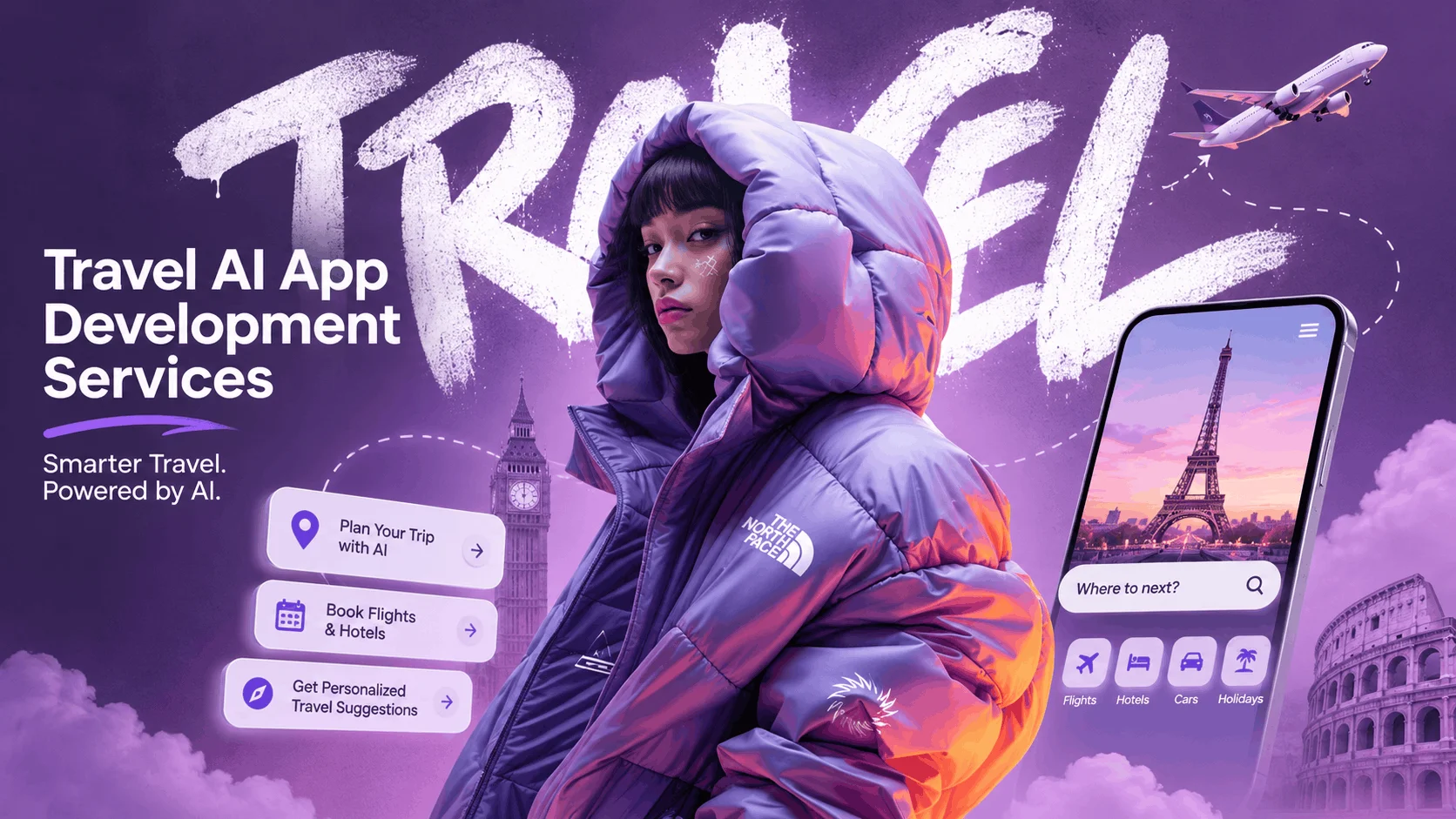
Travellers expect more from digital booking platforms than a simple search box and a list of available hotels or flights. They want applications that understand their preferences, reduce the time spent comparing options, and make travel decisions easier. Travel AI App Development Services help travel businesses introduce intelligent features that connect trip discovery, personalised recommendations, reservation management, and customer assistance within a single application.
1. Moving Beyond Traditional Travel Booking Applications
Conventional travel applications depend largely on filters and manual searches. Users enter destinations, travel dates, passenger details, and budgets before reviewing individual results.
AI-powered travel applications can make this process more conversational and responsive. Travellers can describe what they need in everyday language, and the application can translate those requirements into relevant search parameters.
For example, a user planning a weekend holiday could request a destination within a particular budget, with suitable accommodation and outdoor activities. The application can use this information to narrow down relevant options.
This approach helps travel platforms create more engaging experiences while reducing unnecessary search steps.
2. AI-Based Search and Recommendation Engines
Search functionality plays an important role in the overall travel booking experience. An AI recommendation engine can analyse several factors to improve the relevance of search results.
Important capabilities include:
- Destination recommendations based on travel interests
- Hotel suggestions based on budget and amenities
- Flight recommendations based on duration and price
- Activity discovery based on location and preferences
- Personalised suggestions using permitted user history
- Context-aware search through natural language
A recommendation system can combine user preferences, booking information, destination attributes, and available inventory.
Businesses should also provide clear filters so travellers can refine AI-generated suggestions according to their actual requirements.
3. Building an Intelligent Travel Planning Assistant
A travel planning assistant can act as a digital guide throughout the trip preparation process.
Instead of requiring users to navigate several independent sections, the assistant can help organise information through a conversation.
Itinerary Creation
The assistant can generate day-wise travel plans based on destination, trip duration, budget, and preferred activities.
Travel Budget Estimation
It can organise estimated expenses for accommodation, transportation, sightseeing, and other travel requirements.
Activity Recommendations
The system can suggest attractions, restaurants, and experiences according to the traveller's interests and schedule.
Itinerary Modification
When users change their travel dates or remove an activity, the assistant can suggest adjustments to the remaining itinerary.
The application should clearly identify estimated prices, suggested activities, and confirmed reservations rather than presenting all information as guaranteed.
4. How Agentic AI Can Coordinate Travel Activities
Agentic AI for travel can coordinate multiple actions instead of responding only to individual questions.
A travel platform may use specialised agents for different responsibilities.
For example, when a traveller changes the destination, the coordination agent can request updated flight, hotel, and activity information before presenting a revised travel plan.
Such systems require clear task boundaries, reliable integrations, and controls over actions that affect bookings or payments.
5. Personalised Booking Experiences with Generative AI
Generative AI for travel can improve the way booking platforms communicate with customers.
Rather than showing identical descriptions to every user, an application can generate relevant explanations based on travel preferences.
Possible applications include:
- Summarising hotel facilities
- Explaining differences between flight options
- Suggesting suitable travel packages
- Preparing destination guides
- Answering questions about booking conditions
- Generating personalised trip summaries
The information used for these responses should come from trusted travel databases and provider APIs. This reduces the possibility of incorrect details about prices, facilities, or reservation policies.
6. Important Integrations for Travel AI Applications
An intelligent travel application needs access to external information and transaction services.
Common integrations include:
Flight and hotel APIs: Retrieve schedules, pricing, availability, and reservation details.
Payment gateways: Support secure transactions and payment confirmation.
Maps and location services: Help users explore destinations, routes, and nearby attractions.
Weather services: Provide relevant weather information for travel planning.
CRM systems: Maintain customer interactions and support business operations.
Notification services: Send booking updates, reminders, and travel alerts.
The integration architecture should support API failures, changing inventory, authentication requirements, and data synchronisation.
7. User Experience, Security, and Mobile Performance
An AI-powered travel application must remain easy to use even when it offers advanced functionality.
The interface should provide simple navigation between search, recommendations, itinerary planning, bookings, and customer support. AI suggestions should be presented clearly without overwhelming users with unnecessary information.
Security requirements include encrypted communication, secure authentication, protected payment processing, appropriate data access permissions, and careful handling of personal travel information.
Mobile performance is equally important. Search results, itinerary updates, and booking details should load efficiently across different network conditions.
8. Development Approach for a Custom Travel AI Platform
Building a travel application requires a development strategy that balances business objectives with technical requirements.
A structured approach includes:
- Business analysis: Identify the target audience, booking model, and major application requirements.
- Feature planning: Prioritise search, recommendations, itinerary management, and booking functionality.
- Architecture design: Select suitable mobile technologies, backend services, databases, and AI components.
- AI integration: Implement recommendation engines, conversational assistance, and agent workflows.
- Third-party integration: Connect travel providers, payments, maps, and notification services.
- Testing: Validate booking accuracy, application performance, security, and AI responses.
- Deployment: Release the application and monitor its performance.
- Continuous improvement: Refine recommendations and introduce additional capabilities based on user feedback.
Working with a capable AI application development company can help travel businesses evaluate their requirements and build an application with a suitable technical foundation.
Frequently Asked Questions
1. What makes a travel application AI-powered?
An AI-powered travel application uses technologies such as machine learning, natural language processing, and generative AI to provide recommendations, assist with planning, and improve booking interactions.
2. Can AI recommend travel packages based on user preferences?
Yes. AI recommendation systems can analyse travel interests, budgets, trip duration, and other permitted preference data to suggest relevant packages.
3. What is the role of agentic AI in travel booking?
Agentic AI can coordinate activities such as flight discovery, hotel comparison, itinerary preparation, and booking assistance through connected services.
4. Which APIs are required for a travel AI application?
Depending on the business model, the application may require flight APIs, hotel booking APIs, payment gateways, maps, weather services, and notification integrations.
5. Can an existing travel booking application be upgraded with AI?
Yes. AI features can be added to an existing application through APIs or separate backend services, depending on its architecture, data quality, and integration capabilities.