 Sign up with Google
 Sign in with Zoho

Life rarely sends a notice before it asks for money. A sudden hospital bill, a wedding that cannot wait, a child's school admission, or simply the chance to consolidate a few expensive debts into one manageable payment — these moments call for cash that is both quick and affordable. That is exactly where a personal loan online in India at low interest rates earns its place: it gives you access to funds without the long queues, paperwork stacks, or guesswork that used to define borrowing.
Today, borrowing has moved almost entirely online. You can compare offers, check your eligibility, upload documents, and receive money in your bank account, often within the same day, all from your phone. But "low interest rate" is not just a marketing phrase — it depends on your credit profile, income, the lender you choose, and how well you understand the fine print. This guide walks you through everything you need to know before you apply: how personal loans work, what decides your interest rate, who qualifies, what documents are needed, and how to borrow responsibly so the loan solves your problem instead of adding a new one.
What Is a Personal Loan Online in India at Low Interest Rates?
A personal loan is an unsecured loan, meaning you don't need to pledge property, gold, or any other asset as collateral. Lenders assess your income, credit history, and repayment capacity, and if you qualify, disburse a lump sum that you repay over a fixed tenure through Equated Monthly Instalments (EMIs). Because there is no collateral involved, the lender's risk is higher, which is why your credit score and income stability play such a big role in deciding the rate you're offered.
The "online" part of the equation has changed the game for borrowers. Instead of visiting a branch, filling out physical forms, and waiting days for verification, the entire journey — from application to disbursal — happens digitally. Lenders use digital KYC, bank statement analysis, and automated credit checks to approve loans faster, which also lets them pass on some of the operational savings as more competitive interest rates for well-qualified applicants.
What Decides Your Interest Rate?
No two borrowers get the exact same rate, because lenders price a loan based on risk. Understanding these factors helps you position yourself for a better deal before you even apply.
• Credit score: A score of 750 and above generally unlocks the most competitive rates, as it signals a reliable repayment history.
• Income and employment type: Salaried employees at stable, reputed organisations, and self-employed individuals with consistent income, are usually seen as lower risk.
• Existing obligations: A lower debt-to-income ratio (how much of your income already goes toward EMIs) improves your chances of a favourable rate.
• Loan amount and tenure: Shorter tenures and moderate loan amounts can sometimes attract better pricing than very large, long-tenure loans.
• Relationship with the lender: If you already bank with a lender or have repaid a loan with them successfully, you may be offered preferential rates.
• Type of lender: Banks, NBFCs, and digital lending platforms all price risk differently, so comparing more than one option matters.
Who Is Eligible for a Personal Loan Online?
Eligibility criteria vary slightly from one lender to another, but most online personal loan providers in India look at a similar set of baseline conditions:
• Age: Typically between 21 and 60 years at the time of application.
• Nationality and residency: Indian citizen, residing in India.
• Employment: Salaried individuals working with a private company, public sector unit, MNC, or government body, or self-employed professionals and business owners with a steady income source.
• Minimum income: Usually a monthly income threshold set by the lender, which can vary by city and employer category.
• Credit score: A CIBIL score of 650 or above is commonly preferred, though some lenders also work with applicants who have a limited or developing credit history.
• Work experience: A minimum period of employment or business continuity, often 6 months to a year, to establish income stability.
If you don't meet every criterion perfectly, it doesn't automatically rule you out — some lenders offer loans to applicants with modest incomes or thinner credit files, though usually at a slightly higher rate to offset the added risk.
Documents Usually Required
One of the biggest advantages of applying online is how light the documentation has become. In most cases, you will need:
• Identity proof: Aadhaar card, PAN card, passport, or voter ID
• Address proof: Aadhaar card, utility bill, rental agreement, or passport
• Income proof: Latest salary slips (usually 3 months) for salaried applicants, or ITR and bank statements for self-employed applicants
• Bank statements: Typically the last 3 to 6 months, used to assess cash flow and repayment capacity
• A recent photograph and a registered mobile number and email ID linked to your Aadhaar, for e-KYC verification
Most lenders now accept these digitally — you simply photograph or upload scanned copies through the application portal or app, and e-KYC via Aadhaar-based OTP verification often replaces the need for physical document submission altogether.
How to Apply for a Personal Loan Online in India, Step by Step
The process is designed to be simple enough to complete during a lunch break, but it helps to know what to expect at each stage.
1. Check your eligibility: Use an online eligibility calculator, entering your income, city, and employment type, to get an estimate of the loan amount and rate you may qualify for before applying.
2. Compare offers: Look beyond the headline interest rate — check processing fees, prepayment charges, and the total cost of the loan across a couple of lenders.
3. Fill out the application form: Provide your personal, employment, and income details accurately. Mismatched or inflated information is one of the most common reasons for rejection or delay.
4. Upload documents: Submit your KYC, income, and bank statement documents as prompted. Clear, legible scans speed up verification considerably.
5. Complete e-KYC and verification: Most platforms use Aadhaar-based OTP verification, along with a quick video KYC or selfie-based check, to confirm your identity.
6. Review and accept the loan offer: Once approved, read the sanction letter carefully — loan amount, interest rate, tenure, EMI, and all applicable charges should be clearly stated before you accept.
7. Receive disbursal: After e-signing the loan agreement, the amount is credited directly to your bank account, often within a few hours to one business day for pre-approved or well-documented applications.
Why Apply Online Instead of Visiting a Branch?
Applying online isn't just about convenience — it genuinely changes the economics and experience of borrowing.
• Speed: Digital verification and automated credit checks mean approvals that used to take days can now take minutes to a few hours.
• Transparency: Most platforms show you the applicable interest rate, processing fee, and EMI amount upfront, before you commit.
• Accessibility: You can apply from anywhere, at any time, without taking time off work to visit a branch.
• Easy comparison: Switching between lender websites or apps to compare rates takes minutes, helping you make a more informed decision.
• Minimal paperwork: Digital document upload and e-KYC remove the need to carry physical files and get photocopies attested.
Tips to Get the Lowest Possible Interest Rate
A little preparation before you apply can meaningfully lower the rate you're offered.
• Check and improve your credit score before applying. Paying off existing credit card dues or clearing small overdue amounts can help.
• Avoid applying to multiple lenders within a short span, as frequent hard enquiries can temporarily lower your credit score.
• Borrow only what you need. A smaller, well-justified loan amount relative to your income is often viewed more favourably.
• Choose a tenure that balances a comfortable EMI with a reasonable total interest outgo — very long tenures reduce EMI but increase the overall interest you pay.
• Maintain a healthy bank balance and avoid frequent bounced payments or overdrafts in the months before applying, since lenders review your bank statements closely.
• If you have a strong relationship with a bank or NBFC (salary account, existing loan repaid on time), check if they offer pre-approved or relationship-based lower rates.
Understanding EMI and the True Cost of Borrowing
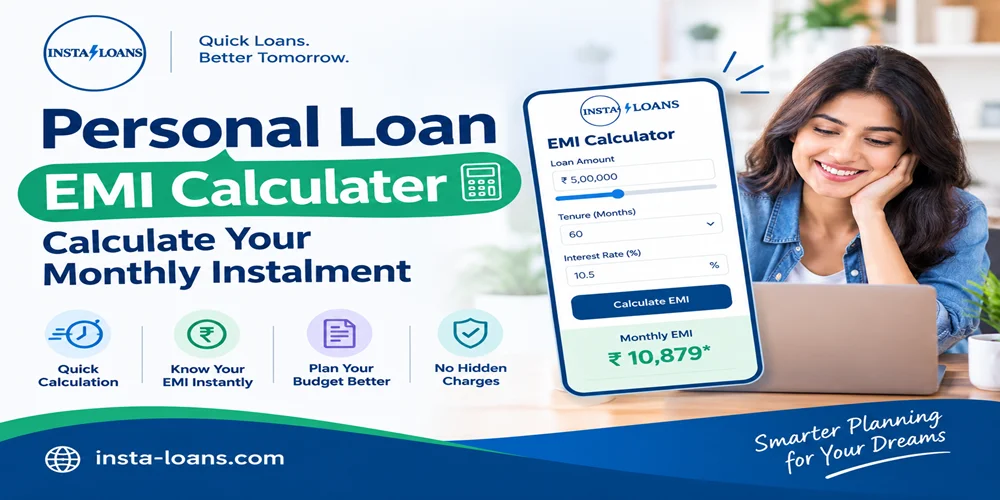
Your EMI is made up of two parts: the principal you borrowed and the interest charged on the outstanding balance. In the early months of the loan, a larger portion of your EMI goes toward interest; as the loan matures, more of it goes toward the principal. This is why prepaying a loan earlier in its tenure, if you have the means to do so, usually saves more on total interest than prepaying later.
Before signing any loan agreement, calculate the total cost of the loan — not just the EMI. Add up the processing fee, any insurance or add-on charges, and the total interest payable over the tenure. Two loans with similar EMIs can have very different total costs depending on tenure length and fee structure, so it pays to look at the complete picture rather than the EMI figure alone.
Common Mistakes to Avoid
Borrowers often focus so much on getting approved quickly that they overlook details that matter just as much as the interest rate itself.
• Not reading the loan agreement fully, especially clauses on prepayment charges, late payment penalties, and foreclosure terms.
• Borrowing more than necessary simply because a higher amount was approved.
• Ignoring the processing fee and other charges while comparing only the headline interest rate.
• Applying to several lenders simultaneously, which can affect your credit score through multiple hard enquiries.
• Skipping the eligibility check and applying directly, which can lead to avoidable rejections that also impact your credit report.
• Not verifying that the lender or platform is a registered, RBI-recognised entity or works with such regulated lenders before sharing personal and financial information.
Types of Personal Loans Available Online
Not every personal loan is identical in purpose or structure, and knowing the variants available can help you pick the right fit instead of defaulting to a generic option.
• Standard personal loan: A lump-sum disbursal for any purpose — medical expenses, travel, a wedding, home improvement, or general cash-flow needs — repaid through fixed EMIs over the chosen tenure.
• Instant or short-term personal loan: A smaller amount, often disbursed within minutes to a few hours, suited for urgent, time-sensitive needs rather than large planned expenses.
• Debt consolidation loan: Used to combine multiple high-interest debts, such as credit card dues or older loans, into a single loan with one EMI and, ideally, a lower blended interest rate.
• Pre-approved personal loan: Offered to existing customers of a bank or NBFC based on their transaction history, usually with faster processing and sometimes a preferential rate.
• Top-up loan: An additional amount offered on top of an existing personal loan to borrowers with a clean repayment record, without having to go through a fresh, full application.
Choosing the right type matters because each comes with its own approval speed, documentation level, and pricing. For a planned, larger expense, a standard loan with a longer tenure may offer a more comfortable EMI; for a genuine emergency, an instant loan's speed is worth more than shaving a fraction off the interest rate.
Who Should Consider a Low-Interest Personal Loan?
A personal loan isn't the right tool for every situation, but it tends to make the most sense for a specific set of circumstances.
• Someone facing a genuine emergency — medical treatment, urgent travel, or an unavoidable expense — who needs funds faster than savings or family support can provide.
• Someone looking to consolidate multiple high-interest debts, such as credit card balances, into a single, lower-rate EMI that's easier to track and repay.
• Someone planning a significant, time-bound expense, like a wedding or a child's admission fee, where the cost is known in advance and can be repaid over a structured tenure.
• Someone with a stable income and a healthy credit score who can comfortably absorb a new EMI without straining their monthly budget.
On the other hand, if the need isn't urgent, or if the EMI would consume an uncomfortably large share of your monthly income, it's often worth pausing to explore alternatives — drawing from an emergency fund, negotiating a payment plan directly with the expense source, or borrowing a smaller amount than originally planned.
How to Compare Lenders Before You Commit
With so many banks, NBFCs, and digital lending platforms offering personal loans online, the choice can feel overwhelming. A short, structured comparison before you apply can save you from a costlier decision later.
• Look at the Annual Percentage Rate (APR), not just the advertised interest rate, since APR reflects the true cost including processing fees.
• Check the foreclosure and prepayment policy — some lenders charge nothing after a lock-in period, while others levy a percentage of the outstanding amount.
• Review customer support channels and turnaround times for queries, especially if you may need to request a statement or resolve a dispute later.
• Read a few independent customer reviews to understand real-world experiences with disbursal speed and post-loan service, rather than relying on the lender's own marketing claims alone.
• Confirm the lender is registered with or regulated by the Reserve Bank of India (RBI), either directly as a bank or NBFC, or indirectly through a partnership disclosed on the platform.
Spending even twenty minutes comparing two or three offers side by side, rather than accepting the first approval you receive, is one of the simplest ways to secure a meaningfully better deal.
A Responsible Way to Borrow
A personal loan, used thoughtfully, is a genuinely useful financial tool — it can help you handle emergencies, consolidate costlier debt, or fund a necessary expense without derailing your savings. The key is to borrow an amount you can comfortably repay, choose a tenure that fits your monthly budget, and read every term before you sign. Low interest rates are available in India's current lending market, but they go to borrowers who understand the process, keep their credit profile healthy, and compare their options rather than accepting the first offer that appears.
Think of the loan as a bridge, not a lifestyle upgrade — it should carry you across a specific, necessary expense and then be repaid down steadily, rather than becoming an open-ended source of spare cash. Borrowers who treat it this way tend to close their loans faster, pay less interest overall, and build a stronger credit profile for the next time they need credit.
If you're exploring a personal loan online in India at low interest rates, take the time to check your eligibility, gather your documents, and compare terms across a couple of trusted lenders before you commit. A few extra minutes of comparison today can mean meaningfully lower interest paid over the life of your loan. With the right preparation, you can move from application to funds in your account quickly, confidently, and on terms that genuinely work in your favour.
Frequently Asked Questions (FAQ)
Q. What is the minimum credit score needed for a personal loan online in India?
A. Most lenders prefer a CIBIL score of 650 or above for a personal loan, and a score of 750 or higher typically helps you access the lowest available interest rates. Some lenders do consider applicants with a limited credit history, though usually at a higher rate.
Q. How quickly can I get a personal loan disbursed after applying online?
A. For applicants with complete documentation and a strong credit profile, disbursal can happen within a few hours to one business day after the loan agreement is e-signed. Timelines can vary depending on the lender and the verification required.
Q. Do I need to pledge any collateral for an online personal loan?
A. No. A personal loan is unsecured, which means you don't need to provide property, gold, or any other asset as security. Approval is based on your income, employment, and credit profile instead.
Q. What documents are required to apply for a personal loan online?
A. You typically need identity proof (Aadhaar, PAN), address proof, income proof such as salary slips or ITR, and recent bank statements. Most lenders accept these as digital uploads and use Aadhaar-based e-KYC for verification.
Q. How is the interest rate on my personal loan decided?
A. Interest rates depend on factors like your credit score, income stability, existing debt obligations, loan amount, tenure, and the specific lender's risk assessment. Applicants with a strong credit score and stable income generally receive lower rates.
Q. Can self-employed individuals apply for a personal loan online?
A. Yes. Self-employed professionals and business owners can apply by submitting income proof such as ITR filings and bank statements, along with standard KYC documents, though specific income and continuity requirements may vary by lender.
Q. Is it safe to apply for a personal loan online?
A. It is safe as long as you apply through a registered, RBI-recognised lender or a platform that works with such regulated lenders, and avoid sharing sensitive financial information on unverified websites or with unsolicited callers.
Q. Can I prepay or foreclose my personal loan early?
A. Most lenders allow prepayment or foreclosure after a minimum lock-in period, though some charge a prepayment fee. It's important to check this clause in your loan agreement, as prepaying early in the tenure usually saves more on total interest.