Sign up with Google
 Sign in with Zoho


Introduction
Clean books for a real estate investor means every property has its own tracked income and expenses, every bank and loan account is reconciled through year-end, every closing statement is fully posted, and every capitalized asset sits on a depreciation schedule that ties to the return. Most investors do not have a tax problem in March. They have a bookkeeping problem that only becomes visible in March.
Key Takeaways
• Track income and expenses by property, not by portfolio. Schedule E, refinances and sale calculations all require it.
• The closing statement is the biggest source of first-year errors and it distorts basis for the entire hold period.
• 100% bonus depreciation was permanently restored for property acquired and placed in service after January 19, 2025.
• The 1099-NEC threshold rose from $600 to $2,000 for payments made on or after January 1, 2026.
• Start cleanup in October. Reconstructing a year of records during filing season is where deductions get lost.
What Do Clean Books Actually Mean?
A ledger is tax-ready when it passes five tests:
1. Reconciliation. Every bank, credit card, loan and escrow account ties to a December 31 statement.
2. Property-level detail. Income and expenses are tagged to a specific property.
3. Documented basis. Each property has a purchase price allocation between land and building.
4. A tied asset schedule. Depreciation agrees to the balance sheet and to the prior return.
5. Retrievable support. Closing statements, major invoices, W-9s and time logs are on file.
Fail any one and the return gets prepared on estimates, which costs deductions and creates exposure.
Fix the Foundation First
Cleanup fails when investors start categorizing transactions instead of fixing the structure underneath them. Run one operating account and one credit card per legal entity, never mixed with personal spending. Commingling is the root cause of most messy real estate books, and it quietly undermines the liability separation an LLC was created to provide.
Your system also needs a dimension below the account level, whether that is classes, tags or properties, because without it you cannot produce a per-property profit and loss. Investors who would rather not run the monthly cycle themselves outsource it, and the subscription delivery model behind Real estate bookkeeping services keeps the ledger current month to month instead of rebuilt every January. Either path works. A shoebox and an unreviewed bank feed does not.
Where Real Estate Books Usually Break
• Mortgage payments expensed in full. Only interest is deductible. Principal reduces the loan and escrow is an asset until disbursed.
• Property manager statements posted as net deposits. Gross rent, fees and repairs each need their own line.
• Security deposits booked as income. A refundable deposit is a liability until applied or forfeited.
• Rehab costs deducted currently. Work that betters, restores or adapts a property must be capitalized.
• Acquisitions never fully posted. The payment clears the bank but basis allocation and depreciation setup never happen.
How to Record a Property Purchase
The settlement statement is a full journal entry, not a single payment. Every line gets one of four treatments.
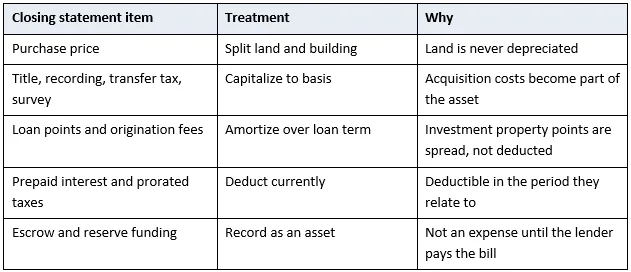
On the land allocation: the county assessor ratio is the most common defensible method and an appraisal is stronger. Document the method the year you buy, because the allocation follows the property until you sell.
Repairs vs. Improvements
A repair is deducted now. An improvement is capitalized over 27.5 or 39 years. Under the tangible property regulations, capitalize when a cost results in a betterment, a restoration, or an adaptation to a new use. Patching a roof is a repair. Replacing the roof is not. Three safe harbors let investors deduct costs that would otherwise be capitalized.
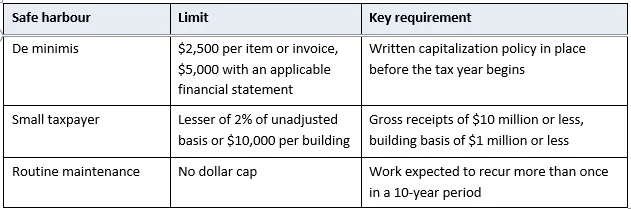
Investors forfeit the de minimis safe harbor most often, because the written policy must exist before the year starts. Writing it in March will not help the year you are filing.
Depreciation and Bonus Depreciation
Residential rental property is depreciated over 27.5 years and non-residential over 39, straight line, with land excluded. Depreciation begins when the property is placed in service, meaning ready and available to rent, not when it is purchased.
The One Big Beautiful Bill Act permanently restored 100% bonus depreciation for qualifying property acquired and placed in service after January 19, 2025, reversing a phase-down that would have cut the rate to 40% in 2025 and to zero by 2027. Property under a written binding contract signed before January 20, 2025 generally stays on the old rates, so acquisition dates matter this year.
Buildings are not bonus eligible because their recovery periods exceed 20 years. The eligible assets are the components inside them: appliances, carpet and fixtures at 5 or 7 years, land improvements and qualified improvement property at 15 years.
When Cost Segregation Earns Its Fee
A cost segregation study reclassifies building components into those shorter categories so they qualify for bonus depreciation. With bonus back at 100%, a study can convert a meaningful share of basis into a current-year deduction. Studies generally make sense above roughly $500,000 in depreciable basis, but the real test is whether you have income the deduction can offset.
Basis allocation, passive activity grouping and cost segregation timing are interconnected decisions, and specialist Accounting for real estate support usually costs less than the deductions a generalist approach leaves behind. Bring it in before the transaction, not after the return is drafted.
Documentation That Protects Deductions
Contractor payments. The 1099-NEC and 1099-MISC threshold rose from $600 to $2,000 for payments made on or after January 1, 2026. For 2025 payments, $600 still applies. The threshold changed but the discipline did not: collect a Form W-9 before the first payment, or backup withholding becomes your obligation.
Time logs. Real estate professional status requires more than 750 hours in real property trades and more than half of all personal services. Short-term rentals averaging seven days or less per stay are not rental activities under the passive loss rules, so material participation can make losses non-passive. Both depend on contemporaneous records.
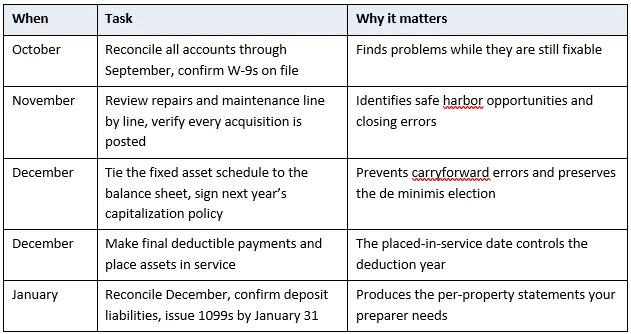
The Q4 Cleanup Sequence
Common Mistakes
• Waiting until March, which turns cleanup into estimates and extensions.
• Treating the portfolio as one property instead of tracking each one.
• Depreciating the full purchase price by skipping the land allocation.
• Assuming bonus depreciation applies automatically without checking the acquisition date.
• Dropping the W-9 habit because the 1099 threshold went up.
Conclusion
Clean books are not a filing season activity. They are the byproduct of a system that separates entities, tracks by property, posts closing statements correctly, and reconciles monthly. A real estate virtual assistant can help investors maintain these processes consistently throughout the year. Investors who run that system arrive at tax season with a trial balance. Everyone else arrives with a bank export and a deadline.
Frequently Asked Questions
When should I start cleaning up my books before tax season?
October. Starting in Q4 leaves time to fix posting errors, collect missing W-9s and make year-end moves that disappear on December 31.
Do I need a separate bank account for each property?
Not per property, but yes per legal entity. Property-level tracking inside the ledger achieves the same reporting result.
What is the difference between a repair and an improvement?
A repair keeps the property in ordinary operating condition and is deducted now. An improvement betters, restores or adapts the property and must be capitalized and depreciated.
Can I still take 100% bonus depreciation on a rental?
Yes, on qualifying components. The building is not eligible, but 5, 7 and 15 year property is, provided it was acquired and placed in service after January 19, 2025.
Do I still need to send 1099s to contractors?
Yes, at the threshold. For 2025 payments it is $600. For payments made on or after January 1, 2026, it is $2,000 per payee per year.
This article is general information, not tax advice. Rules change and outcomes depend on individual facts. Consult a qualified tax professional about your situation.






.webp)